Introduction
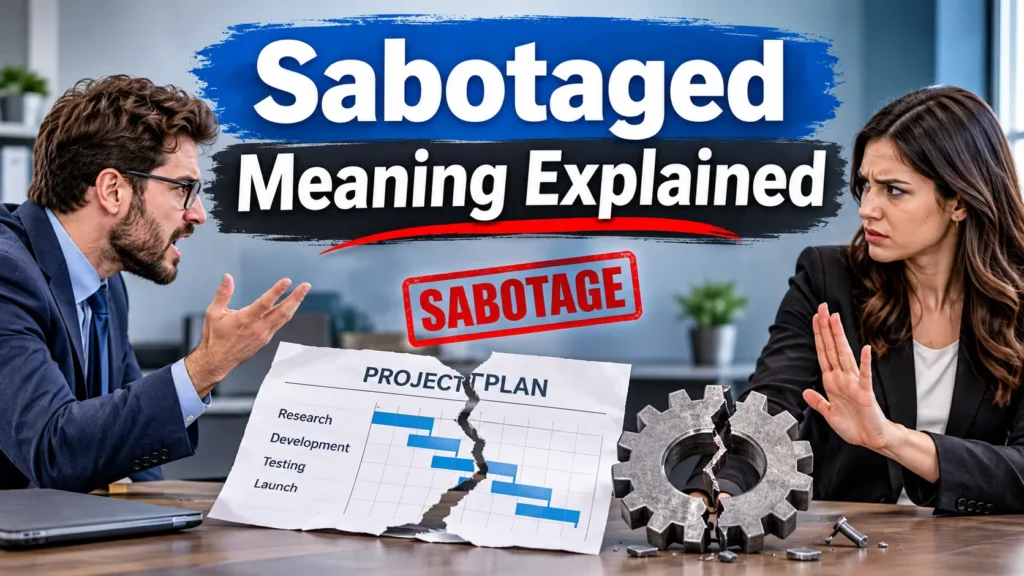
Have you ever heard someone say, “Someone Sabotaged My Plans,” and wondered what they meant? The word sabotaged describes deliberately damaging, disrupting, or interfering with something to prevent it from working properly or succeeding.
Understanding the meaning of sabotaged can help you interpret conversations about friendships, workplace conflicts, failed plans, and personal goals. Below, you will discover its definition, pronunciation, Urdu translation, synonyms, antonyms, and practical examples in simple English.
1. What Does Sabotaged Mean?
Sabotaged means deliberately damaged, disrupted, or undermined something to make it less likely to work or succeed. It is the past tense and past participle of the verb sabotage.
For example, if someone secretly damages a machine to stop it from working, they have sabotaged the machine. Similarly, someone who intentionally interferes with another person’s project may have sabotaged that project.
The word can describe physical damage or figurative interference with plans, relationships, businesses, and opportunities.
Here are three quick examples:
- Someone sabotaged our project by deleting important files.
- His dishonest actions sabotaged the business deal.
- She believed that a colleague had sabotaged her chances of promotion.
The central idea is intentional interference, although the context determines exactly what happened.
2. Sabotaged Meaning in Simple English
In simple English, sabotaged means deliberately spoiled, damaged, or interfered with something to make it fail.
Imagine that a group of students has prepared a presentation. Someone intentionally deletes the slides before the presentation begins. That person has sabotaged the project.
Consider these additional examples:
- Someone sabotaged the plan. They intentionally interfered with it.
- The equipment was sabotaged. Someone deliberately damaged it.
- He sabotaged his chances of winning. His actions undermined his chances.
- Their dishonesty sabotaged the partnership. It damaged the partnership’s chances of succeeding.
Sabotage does not always mean destroying something. Sometimes, it simply creates obstacles, delays progress, or makes success more difficult.
3. Sabotaged Meaning in Urdu
In Urdu, sabotaged can mean جان بوجھ کر نقصان پہنچایا، ناکام بنانے کی کوشش کی، یا کام میں رکاوٹ ڈالی.
The most suitable translation depends on the context.
| English Sentence | Urdu Meaning |
| He sabotaged the plan. | اس نے منصوبے کو ناکام بنانے کی کوشش کی۔ |
| Someone sabotaged the machine. | کسی نے مشین کو جان بوجھ کر نقصان پہنچایا۔ |
| She sabotaged her own chances. | اس نے اپنے ہی کامیاب ہونے کے امکانات کو نقصان پہنچایا۔ |
| Someone sabotaged our work. | کسی نے ہمارے کام میں جان بوجھ کر رکاوٹ ڈالی۔ |
In everyday conversation, the word usually suggests deliberate interference. However, using the word does not automatically prove that a particular person was responsible.
4. How to Pronounce Sabotaged
The word sabotaged is pronounced approximately as SAB-uh-tahzhd.
Its phonetic transcription is commonly represented as /ˈsæb.ə.tɑːʒd/, although pronunciation varies somewhat by accent.
Break the word into three parts:
- Sab: The first syllable receives the main stress.
- Uh: A short, unstressed middle syllable.
- Tahzhd: The final syllable contains the sound associated with the ending of sabotage, followed by a d sound.
Try saying it in a complete sentence: “Someone sabotaged the plan.”
Practicing the word in context makes it easier to remember both its pronunciation and meaning.
5. What Part of Speech Is Sabotaged?
Sabotaged is a verb form derived from sabotage. It functions as the simple past tense and past participle. It can also describe something that has been deliberately damaged or disrupted.
Here are its common grammatical forms:
| Word Form | Usage | Example |
| Sabotage | Base verb or noun | They may sabotage the operation. |
| Sabotages | Present tense | He sabotages every attempt. |
| Sabotaging | Present participle | She is sabotaging the plan. |
| Sabotaged | Past tense | They sabotaged the project. |
Simple past: They sabotaged the plan.
Present perfect: Someone has sabotaged the equipment.
Past perfect: They had sabotaged the project before the meeting started.
Passive voice: The equipment was sabotaged by an unknown person.
Descriptive use: Investigators examined the sabotaged machinery.
These examples demonstrate how the word changes according to the sentence structure.
6. Examples of Sabotaged in a Sentence
Sentence examples make it easier to understand how people use sabotaged in everyday English.
Everyday examples
- Someone sabotaged our picnic by hiding the food supplies.
- The team discovered that someone had sabotaged the machine.
- He suspected that a competitor had sabotaged his business proposal.
- Their argument sabotaged an otherwise enjoyable evening.
- The unexpected interference sabotaged our carefully prepared plan.
- She worried that one careless decision had sabotaged her chances.
- Investigators examined whether someone had sabotaged the system.
- Poor communication sabotaged the entire project.
- The player apologized after his actions sabotaged the team’s performance.
- The organization investigated whether anyone had sabotaged the event.
School and workplace examples
- Someone sabotaged the group project by deleting important work.
- Poor planning sabotaged the team’s attempt to finish on time.
- The manager accused an employee of sabotaging the proposal.
- The students worked together to prevent their project from being sabotaged.
- Her colleague’s misleading information sabotaged the presentation.
These sentences illustrate literal and figurative uses. An accusation of sabotage, however, should not be treated as proof that deliberate interference actually occurred.
7. Sabotaged Meaning in Different Situations
The meaning of sabotaged can become more specific depending on the situation.
Sabotaged in a relationship
When someone says that a person sabotaged a relationship, they usually mean that the person deliberately damaged trust, communication, or the relationship’s chances of succeeding.
Example: “He believed that someone had sabotaged his relationship by spreading false information.”
Arguments and misunderstandings do not automatically prove sabotage. Intentional interference is an important distinction.
Sabotaged at work
In a workplace, sabotaged can describe deliberate interference with someone’s responsibilities, professional reputation, project, or opportunities.
Example: “She accused a colleague of sabotaging her promotion.”
The sentence expresses an accusation, not necessarily a fact.
Sabotaged in school
In school, sabotage may involve deliberately interfering with assignments, group projects, competitions, or examination preparation.
Example: “Someone sabotaged the presentation by removing essential slides.”
Sabotaged in business
Business sabotage can involve deliberately disrupting operations, damaging equipment, interfering with negotiations, or undermining a competitor’s plans.
Example: “The company investigated whether someone had sabotaged its product launch.”
Sabotaged in technology
The word can describe deliberate interference with software, devices, computer systems, or technical operations.
Example: “The technicians investigated whether the system had been sabotaged.”
Sabotaged in personal goals
People also use the word figuratively when describing actions that undermine progress toward a personal goal.
Example: “He sabotaged his chances of success by repeatedly ignoring deadlines.”
Sometimes people use sabotaged loosely to describe poor decisions. However, a person can undermine their progress without consciously intending to fail.
8. Sabotaged vs. Ruined vs. Undermined
These words share related meanings, but they are not Interchangeable in every situation.
| Word | Meaning | Example |
| Sabotaged | Deliberately interfered with something | Someone sabotaged the experiment. |
| Ruined | Spoiled or destroyed something, intentionally or accidentally | The rain ruined our picnic. |
| Undermined | Weakened someone’s position, confidence, or chances | His criticism undermined her confidence. |
| Damaged | Harmed something physically or figuratively | The storm damaged the roof. |
| Disrupted | Interrupted normal progress or operation | The power cut disrupted the meeting. |
| Hindered | Made progress more difficult | The delay hindered our progress. |
The key difference is that sabotaged generally suggests deliberate interference.
For example, a storm might ruin an outdoor event without anyone sabotaging it. If someone intentionally damages the equipment to prevent the event from taking place, sabotaged is more accurate.
9. Synonyms for Sabotaged
Synonyms are words with similar meanings. The right synonym depends on what happened and how strongly the sentence needs to express intentional interference.
Common synonyms include:
- Undermined: Weakened someone’s position, confidence, or chances.
- Disrupted: Interrupted the normal operation of something.
- Damaged: Harmed something physically or figuratively.
- Wrecked: Seriously damaged or ruined something.
- Hindered: Made progress more difficult.
- Obstructed: Blocked progress or prevented movement.
- Subverted: Undermined a system, authority, or established process.
- Disabled: Made something unable to function.
- Crippled: Severely weakened or impaired something.
- Ruined: Spoiled something or made it unsuccessful.
Choosing the best synonym
Use undermined when someone weakens confidence or credibility.
And use disrupted when something interrupts a process or event.
Use damaged when the main idea is harm to an object, relationship, or reputation.
And use obstructed when someone or something blocks progress.
Use wrecked when the result involves serious damage.
Remember that these synonyms do not all communicate intentional interference as strongly as sabotaged.
10. Antonyms for Sabotaged
Antonyms are words with opposite or contrasting meanings. Since sabotage involves interference or harm, suitable contrasting words often describe helping, protecting, repairing, or strengthening.
Common antonyms and contrasting words include:
- Supported: Helped someone or something succeed.
- Assisted: Provided help.
- Strengthened: Made something stronger.
- Protected: Kept something safe from harm.
- Repaired: Restored something damaged.
- Promoted: Encouraged development or success.
- Enabled: Made something possible.
- Improved: Made something better.
- Helped: Contributed positively to an outcome.
- Preserved: Kept something from being damaged or lost.
Examples using contrasting words
- Instead of sabotaging the project, she supported the team.
- He strengthened the partnership rather than undermining it.
- The technician repaired the damaged equipment.
- Their cooperation helped the plan succeed.
- The security team protected the system from interference.
These words are contextual opposites rather than exact antonyms in every sentence.
11. What Does Self-Sabotaged Mean?
Self-Sabotaged means that someone undermined their own progress, success, relationships, or goals through their own actions or decisions.
For example, “He self-sabotaged his chances of passing the examination by refusing to prepare.”
The sentence means his behavior made success less likely.
Examples of self-sabotage
- She self-sabotaged her interview by arriving late.
- He self-sabotaged his savings goal by repeatedly spending beyond his budget.
- They self-sabotaged the project by ignoring important feedback.
- I self-sabotaged my progress by constantly postponing my work.
- He realized that his habits were undermining his goals.
Self-sabotage does not necessarily mean that someone consciously wants to fail. Poor planning, fear, habits, and uncertainty can contribute to behavior that works against personal goals.
The term describes a pattern of behavior; it is not a psychological diagnosis.
Related To Another Article: https://genzwishes.com/delusion-meaning/

12. Common Expressions With Sabotage
The word appears in several common expressions that describe deliberate interference in different situations.
Sabotaged the plan: Deliberately interfered with a plan to prevent it from succeeding.
Example: Someone sabotaged the plan before the team could carry it out.
Sabotaged the relationship: Damaged a relationship or undermined its chances of success.
Example: He believed that dishonesty had sabotaged their relationship.
Sabotaged the chances: Reduced someone’s likelihood of achieving an outcome.
Example: The false information sabotaged her chances of winning the competition.
Sabotaged the mission: Deliberately interfered with an operation or objective.
Example: Investigators examined whether someone had sabotaged the mission.
Sabotaged from within: Describes interference originating inside an organization, group, or system.
Example: The organization suspected that its operations had been sabotaged from within.
Sabotaged by someone: A passive construction that identifies the person believed to be responsible.
Example: The equipment was sabotaged by an unknown individual.
These expressions can be used literally or figuratively, depending on the context.
13. Common Mistakes When Using Sabotaged
Understanding what sabotaged means also involves knowing when not to use it.
Mistake 1: Calling every failure sabotage
Not every unsuccessful plan has been sabotaged. Plans can fail because of bad weather, poor timing, insufficient resources, or ordinary mistakes.
Instead of assuming, “Our event failed, so someone sabotaged it,” explain the known facts: “Our event failed because of unexpected problems.”
Use sabotaged when deliberate interference is intended or supported by the context.
Mistake 2: Confusing sabotaged with ruined
Ruined can describe accidental damage, while sabotaged generally suggests intentional interference.
Example: “The storm ruined the outdoor event” does not imply that someone deliberately caused the damage.
Mistake 3: Using the wrong verb form
Correct: “They sabotaged the project.”
Correct: “They have sabotaged the project.”
Incorrect: “They have sabotage the project.”
After have or has, use the past participle sabotaged.
Mistake 4: Assuming sabotage always means physical destruction
Sabotage can involve physical damage or figurative interference.
Example: “His dishonest behavior sabotaged the partnership.”
Mistake 5: Treating an accusation as a proven fact
If someone says, “My colleague sabotaged my work,” they are making a claim. The sentence alone does not prove that the colleague deliberately interfered.
Careful writing distinguishes between confirmed actions and suspicions.
People Also Ask
A: Sabotaged means deliberately damaged, disrupted, or interfered with something to make it less likely to work or succeed.
A: It can mean جان بوجھ کر نقصان پہنچایا، ناکام بنانے کی کوشش کی، or کام میں رکاوٹ ڈالی. The appropriate translation depends on the sentence.
A: Sabotaged generally has a negative meaning because it describes interference that harms something or makes success more difficult.
A: Yes. Sabotaged is both the simple past tense and the past participle of sabotage.
A: Possible alternatives include undermined, disrupted, damaged, obstructed, hindered, and wrecked. The best choice depends on the context.
Conclusion
The Word Sabotaged means deliberately damaged, disrupted, or undermined something to prevent it from functioning properly or succeeding. It is the past tense and past participle of sabotage and can describe physical damage, workplace conflicts, relationship difficulties, failed plans, and actions that undermine personal goals.
Its meaning is closely related to words such as damaged, disrupted, and undermined, but it usually carries a stronger suggestion of intentional interference. In Urdu, it can mean جان بوجھ کر نقصان پہنچایا or ناکام بنانے کی کوشش کی, depending on the context.
Save this guide if you are learning English vocabulary, and explore more word meanings on GenzWishes to build your understanding of everyday English.