Introduction
Have you ever spotted a many-legged creature moving quickly across your bathroom floor or wondered what seeing a centipede means in a dream? The word centipede has a straightforward biological definition, but people also search for its spiritual symbolism, dream interpretations, and possible significance when it appears inside a home.
Centipede Meaning: A centipede is an elongated, segmented arthropod with one pair of legs on each leg-bearing body segment. Centipedes are predators that feed on insects, spiders, worms, and other small animals. In some modern spiritual interpretations, they symbolize adaptability, resilience, protection, or personal change, although these symbolic meanings are beliefs rather than scientifically established messages.
Whether you want to understand the word, identify the animal, or explore its symbolism, this guide explains the different meanings in simple English.
1. What Does Centipede Mean?
A centipede is a many-legged arthropod belonging to the class Chilopoda. It has a segmented body, antennae, and one pair of legs on each leg-bearing segment. Many species move quickly and hunt small animals.
The word has several possible interpretations depending on the context:
- Literal meaning: A long-bodied animal with numerous legs.
- Scientific meaning: A predatory arthropod classified as a centipede.
- Spiritual meaning: A creature that some people associate with resilience, adaptability, or protection.
- Dream meaning: An image that may reflect fear, discomfort, or feeling overwhelmed, depending on the dreamer’s personal experiences.
For example, someone who says, “I found a centipede in my bathroom,” is referring to the animal. Someone searching for the spiritual meaning of a centipede is looking for a possible symbolic interpretation.
Understanding the context helps you find the right meaning without confusing scientific facts with personal beliefs.
2. Centipede Definition, Pronunciation, and Examples
Centipede is a noun used to describe an elongated arthropod with numerous legs and a segmented body.
Pronunciation: SEN-tuh-peede.
Part of speech: Noun.
Plural form: Centipedes.
Simple definition: A many-legged arthropod with one pair of legs on each leg-bearing body segment.
Here are some examples of the word in everyday English:
- I saw a centipede crawling across the bathroom floor.
- The centipede disappeared beneath a rock.
- Our science teacher explained the difference between centipedes and millipedes.
- A centipede entered the house through a small gap.
- I looked up the meaning of centipede after seeing one in a dream.
Centipedes are sometimes mistaken for insects, but they belong to a different arthropod class. Insects generally have six legs, while centipedes have many more.
3. What Is the Origin of the Word Centipede?
The word centipede comes through French from Latin centipeda. Its roots are associated with centum, meaning “hundred,” and pes or pedis, meaning “foot.”
The name refers to the animal’s many legs rather than an exact scientific count. A centipede does not have to possess exactly 100 legs to qualify as one.
This is an interesting example of how a word’s origin can explain its name without describing every feature of the thing itself.
The term is used in biology, gardening, pest control, nature education, and everyday conversation.
4. What Does a Centipede Look Like?
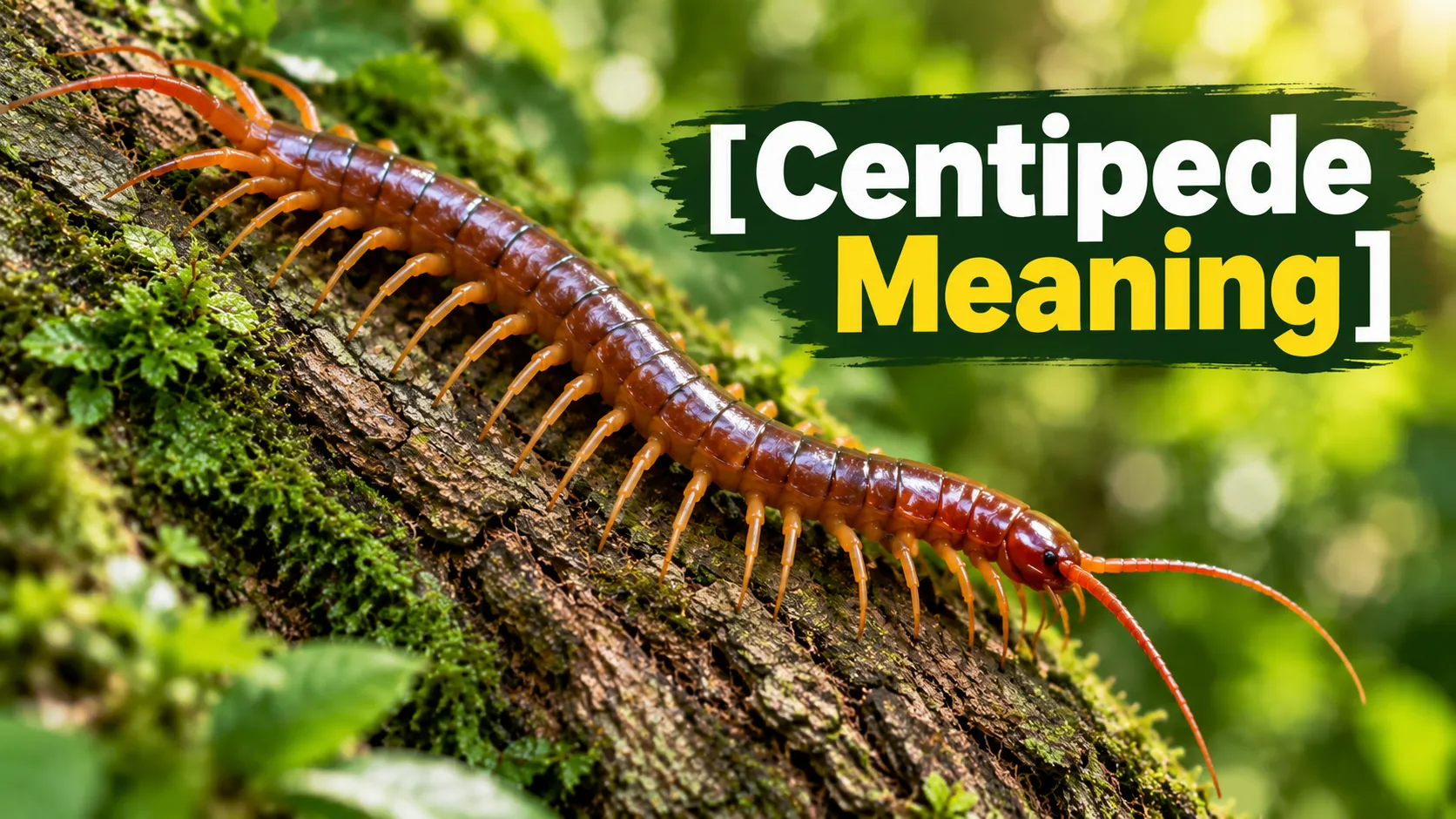
A centipede usually has a long, segmented body, a pair of antennae, and numerous legs extending from the sides of its body. Its appearance varies according to its species.
Common characteristics include:
- An elongated, segmented body.
- One pair of legs on each leg-bearing segment.
- Antennae that help it sense its surroundings.
- Modified front legs that deliver venom to capture prey.
- Fast movement in many species.
- A preference for sheltered places, such as spaces beneath rocks, logs, leaves, or other damp materials.
Some centipedes live mainly outdoors, while house centipedes may occasionally appear indoors. Certain species have relatively short legs, whereas house centipedes have long legs that make them particularly noticeable.
Although their appearance can be startling, centipedes play a role in the ecosystem by hunting other small invertebrates.
5. Does a Centipede Really Have 100 Legs?
No. Despite its name, a centipede does not necessarily have 100 legs.
The number of legs varies by species and depends on the number of leg-bearing body segments. Centipedes have one pair of legs on each such segment, and their total number of leg pairs varies considerably.
The name comes from Latin roots associated with a hundred feet, but it is not a literal count of every centipede’s legs.
This is one of the most common misconceptions about the animal. A centipede with fewer than 100 legs is still a centipede because its classification depends on its biological characteristics, not the number suggested by its name.

6. Centipede vs. Millipede: What Is the Difference?
Centipedes and millipedes may look similar at first, but they have important differences in body structure, movement, diet, and defense.
| Feature | Centipede | Millipede |
| Scientific class | Chilopoda | Diplopoda |
| Body shape | Usually flattened | Usually rounded or cylindrical |
| Legs per body segment | One pair on each leg-bearing segment | Usually two pairs on most body segments |
| Movement | Often fast | Usually slower |
| Diet | Mainly small animals and other arthropods | Mainly decaying plant material and other organic matter |
| Defense | Modified front legs deliver venom | Many species curl up or release defensive chemicals |
| Typical role | Predator of small invertebrates | Helps break down decaying plant material |
Neither animal is an insect. Both belong to the broader group of arthropods, but they belong to different classes.
If you see a fast-moving animal with a relatively flat body and legs projecting from its sides, it may be a centipede. A slower animal with a rounded body that curls up when disturbed is more likely to be a millipede.
For more details, see the University of California’s guide to centipedes and millipedes and the Library of Congress’s comparison of these animals.
7. What Is the Spiritual Meaning of a Centipede?
In some modern spiritual interpretations, a centipede symbolizes adaptability, resilience, protection, awareness, or personal change.
These meanings are symbolic beliefs, not scientifically proven messages. Interpretations vary among individuals and spiritual traditions, so there is no single meaning that applies to everyone.
Here are five common symbolic associations.
Adaptability: A centipede coordinates many legs as it moves through its environment. Some people interpret this as a reminder to adjust to changing circumstances.
Resilience: Its ability to navigate narrow spaces and varied surroundings can represent persistence during difficult times.
Protection: Because centipedes use venom to capture prey, some symbolic interpretations connect them with boundaries and self-protection.
Awareness: A centipede’s antennae help it sense its surroundings. Symbolically, this may encourage someone to pay attention to details.
Personal change: Some people interpret the creature’s movement and growth as a reminder to keep moving through unfamiliar experiences.
These associations can offer a starting point for personal reflection, but seeing a centipede does not prove that a supernatural event or future change is about to occur.
8. What Does Seeing a Centipede Mean Spiritually?
Some people interpret seeing a centipede as a reminder to remain adaptable, pay attention to their surroundings, or protect their personal boundaries.
The interpretation may depend on what is happening in your life and how you feel about the encounter.
For example, someone dealing with a major life change might associate a centipede with adaptability. Someone managing several responsibilities might use its many legs as a personal reminder to organize different tasks.
However, there is also an ordinary Biological Explanation for seeing one. Centipedes move around to find prey and suitable shelter. They may appear in gardens, beneath stones, or in damp parts of buildings.
Does seeing a centipede mean good luck or bad luck?
There is no scientific evidence that a centipede predicts good luck, bad luck, or a particular future event. Its symbolic meaning depends on personal beliefs and cultural context.
You can explore the spiritual interpretation if it interests you while recognizing that the encounter may simply reflect the animal’s natural behavior.
9. What Does a Centipede in Your House Mean?
Finding a centipede in your house usually means that the animal has entered while searching for shelter, moisture, or food.
Centipedes may hide in damp bathrooms, basements, storage areas, cracks, and other sheltered spaces. Some house centipedes hunt small insects and other arthropods.
Finding one does not automatically mean that your home is dirty or that something bad will happen.
If centipedes appear repeatedly, consider these practical steps:
- Reduce excess moisture in damp rooms.
- Repair leaking pipes and improve ventilation where necessary.
- Seal gaps around doors, windows, and pipes.
- Remove clutter from damp storage areas.
- Reduce other small pests that may provide food for centipedes.
- Avoid picking up unfamiliar centipedes with bare hands.
From a spiritual perspective, some people associate a centipede inside the home with protection, change, or awareness. These are personal interpretations rather than established explanations for why the animal entered.
The practical explanation should come first: the centipede may simply have found a suitable place to hide or hunt.
10. What Does a Centipede in a Dream Mean?
Dreaming about a centipede does not have one universal meaning. The interpretation may depend on the dream’s details, your emotions, and your personal experiences.
Here are several ways people might reflect on such dreams.
1. Dreaming of a centipede crawling: You might associate the image with an uncomfortable situation or something that feels difficult to control.
2. Dreaming of many centipedes: If the dream feels stressful, it may reflect a feeling of having too many tasks or worries at once.
3. Dreaming of a centipede on your body: A frightening dream of this kind might connect with feelings of discomfort, vulnerability, or a desire for personal space.
4. Dreaming of killing a centipede: You might interpret this as a personal image of confronting a fear or trying to resolve an irritating problem.
5. Dreaming of a centipede moving away: Depending on your feelings, you might associate it with relief or distance from a stressful situation.
These are possible interpretations, not reliable predictions. Dreams can be influenced by memories, emotions, stress, and everyday experiences.
A centipede dream does not prove that an enemy is nearby, that someone intends to harm you, or that a particular event will occur.
For a more useful personal reflection, consider three questions:
- What emotion did you feel during the dream?
- What is currently happening in your life?
- Does the centipede remind you of a particular experience or concern?
Your answers may help you explore the dream’s personal significance without treating an interpretation as a fact.
11. Are Centipedes Dangerous to Humans?
Centipedes can bite when threatened, handled, or accidentally trapped against the skin. Their modified front legs deliver venom that helps them capture prey.
A bite can cause pain, redness, swelling, and tenderness. The severity depends on the species, the bite, and the individual. Some bites are more painful or concerning than others.
To reduce the risk of a bite:
- Avoid handling unfamiliar centipedes.
- Wear appropriate footwear when moving items in areas where centipedes may hide.
- Check shoes or clothing if you suspect an animal is inside.
- Use suitable tools or seek professional help if removal is necessary.
- Seek medical advice for severe pain, worsening swelling, or other concerning symptoms.
Get emergency medical help if a bite is followed by breathing difficulties, throat swelling, collapse, or other signs of a severe allergic reaction.
Centipedes are predators, not animals that automatically attack people. Giving an unfamiliar centipede space is safer than trying to pick it up.
For additional medical information, consult MedlinePlus’s centipede bite guide.
Related To Another Article: https://genzwishes.com/bishop-meaning/
12. How Is Centipede Used in a Sentence?
The word centipede is commonly used in conversations about animals, gardens, homes, and nature.
Here are seven example sentences:
- I saw a centipede crawling across the bathroom floor.
- The centipede disappeared under a rock before I could examine it.
- We learned about centipedes during our science lesson.
- My brother found a centipede near the garden wall.
- The centipede moved quickly through the damp leaves.
- A centipede entered the house through a small gap.
- I searched for the meaning of centipede after seeing one in a dream.
In most everyday sentences, the word refers to the animal itself. When someone discusses its spiritual meaning, the word is being used in a symbolic context.
13. How Can You Understand Centipede Symbolism Without Misinterpreting It?
The best way to understand centipede symbolism is to separate observable facts from personal interpretations.
The animal’s segmented body, numerous legs, and predatory behavior are biological characteristics. Ideas about protection, resilience, transformation, and spiritual messages are interpretations that people attach to those characteristics.
Use this simple framework:
Start with the context. Ask whether you want the dictionary definition, information about an animal in your home, or a symbolic interpretation.
Look for practical explanations. If you found a centipede indoors, consider moisture, shelter, and prey before assuming the encounter has a spiritual cause.
Consider your own associations. If the animal appeared in a dream, think about the emotions and experiences connected with it.
Avoid universal claims. A symbol may have different meanings for different people. There is no single interpretation that must apply to every encounter.
Check factual claims against reliable sources. Scientific references can explain centipede biology and behavior, while spiritual interpretations should be presented as beliefs rather than scientific conclusions.
This approach allows you to explore symbolism without confusing it with evidence-based information.
People Also Ask
A: A centipede is a many-legged arthropod with an elongated, segmented body and one pair of legs on each leg-bearing body segment.
A: The name comes from French, from Latin roots associated with “hundred” and “foot.” It describes the animal’s many legs rather than an exact count of 100.
A: No. A centipede is an arthropod belonging to the class Chilopoda. Insects generally have six legs, while centipedes have numerous legs.
A: In some modern spiritual interpretations, a centipede symbolizes adaptability, resilience, protection, awareness, or personal change. These meanings vary and are not scientifically established messages.
A: There is no scientific evidence that seeing a centipede predicts good or bad luck. Its interpretation depends on personal beliefs and cultural context.
Conclusion
The meaning of a Centipede depends on the context. Literally, a centipede is a many-legged arthropod with a segmented body and one pair of legs on each leg-bearing segment. Its name comes from roots associated with a hundred feet, although it does not necessarily have 100 legs.
In spiritual symbolism and dream interpretation, people may associate centipedes with adaptability, resilience, protection, or personal concerns. These interpretations can provide a starting point for reflection, but they should not be confused with scientific facts or predictions.
If you encounter a centipede in your home, practical explanations such as shelter, moisture, and the availability of prey are worth considering first.
Whether you are learning a new English word, identifying an unfamiliar animal, or exploring its symbolic meaning, understanding these different contexts gives you a clearer answer. Save this guide for future reference and share it with anyone curious about centipedes and their meanings.