Introduction
Epitaph Meaning refers to a short message written in memory of someone who has died, usually engraved on a gravestone or memorial. The word also has a figurative meaning: a statement or event that represents the end of a career, an era, or something significant. Understanding both meanings will help you recognize epitaph in everyday English, literature, and news articles.
An epitaph can express love, respect, remembrance, or even humor in just a few words. But what makes it different from a eulogy, elegy, or ordinary inscription? Let’s explore its definition, pronunciation, origin, examples, and practical uses in simple English.
1. What Does Epitaph Mean?
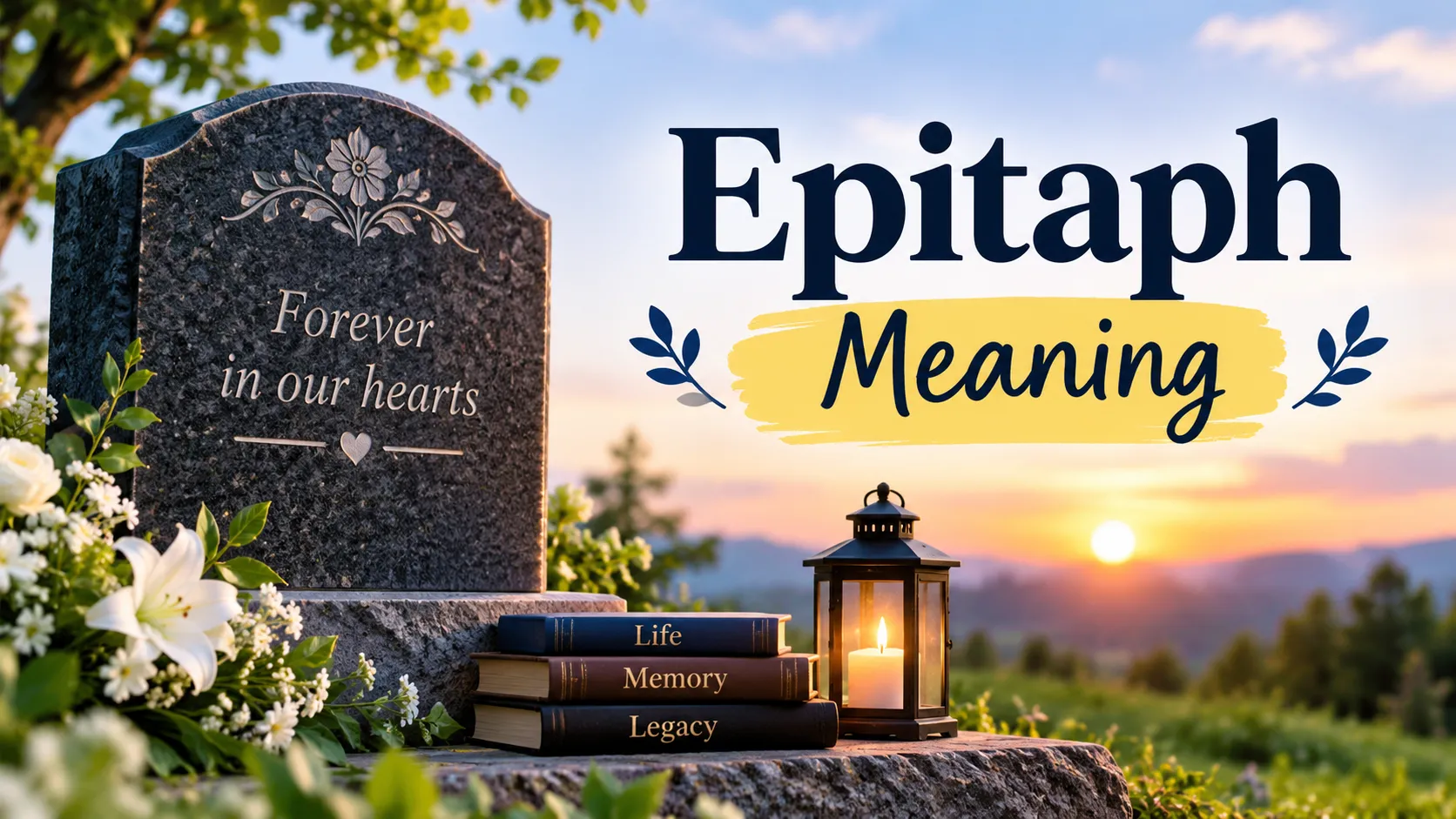
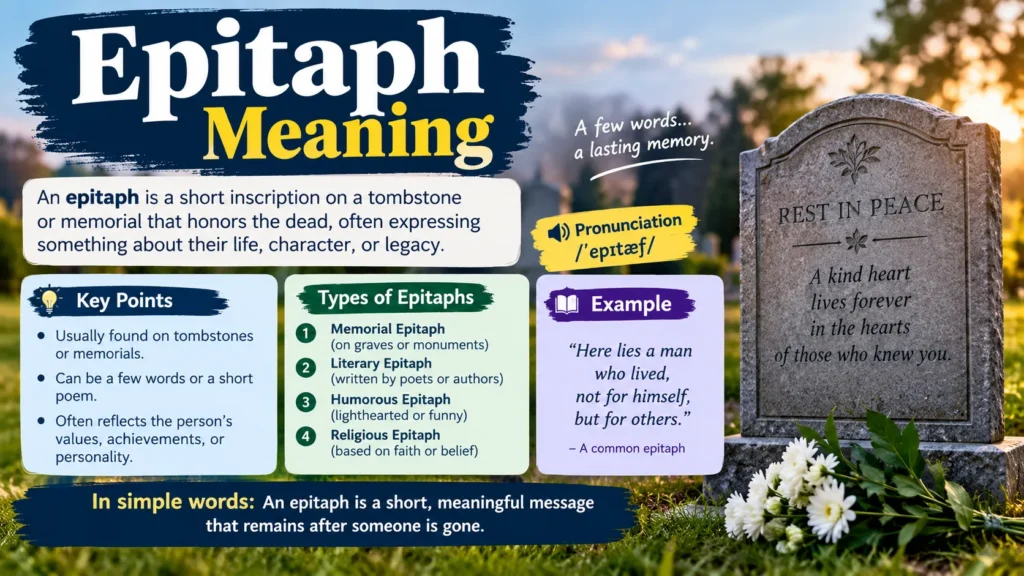
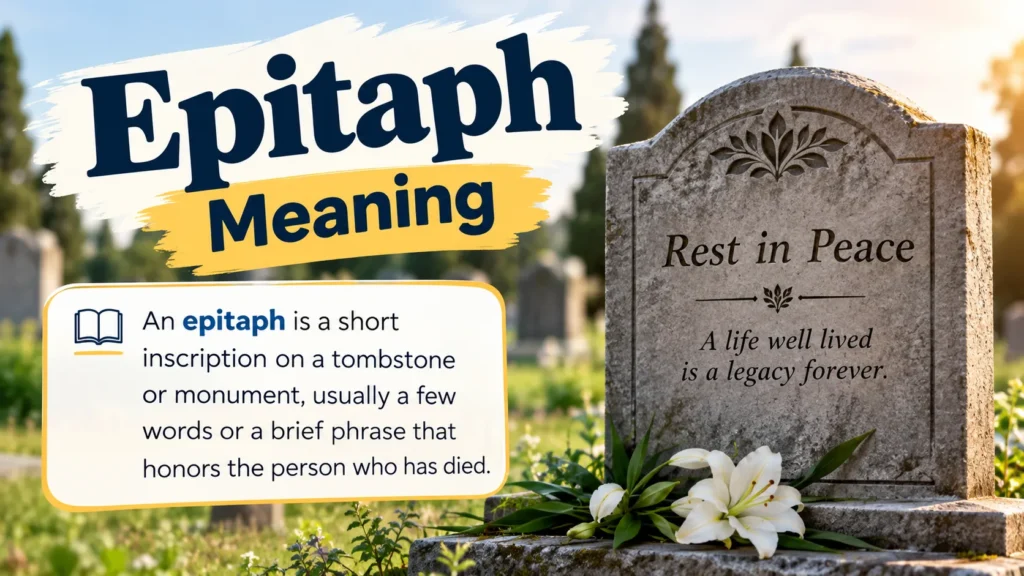
An epitaph is a short message that honors a person who has died. People commonly place it on a gravestone, tombstone, memorial plaque, or monument to express how the person will be remembered.
For example, a memorial might display the words, “A Loving Mother, Forever in Our Hearts.” This message serves as an epitaph because it expresses remembrance and affection.
The word also appears in figurative expressions. When someone describes a failed project as an epitaph for a company’s ambitions, they mean that the failure effectively marked the end of those ambitions.
In simple terms, an epitaph is either a commemorative message for someone who has died or, figuratively, a statement that symbolizes the end of something important.
2. Epitaph Definition in Simple English
The simplest definition of epitaph is a few words written to remember and honor a deceased person.
Here are the essential facts:
- Part of speech: Noun.
- Plural form: Epitaphs.
- Common location: A gravestone, tombstone, plaque, or memorial.
- Main purpose: To honor someone and preserve their memory.
- Figurative meaning: A final statement or judgment representing the end of something.
Example: “The family chose a meaningful epitaph for their grandfather’s memorial.”
In this sentence, epitaph refers to the commemorative words selected by the family.
Another example is, “The scandal became an epitaph for his political career.”
Here, the word is figurative because the scandal marked the end of his career rather than appearing on a physical memorial.
These two meanings share a common idea: a lasting statement associated with remembrance or an ending.
3. How to Pronounce Epitaph
Epitaph has two commonly Recognized pronunciations, depending on the variety of English.
- British English: /ˈep.ɪ.tɑːf/
- American English: /ˈep.ə.tæf/
The Cambridge Dictionary provides audio pronunciation examples for both varieties.
To make the word easier to pronounce, divide it into three syllables: ep-i-taph. Place the main stress on the first syllable: EP-i-taph.
One detail often surprises English learners: the final letters “ph” produce an /f/ sound. The word therefore ends with the same consonant sound heard in “if,” not the sound heard in “this.”
Practicing the word slowly and then saying it at a natural pace can help you use it confidently in conversations, classroom discussions, and literary analysis.
4. Origin and History of the Word Epitaph
The word epitaph entered English through Old French and Latin and ultimately comes from ancient Greek. Its historical roots relate to something placed on or associated with a tomb.
The Greek elements are commonly explained as:
- Epi: On, upon, or over.
- Taphos: Tomb.
The Greek word epitaphion referred to a funeral oration or something associated with a tomb. Over time, epitaph developed into the English word used for a commemorative inscription or statement honoring someone who has died.
Later, writers extended its meaning beyond physical memorials. They began using epitaph figuratively for a statement, decision, or event that seemed to summarize the end of a person’s career or a historical period.
For example, a historian might describe the collapse of a government as an epitaph for an unsuccessful political era.
This word history helps explain why epitaph can refer to both a memorial message and a symbolic ending.
5. What Is the Purpose of an Epitaph?
An epitaph allows people to preserve a memory through a short, meaningful message. Although the wording may be brief, it can communicate affection, values, achievements, and the qualities that made a person special.
Common purposes include:
- Honoring someone’s life and character.
- Expressing love and remembrance.
- Reflecting religious beliefs or personal values.
- Recognizing achievements or service to others.
- Preserving a legacy for future generations.
- Expressing humor or individuality when appropriate.
Consider the example, “A Gentle Heart That Made the World Brighter.” This message celebrates kindness rather than listing dates or accomplishments.
Another example is, “A Life of Courage, A Legacy of Hope.” These words emphasize bravery and the positive influence the person left behind.
A good epitaph does not need complicated vocabulary. Often, the most meaningful message is one that expresses something genuine about the person being remembered.
6. Literal and Figurative Meaning of Epitaph
Epitaph has two important meanings in English. Understanding the difference will help you interpret the word correctly in different situations.
Literal meaning
The literal meaning refers to a commemorative message honoring someone who has died. It is often engraved on a gravestone or memorial.
Example: “The epitaph on the monument honored the soldiers who died defending their country.”
Here, epitaph refers to an actual memorial message.
Figurative meaning
The figurative meaning describes a statement, event, or judgment that symbolizes the end of something important.
Example: “The failed launch became an epitaph for the ambitious project.”
This means the failure effectively marked the project’s end.
Other examples include:
- The defeat became an epitaph for the team’s championship hopes.
- The scandal served as an epitaph for the politician’s career.
- The abandoned factory became an epitaph for the town’s industrial past.
In each sentence, epitaph describes an ending or lasting reminder rather than a literal inscription.
The surrounding context usually makes it clear which meaning the writer intends.
7. Epitaph Examples and Their Meanings
Examples make the meaning of epitaph easier to understand. The following are original illustrative examples, not quotations claimed to come from actual graves.
Memorial epitaph examples
- “Forever Loved, Never Forgotten.”
Meaning: The person will remain in the memories of loved ones. - “A Kind Soul Who Touched Many Lives.”
Meaning: The person is remembered for kindness and positive influence. - “A Loving Parent and a Faithful Friend.”
Meaning: The message honors important family and friendship relationships. - “Their Love Lives On in Every Heart.”
Meaning: The person’s influence continues through the people who loved them. - “A Life of Courage, A Legacy of Hope.”
Meaning: The inscription celebrates bravery and lasting inspiration.
Figurative epitaph examples
- “The failed experiment became an epitaph for the research team’s ambitions.”
Meaning: The failure marked the end of those ambitions. - “That final defeat was an epitaph for the team’s championship hopes.”
Meaning: The defeat ended the team’s realistic chance of winning. - “The investigation became an epitaph for his public career.”
Meaning: The investigation brought his career to an end or permanently damaged his reputation. - “The factory’s closure was an epitaph for a once-thriving industry.”
Meaning: The closure symbolized the end of an important industrial period. - “Her farewell speech served as an epitaph for a remarkable career.”
Meaning: The speech provided a final reflection on her professional life.
These examples show how one word can express remembrance in one context and a symbolic ending in another.
8. Epitaph in a Sentence
Reading epitaphs in complete sentences can help you understand their grammar and learn how to use them naturally.
Here are ten original examples:
- The family selected a short epitaph for their Father’s Gravestone.
- Her epitaph reflected the compassion she showed throughout her life.
- Visitors stopped to read the epitaph engraved on the memorial.
- The poet wrote an epitaph in honor of his late friend.
- The memorial included an epitaph celebrating a lifetime of service.
- The unexpected defeat became an epitaph for the team’s season.
- The scandal proved to be an epitaph for the politician’s career.
- The final chapter felt like an epitaph for a fading tradition.
- His farewell letter served as an epitaph for their friendship.
- The abandoned building became an epitaph for a disappearing way of life.
The first five sentences use epitaph in its commemorative sense. The remaining examples demonstrate the figurative meaning.
You may also notice common expressions such as “write an epitaph,” “choose an epitaph,” “serve as an epitaph,” and “become an epitaph.”
Learning these natural word combinations can improve your vocabulary and make your writing more precise.
9. What Is an Epitaph in Literature?
In literature, an epitaph is a short piece of writing that commemorates a deceased person. It may appear as an inscription in a poem, a passage in a play, or a brief statement that captures the essence of someone’s life.
Literary epitaphs often communicate a larger idea through carefully chosen words. They may celebrate virtues, reveal contradictions, express grief, or encourage readers to reflect on mortality and legacy.
For example, a fictional epitaph reading “He Sought the Truth and Questioned Every Answer” could suggest that the person valued curiosity and independent thought.
Writers also use the concept figuratively. A character’s final words or a story’s concluding passage may function like an epitaph if it summarizes the character’s achievements, failures, or lasting significance.
The brevity of an epitaph makes every word important. A short statement can leave readers thinking about a person’s character long after they finish reading.
10. Epitaph vs. Eulogy
Epitaph and eulogy both relate to remembering someone who has died, but they differ in form, length, and purpose.
| Feature | Epitaph | Eulogy |
| Meaning | A short commemorative message | A tribute praising someone’s life |
| Common form | Inscription or brief written statement | Speech or longer written tribute |
| Typical setting | Gravestone or memorial | Funeral or memorial service |
| Length | Usually brief | Often several minutes when spoken |
| Main purpose | To commemorate in a few words | To share memories, qualities, and achievements |
Example of an epitaph: “A Loving Father, Forever in Our Hearts.”
Example of a eulogy: A speech describing a father’s kindness, sharing family stories, and explaining the lessons he taught others.
The main difference is that an epitaph is usually concise and associated with a memorial, while a eulogy offers a fuller tribute. A eulogy may also be written, but it is commonly delivered aloud.
11. Epitaph vs. Elegy vs. Inscription
So, Epitaph, elegy, and inscription are related words, but they describe different forms of remembrance and writing.
Epitaph
An epitaph is a short commemorative message honoring someone who has died.
Example: “Beloved by Many, Forgotten by None.”
Elegy
An elegy is a poem or other literary work that expresses sorrow, particularly grief over death or loss. It often explores memory, mortality, and consolation.
Example: A poem reflecting on the loss of a close friend and the memories that remain.
Inscription
An inscription is writing engraved, carved, or otherwise displayed on a surface. It does not necessarily relate to death.
Example: A dedication engraved on a building to commemorate its opening.
An epitaph can form part of a memorial inscription, but an inscription can also contain a person’s name, dates, dedication, or historical information.
The easiest way to remember the difference is that an epitaph commemorates the deceased, an elegy expresses mourning, and an inscription refers to writing displayed on a surface.
12. Epitaph vs. Epithet: What’s the Difference?
Epitaph and epithet look similar, but their meanings are different. Confusing them can change the meaning of a sentence.
An epitaph is a commemorative message for someone who has died or, figuratively, a statement that represents the end of something.
An epithet is a descriptive word or phrase associated with a person or thing. Depending on its context, it can express admiration, identify a characteristic, or serve as an insulting label.
Consider these examples:
- Epitaph: “The family chose an epitaph that honored her generous spirit.”
- Epithet: “The title ‘the Great’ became an epithet associated with the ruler.”
In the first sentence, epitaph refers to a memorial message. In the second, epithet refers to a descriptive title.
A simple memory tip is to associate epitaph with a tomb or final remembrance and epithet with a descriptive label.
Although the words look and sound similar, they are not synonyms.
13. Synonyms and Related Words for Epitaph
Several words are associated with epitaph, but each has a slightly different meaning. Choosing the right word depends on what you want to communicate.
| Word | Meaning |
| Memorial | Something created to remember a person or event |
| Inscription | Writing engraved or displayed on a surface |
| Tribute | An expression of respect, admiration, or appreciation |
| Commemoration | The act of remembering or honoring someone or something |
| Eulogy | A speech or written tribute praising a person |
| Elegy | A poem or literary work expressing sorrow or mourning |
| Remembrance | The act of remembering someone or something |
| Obituary | A notice announcing a person’s death, often with biographical information |
These words overlap in meaning, but they cannot always replace epitaph.
For instance, an obituary announces a death and may summarize the person’s life, whereas an epitaph is a short commemorative message. A tribute may honor a living person, while an epitaph is most commonly associated with someone who has died.
When selecting a synonym, consider whether you mean a physical inscription, an expression of grief, a speech, or a general act of remembrance.
- Related To Another Article: https://genzwishes.com/differentiation-meaning/
14. Common Mistakes When Using Epitaph
Understanding common mistakes will help you use epitaph accurately in conversation and writing.
Mistake 1: Assuming every epitaph appears on a gravestone
A gravestone is the most familiar setting, but epitaphs may also appear on memorial plaques and monuments. Figurative uses do not require a physical memorial.
Mistake 2: Treating epitaph and eulogy as identical
An epitaph is usually a short commemorative message. A eulogy is a fuller tribute, commonly delivered at a funeral or memorial service.
Mistake 3: Confusing epitaph with epithet
An epitaph commemorates the deceased or represents an ending. An epithet describes or labels a person or thing.
Mistake 4: Assuming an epitaph must be sad
Epitaphs can be solemn, affectionate, hopeful, philosophical, or humorous. Their tone depends on the message and the person being remembered.
Mistake 5: Ignoring the figurative meaning
In discussions about careers, businesses, politics, or history, epitaph may describe a final judgment or symbolic ending rather than a literal grave inscription.
Mistake 6: Using epitaph when you mean obituary
An obituary announces a death and often provides biographical details. An epitaph is a short commemorative message.
Remember the central distinction: epitaph focuses on remembrance or a symbolic ending, while related words describe other forms of tribute, mourning, or description.
People Also Ask
A: An epitaph is a short message written in memory of someone who has died, usually on a gravestone or memorial. Figuratively, it can describe a statement or event that marks the end of a career, era, or important undertaking.
A: “Forever Loved, Never Forgotten” is an example of an epitaph. It expresses lasting affection for someone who has died. This is an original illustrative example rather than a quotation from a particular grave.
A: An epitaph is generally a brief memorial inscription, while a eulogy is a longer tribute that describes and celebrates someone’s life, often during a funeral or memorial service.
A: Figuratively, epitaph means a final statement, judgment, or event that symbolizes the end of something. For example, a major failure might become an epitaph for a company’s reputation.
A: Epitaph comes through Old French and Latin from the Greek word epitaphion, associated with a funeral or tomb. Its Greek roots are commonly explained as epi, meaning “upon,” and taphos, meaning “tomb.”
Conclusion
The Meaning Of Epitaph goes beyond words engraved on a gravestone. It describes a short message that honors someone who has died, preserves a memory, or expresses a lasting tribute. Figuratively, it can also represent the final judgment on a career, organization, event, or historical period.
Understanding its pronunciation, origin, examples, and differences from related terms such as eulogy, elegy, inscription, and epithet makes the word easier to recognize and use correctly.
If this guide helped you understand the meaning, bookmark it for future vocabulary practice and explore more simple English meaning guides on GenzWishes.