Introduction
What does Differentiation Mean, and why does the word have different meanings in different subjects? In simple English, differentiation means recognizing, showing, or creating differences between people, things, ideas, or processes. It helps us understand what makes one thing distinct from another.
For example, a company may use product differentiation to make its products stand out from competitors, while a teacher may use differentiation to support students with different learning needs. In mathematics, differentiation means finding the derivative of a function, and in biology, it describes how cells develop specialized structures and functions.
Although these meanings sound different, they share a central idea: identifying or developing distinctions. This guide explains differentiation meaning, pronunciation, synonyms, examples, and common uses in clear, beginner-friendly language.
1. What Does Differentiation Mean?
Differentiation means the act or process of recognizing, expressing, or creating a distinction between two or more things. It helps people understand how objects, ideas, people, or processes differ.
In everyday English, differentiation may involve identifying an existing difference or making a unique characteristic more noticeable.
For example, two smartphones may look similar, but one might have a better camera and longer battery life. These features help distinguish one phone from the other.
Here are some simple examples:
- Comparing two products to identify their different features is differentiation.
- Recognizing how two opinions differ involves differentiation.
- Adapting lessons to students’ learning needs is educational differentiation.
- Calculating the derivative of a function is mathematical differentiation.
Simple definition: Differentiation is the process of identifying or establishing differences between things.
The exact meaning depends on the context in which the word appears.
2. Differentiation Meaning in Simple English
In simple English, differentiation means finding out what makes something different from something else.
Imagine that two students complete the same assignment. One explains the topic using original examples, while the other uses examples from a textbook. Recognizing the differences between their work is a form of differentiation.
The word can also describe making something distinct. For example, a bakery might develop a special recipe that customers cannot easily find elsewhere. That recipe helps differentiate the bakery from competing businesses.
Think of differentiation as answering two questions:
- What makes these things different?
- What makes this thing stand out from similar things?
Example: The bright red cover creates differentiation between this book and the other books on the shelf.
In other words, differentiation helps us recognize distinctions, understand variation, and identify unique characteristics.
3. Differentiation Definition and Pronunciation
Differentiation is a noun that generally describes the act, process, or result of distinguishing things or making them different.
Pronunciation: /ˌdɪfəˌrenʃiˈeɪʃən/
Part of speech: Noun
1. Related verb: Differentiate
2. Related adjective: Differentiated
3. Related adverb: Differently
The word usually refers to a process, but it can also describe the resulting distinction between things.
Examples:
- “The differentiation between the two designs is clear.” The word refers to a recognizable distinction.
- “The company focuses on product differentiation.” The word refers to making a product distinct from competitors.
- “The students are learning differentiation in calculus.” The word refers to a mathematical process.
Although differentiation is a relatively long word, its basic meaning becomes easier to understand when you consider the surrounding sentence.
4. Differentiation Examples in Sentences
Sentence examples show how differentiation works in everyday communication and specialized subjects.
- The teacher used differentiation to support students with different learning needs.
- Product differentiation helps a company stand out in a competitive market.
- The color difference allows easy differentiation between the two wires.
- Scientists studied cell differentiation during early development.
- Students learned differentiation while studying calculus.
- The new logo creates differentiation between the brand and its competitors.
- Clear differentiation between facts and opinions improves critical thinking.
- The manager encouraged differentiation between personal and professional responsibilities.
- The designer used unique patterns to create visual differentiation.
- The course explains differentiation through practical mathematical problems.
- The company relies on quality and reliability for market differentiation.
- The teacher explained the differentiation between the two learning methods.
- Researchers examined the differentiation of specialized cells.
- The distinctive packaging helps customers recognize the product.
- Understanding differentiation makes the technical definition easier to remember.
These examples demonstrate that differentiation can refer to recognizing differences, creating distinctions, or describing a technical process.
When you encounter the word in a sentence, look at the surrounding words to identify its intended meaning.
5. Differentiation Meaning in Education
In education, differentiation means adapting teaching methods, learning activities, materials, or assessments to accommodate students’ different abilities, needs, and levels of understanding.
Students do not all learn at the same pace. Some understand a topic quickly, while others benefit from additional explanations, guided practice, or alternative learning materials.
For example, a teacher might ask one group to practice basic multiplication while another group solves more complex word problems. Both groups study the same broad topic, but the teacher adjusts the tasks to suit their current learning needs.
Common approaches include:
1. Differentiated Content: Providing learning materials with appropriate levels of complexity.
2. Differentiated Process: Using different activities to help students understand the same concept.
3. Differentiated Products: Allowing students to demonstrate their learning in different ways.
4. Differentiated Support: Giving additional guidance to students who need it.
The goal is to help students make meaningful progress without assuming that everyone learns in exactly the same way.
Educational differentiation does not necessarily require a completely separate lesson for every student. Teachers can use flexible groups, varied resources, and targeted support to address different learning needs.
6. Differentiation Meaning in Business
In business, differentiation means making a product, service, or brand distinct from competing alternatives. Companies use differentiation to communicate their unique value and give customers reasons to choose their offerings.
Businesses may differentiate themselves through quality, design, customer service, convenience, technology, reliability, or specialized features.
For example, two coffee shops may sell similar drinks. One may attract customers through lower prices, while the other offers a distinctive atmosphere, carefully prepared beverages, and personalized service.
These differences help customers decide which business best matches their preferences.
Common types of differentiation include:
- Product differentiation: Offering distinctive features, quality, or design.
- Service differentiation: Providing a distinct customer experience.
- Brand differentiation: Developing a recognizable identity and reputation.
- Customer experience differentiation: Making the buying and support process distinctive.
- Competitive differentiation: Establishing meaningful advantages over competing businesses.
Effective differentiation should provide genuine value rather than rely only on advertising claims.
For instance, a company that promises fast delivery must deliver orders reliably if speed is its main competitive advantage.
7. Differentiation Meaning in Mathematics
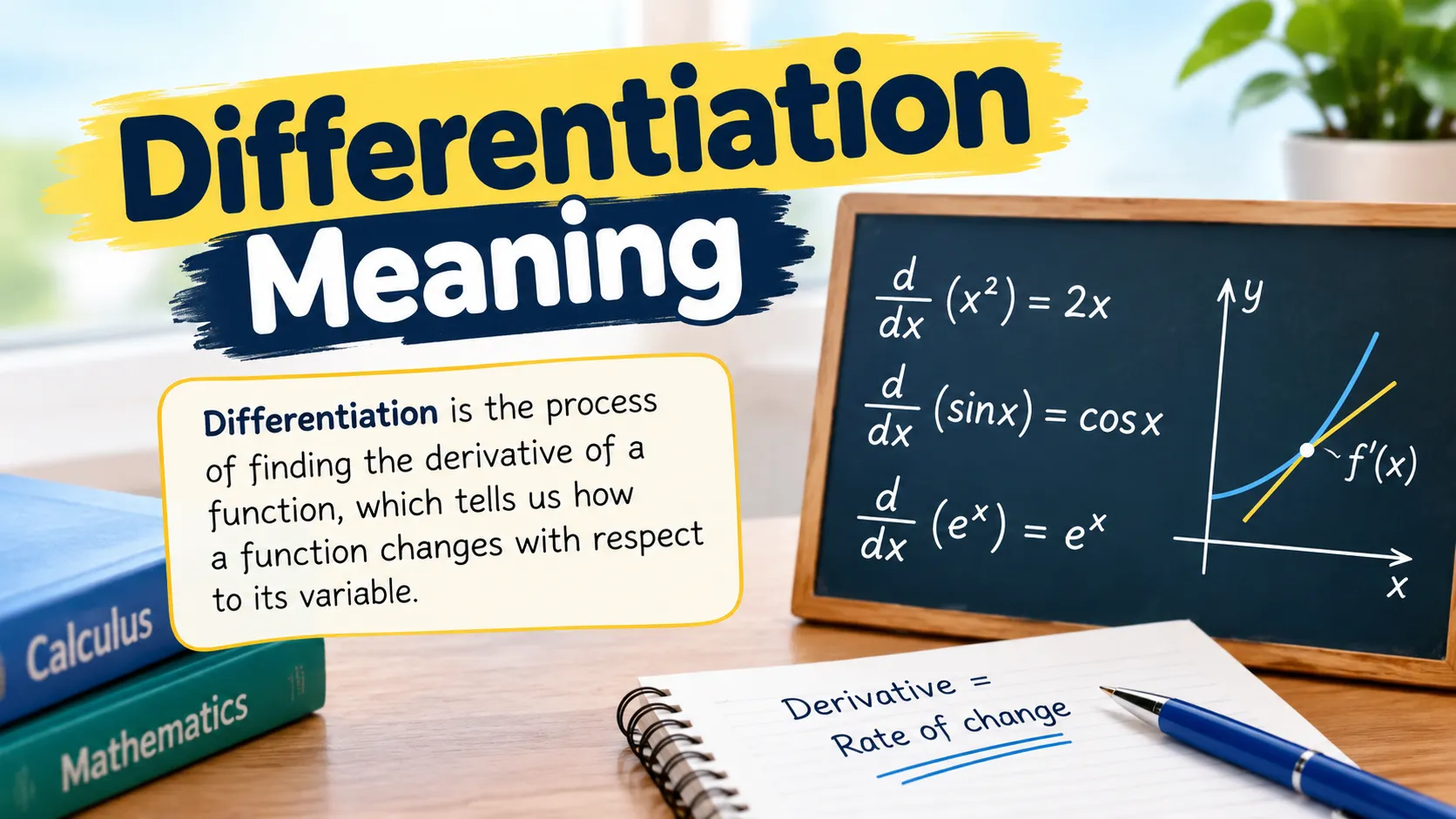
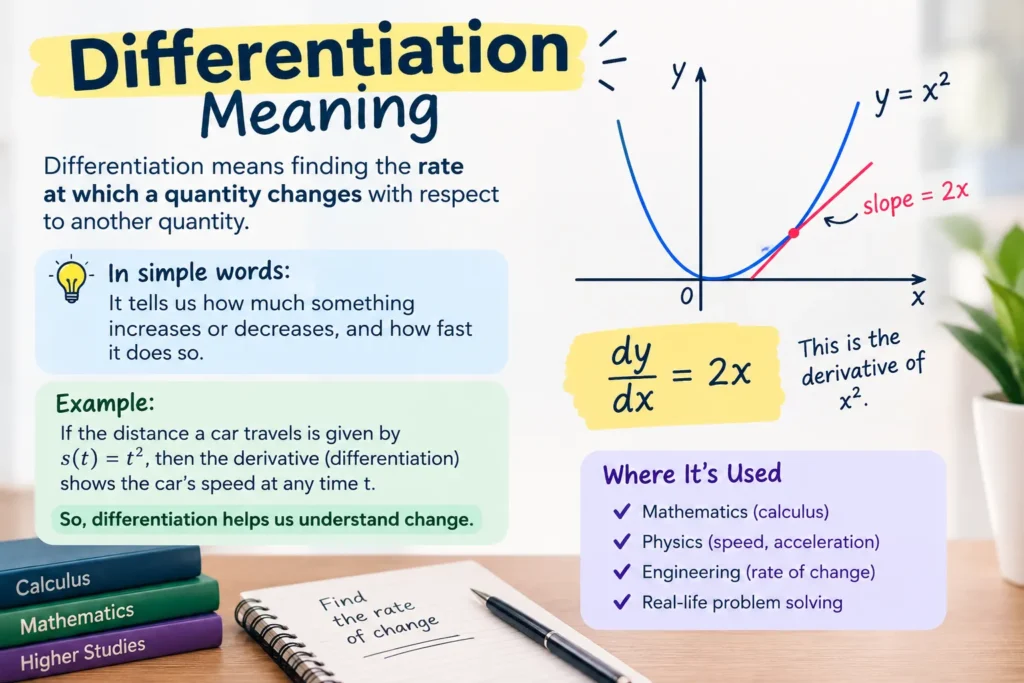
In mathematics, differentiation is a fundamental process in calculus used to calculate the derivative of a function. A derivative describes how a quantity changes in relation to another quantity.
It can help determine the slope of a curve at a particular point or measure an instantaneous rate of change.
Consider the function:
y = x²
Differentiating this function with respect to x gives:
dy/dx = 2x
At x = 3, the derivative equals 6. This means the slope of the curve at that point is 6.
Differentiation has several practical applications:
- Calculating velocity from a position function.
- Finding acceleration from a velocity function.
- Determining marginal cost in economics.
- Identifying maximum or minimum values.
- Studying rates of change in scientific models.
In mathematics, differentiation has a precise technical meaning rather than simply describing a difference between two objects.
It is closely related to integration, another major concept in calculus. Differentiation finds derivatives, while integration can help calculate accumulated quantities or find antiderivatives under appropriate conditions.
8. Differentiation Meaning in Biology
In biology, differentiation is the process through which cells develop specialized structures and functions. It plays an essential role in the growth and development of multicellular organisms.
During development, cells can acquire characteristics that allow them to perform particular roles. These changes involve gene expression and other cellular processes.
For example, cells may develop into muscle cells, nerve cells, or certain types of blood cells. Each specialized cell type performs functions that help the body operate.
Examples of specialized cells include:
- Nerve cells: Transmit electrical and chemical signals.
- Muscle cells: Contract to move.
- Red blood cells: Transport oxygen through the bloodstream.
- Skin cells: Help form protective barriers around the body.
Cell differentiation allows different tissues and organs to perform their specialized functions.
The biological meaning differs from the everyday meaning, although both involve the development or recognition of distinctions.
9. Differentiation Meaning in Everyday Life
Differentiation appears in ordinary situations whenever people identify distinctions between choices, objects, ideas, or behaviors.
You do not need to study business or advanced mathematics to understand the concept.
Choosing between phones: You compare battery life, price, camera quality, and storage before deciding which phone suits you.
Recognizing facts and opinions: You distinguish verifiable information from someone’s personal judgment.
Comparing learning methods: You identify which study technique helps you understand a difficult subject.
Selecting clothing: You notice differences in fabric, fit, color, and design before making a purchase.
Understanding personalities: You recognize that two people may have different interests, communication styles, or preferences.
In each situation, differentiation helps you make distinctions that support a decision or improve your understanding.
The word may sound formal, but the underlying idea is part of everyday thinking.
10. Differentiation Synonyms and Antonyms
Synonyms are words with similar meanings, while antonyms express opposite or contrasting ideas. The best alternative to Differentiation Depends on the sentence.
Common synonyms
| Synonym | Meaning |
| Distinction | A recognizable difference between things |
| Difference | A way in which things are not the same |
| Contrast | A noticeable difference between things |
| Separation | The act of keeping things apart |
| Diversification | The process of introducing variety |
| Specialization | Developing a particular skill, role, or function |
These words are related but not always interchangeable. For example, diversification usually means increasing variety, while differentiation emphasizes distinctions.
Common antonyms and contrasting terms
| Word | Meaning |
| Similarity | The state of being alike |
| Sameness | The quality of being the same |
| Uniformity | A lack of meaningful variation |
| Identicalness | The state of being identical |
| Indistinguishability | The condition of being difficult to tell apart |
Integration may contrast with differentiation in certain technical or organizational contexts, but it is not a universal antonym.
Choose words according to the intended meaning instead of replacing differentiation automatically.
- Related To Another Article: https://genzwishes.com/stilt-meaning/
11. Differentiation vs. Difference
Differentiation and difference are closely related, but they do not mean the same thing.
A difference is a particular way in which two or more things are not the same. Differentiation usually refers to the act, process, or result of recognizing, expressing, or creating such distinctions.
| Feature | Differentiation | Difference |
| Main meaning | The process of distinguishing or making distinct | A characteristic that makes things unlike |
| Focus | An action, process, or broader concept | A specific distinction |
| Business example | Developing a distinctive product strategy | One product costs less than another |
| Education example | Adapting teaching activities | Two students have different skill levels |
| Mathematics | Calculating derivatives | Comparing numerical values |
Example of difference: There is a difference between the prices of the two laptops.
Example of differentiation: The manufacturer uses a distinctive design to differentiate its laptops from competing models.
In simple terms, difference describes what is unlike, while differentiation describes the process or practice of identifying or creating distinctions.
12. Differentiate vs. Differentiation
So “Differentiate” and “differentiation” belong to the same word family, but they have different grammatical functions.
Differentiate is a verb. It describes the action of identifying, showing, or creating a distinction.
Differentiation is a noun. It names the action, process, or result.
Compare these examples:
- Verb: Customers can differentiate the two brands by their packaging.
- Noun: The packaging creates differentiation between the brands.
- Verb: Teachers differentiate their instruction to support different learners.
- Noun: Differentiation helps teachers address different learning needs.
Other related word forms include:
- Different: An adjective describing things that are not the same.
- Differently: An adverb describing how an action is performed.
- Differentiated: A form used to describe something made or recognized as distinct.
- Differentiating: The present participle of differentiate.
Learning these word forms helps you use the correct expression in writing and conversation.
13. Common Uses and Phrases With Differentiation
Differentiation often appears alongside other words that clarify its meaning.
Product differentiation: Making a product distinct from competing products.
Example: Product differentiation helps the company communicate the unique benefits of its new headphones.
Competitive differentiation: Establishing meaningful differences between a business and its competitors.
Example: Reliable customer support is a major source of competitive differentiation for the company.
Differentiation in education: Adjusting teaching methods or learning materials to meet students’ different needs.
Example: Differentiation in education can help students work toward shared learning goals with appropriate support.
Cell differentiation: The process through which cells develop specialized structures or functions.
Example: Cell differentiation contributes to the formation of specialized tissues during development.
Differentiation between two things: Recognizing or explaining how two things differ.
Example: The report explains the differentiation between essential and optional expenses.
Differentiation strategy: A plan for making a product, service, or organization distinct in a meaningful way.
Example: The brand’s differentiation strategy focuses on durability and customer service.
These expressions show why context matters when interpreting the word.
People Also Ask
A: Differentiation means recognizing, showing, or creating differences between people, things, ideas, or processes. In simple terms, it helps explain what makes one thing distinct from another.
A: A company that makes a phone with a distinctive camera system and longer battery life uses product differentiation to stand out from competing phones.
A: Common synonyms include distinction, difference, contrast, and separation. The best choice depends on the sentence and the intended meaning.
A: In education, differentiation means adapting teaching methods, materials, activities, or assessments to accommodate students’ different learning needs and levels of understanding.
A: In mathematics, differentiation is the process of finding the derivative of a function. The derivative describes how a quantity changes relative to another quantity.
Conclusion
Differentiation Means Recognizing, showing, or creating differences between things. It helps people understand distinctions, compare options, communicate clearly, and identify what makes something unique.
The word has several specialized meanings. In education, it involves adapting instruction to students’ needs. And in business, it describes how products and brands stand apart from competitors. In mathematics, it refers to calculating derivatives, while in biology, it describes how cells develop specialized structures and functions.
The easiest way to understand differentiation is to consider the context in which it appears. Once you recognize whether the word refers to an everyday distinction or a technical process, its meaning becomes much easier to understand and use correctly.
If this guide helped you understand the word, bookmark it for future reference and explore related English vocabulary articles on GenzWishes.