
Introduction
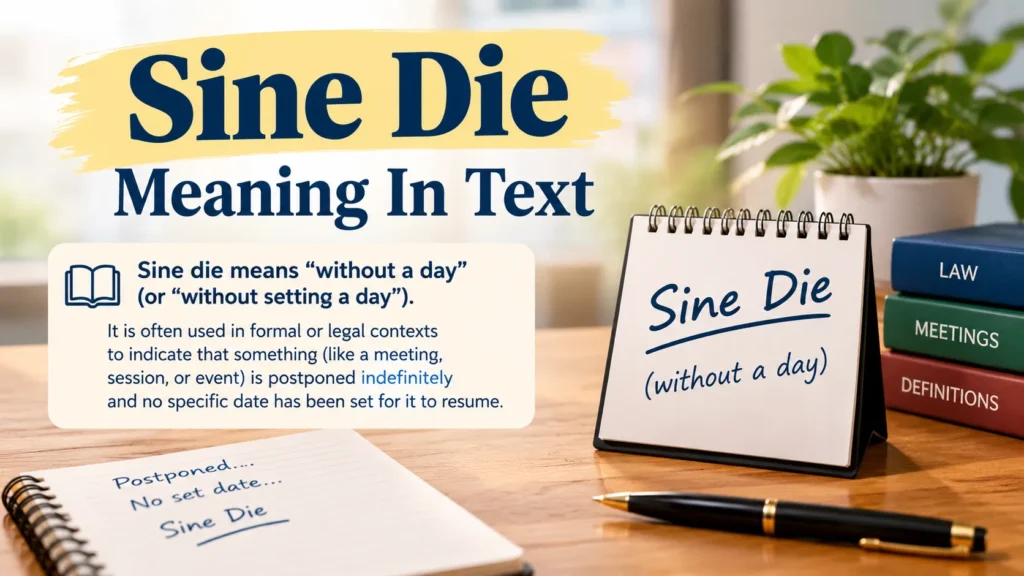
If you have seen “sine die” in a text message, email, or online post, you may be wondering what it means. “Sine Die” means “without setting a future date.” People use this Latin expression when officials adjourn a meeting or formal proceeding without scheduling a date to resume.
Unlike LOL or BRB, sine die is not a standard texting abbreviation. Understanding this distinction will help you interpret the phrase correctly instead of assuming it has a hidden social-media meaning.
What Does Sine Die Mean in Text?
People use “sine die” in messages to indicate that officials have adjourned a meeting, hearing, session, or proceeding without setting a specific date for its return.
The expression is formal rather than typical internet slang. Its meaning depends on the surrounding conversation, especially when the message concerns an official event.
- The organizers ended the meeting without setting a new date.
- The judge adjourned the hearing indefinitely.
- The committee has no scheduled return date.
- The proceedings ended with no future date announced.
- The committee paused its proceedings without fixing a date.
- The official session ended without a return date.
- The assembly concluded its current session.
- The board adjourned without planning its next meeting.
- The hearing ended without a definite continuation date.
- The proceedings were adjourned without a scheduled restart.
- The announcement confirmed that no future date had been fixed.
Is Sine Die a Texting Slang Term?
No. Sine die is a formal Latin expression, not a widely established texting abbreviation. You may see it in professional messages, legal notices, political announcements, or conversations about official proceedings.
If a friend uses it casually, read the surrounding conversation before deciding what they mean.
- “The meeting is adjourned sine die.” — No new meeting date is set.
- “The hearing ended sine die.” — No future hearing date was arranged.
- “The committee adjourned sine die.” — Its proceedings ended without a fixed return date.
- “The announcement says sine die.” — The announcement refers to an indefinite adjournment.
- “I found sine die in the notice.” — The phrase requires a formal-context interpretation.
- “The court adjourned sine die.” — The court did not set a date for the proceedings to resume.
- “The assembly rose sine die.” — The assembly concluded its session without fixing a date to reconvene for that session.
- “The email mentioned sine die.” — Check which meeting or proceeding the email discusses.
- “The board finished sine die.” — The phrase suggests a formal adjournment without a fixed future date.
- “The report uses sine die.” — It is using formal terminology.
- “Is sine die slang?” — No, it is a traditional Latin expression.
What Does Sine Die Mean in Simple English?
In simple English, sine die means “without a fixed date.” People often use “postponed indefinitely” to explain “sine die,” but the exact meaning depends on the event or proceeding.
- Nobody has announced the next meeting date.
- The meeting ended without a scheduled return.
- The next session has no fixed date.
- The committee has not scheduled another meeting.
- The session finished without a date for resuming.
- The proceedings ended without a planned continuation date.
- The organization has not announced when it will meet again.
- The next stage has no scheduled date.
- The hearing’s future date remains unannounced.
- The committee has left the next meeting date open.
- The announcement gives no date for the proceedings to resume.
How to Pronounce Sine Die
English pronunciations vary by region and dictionary. Common pronunciations include “SY-nee DYE-ee” and “SIN-ay DEE-ay.” Listening to a reputable dictionary’s audio pronunciation is a good way to learn the version used in your region.
- Practise saying “sine” slowly.
- Practise saying “die” separately.
- Repeat both words together.
- Listen to a dictionary pronunciation.
- Repeat the phrase at a comfortable pace.
- Focus on the two-word rhythm.
- Avoid rushing through the expression.
- Say it in the sentence “The meeting adjourned sine die.”
- Practise the phrase before using it in a presentation.
- Listen for regional differences in pronunciation.
- Repeat the phrase after hearing an audio example.
- Use a dictionary that provides British or American pronunciation.
- Practise reading the phrase aloud.
- Compare pronunciation guides if you encounter different versions.
- Choose a pronunciation consistent with the English variety you use.
Where Does Sine Die Come From?
Sine die comes from Latin and literally means “without a day.” It entered formal English usage and became particularly associated with adjournments in legal, parliamentary, and administrative contexts.
- Sine die is a Latin Expression.
- The phrase literally means “without a day.”
- Sine is the Latin word meaning “without.”
- Die is a Latin form of the word for “day.”
- The expression describes the absence of a specified date.
- It appears in legal writing.
- It can describe committee adjournments.
- It appears in official announcements.
- It is not a modern internet acronym.
- It has a historical connection to formal proceedings.
- Its literal meaning helps explain its modern use.
- The phrase is more formal than “no date yet.”
- Its meaning remains useful in institutional communication.
What Does Sine Die Mean in Law?
In legal contexts, courts or officials use “sine die” to adjourn proceedings without setting a date to resume. The phrase alone does not mean that a court has dismissed a case or that the matter cannot return.
- The court did not set a date for resuming the hearing.
- The legal notice refers to an indefinite adjournment.
- The proceedings ended without a scheduled continuation date.
- The order uses formal legal terminology.
- The parties were not given a new hearing date in the notice.
- The court record mentions an adjournment sine die.
- The next procedural date remains unspecified.
- The hearing’s status should be checked in the complete order.
- The phrase does not independently prove that a case was dismissed.
- The legal consequences depend on the applicable rules.
- The court’s order provides important context.
- A lawyer can explain the effect on a particular case.
- The phrase can also occur in legislative proceedings.
- An official record should be read in its full context.

Sine Die Examples in Sentences
These examples show how the phrase can appear in formal writing. They are illustrative sentences, not claims about actual court cases or official events.
- The committee adjourned sine die after completing its business.
- Parliament adjourned sine die at the end of the session.
- The board concluded its proceedings sine die.
- The chairperson announced an adjournment sine die.
- The official notice confirmed that the session had ended.
- The assembly rose sine die after the final debate.
- The committee’s proceedings were adjourned sine die.
- The court record noted that the hearing was adjourned sine die.
- The organization concluded its formal session sine die.
- The announcement did not specify a future date.
- The secretary recorded the adjournment in the minutes.
- The report explained that the session had concluded sine die.
How to Understand Sine Die in a Message
Identify the meeting or proceeding that the sender has adjourned, and check whether they mention a future date. The same expression can appear in a message about a court hearing, committee meeting, or legislative session.
- “The hearing is adjourned sine die.” — No date for resumption is specified.
- “The committee ended sine die.” — The committee’s proceedings concluded without a scheduled return.
- “Parliament rose sine die.” — The parliamentary session concluded without a date to reconvene for that session.
- “The board adjourned sine die today.” — The board ended its proceedings without fixing a future date.
- “The court issued an adjournment notice.” — Check the actual order for its effect.
- “The session concluded sine die.” — The session has ended without a set return date.
- “The committee will update members later.” — A later update may clarify what happens next.
- “The hearing has no new date.” — This expresses the central idea in plain English.
- “The announcement uses Latin terminology.” — The phrase is formal, not necessarily slang.
- “The proceedings ended without a scheduled continuation.” — This restates the central meaning.
Does Sine Die Mean Permanently Canceled?
No, not automatically. Sine Die Means that no specific future date has been fixed. Whether an event is permanently canceled, a session is formally concluded, or a matter may resume depends on the circumstances.
- Sine die does not automatically mean canceled forever.
- A proceeding may have a different legal status depending on its order.
- A formal session may have concluded.
- A later announcement may provide further information.
- A committee may need another decision before meeting again.
- An event organizer may communicate a separate cancellation.
- A court order may explain the next procedural steps.
- The phrase alone does not prove dismissal.
- A postponement may remain open-ended.
- A rescheduled event has a new date.
- A canceled event will not take place as originally planned.
- The surrounding announcement helps clarify the outcome.
- Always check the official notice when the distinction matters.
Sine Die vs. Postponed vs. Canceled
These terms are related but not interchangeable. Sine die emphasizes the lack of a fixed date for resumption, while canceled generally means the planned event will not take place as intended.
- Postponed means delayed until later.
- Canceled means the planned event will not take place as intended.
- Adjourned means a meeting or proceeding has been brought to a close or suspended.
- “Postponed until Friday” identifies a new date.
- “Canceled due to weather” gives a reason for cancellation.
- “Rescheduled for Monday” gives a replacement date.
- “Adjourned until tomorrow” identifies when proceedings will resume.
- “Adjourned sine die” does not provide a resumption date.
- “Canceled permanently” explicitly communicates cancellation.
- “Postponed indefinitely” indicates an open-ended delay.
- “No date announced” is a simple description of the scheduling status.
- Choose the term that accurately describes the announcement.
Synonyms and Alternative Phrases
In everyday English, you can often explain sine die with simpler wording. The best alternative depends on whether you are describing a formal adjournment, an open-ended postponement, or merely the absence of a date.
- Without a fixed date.
- Without a day being set.
- No future date scheduled.
- No new date announced.
- Postponed indefinitely.
- Without a scheduled return.
- With no date fixed.
- No resumption date set.
- For an indefinite period.
- Until further notice, when appropriate.
- No meeting date confirmed.
- Without a planned continuation date.
- The next session remains unscheduled.
When Should You Use Sine Die?
Sine die is most suitable for formal writing about proceedings and official meetings. In casual conversations, a plain-English explanation is usually easier for readers to understand.
- Use it when describing a formal committee adjournment.
- Use it in an appropriate legislative context.
- Use it when accurately reporting an official adjournment.
- Use it when summarizing formal proceedings.
- Use it in meeting minutes where the terminology is appropriate.
- Use it in a report about a parliamentary session.
- Use it when quoting an official announcement.
- Explain it when writing for general readers.
- Avoid assuming every reader knows Latin.
- Explain the term in educational content.
- Check the wording in legal documents before paraphrasing it.
- Avoid using it to imply permanent cancellation without evidence.
- Use the expression only when it fits the context.
- Choose clarity over formality when writing for a broad audience.
Related To Another Article: https://genzwishes.com/wednesday-good-night-wishes/
Common Misunderstandings About Sine Die
Many people mistakenly assume that “sine die” always means someone has permanently canceled something.
- Sine die is not a standard texting acronym.
- It is not commonly established romantic slang.
- It does not automatically mean canceled forever.
- It does not specify why a meeting was adjourned.
- It does not provide a new date.
- It is not identical to a scheduled postponement.
- It is not necessarily the same as a short recess.
- It has formal and legal applications.
- Its exact pronunciation may vary.
- The surrounding sentence affects interpretation.
- A legal notice may require professional explanation.
- A plain-English paraphrase can help avoid confusion.
- Official context matters more than assumptions about slang.
People Also Ask
A: It means that a meeting or proceeding has ended or been adjourned without a specific future date being set. It is a formal Latin expression rather than standard texting slang.
A: It means “without a fixed date.” A simple alternative is “no new date has been scheduled.”
A: The meanings are closely related, but context matters. Sine die is particularly associated with formal adjournments without a scheduled resumption date.
A: No, not automatically. The expression does not by itself establish whether the event or proceeding will ever happen again.
A: It means that a meeting or proceeding has been adjourned without a future date being appointed for it to resume.
Conclusion
The meaning of Sine Die In Text is simple once you recognize its formal origin: it means “without setting a future date.” The expression is used particularly in legal proceedings, legislative sessions, official meetings, and formal announcements.
People do not commonly use “sine die” as an internet abbreviation, and the phrase does not automatically mean they have canceled something forever. When you see it in a message, identify the meeting or proceeding and check the surrounding context to understand what happens next.
Save this guide for future reference or share it with someone who has encountered the expression. Explore related vocabulary guides on GenzWishes to build your understanding of unfamiliar English phrases.