Introduction
Have you ever heard someone say, “Stop Being Petty,” or seen a friend comment, “That’s so petty!” on social media? If you have, you might wonder what they actually mean.
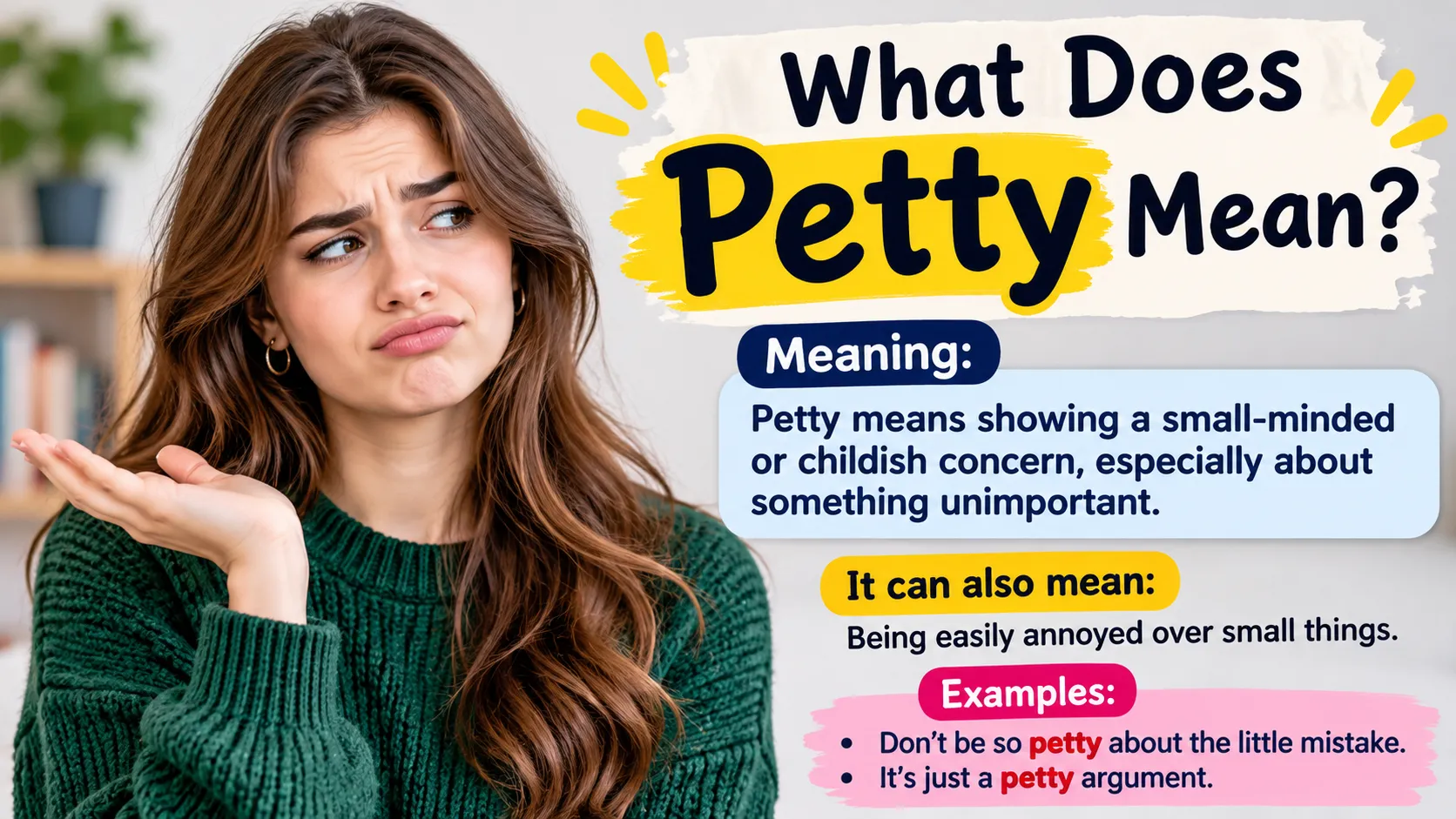
Petty means giving too much attention to small, unimportant things or behaving in an unnecessarily spiteful, mean, or unreasonable way. In everyday conversations, it often describes someone who makes a big deal out of a little problem or tries to get revenge over something minor.
For example, if someone refuses to speak to their friend because they forgot to like their Instagram picture, that reaction might be considered petty.
However, the word has more than one meaning. It can describe a person’s attitude, a small disagreement, an insignificant issue, or even a financial term such as petty cash.
Let’s explore what petty means in simple English, how people use it in texting and slang, and what it looks like in relationships, friendships, and everyday situations.
1. What Does Petty Mean?
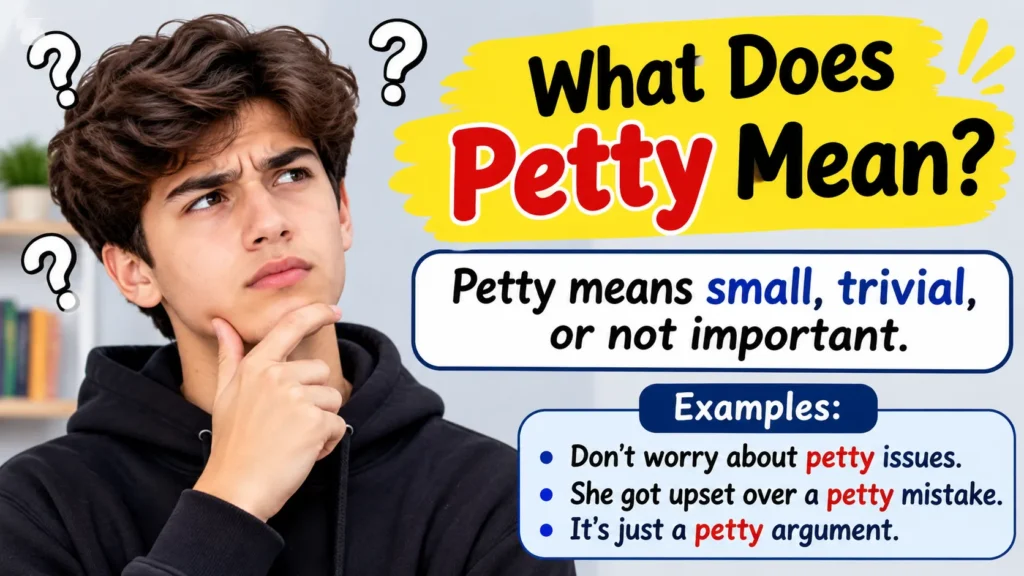
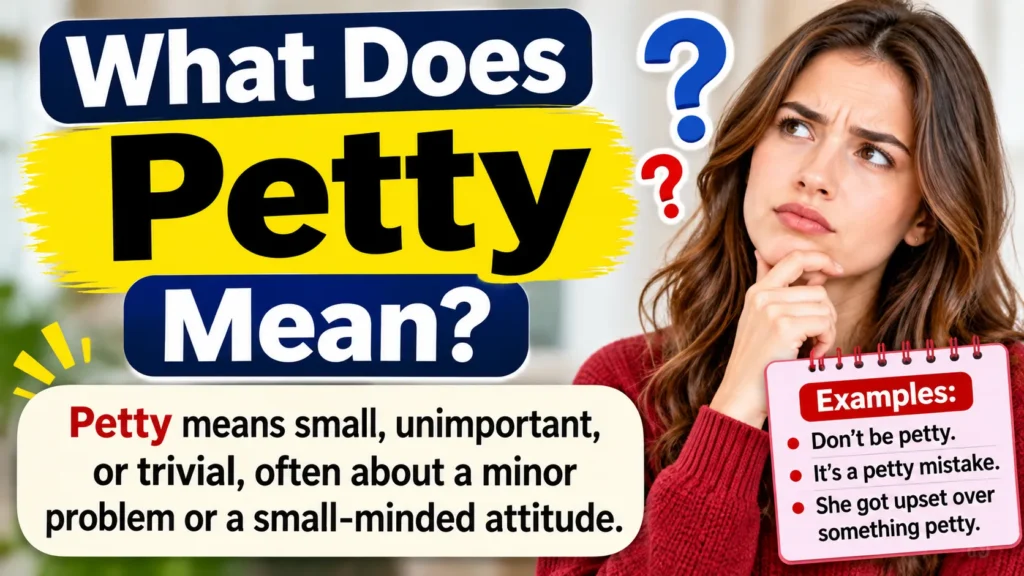
Petty is an adjective that describes something unimportant or someone who focuses too much on insignificant matters. When used to describe behavior, it usually suggests unnecessary negativity, spite, or small-mindedness.
The word has two common meanings:
- Unimportant or minor: Something that has little importance or significance.
- Small-minded or spiteful: Behavior that involves unnecessary arguments, jealousy, or revenge over minor issues.
For example:
- “They had a petty argument about who should wash the dishes.”
- “Ignoring her friend over a small misunderstanding was petty.”
- “We should not waste our time worrying about petty problems.”
In the first example, petty describes a disagreement about a relatively unimportant matter. In the second, it describes an unreasonable reaction.
The meaning depends on the context, but it generally carries a negative tone when describing someone’s attitude.
2. What Does Petty Mean in Simple Words?
In simple English, petty means making too much of something small or acting mean over an issue that is not very important.
Imagine that your friend accidentally loses your favorite pen. Instead of calmly asking about it, you refuse to talk to them for an entire week.
Someone might call that reaction petty because the response seems much bigger than the original problem.
Here are some easy ways to understand the word:
- Making a big deal out of a little problem.
- Getting upset over something insignificant.
- Trying to get even over a minor disagreement.
- Being unnecessarily mean about small things.
- Holding grudges over unimportant situations.
Simple example: If someone stops liking another person’s pictures because they did not like theirs, that could be considered petty behavior.
In short, pettiness often involves giving a small issue more importance than it deserves.
3. What Does Petty Mean in Text and Slang?
In texting and modern slang, petty usually describes someone who acts in a slightly mean, spiteful, or intentionally annoying way because of a small disagreement.
People commonly use it in text messages, social media comments, memes, and casual conversations.
Here are some examples:
- “That’s so petty!”
- “Stop being petty and talk to me.”
- “I’m feeling petty today.”
- “She’s being petty over nothing.”
- “I know it’s petty, but I don’t care.”
- “Not you being petty again!”
The tone can change depending on the situation.
Serious meaning: Someone is behaving unnecessarily mean or immature.
Funny meaning: Someone is joking about a harmless act of revenge or teasing.
For example:
Friend 1: “You ate my last cookie!”
And friend 2: “You ate my fries yesterday.”
Friend 1: “Wow, you’re petty!”
Here, the word is used playfully to describe a small disagreement.
Unlike internet abbreviations, petty is a regular English word. It does not have a special full form or texting expansion.
4. What Does Being Petty Mean?
Being petty means reacting to Small Situations in an unnecessarily negative, spiteful, or unreasonable way.
A person who is being petty may focus on minor mistakes, hold unnecessary grudges, or try to make someone else feel bad over something insignificant.
For example, imagine two friends disagree about where to eat. One friend suggests a restaurant, but the other chooses somewhere else. Instead of accepting the decision, the first friend becomes angry and refuses to participate in the evening.
That reaction could be described as petty.
Other examples include:
- Ignoring someone because they forgot to say thank you.
- Making sarcastic comments about a small mistake.
- Trying to embarrass someone over an insignificant issue.
- Refusing to forgive a minor misunderstanding.
- Keeping score of every little favor or disagreement.
However, expressing disappointment is not automatically petty. People can have legitimate reasons to feel hurt, establish boundaries, or address repeated disrespect.
The important distinction is whether the reaction is reasonable in relation to the situation.
5. Examples of Petty Behavior in Everyday Life
Petty behavior can happen almost anywhere, including at home, school, work, and among friends.
Sometimes it is obvious, while other times it appears through small actions or unnecessary comments.
Here are 15 relatable examples.
- Ignoring messages: Your friend takes two hours to reply, so you deliberately ignore their next five messages.
- Social media revenge: Someone does not like your picture, so you stop liking theirs.
- Small arguments: Two siblings spend an entire evening fighting over the television remote.
- Birthday drama: You refuse to wish someone a happy birthday because they forgot yours.
- Workplace competition: A coworker forgets to bring you coffee, so you refuse to help them with a simple task.
- Friendship jealousy: Your friend gets a new phone, and you make unnecessary negative comments.
- Family disagreements: Someone forgets to invite you to lunch, so you intentionally exclude them next time.
- Food arguments: Your brother eats your favorite snack, so you hide his favorite chocolate.
- Unnecessary criticism: Someone makes a tiny spelling mistake, and you keep reminding them about it.
- Silent treatment: You stop talking to someone over a minor misunderstanding.
- Keeping score: You remind your friend about every small favor you have done for them.
- Online arguments: You spend an hour arguing in the comments over a harmless opinion.
- Group chat drama: You deliberately leave someone out of a conversation because they disagreed with you.
- Borrowed belongings: You refuse to lend a pen because someone forgot to return yours once.
- Unnecessary competition: You try to prove that your weekend was better simply because someone else enjoyed theirs.
These situations show how minor disagreements can turn into unnecessary conflicts.
6. What Does It Mean to Be a Petty Person?
A petty person is someone who frequently focuses on small, unimportant issues and may react to them in an unnecessarily negative or spiteful way.
Such a person might struggle to overlook minor mistakes, forgive small misunderstandings, or move past disagreements.
For example, someone who remembers a tiny argument for months and repeatedly brings it up may be described as petty.
Common characteristics can include:
- Holding unnecessary grudges.
- Making sarcastic comments.
- Getting upset over minor mistakes.
- Trying to get even with others.
- Turning small disagreements into bigger arguments.
- Focusing more on winning than solving problems.
However, calling someone a petty person does not mean everything they do is wrong. It describes a particular attitude or pattern of behavior rather than defining their entire personality.
People sometimes act petty when they feel jealous, frustrated, embarrassed, ignored, or hurt.
7. Signs Someone Is Being Petty
Recognizing petty behavior can help you understand why certain conversations become unnecessarily complicated.
Here are some common warning signs:
1. Making a big deal out of small things: They react strongly to minor mistakes or everyday inconveniences.
2. Holding unnecessary grudges: They continue remembering small disagreements long after they have been resolved.
3. Using sarcasm to hurt others: They make comments designed to embarrass or annoy someone.
4. Seeking small acts of revenge: They try to get even instead of discussing the problem.
5. Keeping score: They remember every small favor, mistake, or disagreement and use it in future arguments.
6. Refusing to admit mistakes: They focus on proving themselves right rather than finding a solution.
7. Creating unnecessary drama: They allow small misunderstandings to damage otherwise healthy relationships.
One isolated action does not necessarily make someone a petty person. Look at the overall pattern and circumstances before judging someone’s behavior.
8. What Does Petty Mean in a Relationship?
In a romantic relationship, petty usually Describes Unnecessary arguments, jealousy, revenge, or negative reactions over relatively small matters.
For example, imagine that your partner forgets to send a good morning message one day. Instead of explaining that you missed hearing from them, you deliberately stop responding to their messages.
Your partner might describe this reaction as petty.
Other examples include:
- Refusing to communicate because of a minor disagreement.
- Making your partner jealous just to get attention.
- Bringing up old arguments during unrelated discussions.
- Giving the silent treatment over small mistakes.
- Making sarcastic comments instead of discussing feelings.
- Trying to win every disagreement instead of solving the problem.
However, there is an important difference between petty behavior and healthy boundaries.
Refusing to tolerate repeated disrespect is not petty. Taking time to calm down before discussing an argument is not petty either.
Healthy relationships require communication, respect, and the ability to resolve disagreements without turning every small issue into a major conflict.
9. What Does Petty Mean Between Friends?
Between friends, petty behavior usually involves small acts of jealousy, unnecessary competition, arguments, or revenge.
Friendships often include misunderstandings, jokes, and occasional disagreements. These situations do not automatically make someone petty.
The problem begins when someone intentionally makes a minor issue bigger or tries to hurt another person over something insignificant.
For example:
- Your friend does not invite you to lunch, so you intentionally exclude them next time.
- Someone forgets your birthday, and you refuse to celebrate theirs.
- Your friend disagrees with your opinion, so you stop speaking to them.
- You refuse to share something because your friend did not share previously.
- Someone receives more attention, and you make negative comments about them.
Sometimes friends use the word humorously without serious intentions.
For example: “You’re petty for eating the last slice of pizza!”
In this situation, the comment might simply be friendly teasing rather than a serious criticism.
10. Is Being Petty Always a Bad Thing?
Being petty is generally considered negative when it involves unnecessary hostility, revenge, or making small problems bigger.
However, people sometimes use the word in a playful way.
For example, if your brother eats your favorite chocolate without asking, you might jokingly hide his favorite snacks the next day and say, “That’s what you get for stealing my chocolate!”
This could be described as harmless pettiness if everyone understands the joke and nobody is genuinely hurt.
Consider these differences:
| Playful pettiness | Harmful pettiness |
| Harmless teasing | Deliberately embarrassing someone |
| Joking about small disagreements | Repeatedly punishing someone |
| Friendly competition | Spreading rumors |
| Lighthearted jokes | Using personal information to hurt others |
| Laughing about a silly argument | Creating unnecessary emotional conflict |
The intention, impact, and circumstances matter. Something that one person considers funny may feel hurtful to someone else.
11. What Is Petty Revenge?
Petty revenge means taking a small, often Humorous Or Spiteful Action to get back at someone for a minor annoyance or disagreement.
It usually involves doing something relatively insignificant because another person has done something irritating.
Examples include:
- Your roommate finishes your snacks, so you eat the last piece of their dessert.
- Your sibling keeps borrowing your charger, so you hide it for a few minutes.
- Your friend always arrives late, so you jokingly make them wait once.
- Someone keeps stealing your seat, so you arrive early and take theirs.
- Your brother changes the television channel, so you jokingly take control of the remote.
These examples illustrate the informal use of the expression.
However, not all revenge is harmless. Threats, harassment, humiliation, property damage, and serious emotional harm should not be dismissed as funny petty behavior.
A playful response should remain respectful and should not turn a small disagreement into a bigger problem.
12. Petty vs. Childish: What’s the Difference?
So, etty and childish are related words, but they do not have exactly the same meaning.
Petty describes someone who gives too much attention to small matters or acts spitefully over insignificant issues.
Childish describes behavior that seems immature, silly, or inappropriate for someone’s age.
| Petty | Childish |
| Focuses on minor issues | Shows immaturity |
| May involve small acts of revenge | May involve silly reactions |
| Often includes spite | Often involves a lack of maturity |
| Can involve holding grudges | Can involve throwing tantrums |
| Suggests unnecessary negativity | Suggests immature behavior |
Petty example: Refusing to congratulate a friend because they received more attention.
Childish example: Throwing a tantrum because you did not get your preferred seat.
A person can be both petty and childish, but the words describe different aspects of their behavior.
13. Petty vs. Mean: What’s the Difference?
So, etty and mean can both describe negative behavior, but their meanings are different.
Petty usually focuses on small issues and unnecessary reactions. Mean describes behavior that is unkind, hurtful, or unpleasant toward another person.
For example:
- Petty: Refusing to share a snack because someone forgot to share theirs yesterday.
- Mean: Insulting someone intentionally to make them feel worthless.
A petty action can also be mean, but not every petty action is seriously hurtful.
Similarly, someone can be mean without being petty. Deliberately bullying another person may be mean even when the situation does not involve an insignificant issue.
14. Synonyms and Antonyms of Petty
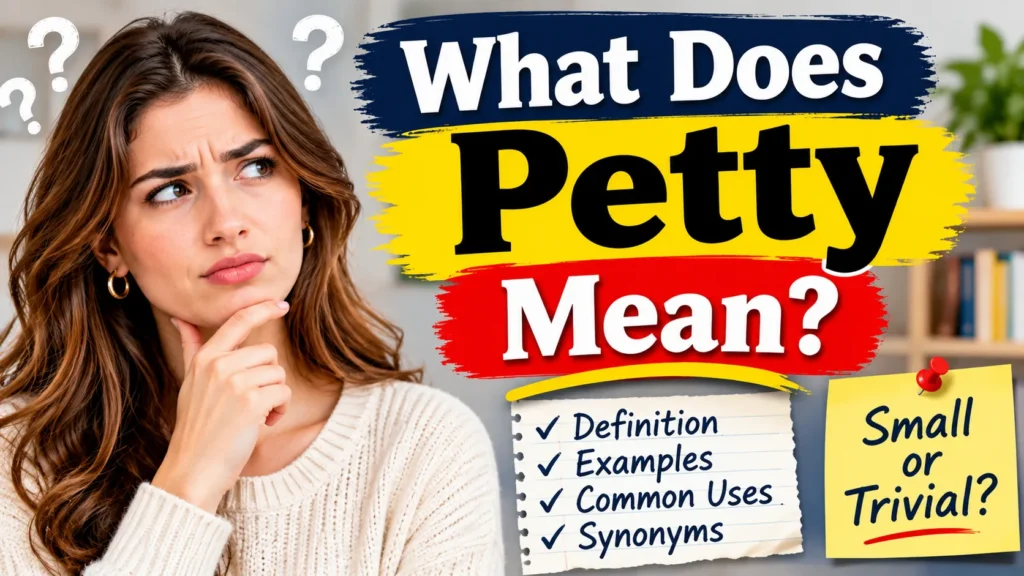
Understanding Synonyms And Antonyms can help you use the word more accurately in conversations and writing.
Synonyms of Petty
These words have meanings related to petty, although they are not interchangeable in every situation.
| Synonym | Meaning |
| Trivial | Having little importance |
| Minor | Small or not very serious |
| Insignificant | Not important or meaningful |
| Small-minded | Having narrow or limited thinking |
| Spiteful | Wanting to hurt or annoy someone |
| Mean | Unkind or unpleasant |
| Childish | Immature or silly |
| Picky | Too particular about small details |
| Narrow-minded | Unwilling to consider different ideas |
| Vindictive | Wanting revenge |
Antonyms of Petty
Antonyms are words with opposite or contrasting meanings.
- Generous
- Mature
- Kind
- Understanding
- Forgiving
- Reasonable
- Important
- Significant
- Considerate
- Open-minded
For example, a mature person may choose to discuss a small disagreement calmly instead of holding a grudge.
15. How to Use Petty in a Sentence
Petty is commonly used before nouns or after linking verbs such as “is,” “was,” and “seems.”
Here are 15 natural examples:
- “They had a petty argument about a parking space.”
- “Please stop being petty and listen to me.”
- “She made a petty comment about his clothes.”
- “I don’t want to waste my time on petty problems.”
- “His petty behavior damaged their friendship.”
- “That was a petty way to respond to a simple mistake.”
- “They continued fighting over petty issues.”
- “I know this sounds petty, but it really annoyed me.”
- “He apologized because he realized his reaction was petty.”
- “We should focus on important matters instead of petty disagreements.”
- “That was the pettiest thing I have ever seen.”
- “She responded pettily to the criticism.”
- “Their argument started over something petty.”
- “Don’t let petty jealousy ruin your friendship.”
- “Sometimes people become petty when they feel ignored.”
Can You Use Petty to Describe a Person?
Yes. You can describe someone as petty when they frequently react negatively to small issues or behave spitefully over insignificant matters.
Example: “He is being petty because he refuses to forgive a small mistake.”
Can You Use Petty to Describe a Situation?
Yes. The word can describe an argument, problem, complaint, disagreement, or other matter that is relatively unimportant.
Example: “They wasted the entire afternoon discussing a petty issue.”
16. Different Forms of the Word Petty
The word petty has Several Grammatical forms that are useful to understand.
| Word form | Grammar | Example |
| Petty | Basic adjective | That was a petty argument. |
| Pettier | Comparative adjective | His response was pettier than hers. |
| Pettiest | Superlative adjective | That was the pettiest excuse. |
| Pettily | Adverb | She responded pettily. |
| Pettiness | Noun | His pettiness surprised everyone. |
What Is the Plural of Petty?
Petty is an adjective, so it does not normally have a plural form.
You can use it with plural nouns:
- Petty arguments
- Petty complaints
- Petty disagreements
- Petty issues
What Is the Comparative Form of Petty?
The comparative form is pettier.
Example: “That reaction was pettier than the original argument.”
What Is the Superlative Form of Petty?
The superlative form is pettiest.
Example: “That was the pettiest thing he had ever done.”
17. What Is Petty Cash?
Petty cash is a small amount of money kept by a business or organization to pay for minor everyday expenses.
Unlike the negative meaning of petty behavior, this expression has a practical financial meaning.
For example, a company may keep petty cash for:
- Buying office stationery.
- Paying for small delivery expenses.
- Purchasing cleaning supplies.
- Covering minor transportation expenses.
- Paying for small emergency purchases.
Example sentence: “The office manager used petty cash to buy additional printer paper.”
In this expression, petty means small or relatively unimportant. It does not suggest that the money or the person handling it is mean or spiteful.
18. What Does Petty Theft Mean?
Petty theft generally refers to the unlawful taking of property of relatively low value.
For example, stealing an inexpensive item from a store may be described as petty theft in some legal systems.
However, the exact legal definition, monetary threshold, classification, and possible penalties depend on the jurisdiction.
In some places, the distinction between petty theft and more serious theft is based partly on the value of the property. Other circumstances can also affect how an offense is classified.
It is important not to confuse this legal expression with petty behavior in everyday conversations.
Example: “The news report discussed a case involving petty theft from a local store.”
In this context, petty describes the legal category or relative seriousness of the offense, not someone’s attitude.
Related To Another Article: https://genzwishes.com/what-does-second-degree-murder-mean/
19. Where Did the Word Petty Come From?
The word petty has an interesting history.
It comes from the Old French word petit, meaning small or little. It entered English during the Middle English period and originally referred to something small in size, amount, importance, or rank.
Over time, the word developed additional negative meanings.
Today, people commonly use petty to describe unimportant matters, small-minded attitudes, and unnecessarily spiteful behavior.
This historical development explains why the word can have different meanings depending on the expression.
For example:
- Petty argument refers to an unimportant disagreement.
- Petty behavior refers to unnecessarily negative actions.
- Petty cash refers to a small amount of money.
- Petty theft refers to a category of relatively minor theft.
People Also Ask
A: Petty and childish have similar negative associations, but they are not identical. Petty describes making too much of small issues or acting spitefully, while childish describes immature or silly behavior.
A: It can be an insult because petty usually suggests that someone is small-minded, unnecessarily mean, or overly focused on insignificant problems. However, friends sometimes use it jokingly.
A: On social media, petty usually describes small acts of revenge, sarcastic comments, jealousy, or deliberately annoying behavior. People may also use it humorously in captions and memes.
A: Someone who refuses to speak to a friend for several days because they forgot to like a social media picture may be considered petty. The reaction gives too much importance to a minor issue.
A: Being petty is generally negative when it involves spite, unnecessary arguments, or attempts to hurt others. However, people sometimes use the word playfully to describe harmless teasing or joking revenge.
Conclusion
So, what does Petty Mean? It describes something unimportant or behavior that gives too much attention to small matters, often involving unnecessary negativity, jealousy, or revenge.
In everyday conversations, texting, and social media, people usually use petty to describe someone who makes a big deal out of a little problem or acts spitefully over something insignificant.
However, context matters. A playful joke is not necessarily harmful, and standing up for yourself is not automatically petty.
The next time you hear someone say, “You’re being petty,” you will understand that they are probably referring to an unnecessarily negative reaction to a relatively small situation.
If this explanation helped you understand the word, share it with a friend who might find it useful, and explore more simple English meanings on GenzWishes.