Introduction
Have you ever seen the abbreviation OEM while shopping for car parts, computers, smartphones, or electronic devices? You may have noticed it in Product Descriptions, technical discussions, or manufacturing documents. But what does OEM mean, and why is it important?
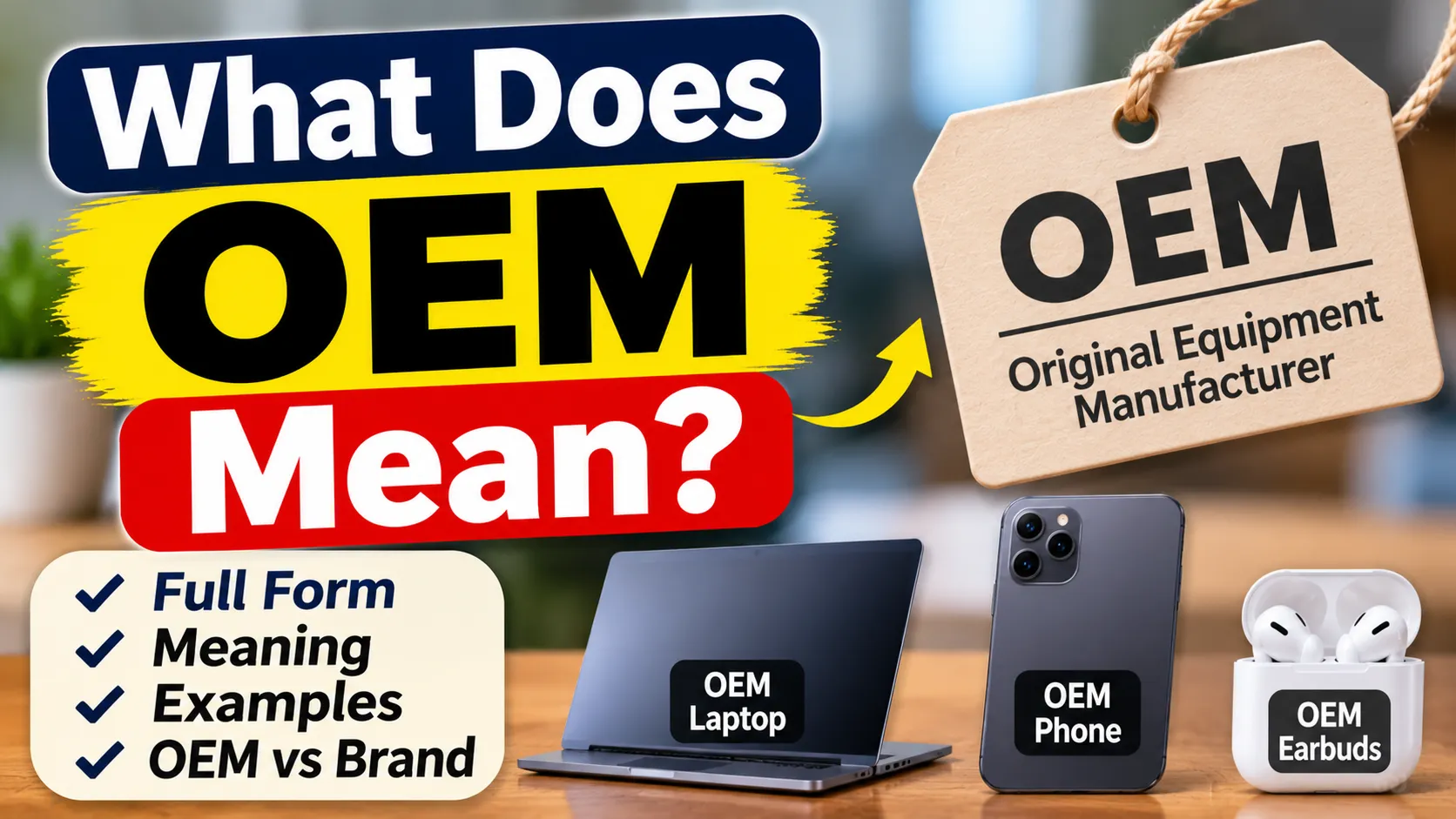
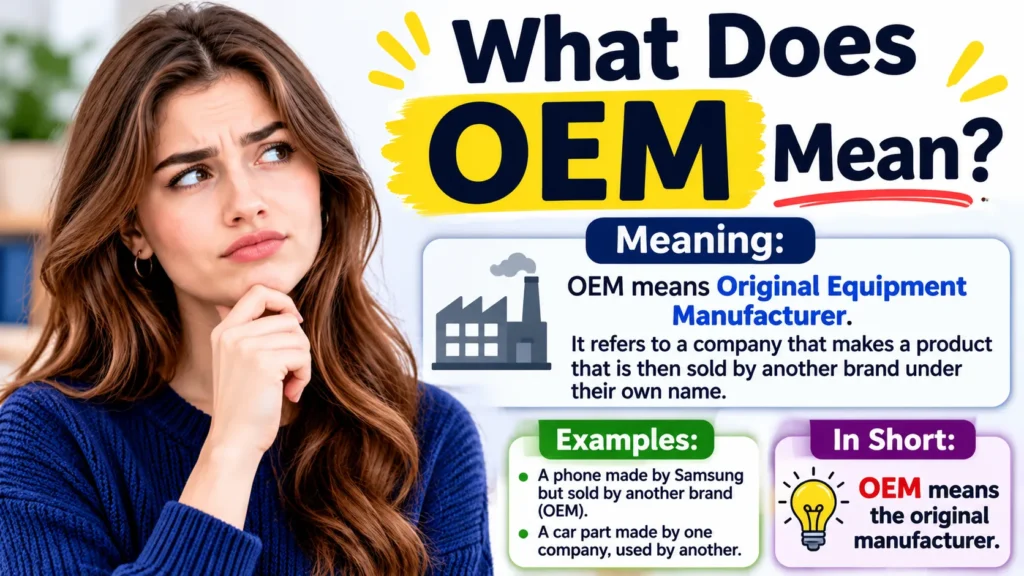
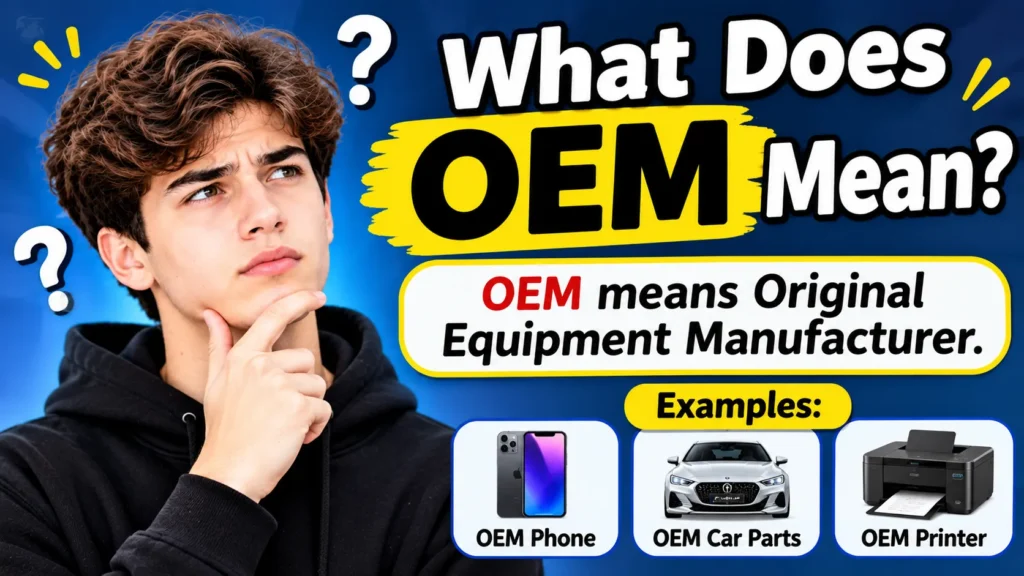
OEM stands for Original Equipment Manufacturer. It generally refers to a company that manufactures products, equipment, or components used in another company’s finished product. Depending on the industry, OEM can also describe an original manufacturer or a replacement part associated with the original equipment.
For example, a computer manufacturer may purchase processors from Intel and storage devices from another supplier before assembling a complete computer under its own brand.
Understanding OEM can help you make better purchasing decisions, compare replacement parts, and understand how modern businesses manufacture products. Let’s explore its meaning, different uses, advantages, and differences from other manufacturing terms.
1. What Does OEM Mean?
OEM means Original Equipment Manufacturer. It describes a company that manufactures equipment, components, or products that become part of another company’s finished product or are supplied through an agreed manufacturing arrangement.
In simple words, an OEM is a manufacturer involved in producing the original equipment or components used in a product.
For example, imagine a company that sells laptops. Instead of manufacturing every component itself, it purchases processors, memory chips, and storage devices from specialized manufacturers. Those suppliers participate in the laptop’s manufacturing supply chain.
OEM can have slightly different meanings depending on the industry.
Here are some common examples:
- In the automotive industry, OEM can refer to a vehicle manufacturer or a component supplier.
- In computers, it often describes manufacturers supplying hardware components.
- In software, it can refer to software licensed for installation or distribution with another company’s hardware.
- In business, it describes relationships involving manufacturing and product supply.
Quick answer: OEM means Original Equipment Manufacturer, a company that produces equipment, products, or components for use in another product or manufacturing arrangement.
2. What Does OEM Stand For?
OEM is an abbreviation for Original Equipment Manufacturer.
Each letter represents one word:
| Letter | Full Word | Meaning |
| O | Original | Relates to the original equipment or product |
| E | Equipment | Machinery, products, devices, or components |
| M | Manufacturer | A company that makes products |
The term is commonly used in manufacturing, automotive production, electronics, computer hardware, and business supply chains.
OEM relationships allow companies to work with specialized manufacturers rather than producing every component independently.
For example, a smartphone company might design a device but purchase its display, battery, camera sensor, and processor from different suppliers.
The finished smartphone carries the company’s brand, even though several manufacturers contributed to its production.
3. How Does an OEM Work?
An OEM generally works through a business-to-business relationship. One company needs particular equipment or components, while another company has the manufacturing capabilities to produce them.
The exact arrangement depends on the contract, product design, and responsibilities of each business.
Here is a simplified example of how the process works.
Step 1: A company develops a product idea
A business decides to manufacture a new product, such as a laptop, smartphone, or vehicle.
Step 2: It identifies manufacturing requirements
The business determines which components, materials, and technical specifications are required.
Step 3: It selects manufacturing suppliers
The company partners with manufacturers that have the necessary equipment, expertise, and production capacity.
Step 4: The OEM manufactures components
The supplier produces the required components according to the agreed specifications.
Step 5: Products undergo quality checks
The manufacturer or buyer checks whether the products meet the required technical and quality standards.
Step 6: The finished product reaches customers
The buyer integrates the components into its finished product, packages it, and distributes it under its brand.
For example, a laptop company might purchase processors, memory modules, and storage devices from specialized manufacturers before assembling its computers.
This arrangement helps businesses concentrate on product development, branding, marketing, and customer service.
4. What Does OEM Mean in Different Industries?
OEM is not limited to automobiles or computer parts. It is used across several industries where businesses manufacture products or components for other companies.
Understanding the context helps you identify what the term means in a particular situation.
Automotive Industry
Car manufacturers work with specialized suppliers to obtain engines, brakes, sensors, batteries, windshields, and other components.
An automotive OEM may refer to the vehicle manufacturer itself or a supplier involved in producing original vehicle components.
Computer Industry
Computer manufacturers purchase processors, graphics components, memory, storage devices, and other hardware from specialized suppliers.
These components are integrated into desktops, laptops, and servers.
Smartphone and Electronics Industry
Smartphone manufacturers often depend on suppliers for camera modules, displays, batteries, processors, and electronic components.
A single smartphone may contain parts manufactured by several different companies.
Software Industry
OEM software is software provided under an arrangement that allows it to be installed, bundled, or distributed with another company’s product.
For example, a computer manufacturer may offer a device with Windows preinstalled.
However, OEM software licensing terms can differ from retail licensing. Activation, support, and transfer conditions depend on the particular agreement.
Industrial Manufacturing
Industrial businesses purchase motors, pumps, sensors, valves, and control systems from specialized manufacturers.
These components help companies build complex machinery without manufacturing every part themselves.
5. What Does OEM Mean in Cars?
In the automotive industry, OEM stands for Original Equipment Manufacturer.
The term can refer to the vehicle manufacturer, a company supplying components for a vehicle, or replacement parts associated with the original equipment.
For example, Toyota and Ford are automotive manufacturers. They work with networks of suppliers that produce components used in their vehicles.
When someone says, “I want an OEM car part,” they generally mean a replacement component associated with the vehicle’s original manufacturer or original specifications.
What Are OEM Car Parts?
OEM car parts are components associated with the original equipment manufacturing process or the specifications used for a particular vehicle.
Common examples include:
- OEM brake pads
- OEM headlights
- OEM bumpers
- OEM air filters
- OEM alternators
- OEM spark plugs
- OEM engine components
- OEM electronic sensors
These parts are intended for particular vehicle applications and specifications.
However, there is an important distinction between an OEM-supplied component and a genuine branded replacement part.
A supplier may manufacture components for a car company without selling every replacement component under that vehicle brand’s packaging.
Therefore, check the manufacturer, part number, packaging, and seller before assuming a product is officially branded or identical to the factory-installed component.
6. What Does OEM Mean in Computers and Technology?
In computers and technology, OEM commonly refers to manufacturers that produce hardware or software for integration into another company’s products.
For example, a laptop brand may purchase processors, memory modules, graphics components, and storage devices from specialized suppliers.
The laptop is then assembled and sold under the laptop manufacturer’s brand.
What Is OEM Hardware?
OEM hardware includes physical equipment and components supplied for use in another product.
Examples include:
- Computer processors
- Motherboards
- Graphics cards
- Memory modules
- Solid-state drives
- Networking components
- Embedded hardware
- Electronic controllers
These components can be manufactured by different companies and integrated into one finished device.
What Is OEM Software?
OEM software is software supplied under an agreement for installation or distribution with another company’s hardware or product.
A common example is an operating system preinstalled on a new computer.
OEM software may have different licensing conditions from retail software.
Before purchasing it, check:
- Whether activation is included.
- Whether the license is linked to a particular device.
- Whether transferring the license is permitted.
- Who provides technical support.
- Which restrictions apply to commercial or personal use.
Important: OEM does not automatically mean free software, pirated software, or an unauthorized copy. The actual licensing agreement determines how the software can be used.
7. What Does OEM Mean in Business?
In business, OEM describes a manufacturing and supply-chain relationship between companies.
One company manufactures components or equipment, while another company uses those products in its finished goods, integrates them into its systems, or distributes products under an agreed brand arrangement.
For example, a business developing industrial machines may purchase specialized motors and electronic controllers from OEM suppliers.
It then integrates those components into its finished machinery.
Why Do Businesses Work With OEM Manufacturers?
Businesses commonly choose OEM partnerships for several reasons.
1. Specialized expertise: Manufacturers may have extensive experience producing particular components.
2. Production capacity: Established suppliers can produce components in large quantities.
3. Lower development costs: Businesses may avoid building their own manufacturing facilities for every component.
4. Faster production: Existing manufacturing capabilities can reduce the time needed to bring a product to market.
5. Consistent specifications: Companies can agree on technical requirements and quality standards.
6. Business flexibility: Companies can focus on their core products while working with specialized manufacturing partners.
OEM relationships are an important part of modern global supply chains.
8. What Is an OEM Product?
An OEM product is a product, component, or piece of equipment manufactured through an original equipment manufacturing arrangement.
It may be supplied to another company for integration, assembly, branding, or distribution.
For example, a computer manufacturer may purchase OEM hardware components and combine them into a complete desktop computer.
Similarly, an automotive manufacturer may use components from several OEM suppliers when assembling a vehicle.
Common Examples of OEM Products
| Industry | OEM Product Examples |
| Automotive | Brakes, sensors, engines, and filters |
| Computers | Processors, memory, and storage |
| Smartphones | Camera modules, batteries, and displays |
| Industrial | Motors, pumps, and control systems |
| Software | Preinstalled operating systems and firmware |
| Healthcare | Medical equipment components |
| Electronics | Circuit boards and electronic modules |
An OEM product is not automatically cheaper, more expensive, or better than an alternative.
Its value depends on the manufacturer, specifications, production quality, compatibility, and intended use.
9. OEM vs Aftermarket: What’s the Difference?
OEM and aftermarket are two commonly used terms when discussing replacement parts, particularly for cars and electronic equipment.
An OEM replacement component is associated with the original equipment manufacturer or the specifications of the original product.
An aftermarket product is manufactured independently and sold as an alternative replacement or upgrade.
OEM vs Aftermarket Comparison
| Feature | OEM | Aftermarket |
| Manufacturer | Original equipment manufacturer or associated supplier | Independent manufacturer |
| Design | Associated with original specifications | May follow or modify original designs |
| Compatibility | Designed for specified applications | Depends on the individual product |
| Price | Can be more expensive | Often offers lower-cost choices |
| Availability | Depends on the original supply network | May offer more alternatives |
| Quality | Depends on manufacturer and specifications | Varies between brands |
| Warranty | Depends on seller and manufacturer terms | Depends on the specific brand and seller |
Which One Should You Choose?
Neither option is automatically better in every situation.
OEM may be appropriate when you want a replacement associated with the original product specifications.
Aftermarket may be suitable when you want more choices, a lower price, or a particular upgrade.
For safety-critical automotive parts, consider product certification, manufacturer reputation, fitment, and professional advice.
The important thing is to compare the actual product rather than choosing based on its label alone.
10. OEM vs ODM: What’s the Difference?
So, OEM and ODM are Related Manufacturing terms, but they describe different business arrangements.
OEM stands for Original Equipment Manufacturer, while ODM stands for Original Design Manufacturer.
The biggest difference is generally who develops and controls the product design.
What Is an ODM?
An Original Design Manufacturer develops and manufactures products that other businesses can purchase, customize, rebrand, or sell.
In many ODM arrangements, the manufacturer handles a significant portion of the product design and development.
OEM vs ODM Comparison Table
| Feature | OEM | ODM |
| Full form | Original Equipment Manufacturer | Original Design Manufacturer |
| Product design | Often supplied or controlled by the buyer | Generally developed by the manufacturer |
| Manufacturing | Follows agreed specifications | Manufactures its developed design |
| Customization | Often offers greater design control | Depends on available customization |
| Development work | Buyer may handle more design work | Manufacturer handles more design work |
| Best suited for | Businesses needing specific product designs | Businesses wanting an existing product design |
Simple Example
Imagine a company wants to launch a new wireless speaker.
If the company develops its own product design and hires a manufacturer to produce it, the arrangement may follow an OEM model.
If it purchases an already-developed speaker design from a manufacturer and sells the product under its own brand, the arrangement may follow an ODM model.
Real-world manufacturing agreements can combine elements of both models. The contract determines who owns the design, intellectual property, and manufacturing responsibilities.
11. OEM vs Original Parts vs Genuine Parts
OEM, original parts, and genuine parts are sometimes used interchangeably, especially in automotive discussions.
However, they do not always describe exactly the same thing.
OEM Parts
OEM parts are associated with the original equipment manufacturer or the specifications used in the original product.
Original Parts
Original parts generally refer to components originally installed or supplied with a product.
The precise meaning can vary between sellers and industries.
Genuine Parts
Genuine parts generally refer to officially branded or authorized replacement components sold through the relevant manufacturer’s parts network.
Comparison Table
| Term | General Meaning |
| OEM | Associated with original equipment manufacturing or specifications |
| Original part | Component originally installed or supplied |
| Genuine part | Officially branded or authorized replacement component |
| Aftermarket part | Independently manufactured replacement component |
For example, a vehicle component manufacturer might supply a part for factory installation and also sell replacement products through another distribution channel.
The packaging, branding, specifications, and warranty may differ.
Always verify the part number and manufacturer’s documentation before assuming two products are identical.
12. What Are the Advantages and Disadvantages of OEM Products?
OEM products offer several benefits, but they also have potential limitations.
Understanding both sides can help consumers and businesses make informed decisions.
Advantages of OEM Products
1. Product compatibility
OEM components are often manufactured for particular products or applications, helping ensure the required fit and compatibility.
2. Specialized manufacturing
OEM suppliers may have advanced production equipment and technical knowledge.
3. Consistent specifications
Businesses can establish specific manufacturing requirements and quality standards.
4. Manufacturing efficiency
Companies can obtain specialized components without producing everything internally.
5. Production scalability
Experienced suppliers may be able to increase production to meet changing demand.
6. Established supply relationships
Businesses can develop long-term relationships with manufacturers and suppliers.
Disadvantages of OEM Products
1. Potentially higher prices
Some OEM replacement products cost more than comparable independent alternatives.
2. Supplier dependence
A business relying heavily on one supplier may face problems if production or delivery is interrupted.
3. Limited availability
Certain original components may be difficult to find, particularly for older products.
4. Licensing restrictions
OEM software may have specific activation, transfer, and support conditions.
5. No automatic quality guarantee
The OEM label alone does not prove that a product is better than every aftermarket alternative.
6. Less flexibility in some arrangements
Certain OEM partnerships may involve strict product specifications, minimum order quantities, or contractual restrictions.
Related To Another Article: https://genzwishes.com/what-does-petty-mean/
13. How Can You Identify an OEM Product?
Identifying an OEM product requires more than checking whether the packaging contains the letters OEM.
Different manufacturers use different identification systems, but these practical checks can help.
1. Check the Manufacturer
Find out which company actually produced the component.
The company selling the finished product may not be the same company that manufactured every individual part.
2. Verify the Part Number
For automotive and electronic components, compare the part number with the manufacturer’s official catalog or product documentation.
3. Examine Product Packaging
Check the manufacturer’s name, model number, batch details, identification labels, and other product information.
4. Purchase From a Reliable Seller
Consider authorized dealers, recognized distributors, and established retailers.
Be cautious when a seller makes unsupported claims about authenticity.
5. Confirm Product Compatibility
Check the exact vehicle model, computer model, equipment version, or technical specifications.
A component can be genuine but still unsuitable for your particular device or vehicle.
6. Review the Warranty
Read the warranty conditions carefully.
Check who provides the warranty, what it covers, and whether installation or registration requirements apply.
Buying tip: A product advertised as OEM is not automatically genuine, new, or officially authorized. Verify its origin and documentation before purchasing.
14. Common Misunderstandings About OEM
OEM is widely used in manufacturing and technology, but several misconceptions can make its meaning confusing.
Here are some common misunderstandings.
Misunderstanding 1: OEM always means the brand manufactured the product.
Not necessarily. A brand may purchase components from independent manufacturers and integrate them into its finished product.
Misunderstanding 2: OEM and aftermarket mean the same thing.
They are different terms. OEM relates to original equipment manufacturing, while aftermarket generally describes independently produced replacement products.
Misunderstanding 3: Every OEM product is better.
The OEM label does not guarantee superior quality. Specifications, manufacturing standards, and supplier reputation matter.
Misunderstanding 4: OEM products are always cheaper.
Some OEM products are competitively priced, while others cost more than independent alternatives.
Misunderstanding 5: OEM only applies to cars.
OEM is used in automotive manufacturing, computers, smartphones, electronics, healthcare, industrial equipment, and software distribution.
Misunderstanding 6: OEM and ODM are identical.
They describe different manufacturing arrangements. OEM commonly involves producing according to a buyer’s specifications, while ODM generally involves designing and manufacturing a product for another business.
Misunderstanding 7: OEM software is automatically illegal.
OEM software can be legitimately licensed. Its permitted use depends on the license agreement and distribution arrangement.
15. Is OEM Better Than Aftermarket?
OEM is not automatically better than aftermarket. The Right Choice Depends on what you are purchasing, your budget, the intended use, and the quality of the available alternatives.
Consider OEM when:
- You want a component associated with the original specifications.
- Product compatibility is particularly important.
- You prefer an established manufacturer’s replacement channel.
- You need particular manufacturer support or warranty coverage.
Consider aftermarket when:
- You want more product choices.
- You are comparing lower-cost alternatives.
- An independent manufacturer offers suitable specifications.
- You need a specialized replacement or upgrade.
Before making a decision, compare the following:
| Buying Factor | What to Check |
| Quality | Manufacturer reputation and product standards |
| Compatibility | Exact model and specifications |
| Price | Total cost, including installation |
| Warranty | Coverage and support conditions |
| Authenticity | Manufacturer details and part numbers |
| Safety | Certifications and suitability for the intended use |
Final recommendation: Do not select a product simply because it carries an OEM or aftermarket label. Understand who manufactured it, what specifications it meets, and whether it is suitable for your needs.
People Also Ask
A: OEM stands for Original Equipment Manufacturer. It generally refers to a company that makes equipment, components, or products used in another company’s finished product.
A: Not always. OEM can refer to a company that produces components for another brand, while in some industries it also refers to the manufacturer of the original finished product.
A: Not necessarily. OEM products are associated with original equipment manufacturing or specifications, while aftermarket products come from independent manufacturers. Quality depends on the individual product and manufacturer.
A: On a car part, OEM generally refers to a component associated with the original equipment manufacturer or the vehicle’s original specifications. It may come from the vehicle brand or one of its component suppliers.
A: OEM manufacturers generally produce products according to agreed customer specifications, while ODM manufacturers typically design and manufacture products that other businesses can purchase, customize, or rebrand.
Conclusion
OEM stands for Original Equipment Manufacturer. It describes an important part of modern manufacturing, where companies produce components, equipment, and products for use in other businesses’ finished goods.
The term appears across automotive manufacturing, computers, smartphones, electronics, software, and industrial production. However, its exact meaning depends on the industry and business relationship.
Whether you are purchasing replacement car parts, comparing computer hardware, or learning about manufacturing, understanding OEM can help you make better decisions.
Remember that OEM does not automatically mean better quality, lower prices, or genuine branding. Always check the manufacturer, specifications, compatibility, and warranty before choosing a product.
If this guide helped you understand OEM, share it with someone who might find the term confusing. You can also bookmark it for future reference and explore more simple explanations on GenzWishes.