Introduction
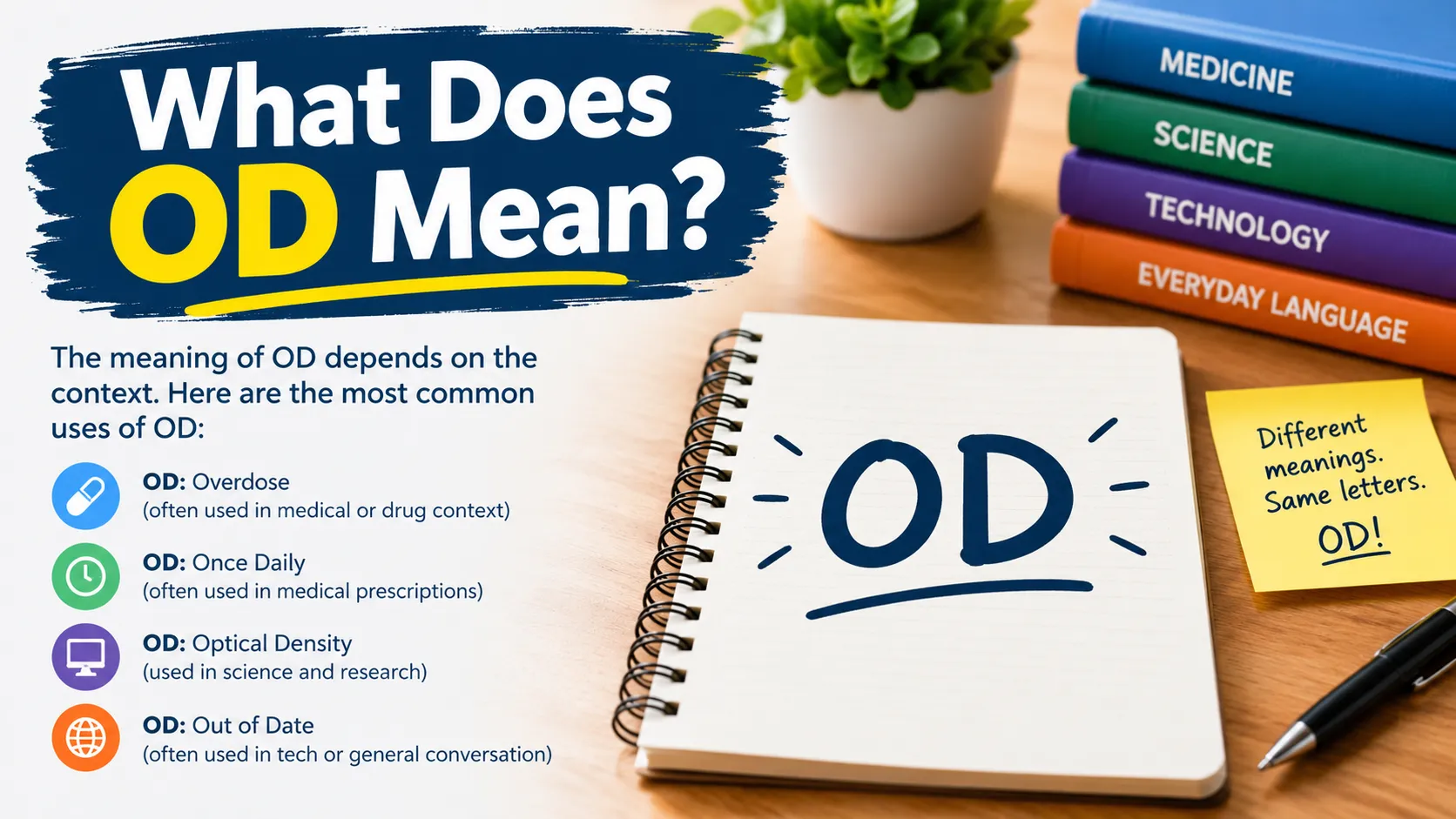
Have you ever received a message saying “That’s OD funny” or seen someone comment “You’re OD” on TikTok? If you wondered what those two letters meant, you’re not alone. Internet slang can be confusing when one abbreviation has several interpretations.
In casual American slang, OD Often Means “very,” “extremely,” or “too much.” People use it to describe something intense, emphasize a feeling, or suggest that someone is overdoing something. However, OD can also stand for overdose, so the surrounding conversation matters.
In this guide, you’ll discover what OD means in texting, how people use it on social media, what common phrases mean, and how to respond when someone uses the expression.
1. What Does OD Mean?
OD has several meanings, depending on the context. In casual slang, it often describes something as extremely intense, excessive, or over the top.
For example, if someone says, “That movie was OD funny,” they mean the movie was extremely funny. If a friend tells you, “You’re OD,” they might mean you’re acting dramatically or doing too much.
The abbreviation comes from overdose in its literal sense. Informal slang has also developed uses that describe having too much of something or experiencing something excessively.
Here are the most common interpretations:
| Expression | Meaning |
| OD funny | Extremely funny |
| OD tired | Very tired |
| You’re OD | You’re doing too much or acting extra |
| Stop ODing | Stop overdoing it or overreacting |
| OD on something | Have too much of something; in medical contexts, this can refer to a dangerous overdose |
The key is context. The words surrounding OD usually help you understand whether someone means “extremely,” “too much,” or an actual overdose.
2. What Does OD Mean in Texting?
In texting, OD often communicates intensity or excess when friends use it as slang. It lets someone emphasize a feeling without writing a long explanation.
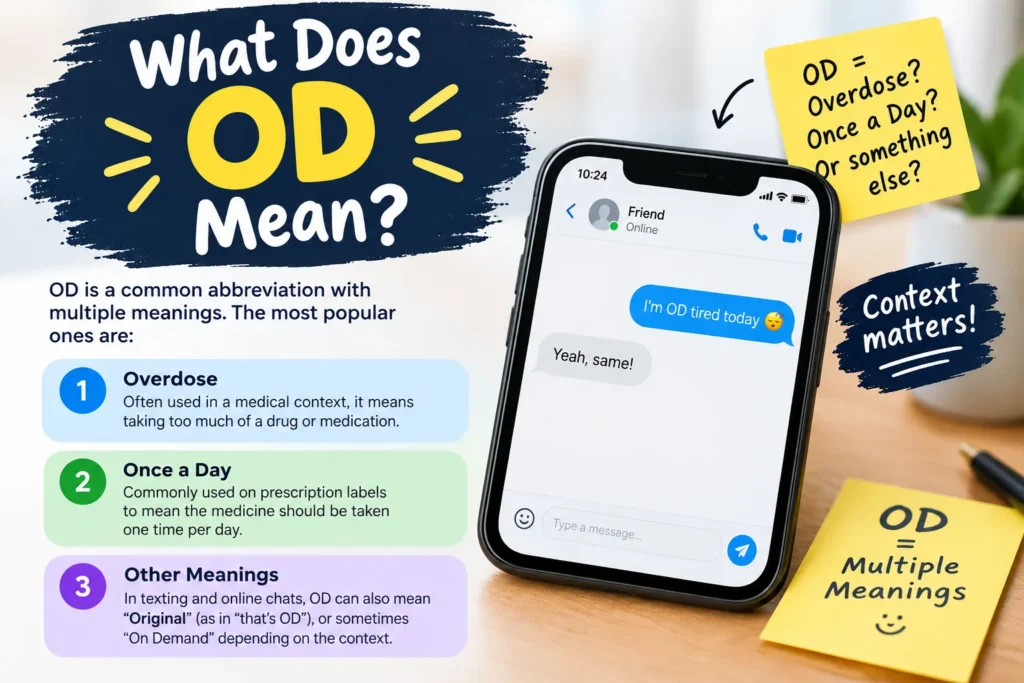
For example, someone might text, “I’m OD tired today.” They mean they’re extremely tired.
Here are more examples:
- “That test was OD hard.” The test was extremely difficult.
- “Your new shoes are OD clean.” Your shoes look exceptionally good.
- “This weather is OD cold.” The weather is very cold.
- “You’re OD dramatic.” You’re being overly dramatic.
- “That price is OD expensive.” The price is extremely high.
- “This food is OD good.” The food tastes exceptionally good.
- “I’m OD hungry right now.” You’re extremely hungry.
- “That game was OD stressful.” The game was very stressful.
People often use this expression in informal messages because it is short and easy to understand among friends familiar with the slang.
However, not everyone uses OD in the same way. If a message concerns drugs, medication, or a medical emergency, the abbreviation may mean overdose instead.
3. What Does OD Mean in Slang?
In slang, OD can describe something as excessive, intense, or unusually strong. Depending on the sentence, it can intensify an adjective or describe someone’s behavior.
The expression is particularly associated with New York slang and hip-hop culture. It has also spread through online conversations and social media.
Consider these examples:
- “That song is OD good.” The song is extremely good.
- “Bro, you’re OD.” You’re acting like you’re doing too much.
- “This game is OD difficult.” The game is extremely difficult.
- “She laughed OD hard.” She laughed a lot.
- “That reaction was OD.” The reaction was excessive or unusually intense.
- “Your editing skills are OD.” Your editing skills are impressive or unusually strong.
- “This assignment is OD annoying.” The assignment is extremely annoying.
The expression can be positive, negative, or neutral. Calling something OD good is a compliment, while telling someone they’re OD may be criticism or playful teasing.
Remember that slang is informal. In professional emails, academic writing, and formal conversations, words such as extremely, excessively, and overreacting are usually clearer.
4. What Does OD Mean on TikTok and Social Media?
On TikTok and other social platforms, people may use OD in comments, captions, videos, and direct messages.
The meaning depends on what the person is describing. Someone might use it to praise a funny video or criticize a dramatic reaction.
| Social media comment | What it means |
| “This video is OD funny.” | The video is extremely funny. |
| “That transition was OD clean.” | The transition looked exceptionally smooth. |
| “Bro is OD.” | The person is acting excessively or dramatically. |
| “This edit goes OD hard.” | The edit is especially impressive. |
| “You’re OD for that.” | Your action was excessive, unexpected, or over the top. |
| “That outfit is OD fire.” | The outfit looks exceptionally good. |
Imagine someone posts a video of a friend laughing uncontrollably at a simple joke. A viewer might comment, “You’re OD for laughing like that.”
The commenter is probably teasing the person for their unusually strong reaction.
This is part of internet humor, where short expressions communicate reactions quickly. However, OD does not have one fixed meaning on every platform. If a post discusses substance use or a medical emergency, the abbreviation may refer to an overdose.
5. What Does OD Mean in Different Contexts?
Understanding the surrounding conversation is the easiest way to interpret OD correctly. The same abbreviation can communicate praise, frustration, exaggeration, or something serious.
| Context | Example | Likely meaning |
| Compliment | “Your outfit is OD clean.” | Extremely stylish or impressive |
| Humor | “That joke was OD funny.” | Very funny |
| Frustration | “This assignment is OD hard.” | Extremely difficult |
| Criticism | “You’re OD right now.” | You’re doing too much |
| Food | “I OD’d on pizza.” | I ate too much pizza |
| Health | “He had an OD.” | He experienced an overdose |
| Business | “OD strategy meeting” | Could refer to organizational development, depending on context |
| Engineering | “Check the OD measurement.” | Could refer to outside diameter |
Notice that some examples use slang, while others use the abbreviation in a literal or specialized sense.
For instance, saying you OD’d on pizza is often a humorous way to describe eating too much. It does not mean you experienced a drug overdose.
By contrast, a message describing someone becoming unconscious after taking drugs could involve a genuine medical emergency. Never assume that such a situation is just slang.
When the meaning is unclear, ask the sender what they intended instead of making assumptions.
6. What Does “You’re OD” Mean?
When someone says “You’re OD,” they often mean you’re acting excessively, being dramatic, or taking something too far.
The tone can be playful or critical. Friends Might say it while laughing, but the same words could sound annoyed during an argument.
Example 1: A funny reaction
Friend A: “I watched that video 20 times.”
Friend B: “Bro, you’re OD!”
Meaning: Your reaction is excessive, probably in a humorous way.
Example 2: An argument
Friend A: “You got angry because I replied five minutes late?”
Friend B: “You’re OD right now.”
Meaning: You’re overreacting to the situation.
Example 3: A compliment
Friend A: “I spent six hours editing this video.”
Friend B: “You’re OD with these edits!”
Meaning: Your editing is intense or impressive. Depending on the tone, this could be admiration or teasing.
Example 4: A school conversation
Student A: “I rewrote my notes four times because the handwriting wasn’t perfect.”
Student B: “You’re OD!”
Meaning: Your friend thinks you’re taking the task unusually far.
If someone says this to you, consider their tone and the subject of the conversation before deciding whether they’re joking or criticizing you.
7. What Does “Stop ODing” Mean?
“Stop ODing” usually means stop overdoing something, being excessively dramatic, or taking a situation too far in casual slang.
Friends may use it when someone has an unusually strong reaction or keeps exaggerating a story.
For example:
- “Stop ODing over one mistake.” Stop making such a big deal about one mistake.
- “Stop ODing with the filters.” You’re using too many filters.
- “Bro, stop ODing in the group chat.” You’re being excessive in the conversation.
- “Stop ODing over that game.” Calm down and stop reacting so strongly to the game.
- “Stop ODing with the decorations.” You’re going overboard with the decorations.
The phrase can sound playful, dismissive, or rude, depending on how someone says it.
It’s also important to recognize the literal meaning. In a conversation about drugs or a medical emergency, “ODing” can refer to experiencing an overdose. In that situation, do not interpret the phrase as ordinary slang without checking the circumstances.
8. What Does “OD Funny” Mean?
“OD funny” means extremely funny or exceptionally amusing.
In this expression, OD strengthens the word funny. It communicates that something made a person laugh much more than usual.
Here are some examples:
- “That meme is OD funny.”
- “Your brother’s reaction was OD funny.”
- “This comedian is OD funny.”
- “That scene had me laughing because it was OD funny.”
- “The group chat was OD funny last night.”
- “Your impression of the teacher was OD funny.”
Imagine watching a comedy sketch in which someone confidently enters the wrong classroom and begins teaching. If your friend says, “That was OD funny,” they’re emphasizing how funny they found the moment.
The expression works best in casual conversations, captions, and comments.
Similar alternatives include:
- Extremely funny
- Hilarious
- Too funny
- Really amusing
- Absolutely hilarious
- Funny beyond words
These alternatives are easier to understand across different age groups and English-speaking communities.
9. How to Use OD in a Sentence
You can use OD in several ways, depending on what you want to communicate. In casual slang, it may intensify an adjective, describe behavior, or refer to excessive activity.
As an intensifier
- “This coffee is OD strong.”
- “That movie was OD good.”
- “I’m OD hungry.”
- “The homework is OD difficult.”
- “That song is OD catchy.”
In these sentences, OD means very or extremely.
To describe behavior
- “You’re OD with the jokes today.”
- “He was OD in the comments.”
- “She went OD with the decorations.”
- “You’re OD for arguing about a tiny detail.”
These sentences suggest that someone is doing something excessively or taking it to an unusual level.
As a humorous expression of excess
- “I OD’d on chocolate cake.”
- “We OD’d on snacks during the movie.”
- “I OD’d on that TV series this weekend.”
Here, the speaker is exaggerating to say they had too much of something or consumed a lot of it.
In casual writing, you’ll see forms such as OD’d, ODed, ODing, and OD’ing. The intended meaning still depends on the context.
For clear communication, avoid this abbreviation in formal documents unless you are using it in a specific, established sense.
10. Real-Life Examples of OD in Conversations
Short conversations make it easier to understand how people use slang naturally.
Example 1: Talking About a Movie
Alex: “Did you watch that New Comedy?”
Sam: “Yeah, it was OD funny.”
Meaning: Sam thought the movie was extremely funny.
Example 2: Complimenting an Outfit
Mia: “What do you think of my new shoes?”
Zoe: “They’re OD clean!”
Meaning: Zoe thinks the shoes look exceptionally good.
Example 3: Reacting to a Game
Ryan: “I lost the final round again. I’m deleting this game.”
Chris: “Bro, you’re OD. It’s just one match.”
Meaning: Chris thinks Ryan is overreacting.
Example 4: Talking About Food
Liam: “I ate three burgers and a whole pizza.”
Noah: “You OD’d on fast food!”
Meaning: Noah is joking that Liam ate too much.
Example 5: Discussing Homework
Ella: “We have four assignments due tomorrow.”
Grace: “That’s OD stressful.”
Meaning: Grace thinks the workload is extremely stressful.
Example 6: Commenting on a Video
Jordan: “Did you see that dance?”
Taylor: “That was OD!”
Meaning: Taylor thinks the dance was impressive, intense, or over the top. The exact interpretation depends on the video.
Example 7: Teasing a Friend
Ava: “I changed my outfit seven times before leaving.”
Maya: “Girl, you’re OD.”
Meaning: Maya is teasing Ava for being excessive or taking too long to choose an outfit.
These examples demonstrate why context matters. The same abbreviation can communicate admiration, humor, frustration, or excess.
11. Is OD a Bad Word?
No. OD is not inherently a swear word.
In casual slang, people use it to mean very, extremely, or too much. It can appear in jokes, compliments, and everyday conversations.
For example, saying “That song is OD good” is generally a compliment. Telling someone “You’re OD” might be playful teasing or criticism, depending on the circumstances.
However, there are two important considerations.
First, slang can sound unprofessional in formal situations. If you’re writing a school assignment, job application, or business email, use clearer expressions such as extremely good or overreacting.
Second, OD also refers to an overdose. Using overdose-related language jokingly can upset people who have experienced substance-related emergencies or lost someone to an overdose.
The best approach: Understand your audience, consider the context, and choose words that communicate your intended meaning clearly.
Related To Another Article: https://genzwishes.com/what-does-maga-mean/
12. What Does OD Stand For?
OD commonly stands for overdose in its literal, drug-related meaning.
In everyday slang, however, people also use it to describe something excessive or extremely intense. The slang usage can communicate a similar idea to too much, very, or over the top.
The abbreviation can have other meanings in specialized fields, too. For example, it may refer to organizational development in business or outside diameter in technical contexts.
Here is a quick comparison:
| Usage | Meaning |
| Texting slang | Very, extremely, or too much |
| Casual expression | Overdoing something or acting excessively |
| Medical or drug-related conversation | Overdose |
| Business | Organizational development |
| Engineering and manufacturing | Outside diameter |
These meanings are not interchangeable. If you encounter OD in a workplace document, prescription, technical drawing, or medical message, don’t automatically apply its slang interpretation.
The surrounding words and subject matter help identify the intended meaning.
13. How to Reply When Someone Says OD
Your response depends on whether the other person is complimenting you, teasing you, or criticizing your behavior.
Here are some natural replies for casual conversations.
If someone compliments you
Person: “Your outfit is OD clean.”
Possible replies:
- “Appreciate it!”
- “Thanks, I tried.”
- “You already know!”
- “Glad you like it!”
If someone says you’re doing too much
Person: “Bro, you’re OD.”
Possible replies:
- “Haha, maybe a little.”
- “I’m just having fun.”
- “Okay, I’ll chill.”
- “What’s too much about it?”
- “That’s just my personality!”
If someone says something is OD funny
Person: “That video is OD funny.”
Possible replies:
- “For real!”
- “I couldn’t stop laughing.”
- “That part got me too.”
- “Send me more videos like that.”
- “I watched it three times!”
If you don’t understand the message
You can simply ask:
- “What do you mean by OD?”
- “Do you mean extremely or too much?”
- “Can you explain that?”
- “Are you using OD as slang?”
Asking for clarification is especially useful when the conversation could involve a serious or medical meaning.
14. OD vs. Overreacting vs. Doing Too Much
OD, overreacting, and doing too much are Related Expressions, but they are not exact synonyms in every situation.
| Expression | Meaning | Example |
| OD | Very, extremely, or excessive, depending on context | “That game is OD hard.” |
| Overreacting | Responding more strongly than a situation seems to warrant | “You’re overreacting to a small mistake.” |
| Doing too much | Taking an action too far or making something unnecessarily excessive | “You’re doing too much with those decorations.” |
| Extra | Being unusually dramatic, elaborate, or attention-seeking | “That outfit is extra.” |
| Over the top | Excessive or more intense than expected | “The celebration was over the top.” |
The key difference is that OD can intensify a positive or negative description. For example, “OD talented” praises someone, while “you’re OD” may criticize someone’s behavior.
Overreacting usually focuses on a person’s response to a situation. Doing too much focuses more broadly on excessive actions or effort.
Understanding these differences helps you interpret slang without assuming every expression carries the same tone.
People Also Ask
A: In casual texting, OD often means very, extremely, or too much. For example, “I’m OD tired” means “I’m extremely tired.” In other contexts, it can refer to an overdose.
A: On TikTok, OD may describe something as extremely funny, impressive, intense, or excessive. The intended meaning depends on the video, caption, and surrounding comments.
A: OD is associated with the word overdose. In casual slang, it can mean very, extremely, or too much. People also use it to describe someone who is overdoing something.
A: It usually means you’re doing too much, acting dramatically, or going over the top. Depending on the context, it can be a joke, criticism, or playful teasing.
A: In casual slang, it usually means stop overdoing something or overreacting. However, in a drug-related or medical context, it can refer to an actual overdose.
Conclusion
OD is a versatile Abbreviation that can mean different things depending on the conversation. In casual slang, it often means very, extremely, or too much. People use it in text messages, TikTok comments, and everyday conversations to describe something funny, impressive, intense, or excessive.
Expressions such as “OD funny,” “you’re OD,” and “stop ODing” demonstrate how its meaning changes with context. At the same time, OD can refer to an actual overdose in medical or drug-related conversations, so it’s important to recognize the difference.
The easiest way to understand the expression is to look at the surrounding words, the subject being discussed, and the speaker’s tone. Once you recognize these clues, interpreting OD in everyday conversations becomes much easier.
If this guide helped you understand a confusing message, bookmark it for later and share it with someone learning modern slang. Explore more texting abbreviations and internet expressions on GenzWishes to keep up with the language people use online.