Introduction
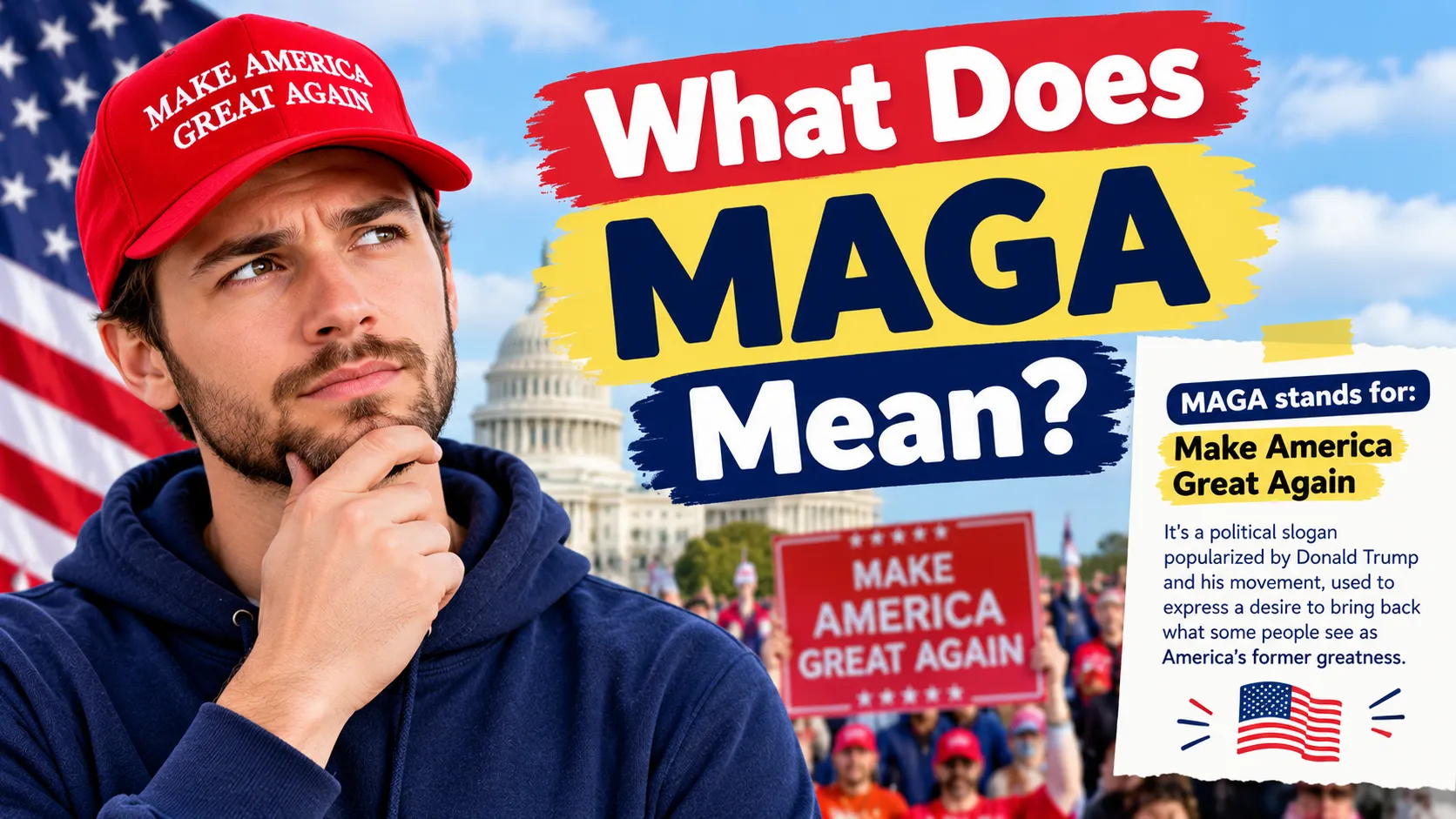
Have you seen MAGA on a red baseball cap, in a political meme, or in a social media comment and wondered what it means? MAGA stands for “Make America Great Again.” It is a political slogan strongly associated with Donald Trump and the movement surrounding his campaigns.
The term appears in American news, political debates, campaign merchandise, and online conversations. However, its meaning goes beyond four letters. Some people use it to express political support or national pride, while others use it critically when discussing policies or political rhetoric.
Understanding its full form, history, and context makes it easier to follow conversations about American politics without confusing the slogan with the broader movement or an individual supporter.
1. What Does MAGA Mean?
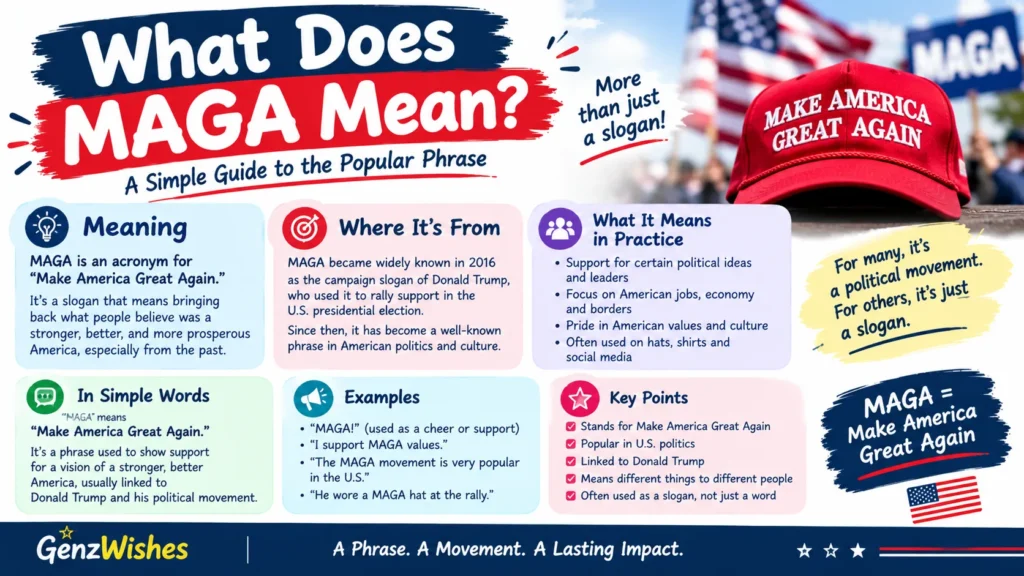
MAGA stands for “Make America Great Again.” It is a political slogan associated with Donald Trump and is also widely used as a label for the political movement connected with his campaigns and ideas.
The phrase communicates a desire to restore or strengthen America’s position, prosperity, or influence. However, people disagree about what American greatness means and which policies would achieve it.
For many supporters, MAGA represents priorities such as national sovereignty, stricter immigration enforcement, domestic industry, and changes to established political practices. Critics may associate it with divisive rhetoric, restrictive policies, or forms of nationalism they oppose.
The term can have three closely related meanings:
- The slogan: The words “Make America Great Again.”
- The movement: The political movement associated with Donald Trump and its supporters.
- A supporter: A person who identifies with or supports MAGA politics.
For example, someone who says, “I saw a MAGA hat at the rally,” is referring to political merchandise. Someone who says, “The MAGA movement influenced the election,” is discussing the broader political movement.
In simple words, MAGA is an abbreviation that became a widely recognized political identity and cultural symbol.
2. What Does MAGA Stand For?
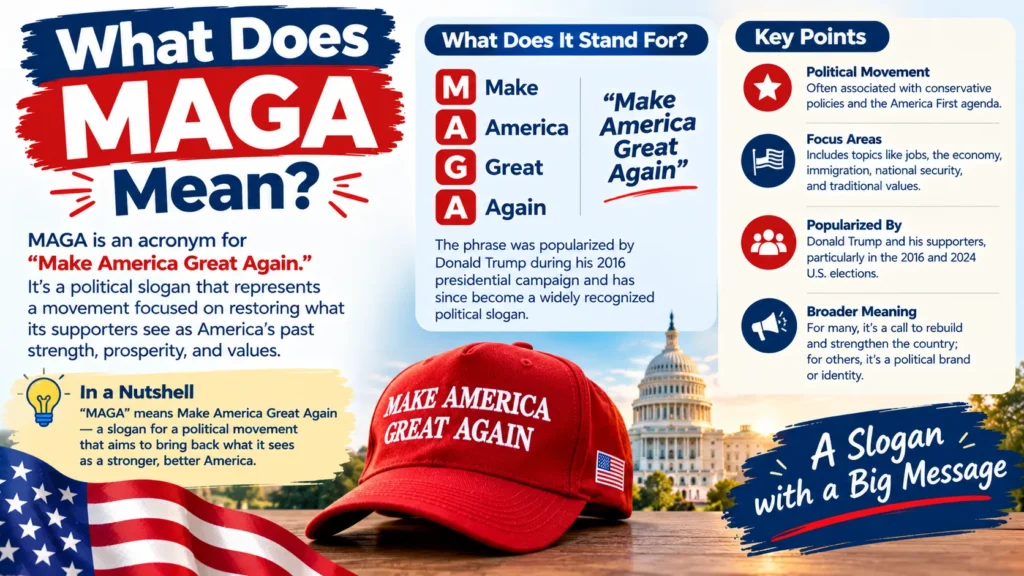
MAGA is formed from the first letters of the four words in the slogan “Make America Great Again.”
| Letter | Word | Meaning in the slogan |
| M | Make | Create, build, or restore |
| A | America | The United States |
| G | Great | Strong, successful, or prosperous |
| A | Again | Return to a previous condition or achieve it once more |
The slogan suggests that America should regain or strengthen a level of greatness that the speaker believes it has lost or needs to improve.
However, the phrase does not identify one specific policy. Different supporters may connect it with employment, manufacturing, immigration, trade, national security, or cultural values.
This broad wording helps explain why the slogan appeals to people with different priorities. It communicates a general political goal while leaving room for different interpretations of what achieving that goal would involve.
When you see MAGA on campaign merchandise or in an online post, the letters generally refer to this slogan and its political associations.
3. What Is the Meaning of MAGA in Politics?
In American politics, MAGA refers to the “Make America Great Again” slogan and the movement associated with Donald Trump.
Trump made the phrase a defining feature of his 2016 presidential campaign. Since then, it has become shorthand for a political identity associated with his leadership, campaigns, supporters, and policy priorities.
The movement is commonly associated with several themes:
- America First: Prioritizing American national interests in areas such as trade, immigration, and foreign policy.
- Immigration enforcement: Supporting stricter border controls and stronger enforcement of immigration laws.
- Domestic industry: Promoting policies intended to strengthen American manufacturing and businesses.
- Political change: Challenging established political leaders and institutions that supporters believe have failed to serve ordinary Americans.
- Conservative priorities: Supporting various conservative positions on cultural, economic, and social issues.
- Trump’s leadership: Identifying with Donald Trump’s political agenda and approach to government.
These themes describe common associations, not a checklist that every supporter follows.
Some people identify strongly with MAGA, while others support selected policies without adopting the label. Critics also disagree with different aspects of the movement for different reasons.
Therefore, understanding MAGA in politics requires looking at the specific policy, person, or discussion involved rather than assuming that the label explains every political belief.
4. Where Did the MAGA Slogan Originate?
Although people strongly associate MAGA with Donald Trump, the underlying phrase existed before his presidential campaigns.
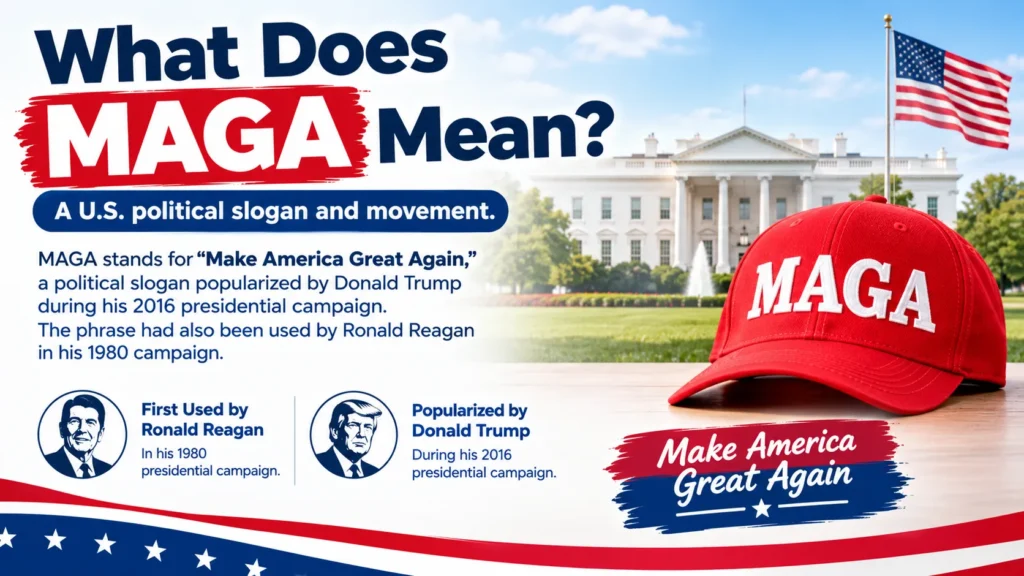
Ronald Reagan used the wording “Let’s Make America Great Again” during his successful 1980 presidential campaign. Bill Clinton also used similar wording during his 1992 campaign. The Smithsonian’s National Museum of American History documents these earlier campaign uses.
Donald Trump later adopted “Make America Great Again” as the central slogan of his 2016 presidential campaign. His campaign helped turn the phrase and its abbreviation into widely recognized political symbols.
Here is a simplified timeline:
| Year | Historical development |
| 1980 | Ronald Reagan used “Let’s Make America Great Again” during his presidential campaign. |
| 1992 | Bill Clinton used similar wording during his presidential campaign. |
| 2015–2016 | Donald Trump adopted “Make America Great Again” as a defining slogan of his presidential campaign. |
| 2020 | Trump continued using the slogan during his reelection campaign. |
| 2024 | The slogan remained a prominent part of Trump’s presidential campaign and political identity. |
The key distinction is that Trump did not invent the underlying phrase. He popularized MAGA as a modern political brand associated with his campaigns and movement.
This historical background helps explain why the term appears in discussions about both earlier American campaign slogans and contemporary politics.
5. How Did Donald Trump Popularize MAGA?
Donald Trump made MAGA a central part of his political identity during the 2016 presidential election.
The slogan was short, memorable, and easy to display on campaign materials. It also communicated a broad message about restoring national strength and changing the country’s direction.
Red baseball caps displaying “Make America Great Again” became one of the campaign’s most recognizable symbols. The slogan appeared at rallies, in campaign advertising, on merchandise, and across social media.
The abbreviation MAGA made the message even easier to share. People could write four letters or use the hashtag #MAGA instead of typing the entire phrase.
Over time, the term expanded beyond the original campaign slogan. Journalists, political commentators, supporters, and critics began using MAGA to describe the broader political movement and its influence on American politics.
The phrase also became part of internet culture. It appeared in memes, reaction images, jokes, arguments, and political commentary.
This combination of memorable wording, recognizable merchandise, and extensive media attention helped make MAGA a widely understood political term.
6. What Does the MAGA Movement Believe?
The MAGA Movement Includes People with different backgrounds and priorities. Although supporters do not agree on every issue, several political themes frequently appear in descriptions of the movement.
America First
Supporters often favor putting American interests first when making decisions about trade, diplomacy, immigration, and government spending.
They may describe this approach as a way to protect American workers, businesses, and national sovereignty. Critics may question whether particular policies create economic costs or weaken international cooperation.
Immigration and Border Security
Stricter immigration enforcement and tighter border controls are prominent MAGA priorities.
Supporters often argue that stronger enforcement protects national security and helps the government manage immigration. Critics may raise concerns about humanitarian consequences, due process, family separation, and the effects of restrictive policies.
Economic Policy
MAGA supporters frequently emphasize domestic manufacturing, American businesses, and changes to trade relationships.
However, they may disagree about tariffs, taxation, government spending, and the best ways to create jobs.
Opposition to Political Establishments
The movement often presents itself as a challenge to established political leaders and institutions.
Supporters may see this approach as a way to demand accountability and challenge a system they believe has ignored ordinary citizens. Critics may worry that attacks on established institutions can undermine public trust or democratic safeguards.
Cultural and Social Issues
MAGA politics is also associated with conservative positions on several cultural and social questions.
Individual supporters may have different motivations, including economic concerns, immigration, national identity, religious values, or dissatisfaction with existing political leadership.
These themes provide a useful overview, but the MAGA label does not tell you everything about an individual’s political beliefs.
7. What Does a MAGA Supporter Mean?
A MAGA supporter is generally someone who supports Donald Trump’s MAGA movement, its central political message, or many of the policies associated with it.
The term can describe someone who identifies strongly with Trump, supports his campaigns, or agrees with several priorities associated with his political agenda.
Consider these examples:
- “My uncle is a MAGA supporter.” This means the speaker’s uncle supports the movement associated with Trump.
- “The rally attracted many MAGA supporters.” This means many attendees supported the movement.
- “She identifies with MAGA politics.” This means she connects with the movement’s political ideas or identity.
- “The article examines MAGA supporters.” This means the article discusses people who support or identify with the movement.
The tone of the term depends on context. A person may use it neutrally in a news report, positively when discussing their political identity, or critically when expressing disagreement.
It is also important to distinguish MAGA supporters from Republicans as a whole. The Republican Party includes people with different views, and not every Republican identifies with the MAGA movement.
Likewise, identifying someone as a MAGA supporter does not establish that the person agrees with every policy associated with Trump.
Context matters when interpreting political labels.
8. Why Do People Wear MAGA Hats?
MAGA hats are political caps displaying the slogan “Make America Great Again.” Red versions became especially recognizable during Donald Trump’s presidential campaigns.
For many supporters, wearing a MAGA hat expresses political support for Trump and the movement associated with his campaigns.
The hat can also communicate a sense of belonging to a political community, support for particular policy goals, or a desire to make one’s political identity visible.
Political merchandise works as a quick visual signal. A person can display a slogan without explaining their beliefs in a conversation.
However, MAGA hats do not have the same meaning to everyone.
Supporters may interpret them as symbols of national pride, political change, or loyalty to a candidate. Critics may associate them with policies or rhetoric they consider harmful or divisive.
The hats also appear in political memes, news coverage, photographs, and online arguments because they are easily recognizable.
Although a MAGA hat can provide a clue about someone’s political affiliation, it does not reveal everything about the wearer’s personal beliefs or motivations.
9. What Does MAGA Mean on Social Media?
On Social Media, MAGA usually refers to “Make America Great Again,” the political movement associated with Donald Trump, or support for its ideas.
The abbreviation appears in posts, comments, video captions, hashtags, memes, and political discussions on platforms such as Instagram, TikTok, Facebook, YouTube, and X.
The hashtag #MAGA helps users group or discover content related to the slogan and movement.
Here are examples of how people may use the term online:
| Social media example | What it means |
| “#MAGA at today’s rally.” | The post connects the rally with Trump’s movement. |
| “He shared a photo of his MAGA hat.” | The person posted political merchandise associated with Trump. |
| “The debate about MAGA is everywhere.” | The speaker is discussing the movement’s public visibility. |
| “That comment reflects MAGA politics.” | The speaker believes the comment reflects ideas associated with the movement. |
| “What does MAGA mean?” | The person wants to understand the abbreviation or its political context. |
| “The video makes fun of MAGA supporters.” | The video uses political satire or criticism directed at supporters. |
Unlike some internet slang terms, MAGA does not have a separate, universally accepted texting definition. Its meaning generally remains connected to American politics.
The tone depends on the post. A supportive hashtag may express political agreement, while a critical post may use the same abbreviation to discuss the movement from an opposing perspective.
Before interpreting a post, consider the surrounding text, the author’s apparent position, and whether the content is serious, satirical, or critical.
10. Is MAGA a Political Slogan or a Movement?
MAGA can refer to both a political slogan and a political movement. These meanings are related, but they are not identical.
| Term | Meaning | Example |
| MAGA slogan | The phrase “Make America Great Again” | “MAGA appeared on the campaign hat.” |
| MAGA movement | The broader political movement associated with Trump | “The MAGA movement influenced political debate.” |
| MAGA supporter | A person who supports or identifies with the movement | “Several MAGA supporters attended the event.” |
| #MAGA | A hashtag used to categorize related online content | “The post included #MAGA.” |
The slogan communicates a political message. The movement includes people and groups who support or identify with that message and the associated political agenda.
The supporter label applies to an individual rather than the slogan itself.
These distinctions are useful when reading news reports or participating in political conversations. A sentence about a hat may refer to the slogan, while a sentence about voters or political influence may refer to the movement.
Although the meanings overlap, they are not interchangeable in every situation.
11. Why Is MAGA Controversial?
MAGA is controversial because it represents a highly visible political movement whose goals, rhetoric, and effects people interpret differently.
Supporters may associate it with national pride, economic opportunity, stricter border enforcement, domestic industry, and opposition to established political elites.
Critics may associate the movement with divisive rhetoric, restrictive immigration policies, exclusionary nationalism, or concerns about democratic institutions and civil rights.
These disagreements reflect wider divisions in American politics over national identity, immigration, trade, cultural values, executive power, and the country’s role in the world.
The wording of the slogan also invites debate. It calls for making America great “again” without specifying one historical period or a universally accepted definition of greatness.
Different people may imagine different versions of America’s past. They may also disagree about whether those periods were better for the country as a whole or for particular communities.
As a result, the same slogan can inspire pride in one person and concern in another.
A neutral explanation should distinguish political facts from interpretations and opinions. It should also recognize that supporters and critics do not all share identical beliefs.
Understanding why MAGA is controversial requires examining the specific political issue and context rather than relying on the abbreviation alone.
Related To Another Article: https://genzwishes.com/what-does-ight-mean/
12. Does MAGA Mean the Same Thing to Everyone?
No. MAGA has a clear full form, but its broader meaning depends on the person using it and the context in which it appears.
For many supporters, the term expresses a desire to strengthen America, prioritize national interests, or support Donald Trump’s political agenda.
And for critics, it may represent political policies, rhetoric, or social changes they oppose.
For journalists and researchers, MAGA can serve as a convenient label for the movement associated with Trump and its influence on American politics.
On social media, users may employ the term seriously, sarcastically, or humorously. A hashtag alone does not always reveal whether someone supports the movement.
Consider three examples:
- “I support the MAGA movement.” This directly expresses support.
- “The news report examined MAGA’s influence.” This describes the movement without necessarily endorsing or opposing it.
- “That meme criticizes MAGA.” This indicates that the content takes a critical or satirical approach.
The full form remains the same, but the associations attached to the term can differ considerably.
When you encounter MAGA, examine the surrounding conversation before deciding what the speaker intends to communicate.
13. How Do You Use MAGA in a Sentence?
MAGA commonly appears in political writing, news reporting, social media posts, and everyday conversations.
These original examples show how the term can be used naturally:
- “I saw the abbreviation MAGA in a news article and wanted to understand it.”
- “The candidate used the phrase Make America Great Again during the campaign.”
- “Several people wore MAGA hats at the political rally.”
- “The journalist discussed the influence of the MAGA movement.”
- “Her social media post included the hashtag #MAGA.”
- “The documentary examined the history of the MAGA slogan.”
- “The debate focused on policies associated with MAGA.”
- “He asked whether every Republican identifies with MAGA.”
- “The commentator explained why MAGA supporters disagree with some political opponents.”
- “The article compared the original slogan with its modern political meaning.”
These examples demonstrate the term’s different uses.
When a sentence mentions campaign merchandise, MAGA may refer to the slogan or its abbreviation. When it discusses voters, political ideas, or influence, it usually refers to the broader movement or its supporters.
The surrounding words generally make the intended meaning clear.
14. What Are Common Misunderstandings About MAGA?
Several Misunderstandings can make conversations about MAGA confusing. Knowing the distinctions helps readers interpret the term more accurately.
Misunderstanding 1: Donald Trump invented the entire phrase
The underlying slogan existed before Trump’s presidential campaigns. Ronald Reagan used an earlier version during his 1980 campaign, and Bill Clinton used similar wording in 1992. Trump later made it a defining feature of his political brand.
Misunderstanding 2: MAGA only means a red hat
MAGA appears on hats and other political merchandise, but it also refers to the slogan and the broader political movement associated with Trump.
Misunderstanding 3: Every Republican is a MAGA supporter
The Republican Party includes people with different political identities and varying levels of support for Trump. Republican affiliation does not automatically mean someone identifies with MAGA.
Misunderstanding 4: Every MAGA supporter has identical beliefs
Supporters may agree on certain priorities while disagreeing about economic policy, foreign affairs, government spending, or other issues.
Misunderstanding 5: MAGA always expresses support
Some people use the term positively, while others use it neutrally in reporting or critically in political discussions. Context determines its tone.
Misunderstanding 6: The slogan has one universally accepted interpretation
Supporters, critics, journalists, and researchers may interpret the movement differently. The slogan’s literal meaning does not resolve every disagreement about its political implications.
Misunderstanding 7: MAGA is simply another name for the Republican Party
MAGA is closely associated with Trump’s political movement and has had substantial influence within the Republican Party. However, the terms do not mean the same thing.
Recognizing these distinctions helps readers separate the literal definition from the broader political debate.
People Also Ask
A: MAGA stands for “Make America Great Again.” It is a political slogan strongly associated with Donald Trump and the movement built around his campaigns.
A: In simple words, MAGA expresses the idea of restoring or strengthening America’s greatness. It is also widely used to describe Trump’s political movement and its supporters.
A: In politics, MAGA refers to Trump’s slogan and the movement associated with his leadership, campaigns, supporters, and policy priorities.
A: MAGA generally retains its political meaning in text messages: “Make America Great Again.” The sender’s tone may be supportive, critical, humorous, or neutral.
A: MAGA is commonly pronounced “MAG-uh,” with the first syllable sounding like the beginning of “magazine.” Some people also pronounce the letters individually as “M-A-G-A.” Cambridge Dictionary provides pronunciation guidance for the term.
Conclusion
MAGA stands for “Make America Great Again,” a political slogan that became closely associated with Donald Trump during his 2016 presidential campaign. Although the underlying phrase appeared in earlier American political campaigns, Trump made it a defining symbol of his political identity and movement.
Today, MAGA can refer to the slogan, the broader political movement, its supporters, or the ideas associated with it. People interpret the term differently depending on their political views and the context in which they encounter it.
Understanding the abbreviation, its historical background, and its modern usage makes it easier to interpret MAGA in news reports, online conversations, campaign materials, and social media posts.
If this explanation helped you understand the term, consider bookmarking the guide for future reference and exploring more meaning and internet terminology articles on GenzWishes.com.