Introduction
Have you Ever Heard someone say, “We decided to elope,” and wondered what they meant? The word might sound mysterious, romantic, or even a little rebellious, depending on the situation.
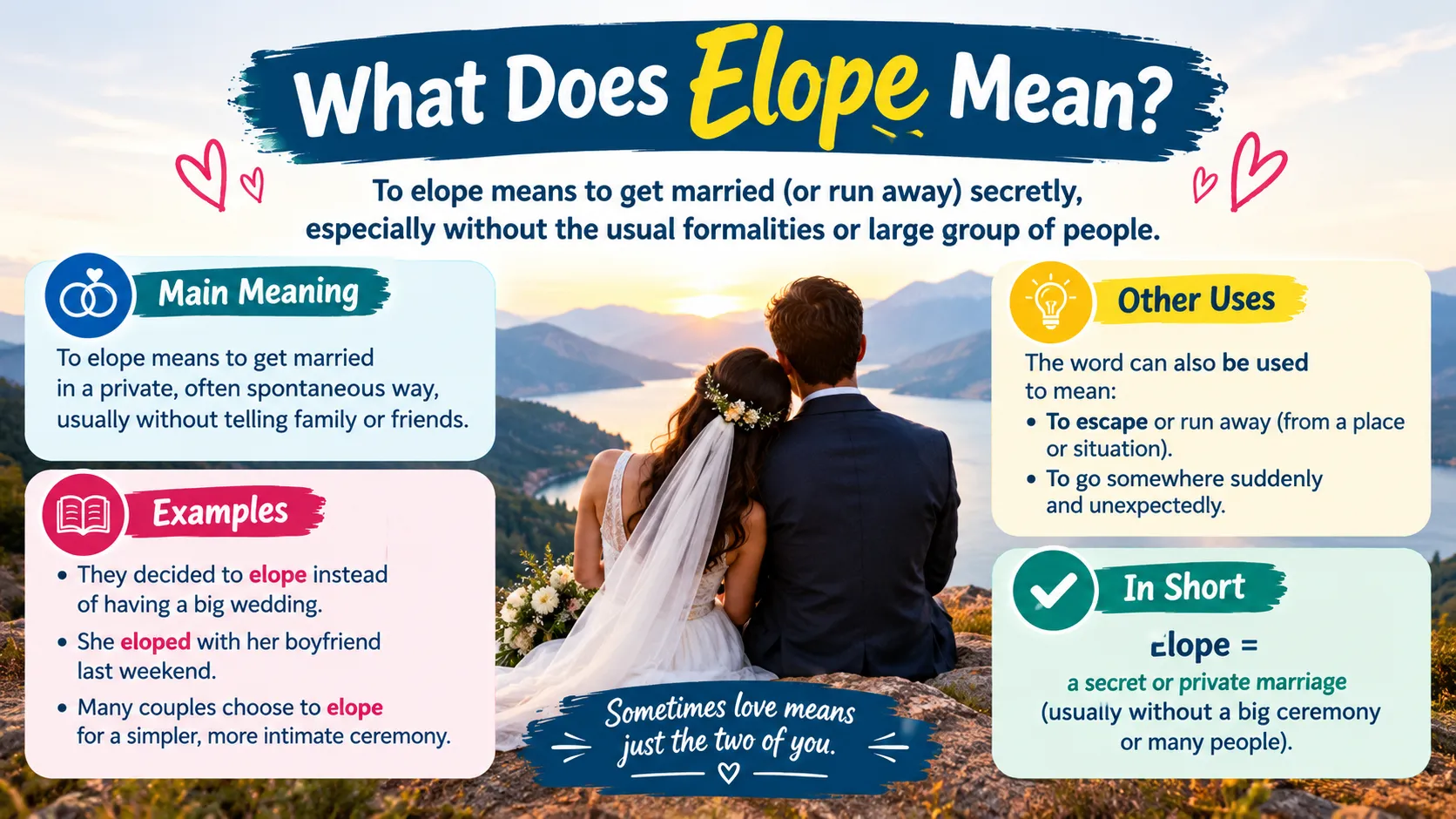
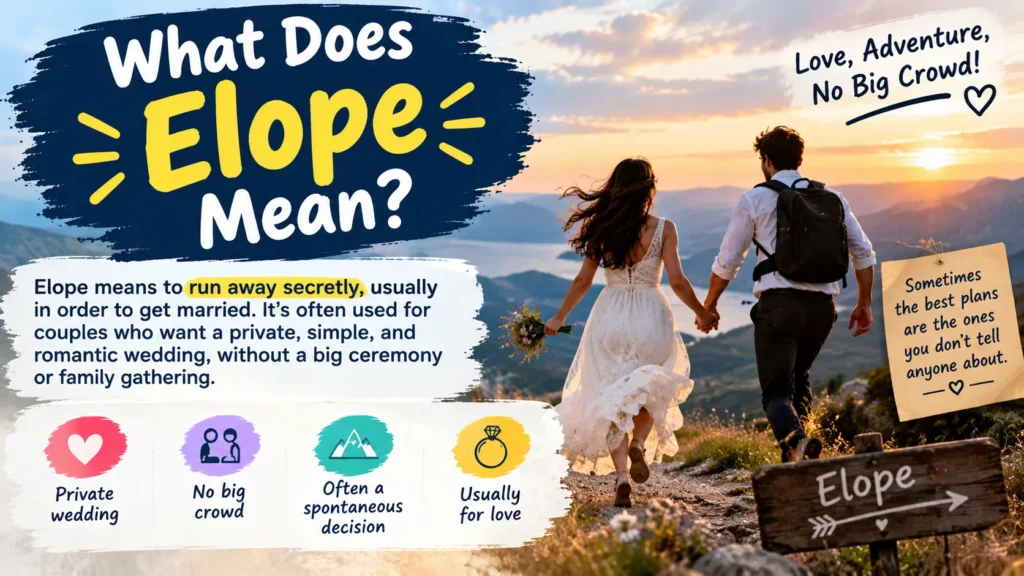
To elope traditionally means to run away secretly with someone to get married, often without informing or obtaining permission from family members. Today, the word also commonly describes couples who choose a small, intimate wedding instead of a large traditional celebration.
For example, a couple might travel to a beautiful mountain location, exchange vows in a private ceremony, and celebrate their marriage with only a few guests. They may describe this experience as eloping, even if their families know about their plans.
Understanding the word’s traditional and modern meanings helps you interpret conversations, books, social media posts, and wedding discussions more accurately.
1. What Does Elope Mean?
To elope means to leave secretly with a romantic partner to get married. Traditionally, the word often suggested that a couple wanted to marry without their families’ knowledge or approval.
However, the meaning has expanded over time. Many couples now use elope to describe choosing a small, private wedding instead of organizing a large event.
For example:
- Traditional usage: A couple secretly leaves home to get married without telling their families.
- Modern usage: Two people arrange a small wedding ceremony with only an officiant and a photographer.
- Destination usage: A couple travels to another location for an intimate wedding experience.
The important distinction is that eloping traditionally emphasizes secrecy, while modern elopements often emphasize privacy, simplicity, and personal choice.
Simple definition: Elope means to run away with a romantic partner to marry, or, in modern usage, to choose a small and intimate wedding.
2. What Does Elope Mean in a Relationship?
In a relationship, eloping usually means that two people decide to get married without having a large traditional wedding. Depending on their circumstances, they might keep their plans private or share them with a small group of loved ones.
Imagine a couple who have been together for several years. They love each other, but neither wants to spend months planning a large wedding. Instead, they arrange a simple ceremony and begin their married life together.
They might tell their friends, “We decided to elope!”
This statement means they chose a more private approach to marriage rather than a conventional wedding celebration.
Eloping does not automatically mean that a couple is acting impulsively, hiding an unhealthy relationship, or rejecting their families. Some couples plan their elopements carefully, while others decide because they prefer a spontaneous experience.
The meaning depends on the couple’s intentions and the situation.
3. What Does Eloping Mean in Simple Words?
Eloping means getting married privately, traditionally by leaving secretly with a romantic partner.
In simple English, you can understand it as choosing to marry without having a big, traditional wedding.
Consider these examples:
- “They eloped last weekend.” They got married privately or without a traditional wedding celebration.
- “She wants to elope with her boyfriend.” She wants to marry him in a private or secretive way.
- “We are eloping in the mountains.” The couple plans an intimate wedding in a mountain location.
- “My grandparents eloped.” They got married in a way that was traditionally associated with secrecy or leaving to marry.
The word is commonly used as a verb. Its related noun, elopement, refers to the act or event of eloping.
Remember that the precise meaning depends on context. A historical novel might use the word to describe a secret marriage, while a modern wedding photographer might use it to describe a small outdoor ceremony.
4. What Is the Difference Between Elope and Elopement?
Although elope and elopement are closely related, they have different grammatical roles.
Elope is a verb. It describes the action of leaving secretly to marry or choosing an intimate wedding in modern usage.
Elopement is a noun. It describes the act, event, or arrangement associated with eloping.
Here are some examples:
| Word | Part of Speech | Example |
| Elope | Verb | They plan to elope next month. |
| Eloped | Past-tense verb | They eloped last spring. |
| Eloping | Present participle | They are eloping this weekend. |
| Elopement | Noun | Their elopement was beautiful. |
| Eloper | Noun | An eloper is someone who elopes. |
You can use elope when describing what someone does and elopement when discussing the event itself.
For example, “They decided to elope” describes their decision. “Their elopement took place beside the ocean” describes the wedding experience.
Understanding this difference makes it easier to use both words correctly in everyday English.
5. What Does It Mean When a Couple Elopes?
When a couple elopes, they choose to marry privately rather than follow the usual pattern of a large wedding celebration. Traditionally, this involved leaving secretly, sometimes because their families disapproved of the relationship.
Today, couples may elope for several reasons:
- They prefer a private ceremony.
- They want to avoid the pressure of a large wedding.
- They want to focus on their relationship rather than the event.
- They prefer a smaller celebration with fewer guests.
- They want to exchange vows in a meaningful location.
- They want a simpler alternative to a traditional wedding.
For example, a couple might decide to marry at a courthouse and celebrate with dinner afterward. Another couple might exchange vows on a beach with two witnesses.
Both situations may be described as elopements in modern conversation, although the exact usage varies.
Importantly, eloping does not automatically mean the couple has no wedding guests. Some modern elopements include a small number of family members or friends.
The central idea is that the couple chooses a more intimate approach to getting married.
6. What Is the Difference Between Eloping and a Traditional Wedding?
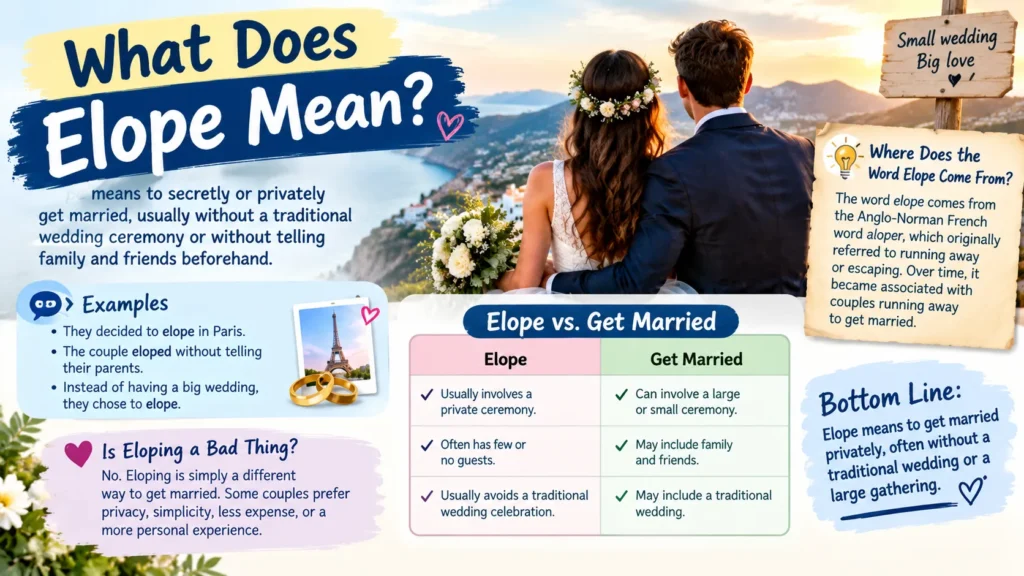
The main difference between eloping and a traditional wedding is the style and scale of the celebration.
A traditional wedding often includes a larger guest list, formal invitations, a reception, and established customs. An elopement usually focuses on a smaller, more private ceremony.
Neither option is inherently better. The right choice depends on the couple’s preferences, circumstances, budget, and cultural traditions.
| Feature | Elopement | Traditional Wedding |
| Guest list | Usually small or sometimes limited to witnesses | Often includes many family members and friends |
| Ceremony | Usually intimate and simple | May be formal and elaborate |
| Planning | Often involves fewer arrangements | May require extensive coordination |
| Cost | Can be less expensive, depending on the plans | Can involve substantial expenses |
| Location | May be a courthouse, outdoor setting, or destination | Often takes place at a venue, religious site, or other chosen location |
| Family involvement | May be limited or extensive | Often includes family participation |
| Reception | Optional | Common, but not essential |
| Personal style | Often highly flexible | May follow established family or cultural traditions |
An elopement can still include professional photography, special clothing, flowers, travel, and a celebratory meal. It does not have to be completely spontaneous or inexpensive.
Likewise, a traditional wedding does not have to be extravagant.
The difference lies primarily in how the couple chooses to organize and experience the occasion.
7. What Is the Difference Between Eloping and a Courthouse Wedding?
Eloping and having a courthouse wedding are related concepts, but they are not the same.
Eloping describes an approach to getting married, while a courthouse wedding describes a ceremony held at a courthouse or another relevant civil marriage venue.
A couple can elope at a courthouse, but a courthouse wedding can also include a planned guest list and a celebration afterward.
Consider these examples:
Example 1: Eloping at a courthouse
Two people arrange a civil marriage ceremony with the required documentation and a small number of witnesses. They keep the event private and celebrate together afterward.
They might describe their decision as eloping.
Example 2: A planned courthouse wedding
A couple invites their parents, siblings, and close friends to attend a civil ceremony. They take photographs and organize a family dinner afterward.
They might simply call it a courthouse wedding.
Example 3: A destination elopement
A couple travels to a scenic location and arranges a small ceremony with a celebrant and photographer.
They might describe the experience as an elopement, even though it does not take place at a courthouse.
Legal requirements vary by location. Couples should confirm the applicable marriage license, registration, officiant, and witness requirements before making arrangements.
8. Why Do Couples Choose to Elope?
Couples choose to elope for Different Personal, practical, and financial reasons. Some want a quiet ceremony, while others prefer to avoid the pressure associated with organizing a large wedding.
Here are some common motivations.
Privacy: Some couples want to exchange vows without a large audience.
Simplicity: A smaller wedding can involve fewer arrangements, although travel and special venues can still require substantial planning.
Budget flexibility: Couples may choose to spend less on a large reception and allocate their money toward other priorities.
Personal freedom: Some people prefer to design a ceremony around their own interests rather than follow every traditional expectation.
Travel and adventure: A destination elopement can combine a wedding with a meaningful trip.
Reduced planning pressure: A smaller event may involve fewer guests, suppliers, and scheduling decisions.
Family circumstances: Some couples face geographical, personal, or family challenges that make a large gathering difficult.
For example, two people who love hiking might exchange vows on a scenic trail instead of organizing a ballroom wedding.
Another couple might prefer a short civil ceremony followed by a quiet meal.
The decision does not necessarily reflect how much the couple values marriage. It reflects how they want to celebrate it.
9. Is Eloping the Same as Getting Married in Secret?
Not always.
Traditionally, eloping often meant leaving secretly to marry without informing one’s family or obtaining their approval. This historical meaning remains common in stories and conversations about relationships.
Modern usage is broader. Couples may announce their plans beforehand, invite a few loved ones, and still describe their small wedding as an elopement.
Compare these situations:
- Secret elopement: A couple marries without telling their families beforehand.
- Private elopement: A couple chooses a small ceremony and limits attendance.
- Announced elopement: A couple tells their loved ones about their plans before the wedding.
- Destination elopement: A couple travels to another location for an intimate ceremony.
These descriptions can overlap. For example, a couple might plan a destination elopement and tell their families only after the wedding.
The word itself does not establish whether the couple obtained family approval, followed legal requirements, or intended to keep their marriage secret permanently.
The surrounding context helps you understand what the speaker means.
10. What Does Elope Mean in Modern Wedding Culture?
In modern Wedding Culture, elope often describes a small, personalized wedding that prioritizes the couple’s experience over a large celebration.
Historically, the word was associated with running away secretly to marry. Contemporary wedding discussions sometimes use it for carefully planned intimate ceremonies, including events attended by a few guests.
Modern elopements may involve:
- A civil ceremony followed by dinner.
- An outdoor wedding in a scenic location.
- A small gathering with close family members.
- A destination wedding focused on the couple.
- A private exchange of vows followed by professional photographs.
- A simple ceremony with a small celebration afterward.
Social media and wedding photography have also helped make intimate ceremonies more visible. Couples can share photographs and stories of their experiences without organizing a large event.
However, the term is not used identically by everyone. Some people reserve elopement for a private marriage with few or no guests, while others use it more broadly for small destination weddings.
If you are writing about a particular couple, it is best to follow the meaning they use to describe their own ceremony.
11. How Do You Use Elope in a Sentence?
The word elope is easy t.o use once you understand that it describes the action of leaving secretly to marry or choosing an intimate wedding in modern usage.
Here are 15 example sentences showing different contexts.
- They decided to elope instead of organizing a large wedding.
- My grandparents eloped when they were young.
- The couple plans to elope near the ocean.
- She wanted to elope with the person she loved.
- They eloped without telling their families beforehand.
- We are thinking about eloping next spring.
- Her friends were surprised to learn that she had eloped.
- The couple chose to elope in the mountains.
- They decided to elope and celebrate with family later.
- He asked whether they could elope instead of having a big ceremony.
- The novel tells the story of two lovers who elope.
- They wanted to elope somewhere meaningful to their relationship.
- My cousin plans to elope with a small group of witnesses.
- The couple eloped privately and announced their marriage afterward.
- They decided that eloping suited their personalities better than a traditional wedding.
Notice how the verb changes according to the sentence:
- Present: They elope.
- Past: They eloped.
- Continuous: They are eloping.
- Infinitive: They want to elope.
These patterns are useful for school assignments, English learning, and everyday writing.
12. What Is the Origin and Historical Meaning of Elope?
The word elope has a long history connected with leaving or running away. Over time, its meaning became strongly associated with romantic partners who left secretly to marry.
Historical dictionaries describe eloping in terms of secretly leaving to get married, often without parental consent. In older stories, the word commonly appears when families oppose a relationship or when lovers choose marriage without following expected social customs.
For example, a novel might describe two young people who elope because their families refuse to approve their relationship.
This traditional use often carries a sense of secrecy, rebellion, or conflict.
Modern wedding culture has broadened the term. Couples may now use elope for a small wedding even when no one is running away, and their families know about the event.
The original association with secret marriage has not disappeared, but it is no longer the only meaning people use.
This shift illustrates how language changes with social practices. A word can retain its historical definition while developing a broader meaning in contemporary conversation.
Related To Another Article: https://genzwishes.com/what-does-gts-mean-in-text/
13. Does Eloping Mean You Are Rejecting Your Family?
No. Eloping does not automatically mean a couple is rejecting their family or refusing to maintain family relationships.
Some couples choose a private wedding because they want a quiet experience. Others have practical reasons, such as distance, financial limitations, or difficulties coordinating a large gathering.
However, eloping can create tension if relatives expect to participate in the wedding or feel hurt because they were not informed.
For example, parents might feel disappointed when they learn that their child married without telling them. The couple, meanwhile, might have wanted a private ceremony rather than a large family event.
Both reactions can be understandable.
If family relationships are important to the couple, they might consider explaining their decision beforehand, sharing photographs afterward, or organizing a small celebration at another time.
There is no single approach that works for every family.
The important point is that choosing a small wedding does not automatically indicate a lack of love or respect. The reasons behind the decision and the way the couple communicates can make a significant difference.
14. Is Eloping Legally the Same as Getting Married?
Eloping is not a separate legal category of marriage in every Jurisdiction. The word describes how a couple approaches their wedding, while legal marriage depends on the rules that apply where they marry.
A couple might elope and complete a legally recognized marriage. Another couple might hold a private ceremony that does not satisfy the local requirements for a valid marriage.
Depending on the location, couples may need to consider:
- Eligibility to marry.
- Identification documents.
- A marriage license or other required authorization.
- An authorized officiant or civil registrar.
- Witness requirements.
- Registration or documentation after the ceremony.
- Recognition of a marriage performed in another country.
Requirements differ across countries and regions, so couples should check the relevant official government guidance before making arrangements.
For example, choosing a beautiful destination and exchanging vows does not automatically guarantee that the ceremony creates a legally recognized marriage.
Similarly, a couple does not necessarily need a large wedding to marry legally.
The key distinction is simple: eloping describes the wedding approach; legal validity depends on the applicable marriage laws and procedures.
People Also Ask
A: Elope traditionally means to run away secretly with a romantic partner to get married. Today, it can also mean choosing a small, private wedding instead of a large traditional celebration.
A: Eloping describes the way a couple approaches their wedding. A couple can elope and get legally married, but the marriage must meet the applicable legal requirements to be recognized.
A: Couples may elope because they prefer privacy, want a simpler ceremony, wish to avoid the pressure of a large wedding, or want to celebrate their relationship in a personal way.
A: Traditionally, eloping often meant marrying secretly without informing or obtaining permission from family members. Today, couples may use the term for a small wedding even when their families know about it.
A: Eloping usually involves a small, intimate ceremony, while a traditional wedding often includes more guests and a larger celebration. Neither approach is inherently better; the right choice depends on the couple’s preferences and circumstances.
Conclusion
The word Elope Traditionally means to run away secretly with a romantic partner to get married. In modern wedding culture, it also commonly describes choosing a small, intimate ceremony instead of a large traditional celebration.
An elopement might involve a quiet courthouse ceremony, an outdoor exchange of vows, or a destination wedding with only a few guests. The couple may keep the event secret, share their plans beforehand, or announce their marriage afterward.
The meaning depends on the context, but the central idea is that the couple chooses a more private or intimate way to marry.
If you encounter the word in a book, conversation, or social media post, consider whether the speaker is discussing a traditional secret marriage or a modern small wedding.
And if you are considering eloping yourself, remember that you can choose a wedding style that reflects your preferences while checking the legal requirements that apply to your circumstances.
Explore more word meanings, relationship terminology, and everyday expressions on GenzWishes to keep building your vocabulary.