Introduction
Have you ever received a message saying “10-4” and Wondered what those numbers actually mean? Perhaps you have heard someone use it in a movie, during a radio conversation, or in a text message. Although it looks like a simple combination of numbers, this expression has an interesting history.
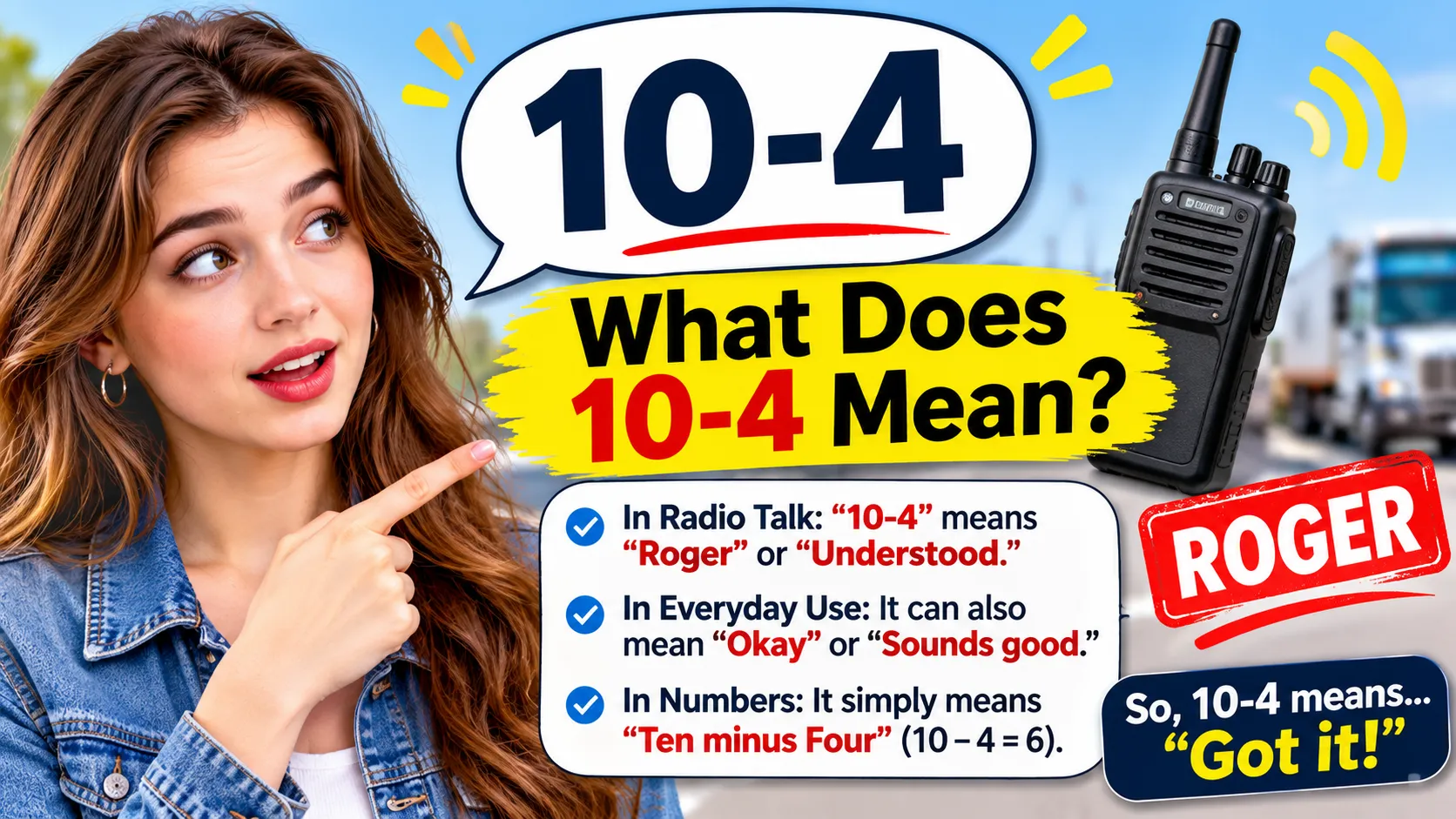
So, what does 10-4 mean? 10-4 (pronounced ten-four) means “message received,” “understood,” or “acknowledged.” It originated as a radio communication code used by police officers and radio operators. Today, people also use it in everyday conversations, text messages, and online chats as a casual way to say “got it” or “okay.”
But there is an important detail: 10-4 does not always mean that someone agrees with you. It primarily confirms that they have received and understood your message.
Let’s explore its meaning, origin, texting examples, radio history, and the best ways to use this familiar expression.
1. What Does 10-4 Mean?
10-4 means “message received and understood.” It is a traditional radio communication code used to acknowledge information from another person. In everyday English, it can also mean “okay,” “got it,” or “understood.”
People pronounce it as ten-four, rather than reading each number separately.
The expression belongs to a communication system called ten-codes, which helped radio operators exchange information quickly and efficiently.
For example:
Person A: Please call me when you reach home.
Person B: 10-4!
In this conversation, the second person confirms that they received and understood the request.
Here are the most common meanings:
- Message received: I have received your information.
- Understood: I understand what you are saying.
- Acknowledged: Your message has been recognized.
- Got it: I know what I need to do.
- Okay: I understand and accept the information in this context.
The central meaning is acknowledgment. Whether it also communicates agreement depends on the conversation.
2. How Do You Pronounce 10-4?
10-4 is pronounced “ten-four.” It has two simple parts: the number ten followed by the number four.
You might hear it spoken in different ways depending on the speaker’s accent, but the standard English pronunciation remains ten-four.
For example:
- Written form: 10-4
- Spoken form: Ten-four
- Informal variation: Ten-four, good buddy
- Common conversational variation: Big ten-four
You may also see it written as “ten-four” in books, online articles, and informal messages.
Both 10-4 and ten-four refer to the same expression.
3. What Does 10-4 Mean in Text Messages?
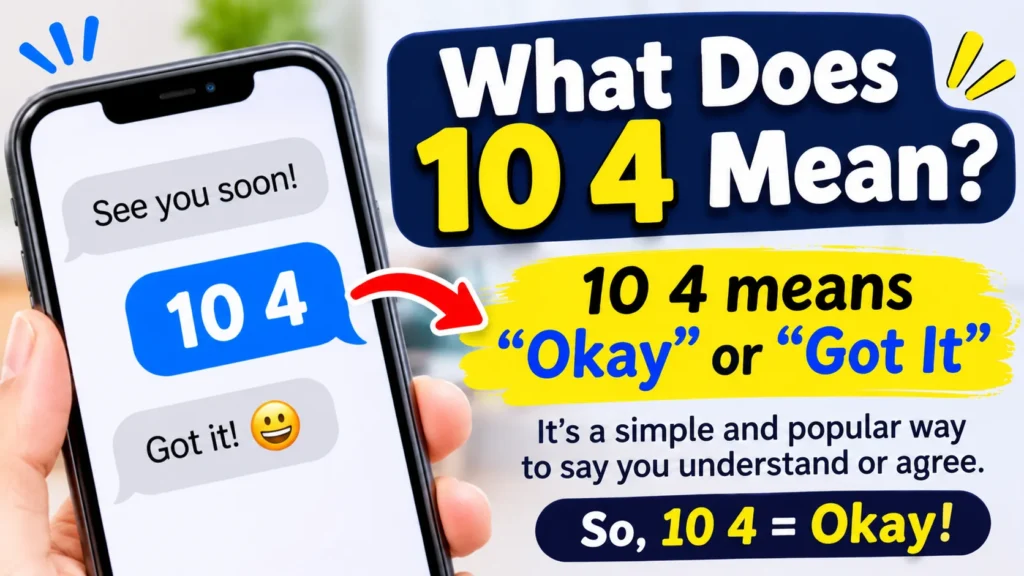
In text messages, 10-4 is a short, casual way of telling someone that you understand their message. It works similarly to expressions such as “got it,” “okay,” and “copy that.”
People sometimes use it because it sounds more interesting than an ordinary reply. It can also add a playful touch to a conversation.
For example:
Friend: Don’t forget to bring your notebook tomorrow.
You: 10-4!
Here, you are confirming that you received the reminder and understand what your friend wants.
Another example:
Friend: I’ll send you the pictures tonight.
You: 10-4, sounds good.
The expression works particularly well when someone gives you instructions, shares information, or makes a simple request.
Unlike abbreviations such as LOL or BRB, 10-4 is not a texting acronym. It is a traditional radio code that has become part of informal digital communication.
4. What Does 10-4 Mean in Slang?
As slang, 10-4 is an informal expression meaning “I understand,” “all right,” or “message received.”
Its meaning originally came from radio communication, but it gradually became recognizable in everyday American English.
People now use it without necessarily knowing its connection to police radio or trucker culture.
For example:
Person A: We’re meeting outside the restaurant at 7 PM.
Person B: That’s a 10-4!
This response means the person understands the arrangement.
Another popular variation is “big 10-4,” which can make acknowledgment sound more enthusiastic or humorous.
Friend: Are you ready for the road trip?
You: That’s a big 10-4!
The expression is particularly recognizable in American pop culture, where it is associated with truck drivers, classic movies, and old-fashioned radio conversations.
5. Where Did 10-4 Come From?
The expression 10-4 originated from the ten-code system developed for American police radio communication during the 1930s.
At that time, police departments were adopting two-way radios, but communication technology had limitations. Radio channels were limited, and officers needed efficient ways to exchange information.
Charles “Charlie” Hopper, a communications director for the Illinois State Police, is widely credited with developing an early ten-code system in 1937.
The Association of Public-Safety Communications Officials International (APCO) later helped establish and standardize ten-code signals.
Within this system, 10-4 became a short acknowledgment meaning that a message had been received.
The expression eventually spread beyond police departments as truck drivers and CB radio enthusiasts adopted similar communication shorthand.
Over time, it became a familiar expression in American English.
6. Why Did Police Officers Use 10-4?
Police officers traditionally used 10-4 to acknowledge information received through radio communication.
The purpose was simple: instead of using a longer sentence such as “I have received your message and understand,” an officer could respond with a short code.
This helped keep radio transmissions brief and efficient.
For example:
Dispatcher: Unit 12, proceed to the reported location.
Officer: 10-4.
The officer is confirming that the instruction has been received.
Ten-codes also included other commonly recognized expressions.
| Radio code | Common traditional meaning |
| 10-1 | Receiving poorly |
| 10-2 | Receiving well |
| 10-3 | Stop transmitting |
| 10-4 | Message received |
| 10-5 | Relay a message |
| 10-6 | Busy |
| 10-7 | Out of service |
| 10-8 | In service |
| 10-9 | Repeat the message |
| 10-20 | Location |
Important: These are commonly recognized historical meanings, not universal definitions. Different police departments and jurisdictions have used different ten-code systems.
That is one reason plain-language communication has become important in public-safety operations.
7. What Does 10-4 Mean for Truckers?
For truck drivers, 10-4 is a traditional CB radio expression meaning “Message Received” or “understood.”
CB stands for Citizens Band, a radio service that allows people to communicate over designated channels.
Truck drivers historically used CB radios to share road conditions, discuss traffic, warn other drivers about hazards, and communicate during long journeys.
For example:
Driver A: There’s heavy traffic ahead. Slow down near the next exit.
Driver B: 10-4, thanks for the warning.
The second driver is acknowledging the information.
Truckers also use other traditional expressions:
| Expression | Meaning |
| 10-4 | Message received |
| 10-20 | Location |
| 10-9 | Repeat your message |
| Breaker breaker | Request to start a radio transmission |
| Good buddy | Friendly way to address another radio user |
| Copy that | Information received or understood |
The phrase “10-4, good buddy” became especially recognizable through American trucking culture.
8. How Did 10-4 Become Popular?
Although started as a radio communication code, it eventually became familiar to people who had never operated a radio.
Several cultural influences helped popularize it.
Police television shows
American television introduced radio expressions to a much wider audience. Police dramas helped viewers become familiar with the language used by officers and dispatchers.
Truck driver culture
Truck drivers adopted ten-codes for communication through CB radios. These expressions became a recognizable part of American trucking culture.
The song Convoy
C. W. McCall’s 1975 hit song “Convoy” helped popularize CB radio language. The song featured trucker conversations and expressions, introducing this vocabulary to a much wider audience.
Movies and entertainment
The 1978 movie Convoy and other trucking-related entertainment helped establish the expression in popular culture.
Eventually, people began using outside radio conversations. It became a familiar way to acknowledge information in everyday situations.
9. How Is 10-4 Used in Everyday Conversations?
Today, people can use in several everyday situations. It is especially useful when someone shares information or asks you to complete a simple task.
Here are some common examples.
When acknowledging instructions
Person A: Please email me the document before lunch.
Person B: 10-4!
When confirming plans
Person A: Let’s meet at the shopping mall tomorrow.
Person B: 10-4, see you there.
When responding to a reminder
Person A: Remember to charge your phone before leaving.
Person B: 10-4, I will.
When confirming information
Person A: The appointment has been moved to Friday.
Person B: 10-4, thanks for letting me know.
When joking with friends
Person A: You better bring snacks this time!
Person B: That’s a big!
In each situation, the expression communicates acknowledgment. Its casual tone makes it suitable for friendly conversations rather than highly formal business communication.
10. Examples of 10-4 in Text Messages
Understanding An Expression becomes easier when you see how people use it in actual conversations.
Below are original examples covering friendship, school, work, travel, and everyday communication.
Example 1: Making plans
A: Are you coming to my birthday party?
B: 10-4! I’ll be there.
Meaning: I understand and confirm that I am coming.
Example 2: Following instructions
A: Please bring your laptop tomorrow.
B: 10-4.
Meaning: Got it. I’ll bring my laptop.
Example 3: Confirming a reminder
A: Don’t forget to submit your assignment.
B: 10-4, thanks for reminding me.
Meaning: I understand the reminder.
Example 4: Talking about travel
A: Let me know when you arrive at the airport.
B: 10-4, I’ll message you.
Meaning: I understand what you want me to do.
Example 5: Casual friendship
A: We’re ordering pizza tonight.
B: That’s a big 10-4!
Meaning: Sounds good!
Example 6: Responding to work instructions
A: Send me the updated report by 3 PM.
B: 10-4. I’ll send it before then.
Meaning: I acknowledge the instruction.
Example 7: Confirming a meeting
A: The meeting starts at 9 tomorrow morning.
B: 10-4!
Meaning: Understood.
Example 8: Sharing important information
A: Your package should arrive tomorrow.
B: 10-4, appreciate the update.
Meaning: I received your information.
Example 9: School conversation
A: Our science project is due on Monday.
B: 10-4, I’ll finish my part this weekend.
Meaning: I understand the deadline.
Example 10: Family conversation
A: Please pick up some milk on your way home.
B: 10-4, anything else?
Meaning: I understand the request.
11. Is 10-4 the Same as Roger, Copy That, or Okay?
10-4, Roger, Copy That, and Okay have similar meanings in Everyday Conversation, but they are not always identical in traditional communication.
All four expressions can acknowledge information, although their original uses have some differences.
| Expression | Meaning | Common context |
| 10-4 | Message received and acknowledged | Radio slang and casual conversations |
| Roger | Message received | Radio communication |
| Copy That | Information received or understood | Radio and everyday conversations |
| Okay | Agreement or acknowledgment | Everyday communication |
| Wilco | Received and will comply | Radio communication |
10-4 vs. Roger
Roger traditionally confirms that a message has been received. It does not automatically mean that the receiver agrees or will follow an instruction.
10-4 vs. Copy That
Both can communicate acknowledgment. Copy That is also commonly used in modern informal conversations.
10-4 vs. Okay
Okay is more flexible. It can communicate acknowledgment, agreement, or acceptance depending on the situation.
10-4 vs. Wilco
Wilco comes from “will comply.” It indicates that the person has received the instruction and intends to follow it.
The most important difference is that 10-4 primarily communicates acknowledgment, while some of these other expressions can communicate additional meanings.
12. How Do You Respond When Someone Says 10-4?
If someone sends you 10-4, you usually do not need to give a complicated response. They are simply acknowledging your message.
You can respond naturally depending on the situation.
Here are some suitable replies:
- “Great!”
- “Thanks!”
- “Sounds good.”
- “Perfect!”
- “Appreciate it.”
- “See you then.”
- “Got it.”
- “Awesome!”
- “Cool, thanks.”
- “Talk to you later.”
Example 1
You: Please call me after the meeting.
Friend: 10-4.
You: Thanks!
Example 2
You: Let’s meet outside at 5 PM.
Friend: 10-4!
You: See you there.
Example 3
You: Don’t forget to bring the tickets.
Friend: 10-4.
You: Perfect!
You can also leave the conversation there. Since 10-4 already acknowledges your message, another response is not always necessary.
Related To Another Article: https://genzwishes.com/what-does-wyf-mean/
13. When Should You Use 10-4?
You can use 10-4 whenever you want to acknowledge information quickly and casually.
It works particularly well in friendly conversations and situations where someone expects confirmation.
Here are some appropriate situations:
1. When someone gives you instructions
If your friend asks you to complete a simple task, you can reply with 10-4 to show that you understand.
2. When someone shares important information
Use it to acknowledge a reminder, update, or announcement.
3. When confirming plans
If someone tells you the time or location of a meeting, 10-4 can communicate that you understand.
4. When chatting with friends
It can make ordinary conversations more entertaining, especially when you enjoy classic radio expressions.
5. When using radio communication
It is a recognizable traditional acknowledgment code, although actual radio users should follow their organization’s communication procedures.
6. When responding humorously
A playful “big 10-4” can add personality to a casual conversation.
However, avoid using it when clear and formal language is necessary. In professional communication, simply saying “Understood” or “Received” may be more appropriate.
14. Is 10-4 Still Used Today?
Yes, 10-4 is still recognized and used today, although its popularity and context have changed over time.
In the past, it was strongly associated with police radio operators and truck drivers. Today, many people use it as a casual expression in text messages, online conversations, and everyday speech.
You might encounter it in:
- Text messages between friends.
- Social media conversations.
- Movies and television shows.
- Trucking and CB radio discussions.
- Walkie-talkie conversations.
- Online communities.
- Informal workplace conversations.
Some public-safety organizations have moved toward plain-language communication because ten-code meanings can differ between jurisdictions.
However, 10-4 remains widely recognizable because its basic meaning is easy to understand.
It has become more than just a radio code. It is now a familiar expression for acknowledging information.
15. Common Misunderstandings About 10-4
Although 10-4 has a relatively Simple Mmeaning, people sometimes misunderstand how to use it.
Here are five common misconceptions.
Misunderstanding 1: 10-4 means only yes.
Not exactly. Its central meaning is acknowledgment. It can sound like yes in casual conversations, but it does not necessarily communicate agreement.
Misunderstanding 2: 10-4 is a texting acronym.
It is not an acronym. It comes from a numerical radio code system.
Misunderstanding 3: Only truck drivers use 10-4.
Truck drivers helped popularize it, but the expression is also recognized in everyday conversations and popular culture.
Misunderstanding 4: Every police department uses identical ten-codes.
Ten-code meanings can differ between departments and jurisdictions. This is why plain-language communication is important when agencies work together.
Misunderstanding 5: 10-4 and Roger always mean exactly the same thing.
They are similar because both can acknowledge a received message. However, they have different historical and operational uses.
Once you understand these differences, it becomes much easier to recognize and use 10-4 correctly.
People Also Ask
A: When someone texts you 10-4, they usually mean “understood,” “got it,” or “message received.” It is a casual way to acknowledge your message or confirm that they understand your instructions.
A: Yes. In everyday conversations, 10-4 can be used as another way of saying okay. However, its original meaning is closer to acknowledging that a message has been received and understood.
A: Police officers traditionally use 10-4 as a radio code to acknowledge information received from another officer or dispatcher. It comes from the ten-code system developed for public-safety radio communication.
A: You can respond with “Great,” “Thanks,” “Sounds good,” or “Perfect.” You can also end the conversation without replying because 10-4 already confirms that the person understands your message.
A: They have similar meanings because all three can acknowledge a message. However, Roger traditionally means a message has been received, while Copy That indicates that information has been received or understood. 10-4 is a traditional ten-code meaning acknowledgment.
Conclusion
So, what does 10-4 mean? It is a Popular Expression that means “message received,” “understood,” or “acknowledged.”
Originally developed as part of American police radio communication, it became widely recognized through trucker culture, television, music, and everyday conversations.
Today, you can use 10-4 in text messages or casual discussions whenever you want to acknowledge information quickly. Whether a friend reminds you about an appointment or someone confirms a meeting time, responding with 10-4 is a simple way to say that you understand.
The next time someone sends you this expression, you will know exactly what they mean. And if you want to sound a little more playful, you can always reply with a classic “That’s a big 10-4!”











1 thought on “What Does 10 4 Mean? Meaning in Text, Slang & Radio”