Introduction
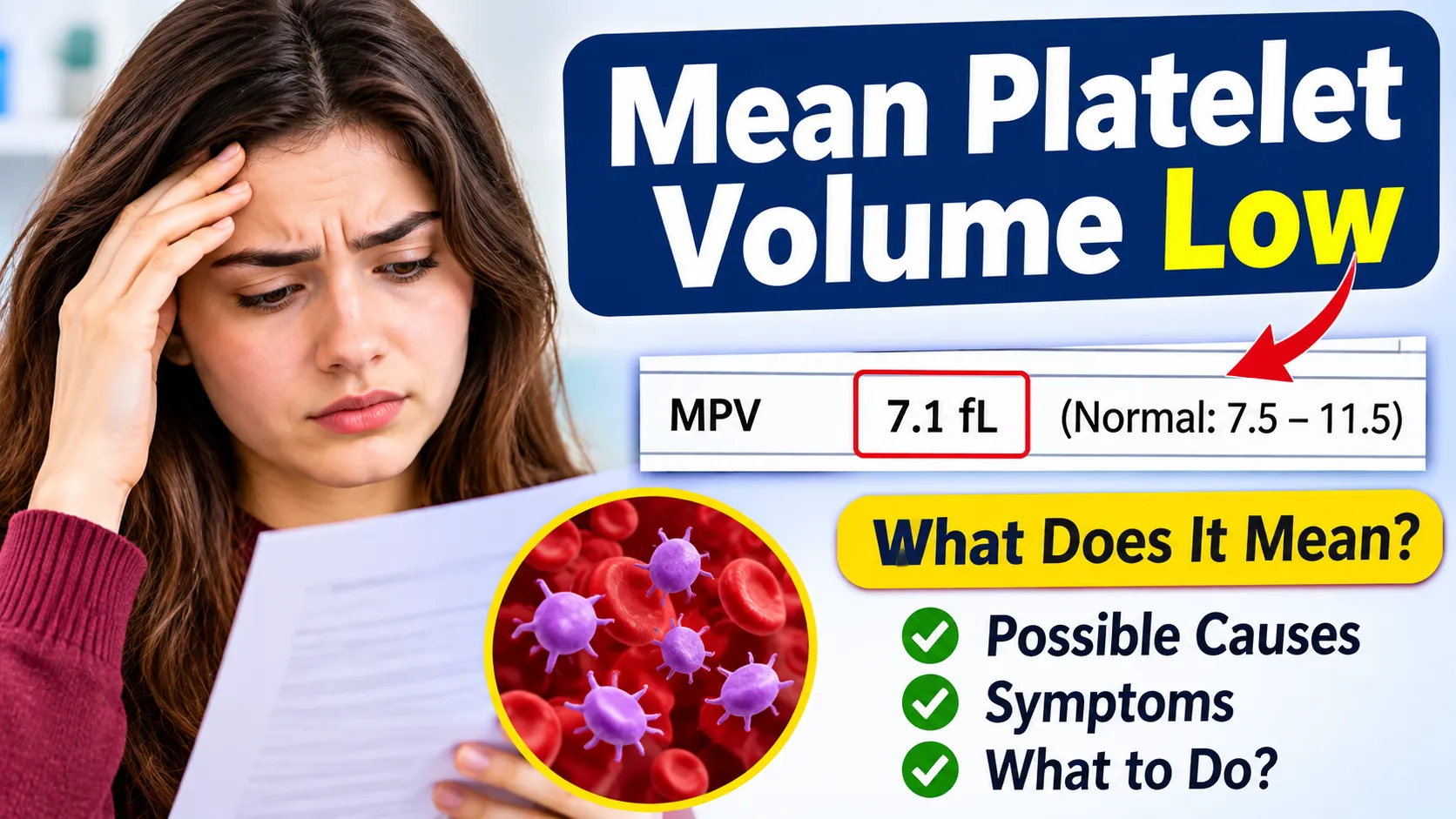
Seeing Mean Platelet Volume Low on your Blood Test Report can be confusing, especially when you do not know what MPV measures or why your result is below the normal range. You might wonder whether your platelets are too small, whether your bone marrow is working properly, or whether you have an underlying health condition.
The good news is that a low MPV result does not automatically mean you have a serious medical problem.
Mean platelet volume (MPV) measures the average size of platelets in your blood. Doctors interpret this measurement alongside your platelet count and other complete blood count (CBC) results to understand your overall blood health.
In this guide, you will discover what low MPV means, its possible causes, symptoms associated with underlying conditions, normal reference ranges, potential risks, and available treatment options. You will also learn what questions to ask your doctor after receiving an abnormal result.
1. What Does Low Mean Platelet Volume Mean?
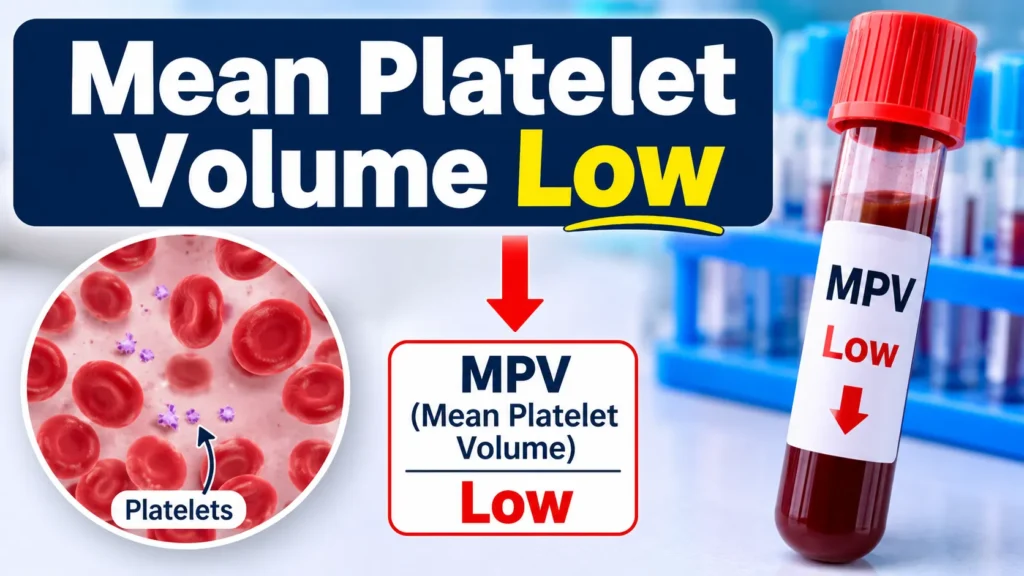
Low mean platelet volume means your platelets are smaller on average than the reference range used by your laboratory.
Platelets are tiny blood components that help your body form clots and control bleeding. Your bone marrow produces these important components.
A lower-than-normal MPV may sometimes suggest reduced platelet production. However, doctors cannot determine the exact cause by looking at this measurement alone.
For example, someone with a slightly low MPV and a normal platelet count may have a different clinical situation from someone whose MPV and platelet count are both low.
Here are the most important things to understand:
- Low MPV refers to smaller average platelet size.
- It does not automatically mean your platelet count is low.
- It cannot diagnose a specific disease by itself.
- Your laboratory’s reference range matters.
- Other CBC measurements help determine its clinical significance.
Therefore, an isolated low MPV result should not be treated as a medical diagnosis.
2. What Is Mean Platelet Volume (MPV)?
Mean platelet volume (MPV) is a measurement included in many complete blood count tests. It calculates the average size of platelets circulating in your bloodstream.
Platelets, also called thrombocytes, are small blood components produced in your bone marrow. Their main responsibility is helping your blood clot when a blood vessel becomes damaged.
For example, when you accidentally cut your finger, platelets gather around the injured area and help form a clot. This process reduces bleeding and supports healing.
MPV provides information about average platelet size. It is different from a platelet count, which measures how many platelets are present in a specific volume of blood.
Understanding the difference between common platelet measurements:
| Blood measurement | What it measures |
| MPV | Average platelet size |
| Platelet count (PLT) | Number of platelets in your blood |
| PDW | Variation in platelet size |
| Plateletcrit (PCT) | Proportion of blood volume occupied by platelets |
Doctors may review these measurements together to investigate abnormalities involving platelet production and other blood-related conditions.
3. What Is the Normal MPV Range?
The normal mean platelet volume range depends on the laboratory, testing equipment, and measurement method.
Cleveland Clinic describes a general adult reference range of approximately 7–9 femtoliters (fL). However, other laboratories may use different intervals.
This is why there is no single universal MPV range that applies to every person.
How to understand your MPV result:
| MPV result | General interpretation |
| Below your laboratory’s lower limit | Low MPV |
| Within your laboratory’s reference interval | Normal MPV |
| Above your laboratory’s upper limit | High MPV |
Always compare your result with the reference range printed on your own blood test report.
For example, imagine your laboratory reports an MPV of 6.8 fL and lists its lower reference limit as 7.0 fL. The laboratory may flag your result as low.
However, another laboratory using a different reference interval might interpret the same number differently.
A result slightly below the laboratory’s lower limit does not automatically indicate a medical problem. Your doctor may consider previous results, platelet count, symptoms, and other CBC measurements before recommending further investigation.
4. What Causes Low Mean Platelet Volume?
Several medical conditions and other factors may be associated with low mean platelet volume.
One possible explanation is reduced platelet production in the bone marrow. However, not every person with low MPV has an underlying disease.
Here are some possible causes and medical associations.
1. Reduced Bone Marrow Activity
Your bone marrow produces platelets along with red and white blood cells.
If its normal activity becomes impaired, platelet production may decrease. This can sometimes contribute to a lower average platelet size.
Doctors may investigate bone marrow function when low MPV occurs alongside a low platelet count or abnormalities in other blood cells.
2. Aplastic Anemia
Aplastic anemia is an uncommon condition in which the bone marrow does not produce enough blood cells.
It can affect red blood cells, white blood cells, and platelets.
People with this condition may experience fatigue, frequent infections, bruising, or bleeding.
Low MPV may occur in certain cases, particularly when platelet production is affected. However, MPV alone cannot diagnose aplastic anemia.
3. Autoimmune Conditions
Certain autoimmune conditions can affect blood cell production or platelet regulation.
For example, systemic lupus erythematosus (SLE) may involve changes in blood cell counts and other blood abnormalities.
A low MPV does not establish that someone has lupus. Doctors consider symptoms, medical history, examination findings, and appropriate laboratory investigations.
4. Certain Medications
Some medications can affect how your bone marrow produces blood cells.
Chemotherapy drugs are an important example because they may suppress bone marrow activity and reduce platelet production.
Other medicines may also influence platelet counts or blood cell production.
Never stop a prescribed medication because of an abnormal MPV result without discussing it with your healthcare provider.
5. Bone Marrow Disorders
Some conditions affect the normal development and production of blood cells in the bone marrow.
These may include marrow hypoplasia and certain cancers affecting blood-forming tissues.
A low MPV may be one finding among several abnormalities, but it is not sufficient to identify a specific bone marrow disorder.
6. Genetic Conditions
Certain inherited conditions can affect platelet development and function.
Wiskott-Aldrich syndrome is an uncommon genetic disorder associated with small platelets and low platelet counts.
It usually involves additional clinical features and cannot be diagnosed from an isolated low MPV result.
7. Certain Infections
Some bacterial and viral infections can affect blood cell production and platelet counts.
The effects vary depending on the infection, its severity, and the individual’s health.
If an infection affects platelet production, changes in MPV may occur alongside other blood count abnormalities.
Important: These are possible medical associations, not a list of diseases that everyone with low MPV should worry about.
5. What Are the Symptoms Associated With Low MPV?
Low MPV itself does not necessarily cause symptoms. Many people discover An Abnormal MPV while undergoing routine blood testing and may feel completely normal.
When symptoms occur, they are generally related to an underlying condition or an abnormal platelet count rather than platelet size alone.
Possible symptoms associated with platelet-related disorders include:
- Easy bruising without an obvious injury.
- Frequent nosebleeds.
- Bleeding gums.
- Small red or purple spots on the skin (petechiae).
- Bleeding that takes longer than usual to stop.
- Unusually heavy menstrual bleeding.
- Weakness or fatigue.
- Frequent infections when other blood cell counts are affected.
Not everyone with these symptoms has a platelet disorder. Other medical conditions can cause similar problems.
If you experience unexplained bleeding, unusual bruising, or persistent symptoms, arrange a medical evaluation.
6. Is Low MPV Dangerous?
Low mean platelet volume is not automatically dangerous. Its importance depends on why the result is low and whether other blood measurements are abnormal.
For example, a slightly low MPV with a normal platelet count and otherwise unremarkable CBC may have limited clinical significance.
However, low MPV accompanied by a low platelet count may suggest reduced platelet production and deserves appropriate medical assessment.
Doctors may investigate further when they find:
- Persistent abnormalities in MPV.
- A low platelet count.
- Abnormal red or white blood cell counts.
- Unexplained bleeding or bruising.
- Other concerning symptoms.
- A history of bone marrow disease or treatment that affects blood production.
The main concern is not the MPV number alone. It is whether the complete blood count reveals an underlying problem that needs attention.
7. Low MPV With Normal Platelet Count
A low MPV with a normal platelet count means your average platelet size is below the laboratory’s reference range, but the total number of platelets remains within its normal interval.
This combination can occur, and it does not automatically indicate a serious health condition.
For example, imagine a blood test showing:
| Measurement | Hypothetical result |
| MPV | 6.8 fL |
| Platelet count | 250,000/µL |
In this hypothetical example, the MPV may be flagged as low depending on the laboratory’s reference interval, while the platelet count is within a commonly used adult reference range.
Your doctor may consider:
- Whether the MPV is only slightly below the reference interval.
- Whether previous blood tests showed similar results.
- Whether other CBC measurements are normal.
- Whether sample handling or the laboratory method affected the measurement.
- Whether you have symptoms or relevant medical conditions.
An isolated low MPV with a normal platelet count generally provides limited information about your health.
The most useful approach is to review the entire blood test rather than focusing on one flagged measurement.
8. Low MPV With Low Platelet Count
When both MPV and platelet count are low, doctors may investigate whether the bone marrow is producing an insufficient number of platelets.
A low platelet count is called thrombocytopenia.
Because platelets help control bleeding, significant thrombocytopenia may increase the risk of excessive bleeding.
Possible underlying causes include:
- Aplastic anemia.
- Bone marrow suppression.
- Certain medications, including chemotherapy.
- Some bone marrow disorders.
- Conditions affecting normal blood cell production.
- Certain infections and other medical conditions.
Doctors may review the complete blood count, medical history, medication use, and a peripheral blood smear.
A peripheral blood smear allows laboratory professionals to examine blood cells under a microscope.
The combination of low MPV and low platelets can provide a useful diagnostic clue, but it does not confirm a specific disease.
The actual platelet count, the degree of abnormality, symptoms, and other test findings help determine the next steps.
9. Low MPV and Anemia: Is There a Connection?
Low mean platelet volume and anemia are different laboratory findings.
Anemia occurs when your blood does not have enough healthy red blood cells or hemoglobin to carry adequate oxygen throughout your body.
MPV, on the other hand, measures the average size of platelets.
Some conditions affecting the bone marrow can influence both red blood cell and platelet production. For example, aplastic anemia can affect multiple types of blood cells.
However, having low MPV does not automatically mean you have anemia.
Doctors may review the following CBC measurements:
| Measurement | Purpose |
| Hemoglobin (Hb) | Measures the oxygen-carrying protein in red blood cells |
| Hematocrit (HCT) | Measures the proportion of blood made up of red blood cells |
| Red blood cell count (RBC) | Measures the number of red blood cells |
| Mean corpuscular volume (MCV) | Measures average red blood cell size |
| Platelet count (PLT) | Measures the number of platelets |
| Mean platelet volume (MPV) | Measures average platelet size |
These results help doctors determine whether abnormalities affect one blood cell type or several.
If your MPV and hemoglobin are both abnormal, your doctor may recommend additional testing depending on the pattern of results.
10. How Is Low MPV Diagnosed?
Low MPV is Usually Identified through a complete blood count (CBC).
A CBC is a common blood test that measures different components of your blood, including red blood cells, white blood cells, and platelets.
The MPV measurement is generally calculated by an automated blood analyzer.
If your result is below the laboratory’s reference range, your healthcare provider may review additional information.
Common Evaluation Steps
1. Review the Complete Blood Count
Your doctor may examine MPV alongside platelet count, hemoglobin, white blood cells, and other measurements.
2. Review Previous Blood Tests
Comparing earlier results can help determine whether the finding is new, temporary, or persistent.
3. Check Your Medical History
Your doctor may ask about medications, recent infections, previous illnesses, and symptoms.
4. Consider a Peripheral Blood Smear
A blood smear allows examination of platelet appearance and other blood cells under a microscope. It may help investigate unexpected or abnormal CBC findings.
5. Order Additional Tests When Necessary
Depending on the suspected cause, your doctor may recommend additional blood tests or specialist evaluation.
Can Laboratory Testing Affect MPV Results?
Yes. MPV measurements can be influenced by laboratory equipment, testing methods, and sample-related factors.
For example, the time between collecting a blood sample and analyzing it can influence platelet measurements.
This is one reason doctors may consider repeating an unexpected result or reviewing the laboratory’s comments before drawing conclusions.
Not everyone with a low MPV needs additional investigations. The next steps depend on the complete clinical picture.
11. How Can You Improve Low MPV?
There is no Established home remedy, food, or supplement that specifically increases mean platelet volume.
Because low MPV is a laboratory finding rather than a disease, the appropriate approach is to identify whether an underlying condition is responsible.
You can support general blood health by following these practices.
Eat a Balanced Diet
Include a variety of nutritious foods, such as:
- Leafy green vegetables.
- Fresh fruits.
- Beans and lentils.
- Eggs.
- Fish.
- Whole grains.
- Other protein-rich foods.
A balanced diet supports normal blood cell production, although it does not guarantee an increase in MPV.
Address Nutritional Deficiencies
If your doctor identifies a nutritional deficiency, appropriate dietary changes or supplements may be recommended.
Do not assume that vitamin B12, folate, or iron deficiency is the cause of low MPV without appropriate testing.
Review Your Medications
Certain medicines can affect bone marrow activity or platelet production.
Ask your healthcare provider whether any medication you take could be contributing to abnormal blood results.
Do not discontinue prescribed treatment independently.
Attend Recommended Follow-Up Tests
If your doctor recommends repeating a CBC, follow the suggested schedule.
Using the same laboratory and testing method when possible can make comparisons more meaningful.
Remember, the goal is to address the underlying cause when one exists, not to chase a particular MPV number.
12. Does Low MPV Require Treatment?
Low MPV does not always require treatment.
Doctors do not usually treat an MPV number in isolation. Instead, they determine whether an underlying medical condition needs attention.
Treatment depends on the diagnosis.
| Underlying issue | Possible medical approach |
| Medication-related bone marrow suppression | Review or adjustment of medication by the treating doctor |
| Aplastic anemia | Specialist treatment based on severity and individual circumstances |
| Autoimmune condition | Treatment directed at the specific condition |
| Infection | Management of the identified infection |
| Confirmed nutritional deficiency | Appropriate replacement treatment |
| Inherited platelet disorder | Individualized specialist care |
Some people may only need observation and follow-up testing.
Others may require additional investigations or treatment from a hematologist, a doctor specializing in blood disorders.
The correct treatment cannot be selected using MPV alone.
Related To Another Article: https://genzwishes.com/what-does-10-4-mean/
13. When Should You See a Doctor?
You should discuss an abnormal MPV result with the healthcare provider who ordered your blood test, particularly when other CBC measurements are also abnormal.
Arrange a medical assessment if you experience:
- Frequent unexplained bruising.
- Repeated nosebleeds.
- Bleeding gums.
- Unusual red or purple spots on your skin.
- Prolonged bleeding after minor injuries.
- Persistent weakness or unexplained fatigue.
- A repeatedly low platelet count.
- Multiple abnormal blood test results.
When Should You Seek Urgent Medical Attention?
Seek urgent medical care for:
- Heavy or uncontrolled bleeding.
- Vomiting blood.
- Significant blood in your stool.
- Severe or sudden headache accompanied by neurological symptoms.
- Bleeding that does not stop with appropriate first aid.
These symptoms should not be ignored or attributed to a low MPV without medical assessment.
If you have a low platelet count, ask your healthcare provider whether you need any specific precautions to reduce bleeding risk.
14. Low MPV vs. High MPV: What’s the Difference?
So, Low and high mean platelet volume describe different average platelet sizes.
Low MPV means platelets are smaller than the Laboratory’s Reference Interval. High MPV means they are larger.
Both results require interpretation alongside the platelet count and other clinical information.
| Feature | Low MPV | High MPV |
| Average platelet size | Smaller | Larger |
| Possible association | Reduced platelet production in certain conditions | Increased platelet turnover in certain conditions |
| Platelet count | May be normal or low | May be normal or low |
| Diagnosis | Cannot diagnose a disease alone | Cannot diagnose a disease alone |
| Medical evaluation | Depends on other findings | Depends on other findings |
Newly produced platelets are generally larger than older platelets. Therefore, MPV can provide clues about platelet production and turnover.
However, neither a low nor a high MPV independently confirms whether a person has a particular blood disorder.
Your doctor must consider the complete blood count, symptoms, medical history, and other relevant findings.
15. What Should You Do After Receiving a Low MPV Result?
If your blood test shows low MPV, there is no need to immediately assume the worst.
Instead, follow these practical steps:
- Check your laboratory’s reference range: Confirm whether your result is actually below the interval printed on your report.
- Look at your platelet count: Determine whether your platelet count is normal or low.
- Review the remaining CBC results: Check hemoglobin, white blood cells, and other platelet measurements.
- Compare previous results: See whether the abnormality is new or has appeared in earlier tests.
- Discuss the result with your doctor: Ask whether your medical history or medications could be relevant.
- Follow recommended investigations: Repeat testing or additional examinations may be appropriate.
- Avoid self-treatment: Do not take supplements or stop medications solely to change your MPV number.
Questions You Can Ask Your Doctor
To make your appointment more useful, consider asking:
- Is my MPV only slightly below the reference range?
- Is my platelet count normal?
- Are any other CBC measurements abnormal?
- Should I repeat my blood test?
- Could my medications or medical history affect the result?
- Do I need a peripheral blood smear or additional tests?
These questions can help you understand your results and make informed decisions about your health.
People Also Ask
A: There is no universally established MPV number that defines a dangerous condition. MPV must be interpreted using your laboratory’s reference range, platelet count, symptoms, and other CBC findings. A low platelet count or significant bleeding symptoms may be more clinically important than an isolated low MPV.
A: Iron deficiency primarily affects red blood cell production and can sometimes be associated with changes in platelet counts. However, low MPV is not a reliable standalone indicator of iron deficiency. Doctors may recommend hemoglobin, ferritin, and other iron studies when appropriate.
A: Yes. MPV measures average platelet size, while hemoglobin measures the oxygen-carrying protein in red blood cells. A person can have a low MPV and normal hemoglobin because these measurements evaluate different blood components.
A: A primary care doctor can initially evaluate an abnormal MPV result. If platelet abnormalities are persistent, significant, or associated with other blood disorders, the doctor may refer you to a hematologist for specialist assessment.
A: Not necessarily. A slightly low MPV with a normal platelet count and otherwise unremarkable CBC may have limited significance. However, discuss the result with your healthcare provider, especially if it persists or you experience unexplained bleeding or bruising.
Conclusion
A low mean Platelet Volume can look concerning on a blood test, but it does not automatically indicate a serious health problem. It simply means that your platelets are smaller on average than the reference range used by your laboratory.
The most important step is to understand the result alongside your platelet count, other CBC measurements, medical history, and symptoms.
In some situations, low MPV may provide a clue about reduced platelet production or an underlying blood disorder. In others, an isolated abnormal result may have limited clinical significance.
Rather than trying to increase your MPV with supplements or home remedies, discuss your complete blood test report with a qualified healthcare professional. The underlying cause, if one exists, should guide any necessary treatment or follow-up.
If this guide helped you understand your blood test, consider bookmarking it for future reference and sharing it with someone who wants to learn more about MPV results.











1 thought on “Mean Platelet Volume Low: Causes, Symptoms & Treatment”