Introduction
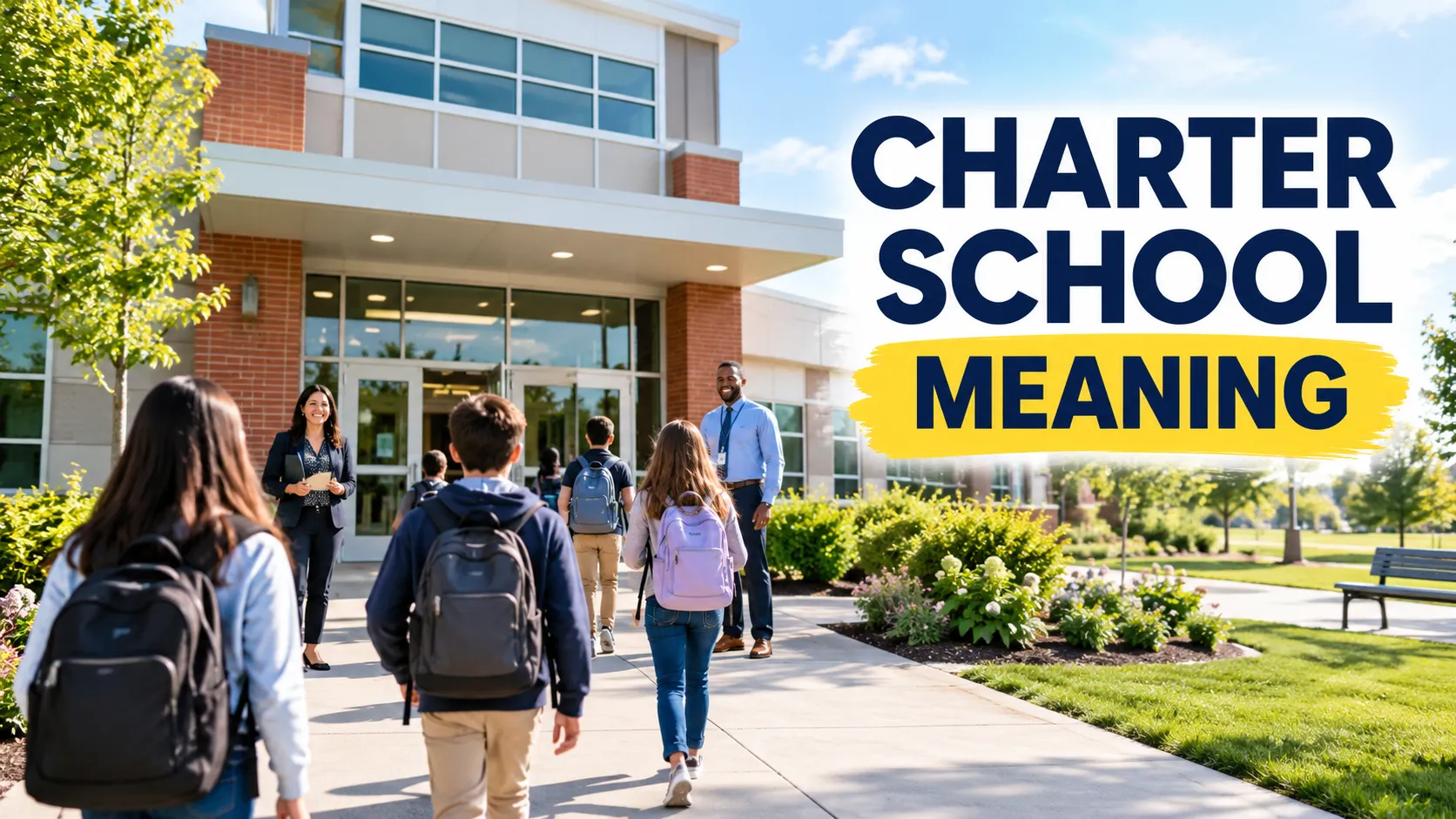
Have you ever heard someone mention a Charter School And Wondered what it actually means? The term is commonly used in the United States to describe a type of public school that operates under an approved agreement called a charter.
Understanding the meaning of a charter school can help students, parents, English learners, and anyone interested in education understand the American school system. Although charter schools share many features with traditional public schools, they may have more flexibility in certain areas of school management and teaching.
In this guide, you will discover the definition of a charter school, its pronunciation, examples, how it works, its advantages and disadvantages, and the differences between charter, traditional public, and private schools.
1. What Is the Meaning of Charter School?
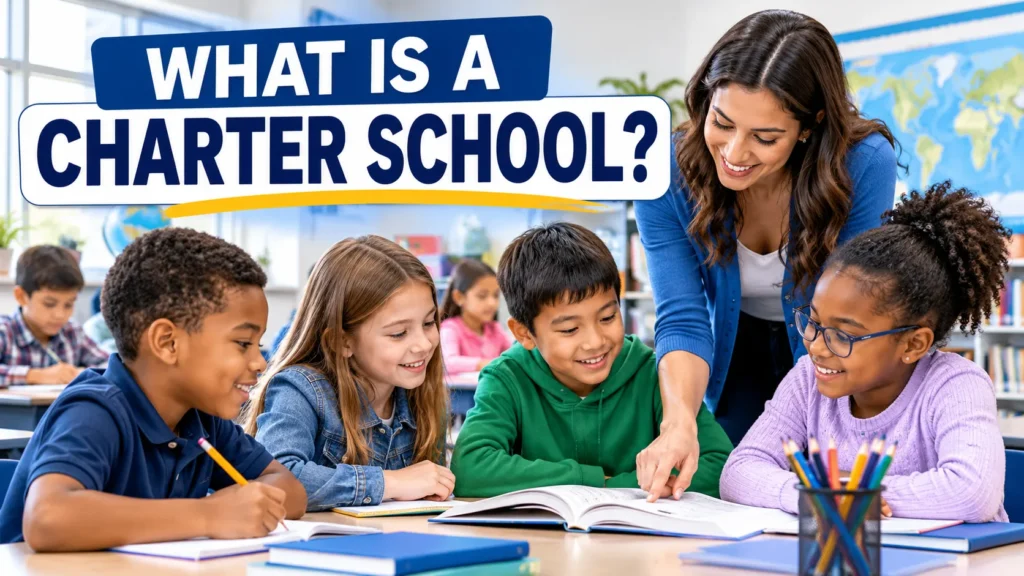
A charter school is a publicly funded school that operates under an approved agreement called a charter. This agreement establishes the school’s mission, educational goals, responsibilities, and performance expectations.
In simple words, a charter school is a public school that may have more independence in how it manages its educational programs and daily operations.
For example, one charter school might focus on science and technology, while another may specialize in performing arts or project-based learning. The programs and freedoms available to each school depend on its approved charter and applicable state laws.
The term is most commonly associated with the United States education system. Charter schools are not simply private schools with a different name; they are part of the public education system.
2. Charter School Definition in Simple English
The charter school definition becomes easier to understand when you break the phrase into its main parts.
A charter is an official agreement or document that authorizes an organization to operate under specific conditions. A school is an educational institution where students learn academic subjects and develop important skills.
Together, the phrase describes a school that operates under an approved educational agreement.
Here are the key points to remember:
- Charter: An approved agreement that explains the school’s mission and responsibilities.
- Public funding: Money provided through applicable public education funding arrangements.
- Educational flexibility: Greater freedom in certain areas of teaching or management.
- Accountability: The responsibility to meet the school’s approved goals and legal requirements.
- School choice: Families may have an additional public-school option, depending on availability and enrollment rules.
The most important point is that charter schools remain public schools, even when they operate differently from traditional district schools.
3. Charter School Pronunciation
The phrase charter school is pronounced approximately as CHAR-ter skool.
The first syllable of charter receives the main stress in American English. The word school is pronounced like the familiar word used for an educational institution.
Here is a simple pronunciation guide:
- Charter: CHAR-ter
- School: skool
- Full phrase: CHAR-ter skool
The word charter can refer to an official document, agreement, or authorization. In the expression charter school, it refers to the agreement under which the school is permitted to operate.
Learning the pronunciation and definition together makes it easier to recognize the phrase in conversations, news reports, and educational discussions.
4. Charter School Examples in Sentences
Examples help you understand how people use the phrase in everyday English. The following sentences show how charter school appears in conversations about education, school choice, and learning opportunities.
- My cousin attends a charter school that specializes in science and technology.
- The parents compared a charter school with their neighborhood public school.
- Her charter school offers a special program in performing arts.
- We learned about charter schools in our social studies class.
- The family researched the school’s academic performance before applying.
- A charter school operates under an approved agreement.
- Some students enjoy the teaching methods used at their charter school.
- The school must meet the requirements established by its charter.
- His parents attended an information session at the charter school.
- The charter school offers an alternative to traditional district schools.
- The teacher explained how charter schools receive public funding.
- Several families applied for places at the new charter school.
- The school focuses on project-based learning and student participation.
- Parents checked the enrollment rules before choosing a school.
- The article explained the difference between charter schools and private schools.
These sentences are useful for English learners, school assignments, vocabulary practice, and understanding education-related news.
5. How Do Charter Schools Work?
Charter schools operate under an agreement approved by an authorized organization or public agency. This agreement establishes the school’s educational mission and the expectations it must meet.
Although the details vary by state, the process generally includes several important elements.
Authorization: A charter school must receive permission to operate under the relevant state system. The authorizing body establishes or approves the school’s charter.
School management: Charter schools often have greater independence in certain operational decisions. Depending on the arrangement, an independent governing board or another authorized organization may oversee the school.
Public funding: These schools receive public funding through applicable state and local arrangements. They generally do not charge tuition for ordinary enrollment.
Student enrollment: Families may apply to a charter school when places are available. If applications exceed available seats, a lottery or another legally permitted admission process may be used.
Accountability: Schools must follow applicable laws and meet the requirements of their charters. Failure to meet required standards can lead to corrective action, nonrenewal, or closure.
In short, charter schools have flexibility in certain areas, but that flexibility comes with responsibilities and accountability requirements.
6. Charter School vs. Traditional Public School
A common question is whether A Charter School is different from a public school. The important clarification is that a charter school is itself a public school. The comparison is therefore between a charter school and a traditional district public school.
| Feature | Charter School | Traditional Public School |
| Funding | Public funding | Public funding |
| Tuition | Generally tuition-free | Generally tuition-free |
| Management | Often has greater operational independence | Usually operates within a school district |
| Curriculum | May have additional flexibility within legal requirements | Follows state standards and district policies |
| Enrollment | Often requires an application or school choice process | Often based on attendance zones, with exceptions |
| Accountability | Must meet charter requirements and applicable laws | Must meet district, state, and federal requirements |
| Availability | Depends on authorized schools and available places | Depends on district offerings and enrollment rules |
The main difference is often the structure of school management and the degree of operational flexibility. Neither type automatically provides a better education. Families should compare individual schools rather than judge them by their labels alone.
7. Charter School vs. Private School
Charter schools and private schools may both appeal to families looking for alternatives to traditional district schools. However, they have different funding arrangements, governance structures, and enrollment requirements.
| Feature | Charter School | Private School |
| Funding | Primarily public funding | Often tuition, donations, and private funding |
| Tuition | Generally no tuition for ordinary enrollment | Often charges tuition |
| Governance | Operates under an authorized charter | Operates under private governance arrangements |
| Admission | Follows applicable public-school enrollment rules | Follows its own lawful admissions policies |
| Religious affiliation | Generally nonsectarian under U.S. charter-school rules | May be religious or nonreligious |
| Accountability | Subject to charter requirements and public-school laws | Subject to applicable laws and relevant oversight |
The biggest distinction is that charter schools are part of the public education system, whereas private schools operate outside its public-school structure.
Parents comparing these options should also consider class sizes, teacher qualifications, transportation, extracurricular activities, academic support, and the school’s overall learning environment.
Related To Another Article: https://genzwishes.com/sumptuous-meaning/
8. What Are the Advantages of Charter Schools?
Charter schools can provide several potential advantages, depending on their educational mission, resources, and management.
Specialized programs: Some schools focus on science, technology, mathematics, arts, language learning, or other subjects that interest particular students.
Educational flexibility: A school may have additional freedom to organize its curriculum, schedule, staffing, or teaching methods within applicable rules.
More school choices: Families may have another publicly funded option beyond their assigned neighborhood school.
Different teaching approaches: Some charter schools emphasize project-based learning, practical activities, or specialized instructional methods.
A clear educational mission: The charter sets out the school’s goals, helping families understand what it aims to achieve.
However, these advantages are not guaranteed. A school with an attractive mission may still face challenges involving staffing, resources, or student outcomes. Parents should investigate the actual school before making a decision.
9. What Are the Disadvantages of Charter Schools?
Charter schools can also present challenges that families should consider before applying.
Limited availability: Some communities have few charter schools, making it difficult for families to find a suitable option nearby.
Admission limitations: Popular schools may receive more applications than they have available places. Admission may involve a lottery or another permitted process.
Differences in quality: Some charter schools perform well, while others struggle with teaching quality, management, or academic outcomes.
Possible school closure: A charter may not be renewed or may be revoked if the school fails to meet required standards, potentially disrupting students’ education.
Varying services: Transportation, extracurricular programs, special education support, facilities, and other services differ among schools.
Travel and scheduling: A charter school may be farther from home than a neighborhood school, which can create practical difficulties for families.
The best approach is to compare the school’s performance, support services, policies, location, and educational environment with other available options.
10. Are Charter Schools Free?
Yes, charter schools in the United States generally do not charge tuition for ordinary student enrollment because they are public schools supported by public funding.
However, families should review each school’s policies for any permitted charges related to optional activities, supplies, meals, transportation, or extracurricular programs. Such costs and services can vary.
A tuition-free school does not necessarily provide every service at no cost, and the absence of tuition does not mean that all charter schools have identical resources or facilities.
Parents should contact the school directly if they need precise information about enrollment costs, available services, or financial assistance.
11. Who Can Attend a Charter School?
Eligibility depends on state law, the school’s grade levels, and its enrollment policies. Charter schools generally serve students who meet the relevant requirements.
Families May Need to complete an application and provide documents such as proof of age or residency, depending on the applicable rules. When the number of applicants exceeds the number of available places, the school may use a lottery or another legally permitted process.
Some charter schools serve particular age groups, while others focus on specific educational programs or teaching methods.
Before applying, parents should check the following:
- Which grades the school serves.
- Whether the student meets eligibility requirements.
- The application deadline and admission process.
- Whether places are currently available.
- Transportation options and school hours.
- Support for students with disabilities or those learning English.
- Academic programs and extracurricular activities.
Understanding these details helps families decide whether a particular charter school is suitable for their child.
12. Are Charter Schools Better Than Public Schools?
There is no universal answer because charter schools are public schools, and educational quality varies among individual institutions.
Some charter schools offer strong academic programs, effective teaching, and specialized learning opportunities. Others may struggle with student outcomes, resources, or management. Traditional district schools also differ in their performance and services.
Parents should consider several factors before choosing a school.
Academic performance: Review available results and, where possible, student progress over time.
Teacher experience: Learn about teacher qualifications, staffing stability, and classroom support.
Student well-being: Consider school safety, student relationships, and the learning environment.
Educational support: Check services for students with disabilities, English learners, and students who need additional academic help.
Practical needs: Consider location, transportation, school hours, extracurricular activities, and family involvement.
Accountability reports: Review official information about school performance, compliance, and improvement efforts.
A school’s actual quality matters more than whether it is called a charter school or a traditional public school. The right choice depends on the student’s needs and the options available to the family.
13. Common Misconceptions About Charter Schools
The term charter school can be confusing, especially for people unfamiliar with the U.S. education system. Here are some common misconceptions and the facts behind them.
Misconception 1: Charter schools are private schools.
Fact: Charter schools are public schools operating under authorized charter agreements.
Misconception 2: Every charter school charges tuition.
Fact: Charter schools generally do not charge tuition for ordinary enrollment.
Misconception 3: Charter schools have no rules.
Fact: They may have greater flexibility in certain areas, but they must follow applicable laws and meet their charter obligations.
Misconception 4: Every charter school provides a better education.
Fact: Educational quality varies. Families should research each school’s programs, performance, and resources.
Misconception 5: Every student is guaranteed admission.
Fact: Enrollment depends on eligibility, available places, and the admission procedures permitted by applicable law.
Misconception 6: All charter schools teach the same way.
Fact: Schools can have different educational missions, curricula, and teaching approaches.
Knowing these facts makes the term easier to understand and helps families make more informed decisions about education.
14. Charter School Meaning in Different Contexts
The phrase charter school generally refers to a particular type of public school in the United States. Its precise legal meaning and operating rules depend on the relevant state.
In everyday conversation: Someone may use the term while discussing where a child attends school or comparing different educational options.
And in education: It describes a public school that operates under an approved charter and may have greater flexibility in certain areas of management and instruction.
In news articles: The phrase often appears in discussions about education policy, school choice, funding, academic results, or school accountability.
In English learning: The term is useful vocabulary for understanding American schools, reading education-related articles, and following conversations about student enrollment.
The word charter has other meanings in different contexts, including an official document or agreement. However, the full phrase charter school has a specific educational meaning.
Understanding the context helps readers avoid confusing a charter school with a private school or a school that simply has a special name.
People Also Ask
A: A charter school is a publicly funded school that operates under an approved agreement and may have greater flexibility in certain areas of management and education.
A: A charter school is a public school in the United States. It operates under an authorized charter and follows applicable public-school laws.
A: Charter schools generally do not charge tuition for ordinary enrollment. However, some optional activities or services may involve costs.
A: The name comes from the charter, an approved agreement that establishes the school’s mission, responsibilities, and performance expectations.
A: A publicly funded school operating under an approved charter and focusing on science, technology, or performing arts is an example of a charter school.
Conclusion
The meaning of a Charter School is simple once you understand the role of the charter agreement. A charter school is a publicly funded school that operates under an approved charter, giving it flexibility in certain areas while holding it accountable for educational goals and legal responsibilities.
Unlike a private school, a charter school is part of the public education system. Compared with a traditional district school, it may have greater independence in management, curriculum, or other operational decisions.
However, not every charter school offers the same programs or achieves the same results. Families should compare academic performance, teaching quality, student support, available resources, and practical needs before choosing a school.
If this guide helped you understand the term, bookmark it for future reference and explore more simple English meanings on GenzWishes.