Introduction
The word received means got, Obtained, or was given something. It is the past tense and past participle of the verb receive. People commonly use it when talking about messages, gifts, money, information, packages, and official documents.
For example, “I received your message” means “I got your message.” In texting and social media, the word may also describe a message status, depending on the platform. However, receiving a message does not necessarily mean someone has read it, accepted it, or replied to it.
In this guide, you will discover the meaning of received in simple English, its use in text messages, grammar rules, everyday examples, synonyms, and differences from similar words.
1. What Does Received Mean?
Received means that someone got, obtained, or was given something. It describes an event in which something comes to a person or reaches its intended destination.
For example, if your friend sends you a birthday present and it arrives, you can say, “I received your gift.” The word works for physical objects as well as digital messages and information.
Here are five examples:
- I received your letter yesterday.
- She received a beautiful birthday gift.
- We received an email from our teacher.
- He received an award for his hard work.
- They received the news with excitement.
- My brother received a new phone.
- The school received our application.
- I received a package this morning.
- She received an invitation to the wedding.
- We received helpful advice from our coach.
- He received a payment from his customer.
- The team received praise for its performance.
- I received a notification on my laptop.
- They received permission to enter the building.
- She received a thank-you card from her friend.
2. Received Meaning in Text
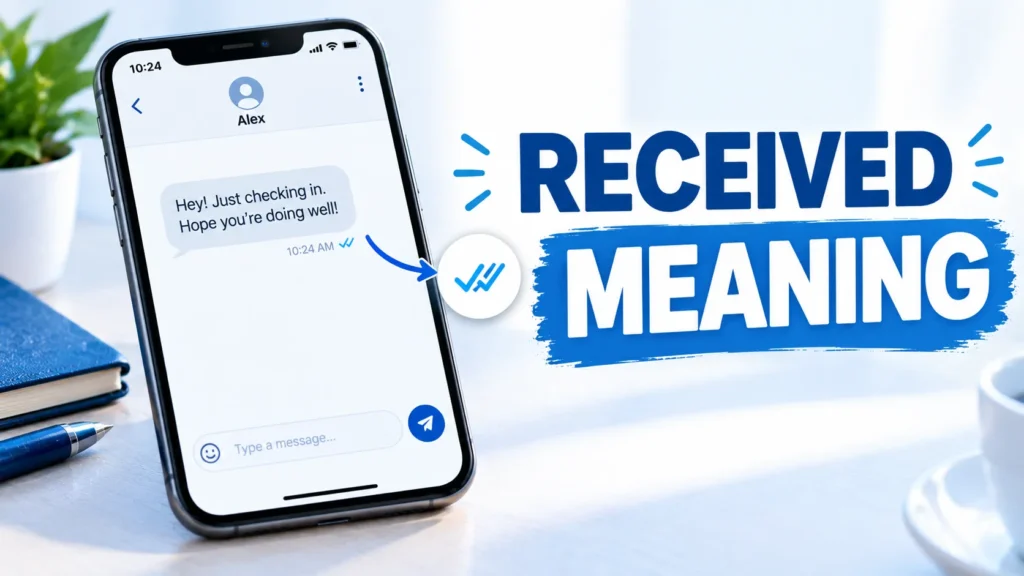
In text messages, received usually means that someone got a message or is confirming that information has arrived. The precise meaning depends on how the person uses the word and whether it appears in a manually written reply or an app notification.
For example, when someone replies “Received, thank you,” they are confirming that they got the information. It is a short, polite response often used in school groups, workplace chats, and formal conversations.
Here are 15 examples of how people use received in texting:
- “Received, thank you!” means the information arrived.
- “Message received” confirms that someone got your message.
- “Received the address” means the person got the location details.
- “Received your assignment” confirms that the assignment arrived.
- “Received the photos” means the photos were successfully obtained.
- “Received, I will check it” confirms receipt before reviewing something.
- “Your message has been received” is a formal confirmation.
- “Received the payment” means the money arrived.
- “Received the document” confirms that a file was obtained.
- “Received, see you tomorrow” acknowledges the information about a plan.
- “I received your update” means the sender’s latest information arrived.
- “Received, I will let you know” confirms receipt before a later response.
- “I have received your reply” confirms that the response arrived.
Remember that the word alone does not prove that someone carefully read the message or agrees with its contents. It confirms receipt, while further context tells you what happens next.
3. Received Meaning in Chat
In online chats, received can mean that a person got a message, document, instruction, or other information. When someone types the word as a reply, they are usually confirming receipt.
The tone can be formal, neutral, or brief. For example, a colleague might write “Received” after getting a work assignment, while a friend might simply say “Got it.”
Consider these 15 chat examples:
- “Received.” — A brief confirmation.
- “Received, thanks.” — A polite acknowledgment of receipt.
- “I’ve received your message.” — Confirmation that a message arrived.
- “Received, I’ll review it tonight.” — Receipt followed by a plan.
- “Received the meeting link.” — Confirmation of the meeting details.
- “Received, please give me a moment.” — Receipt before a later response.
- “I’ve received the latest version.” — Confirmation that a new file arrived.
- “Received your location.” — Confirmation that location details arrived.
- “Received, I’ll share it with the team.” — Receipt followed by a planned action.
- “Payment received.” — Confirmation that payment arrived.
- “Received the notes from class.” — Confirmation of the notes.
- “Received, understood.” — Receipt and an explicit statement of understanding.
- “Received your update, thank you.” — A polite confirmation of new information.
A useful distinction is that receiving information and understanding it are not always the same thing. If clarity matters, ask the recipient to confirm their understanding separately.
4. Received Meaning on Snapchat
On Snapchat, the meaning of a received status depends on the specific label, icon, and type of content. Generally, received refers to incoming Snaps or chats, while other indicators distinguish sent, delivered, opened, or viewed content.
This is different from someone manually typing “Received” in a conversation. The written reply communicates what the person says; an automatic status communicates what the app records.
Here are 15 useful points to understand:
- A received indicator can relate to incoming content.
- A Snap and a chat message may have different status indicators.
- Received is not the same as sent.
- Sent describes content you have attempted to send.
- Delivered indicates a delivery stage according to the app.
- A received status does not automatically prove that the recipient read the content.
- A status alone cannot explain why someone has not replied.
- The meaning of an icon can depend on whether you sent a Snap or chat.
- Different content types can have different indicators.
- App updates may change how labels or icons appear.
- A person can receive information without responding immediately.
- A message status does not reliably reveal someone’s intentions.
- You should check Snapchat’s current help information if an icon is unclear.
- Avoid assuming someone is ignoring you based only on a status.
Important: For an exact Snapchat interpretation, check the current icon and its accompanying label rather than assuming every version of “received” means the same thing.
5. Received Meaning in WhatsApp and Other Messaging Apps
In WhatsApp and other messaging apps, received is often used in ordinary conversation to confirm that a message or piece of information arrived. However, the word is not a universal technical status across every platform.
For example, if your friend writes “I received your WhatsApp message,” they are saying that the message reached them. That sentence alone does not establish whether they have read it carefully or responded to its contents.
Here are 15 examples of receiving messages and information through digital communication:
- I received your WhatsApp message.
- She received the group announcement.
- We received the meeting details.
- He received the photo you shared.
- I received your voice note.
- They received the document in the group chat.
- My friend received the invitation link.
- I received the updated schedule.
- She received the location you sent.
- We received the class notification.
- He received the video you shared.
- I received the confirmation message.
- They received the new project instructions.
- She received the reminder about tomorrow’s event.
- I received your reply and will respond soon.
Messaging platforms can use different delivery and read indicators. Always consult the relevant app’s own explanation before interpreting an automatic status.
6. Received Meaning in Email
In email, Received Means that an email, document, application, or other information has arrived or that a person is confirming its arrival. The word frequently appears in professional and official communication.
For example, “Your application has been received” means the organization has obtained your application. It does not necessarily mean that the organization has approved it.
Here are 15 examples:
- I received your email this morning.
- We received your documents successfully.
- She received an email from the admissions office.
- The manager received the weekly report.
- I received the invoice yesterday.
- Your payment confirmation has been received.
- The office received the complaint.
- We received your request for additional information.
- He received a confirmation email after booking.
- The company received hundreds of applications.
- I have received the revised proposal.
- Your message has been received and recorded.
- The school received the completed registration form.
- We received your feedback and appreciate your time.
In formal communication, distinguish between received, reviewed, approved, and processed. These words describe different stages, and confusing them can create unnecessary expectations.
7. Received Meaning in Simple English
In simple English, received means got something from someone or obtained something. It is commonly used when talking about something that happened in the past.
The word got sounds more conversational, while received often sounds more formal. Both can work in many sentences, but they are not interchangeable in every context.
| Sentence | Simple meaning |
| I received a gift. | I got a gift. |
| She received a message. | She got a message. |
| We received your payment. | We got your payment. |
| He received an award. | He was given an award. |
| They received the news. | They got the information. |
| I received a letter. | A letter came to me. |
| She received a certificate. | She was given a certificate. |
| We received your invitation. | Your invitation arrived. |
| He received permission. | He was allowed to do something. |
| They received help. | Someone helped them. |
| I received a phone call. | Someone called me. |
| She received a refund. | Her money was returned. |
| We received the results. | We got the results. |
| He received a warning. | Someone gave him a warning. |
| They received an offer. | Someone made an offer to them. |
When learning English, remember the basic idea first: something was given, obtained, or came to the person.
8. Received vs. Receive
Receive and received are forms of the same verb, but their grammatical uses differ.
Receive is the base form. Received is the simple past form and past participle. The correct choice depends on the tense and structure of the sentence.
| Word or form | Common use | Example |
| Receive | Base form | Please receive the package. |
| Receive | Present tense with I, you, we, they | I receive emails daily. |
| Receives | Present tense with he, she, it | She receives many messages. |
| Received | Simple past | I received your email yesterday. |
| Have received | Present perfect | I have received your email. |
| Had received | Past perfect | I had received the notice earlier. |
| Receiving | -ing form | I am receiving your messages. |
Here are additional examples:
- I receive updates every morning.
- She receives letters from her friends.
- We received the package yesterday.
- He received an award last year.
- They have received the instructions.
- I had received the email before the meeting.
- Please accept this gift as a token of appreciation.
- The office receives applications every week.
- She is receiving professional training.
- We will receive the results tomorrow.
- He expects to receive a reply soon.
- I received your call while I was working.
- They have received permission to continue.
- The school receives donations from the community.
- She received the news with a smile.
Incorrect: “I receive your package yesterday.”
Correct: “I received your package yesterday.”
The word yesterday identifies a completed past event, so the simple past form is appropriate.
9. Received vs. Delivered
So, received and delivered are related, but they focus on different parts of an exchange.
Received emphasizes getting something. Delivered emphasizes bringing or sending something to its intended destination.
| Received | Delivered |
| Focuses on obtaining something | Focuses on bringing something to its destination |
| “I received the package.” | “The courier delivered the package.” |
| Describes the recipient’s perspective | Describes the delivery process |
| Can refer to messages, money, gifts, or information | Can refer to packages, messages, services, or information |
Here are 15 examples that clarify the distinction:
- I received the package after the courier delivered it.
- The office delivered the documents, and the customer received them.
- I received the email after the system delivered it.
- The courier delivered the parcel to our house.
- We received the order in the afternoon.
- The company delivered the equipment to the school.
- She received the invitation by email.
- The invitation was delivered to her inbox.
- I received the report from my colleague.
- My colleague delivered the report before the deadline.
- The customer received the item in good condition.
- The store delivered the item on time.
- We received confirmation of the booking.
- The system delivered the confirmation email.
- The recipient received the letter after it was delivered.
In messaging apps, technical meanings can vary. A delivery indicator does not automatically mean a person has read, understood, or accepted the message.
10. Received vs. Accepted
Received And Accepted have different meanings.
So, Received means that something arrived or was obtained. Accepted means that someone agreed to take, approve, or recognize something.
For example, if a university says your application was received, it has obtained your application. If it says your application was accepted, it has approved your application for the relevant purpose.
| Received | Accepted |
| Confirms arrival or obtaining something | Confirms agreement or approval |
| A document can be received without being approved | Acceptance usually involves a decision |
| “We received your application.” | “We accepted your application.” |
| Does not automatically mean yes | Often indicates agreement, subject to context |
Here are 15 examples:
- The school received my application, but it has not accepted me yet.
- She received the invitation and accepted it.
- We received the proposal before accepting the offer.
- The company received my CV but has not accepted my job application.
- He received the gift and accepted it graciously.
- The office received the request but rejected it later.
- They received the invitation but declined to attend.
- The university received the documents and later accepted them as valid.
- I received the terms but have not accepted them.
- The customer received the package and accepted the delivery.
- She received a job offer and accepted it.
- The committee received the application and approved it later.
- We received the proposal but requested changes before accepting it.
- He received the apology and accepted it.
- The organization received donations and accepted them gratefully.
The key lesson is simple: receiving something does not necessarily mean approving it.

11. Received vs. Acknowledged
Received means that something was obtained. Acknowledged means that someone recognized, confirmed, or formally responded to it.
In everyday conversation, the two words can overlap. However, acknowledged often emphasizes recognition or confirmation, while received emphasizes arrival or possession.
| Received | Acknowledged |
| Emphasizes obtaining something | Emphasizes recognition or confirmation |
| “I received your email.” | “I acknowledged your email.” |
| The email arrived | The sender’s communication was recognized |
| Does not necessarily imply a response | Often suggests some form of recognition or response |
Here are 15 examples:
- I received your message but have not acknowledged it yet.
- She acknowledged the email after receiving it.
- The manager received the report and acknowledged its arrival.
- We received the complaint and acknowledged it in writing.
- He received the invitation and acknowledged it with a reply.
- I received the document and confirmed that it arrived.
- The office received the request and acknowledged receipt.
- She received the feedback and acknowledged the suggestions.
- We received the notice and acknowledged its contents.
- The team received the update and acknowledged the change.
- He received the instructions and acknowledged that he understood them.
- The organization received the application and acknowledged its submission.
- I received the parcel and acknowledged delivery.
- The teacher received the assignments and acknowledged their submission.
- The customer received the confirmation and acknowledged the details.
In professional communication, “acknowledged” can be useful when a record of confirmation matters.
Related To Another Article: https://genzwishes.com/pita-meaning/
12. Synonyms of Received
Synonyms are words with similar meanings. The right synonym for received depends on what someone got and how they obtained it.
For instance, got is a natural replacement in casual conversation, while obtained may sound more formal. Accepted is appropriate only when the meaning involves agreement or taking something willingly.
Here are 15 possible alternatives:
- Got: I got your message.
- Obtained: She obtained the necessary information.
- Acquired: He acquired new skills through training.
- Was given: She was given a certificate.
- Collected: I collected the package from the office.
- Took delivery of: The company took delivery of the equipment.
- Gained: He gained valuable experience.
- Earned: She earned an award for her performance.
- Secured: The team secured permission to proceed.
- Accepted: He accepted the invitation.
- Retrieved: She retrieved the document from the system.
- Was sent: The information was sent to me.
- Was supplied: The school was supplied with new materials.
- Inherited: He inherited the property from a relative.
- Was awarded: She was awarded a scholarship.
These words have related meanings, but they are not perfect substitutes in every sentence. For example, earned suggests achievement, while inherited describes receiving something through inheritance.
13. Antonyms of Received
An antonym is a word with an opposite or contrasting meaning. Received does not have one universal antonym because its meaning changes with context.
If you are talking about messages, not received may be the clearest opposite. If you are discussing a proposal, rejected may contrast with accepted, but it does not mean the same thing as not received.
Here are 15 contrasting terms and phrases:
- Not received: The package was not received.
- Sent: I sent the message instead of receiving one.
- Returned: The parcel was returned to the sender.
- Rejected: The proposal was rejected.
- Refused: He refused to accept the delivery.
- Declined: She declined the invitation.
- Missed: I missed the call.
- Undelivered: The message remained undelivered.
- Unclaimed: The parcel remained unclaimed.
- Withheld: The information was withheld.
- Denied: The request was denied.
- Dispatched: The order was dispatched to the customer.
- Forwarded: The email was forwarded to another person.
- Resent: The sender sent the message again.
- Awaiting delivery: The package has not arrived yet.
Some terms describe the opposite action, while others describe a different stage in the process. Always choose the word that matches the intended meaning.
14. Received in Sentences: Everyday Examples
The easiest way to understand received is to see it in different contexts. It can describe gifts, schoolwork, business communication, digital messages, money, and many other situations.
The examples below show how the word works naturally in everyday English.
Everyday life
- I received a birthday card from my cousin.
- She received a phone call from her friend.
- We received the news this morning.
- He received a gift for helping his neighbor.
- They received visitors during the afternoon.
School and work
- The teacher received our assignments.
- I received my examination results.
- The office received the completed forms.
- She received praise for her excellent work.
- We received an invitation to the conference.
Online communication
- I received your text message.
- He received the document by email.
- We received confirmation of the booking.
- She received a notification on her phone.
- They received the files before the deadline.
More examples for grammar practice
- I have received your application.
- The company received several complaints.
- She received a scholarship to study abroad.
- We received permission to use the hall.
- He received the package after lunch.
- The team received positive feedback.
- I received your payment confirmation.
- The office received the updated schedule.
- She received an award for her research.
- They received the instructions in writing.
These examples demonstrate that received is a flexible verb form. It works in casual sentences and formal writing, as long as the grammar and context are correct.
People Also Ask
A: Received means got, obtained, or was given something. For example, “I received your message” means “I got your message.”
A: It usually means that someone got a message or is confirming that the information arrived. The exact meaning depends on the conversation and the messaging platform.
A: No, not necessarily. A message can be received without being opened or read. Check the platform’s read indicator if you need to know whether the message was viewed.
A: It generally refers to incoming Snaps or chats, but the precise interpretation depends on the icon, label, and content type. Check Snapchat’s current status guide for the exact indicator.
A: Yes. Received is the simple past form and past participle of receive. For example, “I received your email yesterday.”
Conclusion
The Meaning Of Received is straightforward: it means got, obtained, or was given something. It is the past tense and past participle of receive, and people use it in everyday conversations, schoolwork, business emails, and digital communication.
When someone says “Received, thank you,” they are generally confirming that something arrived. However, receiving something does not necessarily mean reading it, accepting it, understanding it, or approving it.
If you found this guide helpful, save it for future English learning and share it with someone who wants to improve their vocabulary. Explore more word-meaning guides on GenzWishes to understand common English words and expressions with confidence.