Introduction
Have you ever seen a performer walking high above the crowd or a house standing on long poles above the water? Both situations can help you understand the word stilt. Although the word may look unfamiliar, its meaning becomes simple when you see how people use it in different contexts.
Stilt Meaning: A stilt is a long pole used to raise a person above the ground or a vertical support used to hold a structure above the ground or water. The word also refers to certain long-legged wading birds. Its plural form is stilts.
In this guide, you will discover the definition of stilt, its pronunciation, common uses, synonyms, example sentences, and the difference between stilt and stilted. You will also learn whether the word has a recognized slang meaning and how to use it correctly in everyday English.
1. What Does Stilt Mean?
The word stilt generally refers to a long pole or support that raises something above its usual position. Its exact meaning depends on the context in which it appears.
For example, a circus performer may use stilts to walk above the ground, while a building may stand on stilts to keep its floor elevated. The same word can also identify a type of long-legged bird that lives in wetland environments.
Here are the three main meanings of stilt:
- Walking equipment: A long pole with a footrest that allows someone to walk at an elevated height.
- Structural support: A vertical post or similar support that holds a building or platform above the ground or water.
- A type of bird: A long-legged wading bird commonly known as a stilt.
Consider this example: “The entertainer walked on stilts during the festival.” Here, the word refers to equipment that helps the entertainer move above the ground.
In contrast, “The house stands on stilts near the river” refers to structural supports.
Understanding the surrounding sentence helps you identify the correct meaning without confusion.
2. Stilt Definition in Simple English
In simple English, a stilt is a long pole used for walking above the ground or a support used to raise a building.
Imagine a person standing on two tall poles with small platforms attached to them. The person places their feet on the platforms and carefully moves forward. Those poles are called walking stilts.
Now imagine a house built on strong vertical posts instead of resting directly on the ground. Those supports may also be called stilts.
Both examples share one central idea: raising a person or structure to a higher position.
Simple definition: A stilt is a long pole or vertical support used to raise something above the ground.
The word is a noun in its most common uses. It can describe a physical object, a building support, or a bird.
For English learners, the easiest way to remember the word is to connect it with height and support. Whenever you encounter a long pole that helps someone walk higher or a support that raises a structure, stilt may be the appropriate word.
3. How to Pronounce Stilt
The word stilt is pronounced /stɪlt/. It has one syllable and contains the short vowel sound heard in the word sit.
To pronounce it correctly, begin with the /s/ sound, followed by /t/. Then pronounce the short /ɪ/ vowel and finish with /lt/.
Say it naturally as one word: stilt.
The plural form, stilts, is pronounced /stɪlts/. The final sound includes an additional /s/.
Here are some pronunciation examples:
- Stilt: /stɪlt/
- Stilts: /stɪlts/
- Stilted: /ˈstɪltɪd/
The word stilted has two syllables and is pronounced STIL-tid.
Practicing these forms can help you use the word confidently in conversation, reading, and writing. If you are learning English, try saying the singular and plural forms aloud several times to become familiar with their final consonant sounds.
4. What Is the Plural of Stilt?
The plural of stilt is stilts. English forms the plural by adding the letter s to the singular noun.
| Singular | Plural |
| A stilt | Two stilts |
| One wooden stilt | Several wooden stilts |
| A structural stilt | Multiple structural stilts |
| One stilt bird | Two stilt birds |
Examples:
- The performer balanced carefully on a stilt.
- The performer walked across the stage on stilts.
- The house rests on several strong stilts.
- The workers inspected the stilts beneath the platform.
- We spotted two stilt birds in the wetland.
The plural form is straightforward, but the surrounding words still determine the meaning. In a sentence about a performance, stilts usually means walking equipment. In a sentence about a house, it generally refers to structural supports.
Remember that stiltses is not the standard plural. The correct form is simply stilts.
5. What Are Walking Stilts?
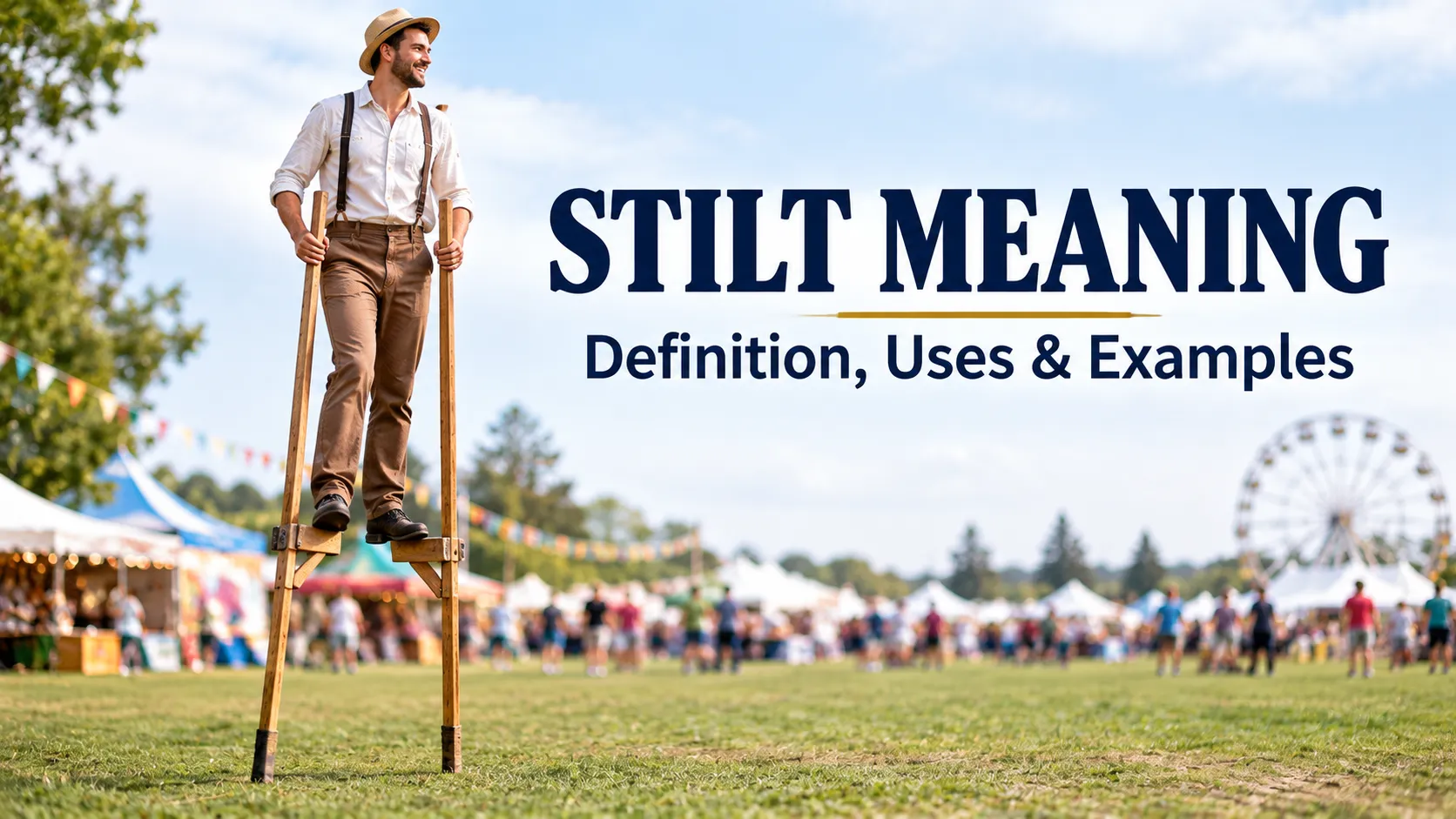
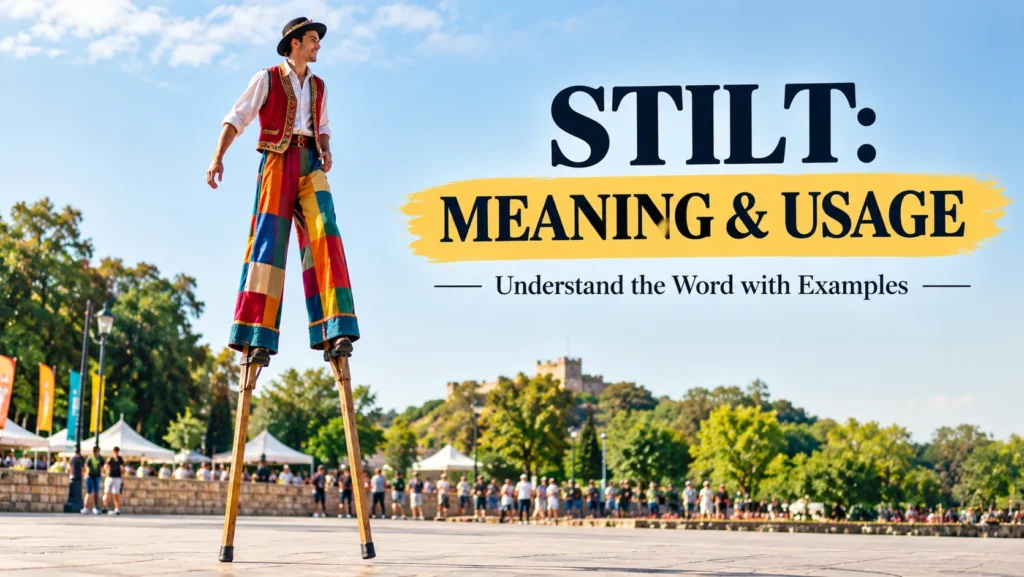
Walking stilts are poles fitted with footrests that allow people to stand and move above the ground. They are often used by circus performers, street entertainers, festival performers, and recreational users.
A traditional pair consists of two poles, each with a platform where the user places one foot. The person must coordinate their movements and maintain balance while walking.
Walking stilts come in several forms:
- Wooden stilts: Traditional poles with footrests, often used for recreation and demonstrations.
- Metal stilts: Equipment made with metal components for particular activities and applications.
- Performance stilts: Specialized equipment used by trained entertainers during shows and festivals.
- Drywall stilts: Adjustable equipment used by trained construction workers to reach elevated working positions.
Performers may decorate their stilts with bright colors, costumes, or other visual elements to attract attention during parades and celebrations.
However, walking on stilts requires practice and care. Beginners should use appropriate protective equipment, choose a clear practice area, and receive proper instruction. Taller stilts can increase the difficulty of balancing and make falls more dangerous.
Example: “The performer entertained the audience while walking on tall stilts.”
In this sentence, stilts refers to the poles that elevate the performer’s feet above the ground.

6. What Does a House on Stilts Mean?
A house on stilts is a Building Raised above the ground on vertical supports. Builders may choose this design because of flooding risks, soft soil, uneven terrain, or other environmental conditions.
The raised structure creates space beneath the house and separates the main floor from the ground.
There are several reasons why a house might be built on stilts:
- Flood management: Elevating the living area can reduce exposure to certain flood levels when the building is properly designed.
- Wet ground: Raised construction can be useful in some damp or marshy environments.
- Uneven terrain: Supports can help accommodate certain sloping or irregular sites.
- Coastal environments: Some buildings are elevated to address local water and environmental conditions.
- Space beneath the building: The open area below a raised house may provide access or other practical uses where appropriate.
For example, a coastal home may stand on stilts so its main living floor is higher than the surrounding ground.
However, a house on stilts is not automatically flood-proof, storm-proof, or earthquake-proof. Its safety depends on structural engineering, foundations, soil conditions, expected hazards, local building regulations, and maintenance.
Example sentence: “The wooden house stood on stilts above the shallow water.”
Here, stilts means the vertical supports holding the house above the surface.
7. What Is a Stilt Bird?
A stilt is also the name of a type of long-legged wading bird. These birds are commonly associated with shallow wetlands, marshes, lagoons, and other watery habitats.
Their long legs help them move through shallow water while searching for food. Many have slender bills that allow them to feed on small aquatic animals.
One recognizable example is the black-winged stilt, a bird known for its long, thin legs and contrasting black-and-white plumage.
The bird meaning is different from the construction and walking-equipment meanings. In this context, stilt refers to a living animal rather than a pole or support.
Consider these examples:
- A black-winged stilt searched for food in the wetland.
- We watched a stilt walking through shallow water.
- The photographer captured a picture of a long-legged stilt bird.
When you see the word in an article about wildlife, birds, wetlands, or feeding behavior, the animal meaning is likely the intended one.
This is a useful reminder that English words can have multiple meanings. Instead of assuming that stilt always describes equipment, examine the subject of the sentence.
8. Stilt Meaning in a Sentence
Reading example sentences is one of the easiest ways to understand how a word works in everyday English. The following examples show the different meanings of stilt and stilts.
- The clown walked on stilts to entertain the children.
- The beach house was built on stilts above the sandy ground.
- The performer practiced balancing on wooden stilts.
- The engineers inspected the supports beneath the raised building.
- The village included houses standing on stilts above the water.
- The festival featured a colorful entertainer walking on stilts.
- The construction team checked the building’s elevated supports.
- The children watched a trained performer walk on tall stilts.
- A black-winged stilt searched for food in the wetland.
- The architect designed a building supported by strong vertical posts.
- The entertainer carefully climbed onto the walking stilts.
- Several stilts supported the elevated wooden platform.
- We observed a stilt bird near the edge of the lagoon.
- The workers examined the stilts before continuing the construction work.
- The performer moved slowly while learning to walk on stilts.
These examples demonstrate why context matters.
Words such as clown, performer, balance, and walk suggest walking equipment. And words such as house, building, engineer, and platform point toward structural supports. Words such as bird, wetland, and lagoon may indicate the animal.
When writing your own sentence, identify what the word describes first. This simple technique will help you select the correct meaning.
9. Synonyms and Related Words for Stilt
The best synonym for stilt depends on the object or idea being described. Some alternatives refer to long poles, while others describe structural supports.
| Word | Meaning | Suitable context |
| Pole | A long, slender object | Walking equipment |
| Post | An upright supporting member | Building construction |
| Pillar | A substantial vertical support | Architecture |
| Column | A vertical structural element | Buildings and structures |
| Support | Something that holds or stabilizes another object | General construction |
| Prop | An object used to hold something in position | Temporary support |
| Pile | A structural member placed into the ground | Foundations and construction |
For example, pole may describe a long piece of walking equipment, while post or support may better describe part of a raised building.
However, these words are not always interchangeable. A column may be much wider than a walking stilt, and a pile may refer to a foundation element designed for a particular purpose.
The word stilt is also related to stilted, but the latter has a figurative meaning. It often describes speech, writing, or behavior that feels stiff or unnatural.
Choosing the right word depends on the meaning you want to communicate.
10. What Is the Difference Between Stilt and Stilted?
Although Stilt and stilted share the same word root, they have different grammatical functions and meanings.
A stilt is usually a noun. It refers to a walking pole, a structural support, or a type of bird.
Stilted is an adjective that often describes language, conversation, writing, or behavior that seems stiff, awkward, or overly formal.
| Word | Part of speech | Meaning | Example |
| Stilt | Noun | A pole or support | The house stands on stilts. |
| Stilts | Plural noun | More than one stilt | The performer walked on stilts. |
| Stilted | Adjective | Stiff or unnatural | Their conversation felt stilted. |
| Stiltedly | Adverb | In a stiff or unnatural manner | He spoke stiltedly during the interview. |
Consider the sentence: “The conversation sounded stilted.”
This means the conversation felt unnatural, awkward, or overly formal. It does not mean that the people were standing on poles.
The figurative meaning of stilted is associated with the stiffness or artificial elevation suggested by the image of something standing on stilts.
Remember this simple distinction: a stilt is generally an object or a bird, while stilted often describes the way someone speaks or writes.
- Related To Another Article: https://genzwishes.com/dagger-tattoo-meaning/
11. Origin and History of the Word Stilt
The word stilt has been used in English for centuries. Historical dictionary sources trace it to Middle English forms and related Germanic words associated with poles, supports, or walking aids.
The word appears in historical records from the late Middle English period. Its early uses referred to objects that helped people walk or supported them in an elevated position.
Over time, the word developed several related applications. It became associated with equipment used by performers, supports beneath raised structures, and certain long-legged wading birds.
The adjective stilted later acquired a figurative sense describing language or behavior that appears unnaturally stiff or formal.
This history helps explain why the word can refer to different things while retaining a connection to height, support, or an elevated appearance.
For readers interested in vocabulary, etymology provides a helpful way to understand how a word develops new meanings. A word that originally describes a physical object may eventually acquire a figurative meaning in everyday speech.
For precise historical dates and linguistic details, consult established etymological references rather than relying on unsupported claims about the word’s origin.
12. Common Mistakes When Using Stilt
The word stilt is relatively easy to learn, but a few common mistakes can lead to confusion.
Mistake 1: Using stilt instead of stilted
Incorrect: The interview sounded stilt.
Correct: The interview sounded stilted.
Use stilted when describing speech, writing, or behavior that feels unnatural or overly formal.
Mistake 2: Using the wrong plural
Incorrect: The performer walked on two stiltses.
Correct: The performer walked on two stilts.
The standard plural form is stilts.
Mistake 3: Assuming every stilt refers to walking equipment
The word can also refer to structural supports or a type of bird. Check the surrounding sentence before deciding which meaning applies.
Mistake 4: Assuming a house on stilts is completely protected from flooding
Elevated construction may reduce exposure to certain flood levels, but protection depends on engineering, location, foundation design, and the severity of the hazard.
Mistake 5: Treating stilt as a standard texting abbreviation
Stilt is an established English word with ordinary dictionary meanings. It does not have one widely recognized general texting definition that replaces those meanings. A particular conversation might use the word specially or figuratively, but that does not establish a standard abbreviation.
Mistake 6: Treating every synonym as interchangeable
A pole, pillar, post, and pile can all refer to physical objects, but each has a different range of uses. Choose the word that accurately describes the object.
Avoiding these mistakes will help you understand the word more accurately and use it naturally in speaking and writing.
13. How to Use Stilt Correctly in Everyday English
You can use stilt and stilts in conversations, school assignments, articles, and descriptions of Construction, entertainment, or wildlife.
The key is to match the word to the context.
When talking about entertainment:
“The performer walked on stilts during the parade.”
Here, stilts refers to the equipment that raises the performer above the ground.
When describing architecture:
“The house rests on stilts to keep its floor elevated.”
In this example, stilts means structural supports.
When discussing wildlife:
“We spotted a black-winged stilt in the wetland.”
Here, stilt refers to a bird.
When writing about construction:
“The engineers inspected the supports beneath the elevated platform.”
This sentence describes the same general construction concept, although supports is used instead of stilts.
When describing a conversation:
“The dialogue sounded stilted and unnatural.”
In this case, stilted is the correct word because it describes the quality of the dialogue.
These examples demonstrate how small changes in context can affect the meaning of a word. By paying attention to the subject and surrounding vocabulary, you can choose the appropriate form confidently.
People Also Ask
A: A stilt is a long pole used for walking at an elevated height or a support used to raise a structure above the ground. It can also refer to a type of wading bird.
A: Depending on the context, alternatives may include pole, post, pillar, or support. These A: words are related but are not always interchangeable.
A: A stilt is generally a noun describing an object or bird. Stilted is an adjective often used for speech or writing that sounds stiff or unnatural.
A: Some houses are elevated on supports to accommodate flood risks, wet ground, sloping land, or other environmental conditions. Their safety depends on proper design and construction.
A: There is no single widely recognized general texting meaning for stilt. Its intended meaning depends on the context in which someone uses it.
Conclusion
The Word Stilt has several meanings, but its most common uses are easy to understand. It can refer to a long pole used for walking above the ground, a structural support beneath a raised building, or certain long-legged wading birds.
Its plural form is stilts, and its pronunciation is /stɪlt/. The related word stilted has a different meaning and often describes speech, writing, or behavior that feels stiff or unnatural.
The best way to understand stilt meaning is to pay attention to the surrounding words. A performer, a raised house, and a wetland bird all provide different clues about the intended meaning.
Save this guide for future vocabulary practice, share it with someone learning English, and explore more word meanings and language guides on GenzWishes.