Introduction
Have you ever seen the word petite on a clothing Label Or Heard someone describe a woman as petite? You might wonder whether it means short, skinny, small, or something else. The word has a slightly different meaning depending on the situation.
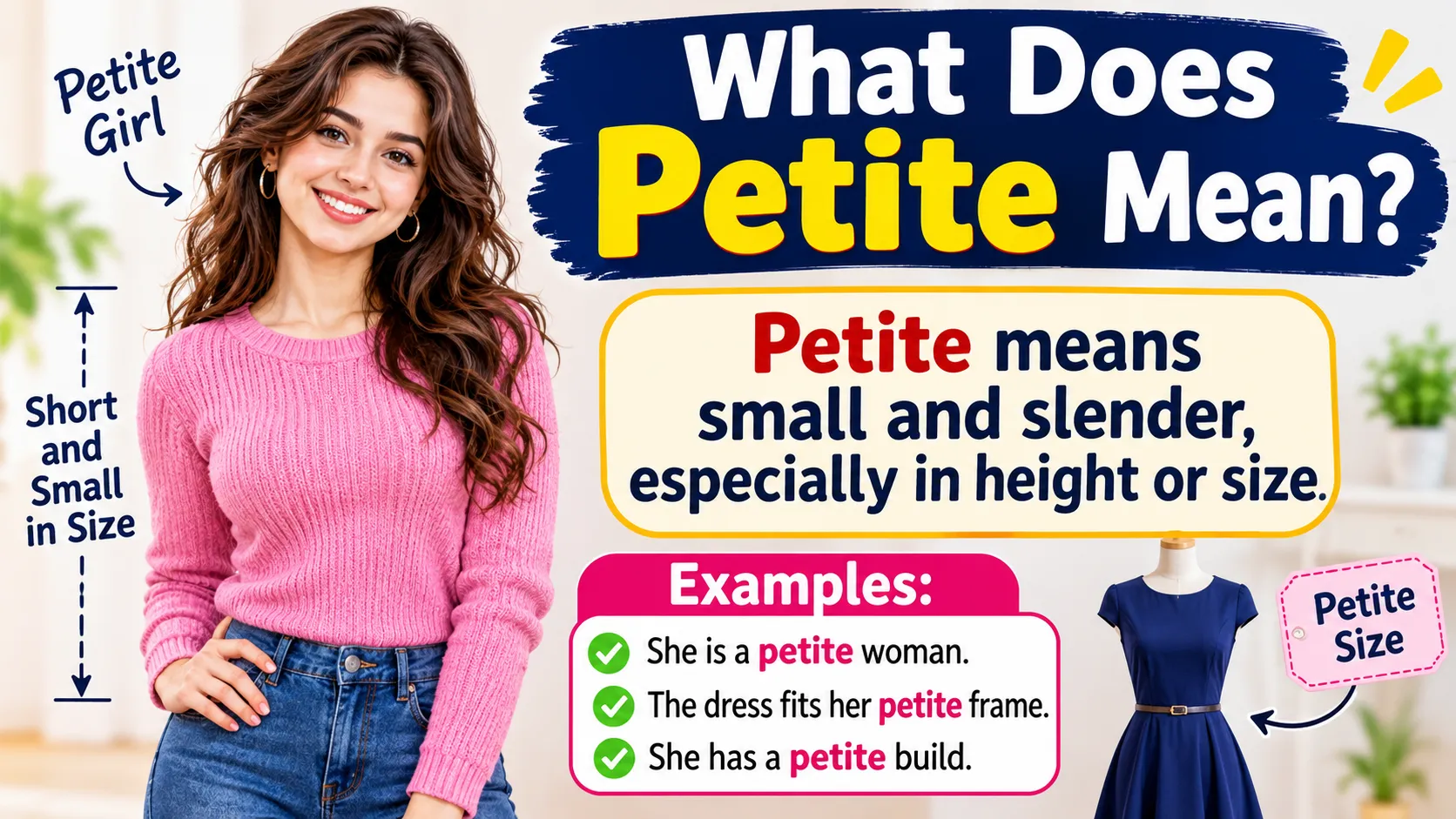
Petite generally means small in stature or fairly short. In fashion, it describes clothing designed for shorter body proportions, not necessarily smaller body sizes. A petite woman can be slim, average-sized, or curvy.
Understanding this difference makes the word much easier to use. In this guide, you’ll discover its simple definition, pronunciation, French origin, clothing meaning, height guidelines, and everyday examples.
1. What Does Petite Mean?
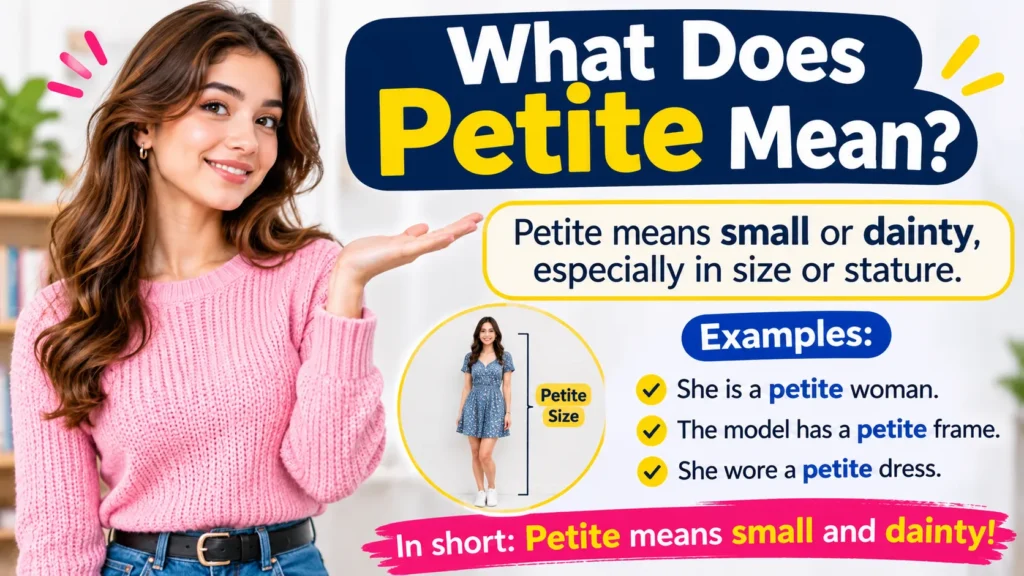
Petite means small, short, or delicately built. People commonly use this adjective to describe a woman with a relatively small frame or shorter stature.
However, the word has another important meaning in fashion. Petite clothing is designed for people with shorter body proportions, including shorter sleeves, inseams, and torso lengths.
For example:
- She is petite and has a small frame.
- My sister prefers petite jeans because regular ones are too long.
- The boutique sells beautiful petite dresses.
- She has a petite appearance but a confident personality.
The meaning depends on the context. When describing someone, petite usually refers to physical stature or appearance. On a clothing label, it identifies a particular fit category.
In simple words, petite means small in stature, while petite clothing is designed for shorter proportions.
2. What Is the Simple Definition of Petite?
The simplest definition of petite is small or short in size, especially when describing a person’s physical appearance.
Petite is an adjective. It describes a person, object, or thing rather than an action.
Here are some simple interpretations:
- Small: Something smaller than average.
- Short: A person with relatively short stature.
- Delicate: Someone with a relatively small or fine-looking frame.
- Compact: Something that takes up less space than usual.
For example, a petite woman may have a shorter stature and a smaller frame. A petite handbag, on the other hand, simply refers to a small handbag.
The word is commonly used in everyday conversations, fashion, and descriptions of physical appearance.
3. What Does Petite Mean When Describing a Woman?
When someone describes a woman as petite, they generally mean she has a relatively small frame, short stature, or delicate appearance.
The description often suggests that she is smaller than average in overall build. However, it does not establish her exact height, weight, or body measurements.
Consider these examples:
- My aunt is petite and loves wearing elegant outfits.
- She has a petite frame and graceful appearance.
- The actress is known for her petite stature.
- My friend is petite, so she often shops in the petite clothing section.
In everyday English, people traditionally use petite more often when describing women and girls.
However, the word can also describe small objects and accessories regardless of gender.
It is important to remember that petite does not reveal someone’s personality, health, or fitness. It describes physical appearance, not personal qualities.
4. What Does Petite Mean in Clothing?
In fashion, petite refers to a clothing category designed for people with shorter body proportions.
Many women’s clothing retailers use approximately 5 feet 4 inches (162.5 cm) as a general height guideline for their petite collections. However, retailers can use different standards.
Petite clothing is not simply regular clothing made smaller. Designers adjust several garment measurements to create a better fit.
Common adjustments include:
- Shorter sleeve lengths.
- Shorter trouser inseams.
- Adjusted torso lengths.
- Different waist placements.
- Higher knee positioning.
- Modified shoulder proportions.
- Shorter dress and skirt lengths.
For example, imagine buying regular jeans that bunch around your ankles. Petite jeans may offer a shorter inseam and a more comfortable fit.
Similarly, petite shirts may have shorter sleeves and a better-proportioned torso.
The main purpose of petite clothing is to improve garment proportions, not necessarily to make the wearer look thinner.
5. What Height Is Considered Petite?
Many fashion retailers consider women around 5 feet 4 inches (approximately 162.5 cm) and under suitable for petite clothing.
However, this is a retail guideline, not a universal scientific definition of a petite person.
Some retailers use slightly different height ranges. For example, certain clothing collections are designed for women between 4 feet 11 inches and 5 feet 4 inches.
Here is a general height reference:
| Height | Common petite sizing guidance |
| 4’10” | Often suitable for petite |
| 4’11” | Often suitable for petite |
| 5’0″ | Often suitable for petite |
| 5’1″ | Often suitable for petite |
| 5’2″ | Often suitable for petite |
| 5’3″ | Commonly suitable for petite |
| 5’4″ | Common petite sizing guideline |
| 5’5″ | Depends on body proportions and brand |
These measurements are shopping guidelines rather than strict rules.
Your arm length, leg length, shoulder width, and torso proportions can also influence which clothing category fits you best.
For example, someone who is 5 feet 5 inches tall may still prefer petite trousers because regular inseams are too long.
6. Does Petite Mean Short or Skinny?
Petite can describe someone with short stature or a small physical frame, but it does not automatically mean skinny.
This is one of the most common misunderstandings about the word.
In traditional descriptions, petite can suggest a small and slender appearance. However, in modern fashion, petite primarily refers to shorter body proportions rather than weight.
Consider these examples:
- A short woman with a slim figure can be petite.
- A short woman with a curvy figure can also be petite.
- A woman with a small frame does not have to be extremely thin.
- A taller woman with relatively short proportions may prefer some petite garments.
Petite and skinny are therefore not interchangeable.
Petite describes stature or clothing proportions, while skinny describes a slim body shape.
7. Can You Be Petite and Curvy?
Yes! A woman can be both petite and curvy.
Being petite does not mean someone must have a Slim Or Straight body shape. Petite refers primarily to shorter stature and, in fashion, shorter garment proportions.
A petite woman may have:
- Wider hips.
- A fuller bust.
- Curvier thighs.
- A defined waist.
- A fuller overall figure.
For example, a woman who is 5 feet 2 inches tall may have curvy hips and a fuller bust. She can still benefit from petite clothing because standard garments may have longer sleeves, rises, and inseams.
Fashion retailers also offer petite clothing in different size ranges.
You might see labels such as:
- XS Petite
- S Petite
- M Petite
- L Petite
- XL Petite
- 14P
- 16P
Availability varies between brands.
The important distinction is that petite and curvy describe different aspects of someone’s body. One does not cancel out the other.
8. What Is the Difference Between Petite and Regular Sizes?
Petite and regular clothing sizes differ mainly in their garment proportions.
Regular clothing follows a retailer’s standard sizing proportions, while petite clothing adjusts measurements for shorter frames.
Here is a simple comparison:
| Feature | Petite Clothing | Regular Clothing |
| Intended fit | Shorter proportions | Standard proportions |
| Sleeve length | Usually shorter | Standard length |
| Pant inseam | Usually shorter | Usually longer |
| Torso length | Adjusted shorter | Standard |
| Knee placement | Often adjusted higher | Standard placement |
| Dress length | Often shorter | Standard length |
| Waist placement | Adjusted for proportions | Standard placement |
For example, imagine buying two pairs of jeans with the same waist size.
One is regular, and the other is petite. The petite pair may have a shorter inseam and adjusted rise, helping the garment fit more naturally.
Exact differences depend on the retailer and garment design.
9. What Is the Difference Between Petite and Small?
Petite sound similar, but they describe different clothing characteristics.
Small describes the general garment size, while petite describes shorter garment proportions.
A small clothing size generally relates to body measurements such as bust, waist, and hips.
Petite sizing focuses on how the garment is proportioned vertically.
For example:
| Clothing Label | Meaning |
| XS Petite | Extra-small size with petite proportions |
| S Petite | Small size with petite proportions |
| M Petite | Medium size with petite proportions |
| S Regular | Small size with regular proportions |
| M Regular | Medium size with regular proportions |
This means a woman might wear a medium petite rather than an extra-small regular size.
The correct choice depends on her measurements and the garment’s fit.
So, petite does not mean extra small. It is a different sizing characteristic.
10. What Changes in Petite Clothing?
Petite Clothing includes several design adjustments that help garments fit shorter proportions.
These changes can improve comfort, appearance, and overall garment fit.
1. Shorter Sleeves
Petite tops and jackets usually have shorter sleeves, helping cuffs reach the appropriate wrist position.
2. Shorter Inseams
Petite trousers and jeans often have shorter inseams, reducing extra fabric around the ankles.
3. Adjusted Torso Length
Petite tops and dresses may have shorter torso measurements so the waistline sits in a more suitable position.
4. Higher Knee Placement
Designers may adjust the knee position to match shorter leg proportions.
5. Modified Shoulder Measurements
Some petite garments have adjusted shoulder widths and armholes to improve the overall fit.
6. Different Dress Lengths
Petite dresses and skirts may have shorter lengths and adjusted waist placements.
These adjustments explain why petite clothing is more than simply removing extra fabric from regular garments.
11. How Do You Know If You Should Wear Petite Sizes?
You may benefit from petite clothing if regular garments consistently feel too long or do not fit your body proportions properly.
Here are some signs that petite sizes might work better for you:
- Regular trousers are frequently too long.
- Shirt sleeves extend beyond your wrists.
- Dress waistlines sit lower than expected.
- Jacket shoulders feel too wide.
- Regular tops appear longer than you prefer.
- You frequently need alterations to shorten clothing.
However, height alone should not determine every clothing decision.
Some people have longer legs and shorter torsos, while others have different proportions in their upper and lower bodies.
A practical way to find your best fit is to compare regular and petite versions of the same garment.
Also, check the retailer’s size chart before ordering because measurements can differ between brands.
12. Can Tall Women Wear Petite Clothing?
Yes, some taller women can wear petite clothing if particular garment proportions suit their bodies.
Although petite sizing is generally designed for shorter people, not every person’s proportions match their overall height.
For example, a taller woman may have shorter arms or a shorter torso compared with someone of the same height.
She might find that petite tops fit her better, even if petite trousers do not.
Similarly, she may prefer petite jackets because their sleeve and torso lengths suit her measurements.
This is why clothing fit should not depend entirely on a number on a height chart.
The best approach is to compare garment measurements and try different fits when possible.
13. What Is the Origin of the Word Petite?
The word petite comes from French. It is the feminine form of petit, which means small or little.
English adopted the word from French, and its use as an English adjective became established in the late eighteenth century.
Over time, petite also developed a specific meaning in the fashion industry.
Today, clothing retailers use it as a sizing category for garments designed around shorter body proportions.
This history explains why petite has two closely related meanings:
- Everyday English: Small, short, or delicate in appearance.
- Fashion terminology: Clothing designed for shorter body proportions.
Understanding its French origin makes the modern meaning easier to remember.
Related To Another Article: https://genzwishes.com/janis-ian-mean-girls/
14. How Do You Pronounce Petite?
Petite is pronounced puh-TEET in English.
Its International Phonetic Alphabet pronunciation is /pəˈtiːt/.
The word has two syllables:
- Puh: The first syllable has a soft sound.
- TEET: The second syllable receives the main emphasis.
Here is an easy example:
“She is petite, so she prefers shorter dresses.”
Practice saying the word slowly:
Puh-TEET.
Cambridge Dictionary provides both British and American pronunciations using the same IPA transcription.
15. What Are the Synonyms and Antonyms of Petite?
Learning Synonyms And Antonyms can help you understand petite more clearly and use it correctly in sentences.
Synonyms of Petite
- Small
- Little
- Tiny
- Diminutive
- Slight
- Delicate
- Compact
- Slender
- Miniature
Some synonyms describe physical size, while others describe appearance or shape. They are not interchangeable in every situation.
Antonyms of Petite
- Large
- Big
- Huge
- Massive
- Oversized
- Broad
- Tall
For example:
- Petite: She has a petite frame.
- Small: She carries a small handbag.
- Tall: Her brother is quite tall.
- Large: They purchased a large suitcase.
Choosing the right word depends on what you want to describe.
People Also Ask
A: Petite generally means small in stature or relatively short. In clothing, it refers to garments designed for shorter body proportions. It does not necessarily mean skinny because petite women can have different body shapes and sizes.
A: Many clothing brands use 5 feet 4 inches (162.5 cm) and under as a general guideline for petite sizing. However, the exact height requirement varies between retailers, and body proportions can also influence clothing fit.
A: No. Petite and extra small are different sizing terms. Extra small describes a garment’s general size, while petite refers to shorter clothing proportions. Petite clothing is available in different size ranges.
A: Yes. A curvy woman can absolutely be petite. Petite clothing is primarily designed for shorter proportions, not a particular weight or body shape. Petite sizes can accommodate different bust, waist, and hip measurements.
A: Petite is often used as a positive or approving description of someone with a small or delicate frame. However, whether someone appreciates the description depends on personal preference and the context in which it is used.
Conclusion
Petite means small in stature, short, or Delicately Built. In fashion, it describes clothing designed for shorter body proportions, including adjusted sleeves, inseams, torso lengths, and waist placements.
However, petite does not automatically mean skinny or extra small. Women with different body shapes, including curvy figures, can wear petite clothing if its proportions provide a comfortable fit.
Whether you encounter petite in a conversation, dictionary, or clothing store, understanding its context will help you recognize its meaning.
Remember: Petite describes stature, while petite clothing focuses on proportions—not simply weight or dress size.
If you found this explanation helpful, explore more simple word meanings and everyday language guides on GenzWishes.com.