Introduction
Have you ever received a message saying “Hola, mi amor” or heard someone affectionately call another person “mi amor”? This Beautiful Spanish expression is commonly used to communicate love, warmth, and emotional closeness. But does it always have a romantic meaning?
Mi amor literally means “my love” in English. Spanish speakers use it as an affectionate nickname for romantic partners, children, family members, and sometimes friends or strangers. Its exact meaning depends on the relationship, cultural background, and situation.
For example, a boyfriend might call his girlfriend mi amor to express romantic affection, while a mother might use the same words when speaking to her child.
In this guide, you’ll discover the meaning of mi amor, its pronunciation, grammar, texting usage, romantic interpretation, and differences from other popular Spanish expressions.
1. What Does Mi Amor Mean?
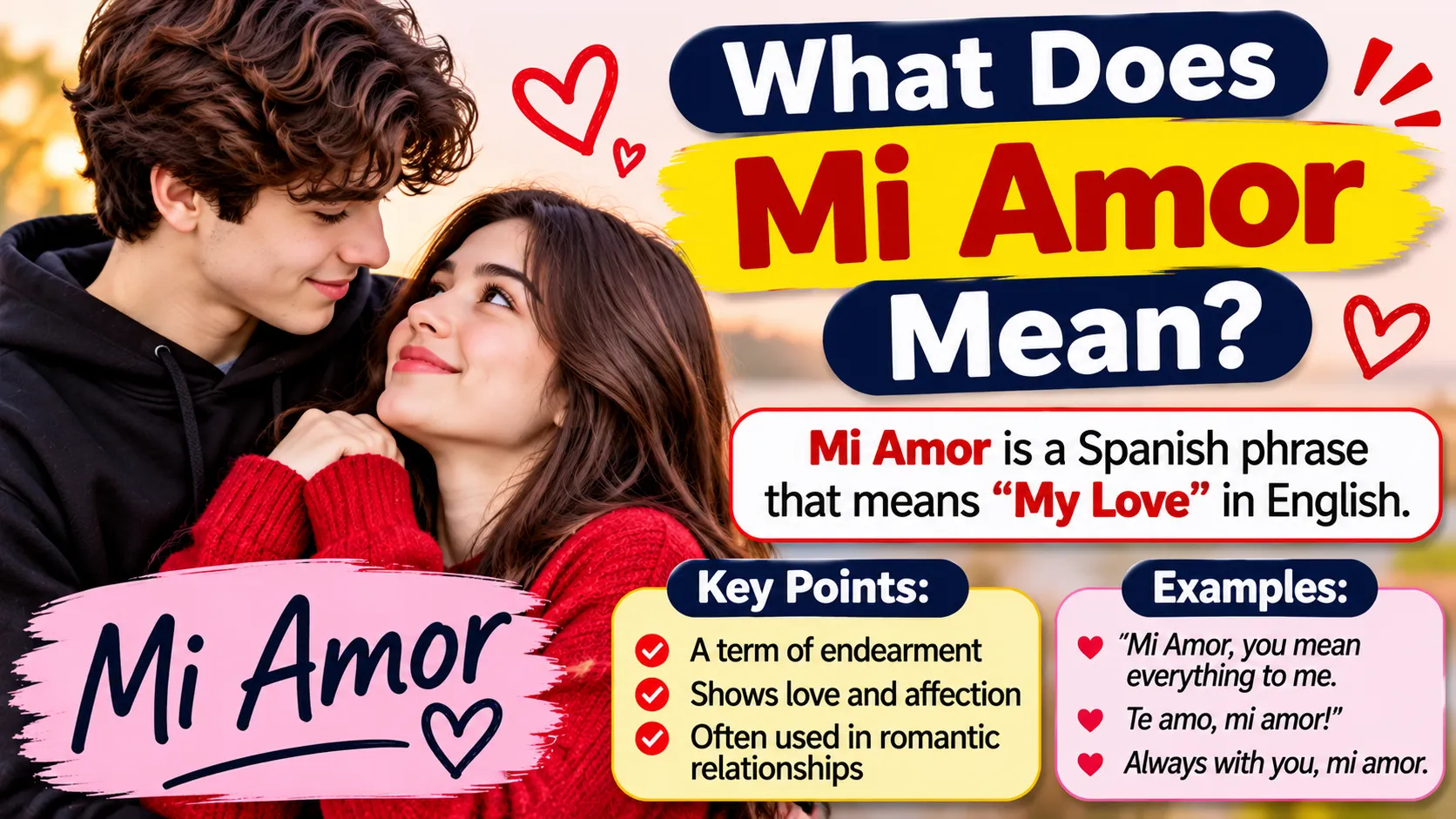
Mi amor is a Spanish expression that literally translates to “my love” in English. People use it to communicate affection, tenderness, appreciation, and emotional closeness toward another person.
It is one of the most recognizable Spanish terms of endearment. You might hear it between couples, parents and children, family members, or people who share a close relationship.
Here are some examples:
- Hola, mi amor. — Hello, my love.
- Te extraño, mi amor. — I miss you, my love.
- Buenos días, mi amor. — Good morning, my love.
- Ven aquí, mi amor. — Come here, sweetheart.
- Buenas noches, mi amor. — Good night, my love.
The phrase doesn’t always indicate romantic feelings. A mother might call her child mi amor, while a romantic partner might use it as a sweet nickname.
Ultimately, the speaker’s relationship with the listener and the surrounding situation help determine its intended meaning.
2. Mi Amor Meaning in English
The direct English translation of mi amor is “my love.” However, people can interpret it in several affectionate ways depending on the conversation.
Here are some common English equivalents:
| Spanish expression | English meaning |
| Mi amor | My love |
| Mi amor | Darling |
| Mi amor | Sweetheart |
| Mi amor | Honey |
| Mi amor | Baby |
| Mi amor | My beloved |
| Mi amor | Love |
For example, “¿Cómo estás, mi amor?” naturally translates to “How are you, sweetheart?”
Similarly, “Buenas noches, mi amor” means “Good night, my love.”
Although these translations communicate similar feelings, their emotional tones can vary. Honey may sound casual and familiar, while my beloved can feel more romantic or poetic.
The best translation depends on the speaker’s intention rather than a single fixed English equivalent.
3. What Does Mi Amor Mean in Spanish?
In Spanish, mi amor is an affectionate expression formed by combining two words: mi and amor.
Understanding these words makes the phrase easier to recognize and use.
Mi: This Spanish possessive adjective means “my.” It expresses possession or a personal connection.
Amor: This Spanish noun means “love.” It describes affection, emotional attachment, or a strong feeling of care.
When combined, they form mi amor, meaning “my love.”
Consider these examples:
- Mi amor por ti es verdadero. — My love for you is genuine.
- Eres mi amor. — You are my love.
- El amor es importante. — Love is important.
- Mi amor es infinito. — My love is endless.
Spanish speakers can use mi amor to address someone directly or as part of a sentence describing love.
One important grammatical detail is that amor is a masculine noun in Spanish. However, mi amor can refer to a person of any gender. You don’t change the expression when speaking to a man or a woman.
4. How to Pronounce Mi Amor
The expression mi amor is relatively easy to pronounce, even if you’re new to Spanish.
Pronunciation: Mee ah-MOR
International Phonetic Alphabet (IPA): /mi aˈmoɾ/
The pronunciation has three main parts:
- Mi: Sounds like “mee.”
- A: Sounds like the “ah” in father.
- Mor: Sounds approximately like “more,” but with a light Spanish r.
The strongest emphasis falls on the final syllable of amor.
Try saying the entire expression smoothly: mee ah-MOR.
Avoid placing a long pause between mi and amor. In natural Spanish speech, the two words often flow together.
Here are a few additional examples:
| Spanish phrase | Approximate pronunciation |
| Mi amor | Mee ah-MOR |
| Hola, mi amor | OH-lah mee ah-MOR |
| Te amo, mi amor | Teh AH-moh mee ah-MOR |
| Buenos días, mi amor | BWEH-nohs DEE-ahs mee ah-MOR |
Learning the pronunciation can help you recognize the expression when someone says it in person, in a video, or during a phone conversation.
5. What Does It Mean When Someone Calls You Mi Amor?
When someone calls you mi amor, they are usually expressing affection or speaking to you in a warm, loving way.
However, it doesn’t automatically mean they are romantically interested in you.
The meaning depends on your relationship, the speaker’s personality, and the situation.
When your partner says it
If your boyfriend, girlfriend, husband, or wife calls you mi amor, it is generally a romantic nickname. It communicates affection, closeness, and appreciation.
Example:
“Te quiero mucho, mi amor.”
Meaning: I love you very much, my love.
When a family member says it
Parents, grandparents, and other relatives may use mi amor to express care and tenderness.
Example:
“¿Estás bien, mi amor?”
Meaning: Are you okay, sweetheart?
When a friend says it
Some Spanish speakers use affectionate expressions with close friends. In this situation, mi amor may communicate friendliness rather than romantic attraction.
When a stranger says it
In certain Spanish-speaking regions and social settings, shopkeepers, service workers, or strangers may use mi amor as a friendly form of address.
For example:
“¿Qué necesitas, mi amor?”
Meaning: What do you need, dear?
Therefore, don’t assume someone has fallen in love with you simply because they use this expression.
6. Is Mi Amor Romantic or Friendly?
Mi amor can be romantic, friendly, familial, or simply polite. Its meaning depends on the relationship and cultural context.
This is one of the most important things to understand before interpreting the expression.
| Situation | Possible meaning |
| Romantic partner | My love, darling |
| Husband or wife | My sweetheart |
| Parent to child | Sweetheart, my dear |
| Grandparent to grandchild | My precious one |
| Close friend | Dear, sweetheart |
| Shopkeeper to customer | Dear, love |
| Stranger in a friendly setting | A warm form of address |
Romantic meaning
In a relationship, mi amor can be a deeply affectionate nickname. Couples often use it in conversations, romantic messages, and everyday greetings.
Friendly meaning
Friends may use the expression to sound warm and caring. It doesn’t necessarily suggest flirting or a romantic relationship.
Family meaning
Parents and grandparents frequently use affectionate words when speaking to children or younger relatives. Mi amor can communicate protection, tenderness, and unconditional care.
Cultural meaning
The way people use affectionate expressions varies across Spanish-speaking countries and communities. An expression that sounds romantic to an English speaker may be an ordinary friendly greeting in another setting.
The best way to understand someone’s intention is to consider their behavior, relationship with you, and overall communication style.
7. Can You Call a Man or Woman Mi Amor?
Yes! You can call both men and women mi amor.
The expression doesn’t change according to the gender of the person you’re addressing.
For example:
- A woman can call her boyfriend mi amor.
- A man can call his girlfriend mi amor.
- Parents can call their sons or daughters mi amor.
- Friends can use it regardless of gender.
This is because amor is a masculine noun in Spanish, but the phrase refers to the feeling of love rather than the gender of the person receiving the nickname.
Compare these examples:
Speaking to a man:
“Buenos días, mi amor.”
Good morning, my love.
Speaking to a woman:
“Buenos días, mi amor.”
Good morning, my love.
Notice that the Spanish expression stays exactly the same.
You don’t need to change it to mi amora or mi amore when addressing someone of a different gender. Mi amor is the standard expression.
8. What Does Mi Amor Mean in Texting?
In texting, mi amor generally means “my love,” “Sweetheart,” or “darling.” People use it in romantic conversations, affectionate messages, social media comments, and everyday chats.
It can make a message sound warmer and more personal.
Here are some examples of how people might use it in messages.
1. Romantic morning message
“Buenos días, mi amor. Espero que tengas un día maravilloso.”
Meaning: Good morning, my love. I hope you have a wonderful day.
2. Sweet goodnight message
“Duerme bien, mi amor. Te veo mañana.”
Meaning: Sleep well, my love. I’ll see you tomorrow.
3. Expressing missing someone
“Te extraño mucho, mi amor.”
Meaning: I miss you so much, my love.
4. Showing appreciation
“Gracias por todo, mi amor.”
Meaning: Thank you for everything, my love.
5. Checking on someone
“¿Cómo estás, mi amor?”
Meaning: How are you, sweetheart?
6. Sending an affectionate reply
“Yo también te quiero, mi amor.”
Meaning: I love you too, my love.
On WhatsApp, Instagram, Snapchat, or other messaging platforms, the expression can also appear with heart emojis or romantic captions.
However, remember that a message containing mi amor isn’t automatically a confession of love. The conversation and relationship provide the real context.
9. How to Respond When Someone Says Mi Amor
If someone calls you mi amor, you can respond in several ways depending on your relationship and comfort level.
You don’t have to use Spanish in your reply. A simple English response is perfectly natural.
Here are some possible replies:
| Response | English meaning |
| Hola, mi amor | Hello, my love |
| Gracias, cariño | Thank you, darling |
| Tú también | You too |
| ¿Cómo estás? | How are you? |
| Gracias, sweetheart | Thank you, sweetheart |
| Hola, querido | Hello, dear (to a man) |
| Hola, querida | Hello, dear (to a woman) |
| ¡Qué lindo! | How sweet! |
If your romantic partner says it:
You can reply with “Yo también te amo,” meaning “I love you too,” if that reflects your feelings.
If a friend says it:
A friendly “Hola” or “Gracias” is enough. You don’t need to respond romantically.
If a stranger says it:
You can simply smile, say thank you, or continue the conversation normally.
If you’re uncomfortable with it:
You can politely respond using their name or explain that you prefer a different form of address.
The most important thing is to choose a response that feels natural to you.

10. How to Use Mi Amor in a Sentence
Mi amor is a flexible expression that can appear in greetings, romantic conversations, family interactions, and everyday sentences.
Here are some useful Spanish sentences with their English translations.
| Spanish sentence | English translation |
| Hola, mi amor. | Hello, my love. |
| Buenos días, mi amor. | Good morning, my love. |
| Buenas noches, mi amor. | Good night, my love. |
| Te extraño, mi amor. | I miss you, my love. |
| Te amo, mi amor. | I love you, my love. |
| Gracias, mi amor. | Thank you, sweetheart. |
| Ven aquí, mi amor. | Come here, my love. |
| Cuídate, mi amor. | Take care, my love. |
| Eres especial, mi amor. | You are special, my love. |
| Siempre estaré contigo, mi amor. | I will always be with you, my love. |
| ¿Qué haces, mi amor? | What are you doing, sweetheart? |
| No te preocupes, mi amor. | Don’t worry, my love. |
| Feliz cumpleaños, mi amor. | Happy birthday, my love. |
| Hasta mañana, mi amor. | See you tomorrow, my love. |
| Estoy aquí para ti, mi amor. | I’m here for you, my love. |
These examples can help you understand how Spanish speakers naturally incorporate the expression into different conversations.
You can also place mi amor at the beginning or end of a sentence when addressing someone affectionately.
11. Mi Amor vs. Mi Vida vs. Cariño
Spanish has several affectionate expressions that English speakers may translate as “my love,” “darling,” or “sweetheart.”
However, these expressions have slightly different meanings and emotional tones.
| Spanish expression | Literal English meaning | Common usage |
| Mi amor | My love | Romantic and affectionate |
| Mi vida | My life | Deep affection and tenderness |
| Cariño | Affection / dear | Warm and caring |
| Mi corazón | My heart | Emotional affection |
| Mi cielo | My heaven | Sweet and tender |
| Mi querido | My dear | Affectionate address to a man |
| Mi querida | My dear | Affectionate address to a woman |
| Mi amorcito | My little love | Cute and intimate |
Mi amor vs. mi vida
Mi amor literally means “my love,” while mi vida means “my life.” Both can be used as affectionate nicknames, but mi vida often emphasizes how precious someone is to the speaker.
Mi amor vs. cariño
Mi amor directly refers to love. Cariño can mean affection, fondness, or an affectionate form of address similar to “dear.”
Mi amor vs. mi corazón
Mi corazón means “my heart.” It is another affectionate expression that can communicate emotional closeness and tenderness.
Mi amor vs. mi amorcito
Mi amorcito is a diminutive form of mi amor. It can sound especially cute, tender, or playful.
Although these phrases share similar meanings, their natural use depends on the speaker, relationship, and personal preference.
12. Mi Amor vs. Te Amo vs. Te Quiero
Mi amor, te amo, and te quiero are three Spanish Expressions connected to love and affection. However, they don’t serve the same grammatical purpose.
Understanding their differences can help you avoid confusing a nickname with an actual statement of love.
| Spanish expression | English meaning | Purpose |
| Mi amor | My love | Affectionate nickname |
| Te amo | I love you | Expression of love |
| Te quiero | I love you / I care about you | Expression of affection |
| Amor mío | My love | Affectionate form of address |
Mi amor
People use this expression to address someone they love or care about.
Example: “Hola, mi amor.”
Meaning: Hello, my love.
Te amo
Te amo is a direct statement meaning “I love you.” It often communicates deep romantic love or strong affection toward someone.
Example: “Te amo con todo mi corazón.”
Meaning: I love you with all my heart.
Te quiero
Te quiero also means “I love you,” but it can be used across different relationships, including romantic partnerships, friendships, and family relationships.
Example: “Te quiero mucho.”
Meaning: I love you very much.
Can you use these expressions together?
Absolutely!
“Te amo, mi amor.”
Meaning: I love you, my love.
Here, te amo expresses the feeling, while mi amor is the affectionate nickname.
Remember that te amo and te quiero can overlap in meaning. Their emotional intensity varies by region, relationship, and personal speaking habits.
Related To Another Article: https://genzwishes.com/what-does-white-nail-polish-mean/
13. Is Mi Amor the Same as Amor Mío?
Mi amor and amor mío both translate to “my love” in English. They express affection and can be used to address someone you care about.
However, their word order and natural tone are slightly different.
Mi amor
This is the standard and widely used expression in everyday Spanish conversations.
Example:
“Buenos días, mi amor.”
Meaning: Good morning, my love.
Amor mío
This expression places the possessive word after the noun. It can sound more poetic, emotional, or expressive, depending on the context.
Example:
“Amor mío, nunca te olvidaré.”
Meaning: My love, I will never forget you.
What’s the difference?
| Mi amor | Amor mío |
| My love | My love |
| Common everyday expression | Often more expressive |
| Natural in casual conversations | Can sound poetic or dramatic |
| Frequently used as a nickname | Often used in emotional expressions |
Both are correct Spanish expressions. You can choose either depending on your speaking style and the situation.
14. Common Mistakes When Using Mi Amor
Although mi amor is a simple expression, Spanish learners sometimes misunderstand its spelling, grammar, and appropriate usage.
Here are some common mistakes to avoid.
1. Thinking mi amor is only for romantic partners
This is incorrect. Family members, children, close friends, and sometimes strangers may also be addressed this way.
2. Changing the phrase according to gender
The standard expression remains mi amor when speaking to either a man or a woman.
You don’t need to write mi amora or mi amore.
3. Adding an unnecessary accent
The correct spelling is mi amor, without an accent on mi.
Spanish distinguishes between mi (my) and mí (me, usually after a preposition).
For example:
- Mi amor es especial. — My love is special.
- Este regalo es para mí. — This gift is for me.
4. Assuming it always means romantic love
Context matters. Someone may use mi amor simply to sound friendly or affectionate.
5. Confusing mi amor with te amo
Mi amor is an affectionate nickname, while te amo means “I love you.” They are related but grammatically different expressions.
6. Pronouncing the final r incorrectly
The Spanish r in amor is generally a light tap rather than the English r sound. Practicing the correct pronunciation makes the expression sound more natural.
Avoiding these mistakes will help you understand and use mi amor more confidently.
15. Why Mi Amor Is a Popular Spanish Term of Endearment
Mi Amor Remains a recognizable and widely understood Spanish expression because it communicates affection in just two simple words.
It can make everyday conversations feel more personal, warm, and emotionally meaningful.
There are several reasons people enjoy using it.
1. It expresses affection naturally
Instead of using someone’s name every time, a speaker can use mi amor to communicate warmth and closeness.
2. It works across different relationships
The phrase isn’t restricted to couples. Parents, grandparents, and other close people can also use it.
3. It’s easy to understand
Even people who don’t speak Spanish may recognize its English translation because it appears frequently in music, movies, social media, and everyday conversations.
4. It sounds affectionate
Its gentle pronunciation and emotional meaning make it a popular choice for romantic messages and personal conversations.
5. It has a simple but meaningful translation
Although the phrase contains only two words, it can communicate love, care, tenderness, and appreciation.
Whether someone uses it in a romantic message, a family conversation, or a friendly greeting, mi amor remains a beautiful example of how language can express human connection.
People Also Ask
A: No. Mi amor literally means “my love.” It is commonly used as an affectionate nickname. The Spanish expression te amo means “I love you.”
A: Mi amor can be both romantic and friendly. Couples use it as a romantic nickname, while family members and some friends use it to express affection. In certain regions, it can also be a friendly form of address.
A: Yes. Mi amor is gender-neutral when used to address someone. You can call a boyfriend, husband, male friend, or family member mi amor without changing the expression.
A: You can respond with “Hola, mi amor,” “Gracias, cariño,” or a simple “Thank you.” Your response should depend on your relationship with the person and whether you feel comfortable using affectionate language.
A: Mi amor literally means “my love,” while mi vida means “my life.” Both are affectionate Spanish expressions, but mi vida often communicates a particularly tender feeling by describing someone as precious to your life.
Conclusion
So, what does mi amor mean? It is a beautiful Spanish expression that translates directly to “My Love” in English. People use it to communicate affection, tenderness, appreciation, and emotional closeness.
You might hear it between romantic partners, family members, close friends, or even strangers in certain cultural settings. It can be romantic, friendly, or simply a warm way to address someone.
Remember that mi amor works for both men and women, is pronounced “mee ah-MOR,” and doesn’t automatically mean someone is romantically interested in you.
Now that you understand its meaning, pronunciation, and everyday usage, you’ll be able to recognize this lovely Spanish expression whenever it appears in a conversation or message.