Introduction
Have you ever heard someone say “Mashallah” while admiring a beautiful baby, celebrating an achievement, or complimenting someone’s new home? This popular Arabic expression conveys appreciation, humility, and recognition of Allah’s will.
But what does it actually mean? Is it another way to say “beautiful,” “amazing,” or “God bless”? When should you use it, and what should you say when someone uses it toward you?
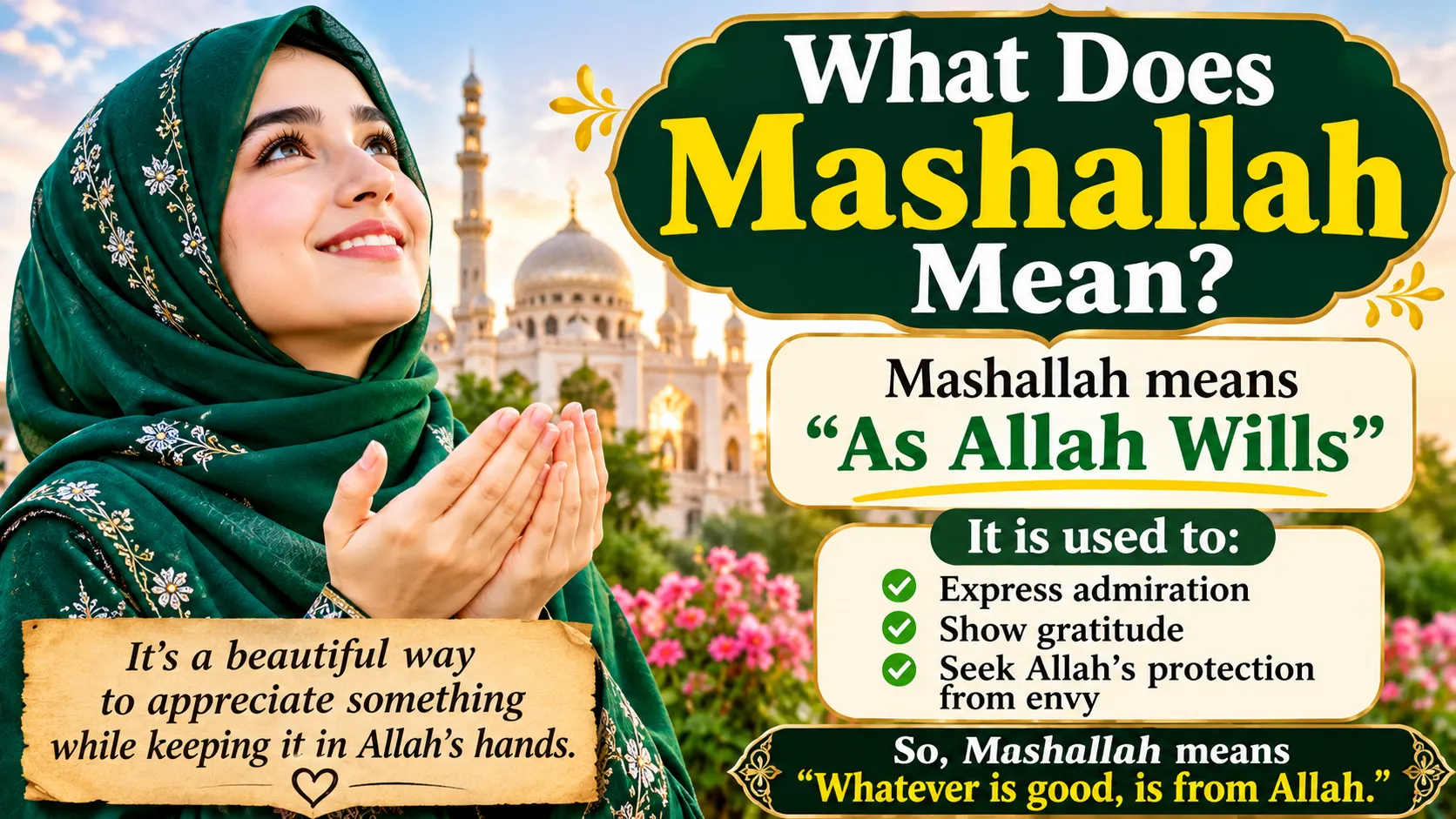
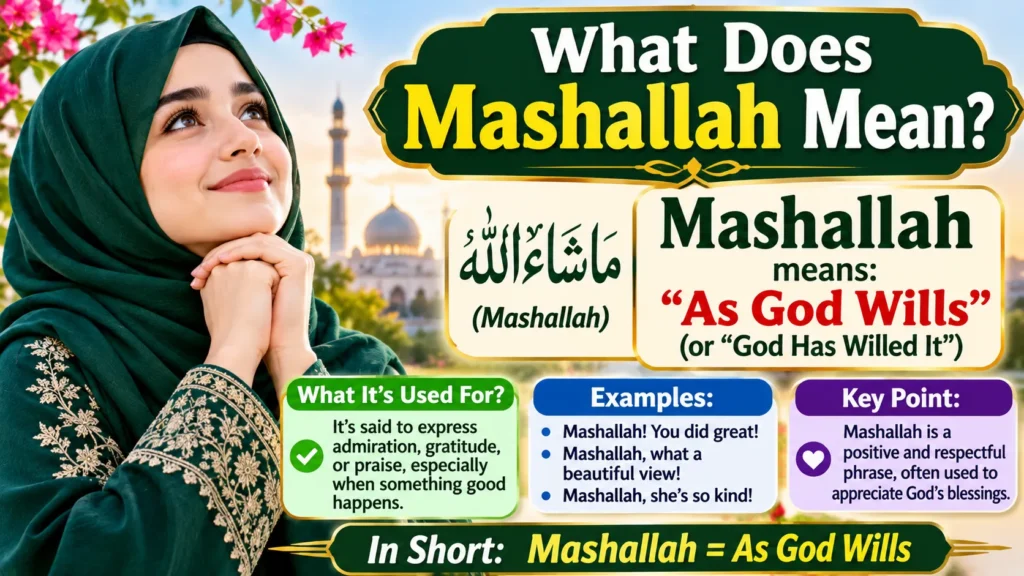
Mashallah (ما شاء الله) means “what Allah has willed” or “what God has willed.” Muslims commonly use this Arabic expression when appreciating something good, expressing admiration, or acknowledging a blessing.
In this guide, you’ll discover its English and Arabic meanings, pronunciation, Islamic significance, everyday examples, and appropriate responses. You’ll also learn how it differs from Inshallah, Alhamdulillah, and other popular Islamic expressions.
1. What Does Mashallah Mean?
Mashallah is an Arabic expression meaning “what Allah has willed.” Muslims commonly say it when appreciating something beautiful, celebrating an achievement, or recognizing a blessing.
For example, imagine your friend shows you a picture of their newborn baby. You might respond, “What a beautiful baby!” This communicates admiration while acknowledging Allah’s will.
People also use this expression when:
- Admiring a beautiful baby or child.
- Complimenting someone’s appearance.
- Celebrating academic achievements.
- Appreciating a beautiful home.
- Hearing wonderful news.
- Recognizing someone’s talents.
- Celebrating professional success.
Although English speakers sometimes translate Mashallah as “God bless,” its literal meaning is closer to “what Allah has willed.”
The expression also reminds believers to remain humble and appreciate the blessings they enjoy.
2. What Is the Literal Meaning of Mashallah?
Understanding the individual Arabic words makes the complete meaning easier to remember. Mashallah consists of three components that combine to express recognition of Allah’s will.
The Arabic expression is written as ما شاء الله.
Here is its word-by-word breakdown:
| Arabic | Transliteration | English meaning |
| مَا | Ma | What |
| شَاءَ | Sha’a | Willed |
| اللَّهُ | Allah | Allah or God |
Together, these words mean “What Allah has willed.”
The expression reflects the Islamic belief that everything happens according to Allah’s will. Therefore, when someone says Mashallah, they acknowledge that a beautiful or positive thing exists through His will.
For example, if someone achieves excellent examination results, you might say, “Mashallah, you worked so hard!”
This communicates appreciation while recognizing the blessings behind the achievement.
3. Mashallah in Arabic: Spelling and Pronunciation
The correct Arabic spelling is ما شاء الله. You may also see it written with vowel markings as مَا شَاءَ اللَّهُ.
Although English spellings vary, they generally represent the same Arabic expression.
Common English spellings include:
- Mashallah
- Masha Allah
- Masha’Allah
- Ma Sha Allah
- Ma Shaa Allah
- MashAllah
How to pronounce Mashallah
A helpful pronunciation guide is:
Maa-Shaa-Allah
Break the expression into three parts:
- Maa: Pronounce it with a long “aa” sound.
- Shaa: Pronounce it like “shah.”
- Allah: Pronounce the name of Allah naturally.
Put the sounds together to say Maa-Shaa-Allah.
Arabic pronunciation has sounds that English cannot represent perfectly, so this is an approximate, beginner-friendly guide.
4. What Does Mashallah Mean in Islam?
In Islam, it expresses recognition that blessings and good things exist through Allah’s will. It encourages believers to appreciate what they have rather than becoming excessively proud of their possessions or achievements.
When Muslims admire something, they may use this expression to acknowledge Allah as the source of blessings.
For instance, parents might hear someone say Mashallah when admiring their child’s growth. Similarly, friends may use it when celebrating someone’s success or appreciating a new home.
The expression communicates several important ideas:
- Recognition: Acknowledging Allah’s will and power.
- Appreciation: Recognizing positive things as blessings.
- Humility: Remembering that achievements and possessions are not independent of Allah.
- Good intentions: Expressing admiration without wishing harm or envy.
- Gratitude: Remembering the Creator when enjoying something beautiful.
Mashallah is more than an ordinary compliment. It carries religious meaning that makes it different from simply saying “Wow!” or “That’s amazing!”
Muslims commonly use it in everyday conversations, family discussions, messages, and social media comments.
5. Where Does Mashallah Appear in the Quran?
An important Quranic connection appears in Surah Al-Kahf, verse 39. This verse contains the expression within a longer statement about recognizing Allah’s power.
The relevant Arabic passage is:
مَا شَاءَ اللَّهُ لَا قُوَّةَ إِلَّا بِاللَّهِ
Its meaning is:
“What Allah has willed; there is no power except through Allah.”
The verse appears in the story of two men, one of whom possessed beautiful gardens and considerable wealth. He became overly confident about his possessions.
His companion reminded him to acknowledge Allah’s will instead of relying on his own power.
This passage teaches an important lesson: wealth, property, achievements, and other blessings should inspire humility rather than arrogance.
The verse provides valuable context for understanding its connection to appreciating blessings.
You can read the complete passage in Surah Al-Kahf 18:32–42, especially verse 39.
6. When Should You Say Mashallah?
People commonly say it when they Notice Something Positive, beautiful, or impressive. It offers a natural way to express admiration while recognizing Allah’s blessings.
Here are some everyday situations where this expression fits naturally.
1. When admiring a baby
You can say Mashallah when seeing a newborn or appreciating a child’s growth.
Example: “Mashallah, your little daughter is adorable!”
2. When complimenting someone’s appearance
Use it when appreciating someone’s beautiful appearance or personal style.
Example: “Mashallah, you look wonderful today!”
3. When celebrating academic success
It works well when someone receives excellent grades or graduates.
Example: “You achieved the highest marks in your class!”
4. When admiring a new home
You can express appreciation for someone’s house or beautiful living space.
Example: “Your new home looks amazing!”
5. When someone starts a business
Use it when celebrating a new business or professional achievement.
Example: “Your business is growing quickly!”
6. When admiring a car
Example: “That’s a beautiful car!”
7. When appreciating someone’s talent
Example: “You have an incredible artistic talent!”
8. When hearing good news
Example: “Congratulations on your new job!”
9. When someone improves their skills
Example: “Your English has improved so much!”
10. When admiring a beautiful garden
Example: “Your garden looks so peaceful!”
You can use the expression in many other positive situations. The important thing is to understand its meaning and use it sincerely.
7. 15 Examples of Mashallah in Everyday Conversations
Learning practical examples makes it easier to understand how people use Mashallah naturally. These sentences cover family, education, friendships, achievements, and everyday compliments.
- “Mashallah, your baby has the sweetest smile!”
- “Mashallah, you got excellent marks in your examination!”
- “Your new house is beautiful!”
- “Mashallah, your family looks so happy together!”
- “You have made incredible progress!”
- “Mashallah, your little son is growing up so quickly!”
- “Your photography skills are amazing!”
- “Mashallah, what a wonderful achievement!”
- “Your garden looks absolutely beautiful!”
- “Mashallah, you finally achieved your dream!”
- “That is a gorgeous wedding dress, Mashallah!”
- “Mashallah, your business is doing really well!”
- “Your daughter is very talented, Mashallah!”
- “Mashallah, you have such a beautiful family!”
- “What wonderful news! Mashallah, congratulations!”
These examples show that Mashallah can appear before or after a compliment. Its placement depends on the speaker’s natural conversational style.
8. How to Respond When Someone Says Mashallah
When someone says Mashallah about you, your family, or something you own, you can respond politely and warmly. There is no single mandatory conversational reply that everyone must use.
Your response can depend on the situation, relationship, and cultural background.
Here are some common responses:
| Response | Meaning |
| Alhamdulillah | All praise belongs to Allah |
| JazakAllahu Khairan | May Allah reward you with goodness |
| BarakAllahu Feek | May Allah bless you |
| Ameen | May it be accepted |
| Thank you | A simple expression of appreciation |
Example conversations
Conversation 1
Person A: “Mashallah, your daughter is beautiful!”
Person B: “Alhamdulillah, thank you!”
Conversation 2
Person A: “Mashallah, you got an excellent result!”
Person B: “JazakAllahu Khairan!”
Conversation 3
Person A: “Mashallah, your new house looks wonderful!”
Person B: “Thank you! Alhamdulillah.”
Conversation 4
Person A: “Mashallah, your business is growing!”
Person B: “BarakAllahu Feek!”
A sincere and respectful response is appropriate. You can also simply thank the person and express gratitude to Allah.
9. Mashallah vs. Inshallah: What’s the Difference?
Mashallah And Inshallah are two common Arabic expressions. Although they both refer to Allah’s will, they have different meanings and purposes.
Mashallah (ما شاء الله) means “what Allah has willed.” People commonly say it when appreciating something that already exists or has happened.
Inshallah (إن شاء الله) means “if Allah wills.” People use it when discussing future plans, intentions, or hopes.
Here is a simple comparison:
| Feature | Mashallah | Inshallah |
| Arabic | ما شاء الله | إن شاء الله |
| Meaning | What Allah has willed | If Allah wills |
| Common use | Present blessings and past achievements | Future plans and hopes |
| Example | Mashallah, your house is beautiful! | Inshallah, I will visit tomorrow. |
| Main purpose | Appreciation | Expressing hope with reliance on Allah’s will |
Easy way to remember:
Use Mashallah when admiring something that already exists.
Use Inshallah when talking about something you hope will happen in the future.
For example:
- “Mashallah, you have a beautiful garden!”
- “Inshallah, I will have a beautiful garden someday!”
Understanding this difference helps you use both expressions correctly.
10. Mashallah vs. Alhamdulillah vs. Subhanallah
Mashallah, Alhamdulillah, and Subhanallah are three widely used Islamic expressions. They all have religious significance, but each communicates a different message.
Mashallah (ما شاء الله)
Meaning: What Allah has willed.
People use it to express admiration and acknowledge something good as a blessing from Allah.
Example: “Mashallah, your son is very talented!”
Alhamdulillah (الْحَمْدُ لِلَّهِ)
Meaning: All praise and thanks belong to Allah.
Muslims use it to express gratitude for blessings, good health, positive outcomes, and everyday experiences.
Example: “Alhamdulillah, I passed my examination!”
Subhanallah (سُبْحَانَ اللَّهِ)
Meaning: Glory be to Allah.
People use it to express Allah’s perfection and greatness. It can also be said when witnessing something remarkable or expressing amazement.
Example: “Subhanallah, what a beautiful view!”
Comparison table
| Expression | English meaning | Common purpose |
| Mashallah | What Allah has willed | Admiration |
| Alhamdulillah | All praise belongs to Allah | Gratitude |
| Subhanallah | Glory be to Allah | Glorification and amazement |
| Inshallah | If Allah wills | Future intentions |
Although these expressions sometimes appear in similar conversations, they are not interchangeable.
Learning their individual meanings helps you communicate more accurately and respectfully.
11. What Does Mashallah Tabarakallah Mean?
Mashallah Tabarakallah combines two Arabic expressions that people commonly use together when appreciating something beautiful or recognizing a blessing.
Mashallah (ما شاء الله): What Allah has willed.
Tabarakallah (تَبَارَكَ اللَّهُ): Blessed is Allah.
Together, these expressions acknowledge Allah’s will and praise His greatness and blessings.
For example:
“Mashallah Tabarakallah, your children are growing up beautifully!”
Another example:
“Mashallah Tabarakallah, you have achieved something wonderful!”
You may see this combination in social media comments, family conversations, and messages celebrating achievements.
Both expressions have their own meanings, even when people use them together.
12. Is Mashallah Related to the Evil Eye?
Many people associate Mashallah with the evil eye. This association is common in Muslim communities, particularly when people admire children, beauty, wealth, or other blessings.
The evil eye is recognized in Islamic teachings. Sahih Muslim 2188 contains a narration from Prophet Muhammad (peace be upon him) affirming its reality.
Another relevant teaching appears in Sunan Ibn Majah 3509. It reports the instruction to pray for blessings when admiring something belonging to another person.
This distinction matters: the religious teaching about praying for blessings should not be confused with a claim that simply saying Mashallah automatically guarantees protection.
Many Muslims use Mashallah when admiring something because it acknowledges Allah’s will and reflects positive intentions.
You may also hear the expression:
Allahumma Barik (اللَّهُمَّ بَارِكْ)
Meaning: “O Allah, bless it.”
This is a supplication asking Allah to grant blessings.
Therefore, Mashallah and prayers for blessings are closely associated with the way many Muslims express admiration without envy.
Related To Another Article: https://genzwishes.com/what-does-nty-mean/
13. Common Mistakes When Using Mashallah
Although Mashallah is a familiar expression, people sometimes misunderstand its meaning or use it in situations where another phrase would be more appropriate.
Here are some common mistakes to avoid.
1. Confusing Mashallah with Inshallah
Mashallah acknowledges something that exists or has happened. Inshallah expresses hope about the future.
2. Thinking Mashallah only means beautiful
The expression has a broader meaning. It can communicate appreciation for achievements, good news, possessions, family, and other blessings.
3. Treating it as an ordinary compliment
Mashallah is a religious expression that acknowledges Allah’s will. It carries more meaning than simply saying “nice” or “amazing.”
4. Assuming it guarantees protection
Although many Muslims associate Mashallah with the evil eye, it should not be described as a guaranteed protective formula.
5. Confusing its different spellings
Mashallah, Masha Allah, and Masha’Allah are common Romanized forms of the same Arabic expression.
6. Using it without understanding its meaning
Learning what an expression means helps you use it sincerely and appropriately.
Understanding these differences makes everyday communication more respectful and meaningful.
14. How to Use Mashallah Naturally in English Sentences
You do not need to speak Arabic fluently to understand or use Mashallah. Many English-speaking Muslims Naturally Include it in their conversations.
The expression can appear at the beginning, middle, or end of a sentence.
At the beginning:
- “Mashallah, you look amazing today!”
- “Mashallah, your family is doing wonderfully.”
- “Mashallah, what a fantastic achievement!”
In the middle:
- “Your new car is, Mashallah, absolutely beautiful.”
- “Your daughter has, Mashallah, grown so much.”
- “The business is, Mashallah, becoming successful.”
At the end:
- “You have a lovely home, Mashallah.”
- “Your children are very talented, Mashallah.”
- “That was an incredible performance, Mashallah.”
You can also use Mashallah in text messages, social media comments, and family group chats.
For example:
- “Mashallah! So happy for you.”
- “Mashallah, congratulations on your graduation!”
- “Beautiful picture, Mashallah!”
- “May Allah bless your family. Mashallah!”
The key is to use the phrase naturally and understand the positive meaning behind it.
15. People Also Ask
A: Mashallah means “what Allah has willed” or “what God has willed.” Muslims commonly use it to express admiration, appreciation, and recognition of blessings.
A: Yes, Mashallah is commonly used when complimenting someone or admiring something beautiful. However, it carries a deeper religious meaning because it acknowledges Allah’s will rather than functioning as an ordinary compliment.
A: You can respond with Alhamdulillah, JazakAllahu Khairan, BarakAllahu Feek, or a simple thank you. Your response depends on the conversation and personal preference.
A: Mashallah means “what Allah has willed” and is commonly used when appreciating something that already exists or has happened. Inshallah means “if Allah wills” and is used when discussing future plans or hopes.
A: Many Muslims associate Mashallah with protection against envy and the evil eye. Islamic teachings recognize the evil eye and encourage praying for blessings when admiring something. However, saying Mashallah should not be presented as a guaranteed form of protection.
Conclusion
Mashallah is much more than a simple Arabic Expression. It means “what Allah has willed” and reflects appreciation, humility, and recognition of the blessings that come from Allah.
Muslims commonly use it when admiring a beautiful baby, celebrating achievements, appreciating someone’s home, or sharing positive news.
Understanding its Arabic spelling, pronunciation, Quranic connection, and everyday usage helps you use the phrase correctly.
Whether you hear Mashallah in a family conversation, receive it as a compliment, or see it in a social media comment, you now understand the beautiful meaning behind these words.
If you found this explanation helpful, bookmark it and share it with someone who wants to understand common Arabic and Islamic expressions.