Introduction
Have you ever received a text saying “Hey, Habibi!” and wondered what that person meant? Perhaps you heard the word in an Arabic song, saw it in a TikTok video, or noticed someone using it as a nickname for a friend or romantic partner.
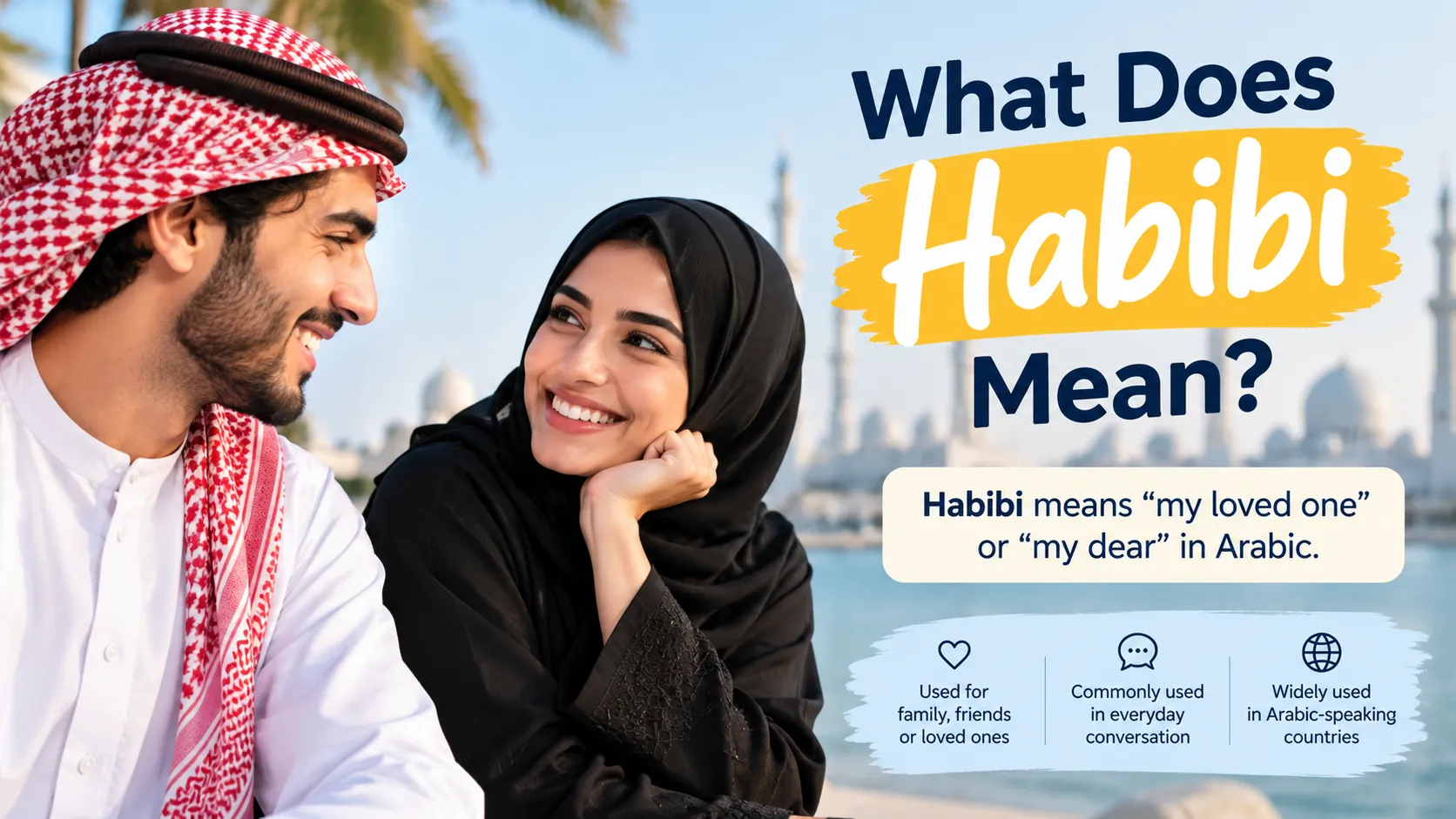
Habibi (حبيبي) is an Arabic word that means “my beloved,” “my dear,” or “my darling.” Depending on the context, it can also be used like “buddy” or “mate.” People use it to express affection, friendliness, and familiarity.
But there is one important detail: habibi does not automatically mean someone is romantically interested in you. Friends, family members, and romantic partners can all use this expression.
In this guide, you will learn the meaning of habibi, its Arabic origin, how to pronounce it, what it means in texts, and how to respond naturally when someone calls you habibi.
1. What Does Habibi Mean?
Habibi is a popular Arabic term of affection that literally means “my beloved” or “my dear.” Depending on the relationship and situation, it can also translate as “darling,” “sweetheart,” “buddy,” or “mate.”
The word expresses warmth and familiarity. A romantic partner might use it as a loving nickname, while a friend might use it as a casual greeting.
Here are 15 examples showing how habibi can appear in everyday English translations:
- “Good morning, habibi!” — A warm greeting.
- “Thank you, habibi.” — Appreciation for someone.
- “How are you, habibi?” — A friendly or affectionate question.
- “Take care, habibi.” — A caring goodbye.
- “Come here, habibi.” — An affectionate way to call someone.
- “Don’t worry, habibi.” — Reassurance and comfort.
- “I missed you, habibi.” — An expression of affection.
- “You’re welcome, habibi.” — A warm response.
- “See you tomorrow, habibi.” — A friendly farewell.
- “Happy birthday, habibi!” — A loving or friendly birthday greeting.
- “Well done, habibi!” — Praise and encouragement.
- “Let’s go, habibi!” — An informal invitation.
- “Are you okay, habibi?” — Concern for someone.
- “Good night, habibi.” — An affectionate bedtime message.
- “You’re the best, habibi!” — Appreciation and warmth.
These translations illustrate possible uses rather than fifteen fixed meanings. The same word can sound romantic in one conversation and completely friendly in another.
2. What Does Habibi Mean in Arabic?
Habibi is written as حبيبي in Arabic. It comes from حبيب (habib), meaning “beloved” or “dear,” combined with ـي (-i), a possessive ending meaning “my.”
Together, these parts give habibi its literal meaning: “my beloved.”
The word is connected to the Arabic root associated with love and affection. A related word, حب (hubb), means “love.”
Here are 15 useful facts about the Arabic word:
- حبيبي is the standard Arabic spelling of habibi.
- The word is read from right to left.
- حبيب means “beloved” or “dear.”
- The ending ـي means “my.”
- Habibi literally means “my beloved.”
- The word is traditionally masculine when addressing someone.
- Habibti is its commonly used feminine counterpart.
- Habibi can be affectionate without being romantic.
- Parents may use it when speaking to their children.
- Friends may use it in casual conversation.
- Romantic partners may use it as a pet name.
- Its tone depends on the relationship and setting.
- Arabic dialects can influence pronunciation.
- Latin-letter spellings can vary between writers.
- Its everyday meaning may be more casual than its literal translation suggests.
Understanding the word’s construction helps explain why it can convey affection without always expressing romantic love.
3. How Do You Pronounce Habibi?
Habibi is commonly approximated in English as ha-BEE-bee. Its Arabic pronunciation is often represented as ḥabībī, with the first consonant coming from the Arabic letter ح.
That first sound is produced deeper in the throat than the ordinary English “h,” so the English spelling is only an approximation.
Here are 15 beginner-friendly pronunciation tips:
- Start with the written form habibi.
- Divide it into three syllables: ha, bi, bi.
- Make the middle vowel sound like “ee.”
- Keep the final vowel similar to the “ee” in “see.”
- Avoid pronouncing the final syllable as “bye.”
- Listen to a native Arabic speaker when possible.
- Notice how the first consonant differs from English “h.”
- Practice saying the word slowly.
- Repeat it at a natural conversational speed.
- Pay attention to the speaker’s Arabic dialect.
- Avoid adding an unnecessary fourth syllable in everyday pronunciation.
- Remember that careful formal pronunciation may differ from casual speech.
- Practice recognizing the word when spoken quickly.
- Do not confuse it with habibti.
- Focus on being understandable rather than immediately achieving a perfect accent.
A useful starting point is to say “ha-bee-bee” slowly, then gradually make the pronunciation more natural.
4. What Does It Mean in English?
The most direct English translations of habibi are “my beloved,” “my dear,” and “my darling.” However, English does not have one word that fits every situation in which Arabic speakers use it.
For example, “my love” might be appropriate between romantic partners, while “buddy” may better capture the meaning between friends.
The following 15 English expressions can help you understand its range:
- My beloved
- My dear
- My darling
- My love
- Sweetheart
- Dear friend
- Buddy
- Mate
- My favorite person
- My precious one
- Dear one
- My sweetheart
- My cherished one
- My lovely friend
- My dear companion
These are possible translations or contextual equivalents, not exact synonyms in every situation.
The best translation depends on the speaker’s intention. When translating a message, consider the entire sentence rather than replacing it with “my lover” every time.
5. Is It Romantic or Friendly?
Habibi can be romantic or friendly. It is an affectionate expression used in several types of relationships, including friendships, families, and romantic partnerships.
The word itself does not establish whether someone has romantic feelings for you. Tone, relationship history, and the rest of the conversation provide more useful clues.
Consider these 15 examples:
- A partner texts, “I miss you, it.” This may be romantic.
- A father says, “Come here, it.” This expresses parental affection.
- A friend says, “Thanks, habibi.” This may simply be friendly.
- A partner writes, “Good night, habibi.” This may be an intimate pet name.
- A friend greets you with, “What’s up, it?” This can be casual.
- A parent reassures a child with, “Don’t worry, habibi.”
- A close friend says, “You did great, it.”
- A romantic partner says, “You’re always in my heart, habibi.”
- A friend writes, “See you tomorrow, habibi.”
- A family member says, “Eat something, it.”
- A partner adds it to a loving anniversary message.
- A friend uses it while joking around.
- A person uses it to make a greeting warmer.
- Someone uses it while offering comfort.
- A speaker uses it as a familiar form of address.
The key takeaway: it can communicate affection, but it does not automatically mean “I love you” or “I want to date you.”

6. What Does It Mean When a Guy Says It?
When a guy calls someone habibi, he may be Expressing Friendship, affection, familiarity, or romantic interest. The word alone cannot tell you which interpretation is correct.
In Arabic-speaking communities, men can use habibi with male friends without any romantic meaning. It can also be used affectionately within families and romantic relationships.
Here are 15 possible situations:
- He uses habibi with all his friends: it may be casual.
- He calls his brother habibi: it may express family affection.
- He calls his partner habibi: it may be a romantic pet name.
- He uses it while thanking you: it may be friendly appreciation.
- He says it while comforting you: it may express care.
- He uses it in a group chat: it may be informal friendliness.
- He adds it to a birthday greeting: it may express warmth.
- He uses it alongside clear romantic compliments: flirting is possible.
- He calls you habibi during a casual greeting: it may be a familiar expression.
- He uses it while joking: it may simply match the playful tone.
- He uses it in a supportive message: it may show kindness.
- He says it when asking for help: it may soften the request.
- He uses it while saying goodbye: it may convey warmth.
- He combines it with an explicit declaration of love: the whole message may be romantic.
- He uses it in a formal or unfamiliar setting: the degree of familiarity depends on local norms.
To interpret his intention, consider whether he uses the word with everyone or mainly with you. Also consider the wider conversation and your existing relationship.
Do not assume that a guy has a crush on you simply because he says habibi.
7. What Does It Mean in Texting?
In texting, habibi can mean “my dear,” “my love,” “darling,” or “buddy.” People use it to make a message sound warmer, friendlier, or more affectionate.
Its meaning depends on the message around it.
Here are 15 realistic texting examples:
- “Hey, habibi! How’s your day going?”
- “Good morning, it. Hope you slept well.”
- “Thank you for everything, habibi.”
- “Don’t stress, it . You’ve got this.”
- “See you soon, habibi!”
- “Happy birthday, habibi! Enjoy your special day.”
- “Good night, habibi. Sweet dreams.”
- “You’re a legend, habibi.”
- “I’m proud of you, habibi.”
- “Take care of yourself, habibi.”
- “No worries, habibi. It happens.”
- “Where are you, habibi? We’re waiting.”
- “You made my day, habibi.”
- “I miss our conversations, habibi.”
- “Thanks for checking on me, habibi.”
The first few examples could be friendly or affectionate. Messages expressing missing someone, romantic feelings, or deep personal attachment may carry a more intimate meaning depending on the relationship.
If you receive a message containing habibi, read the entire conversation before deciding what the sender means.
8. What Is the Difference Between Habibi and Habibti?
The main difference between habibi and habibti is grammatical gender.
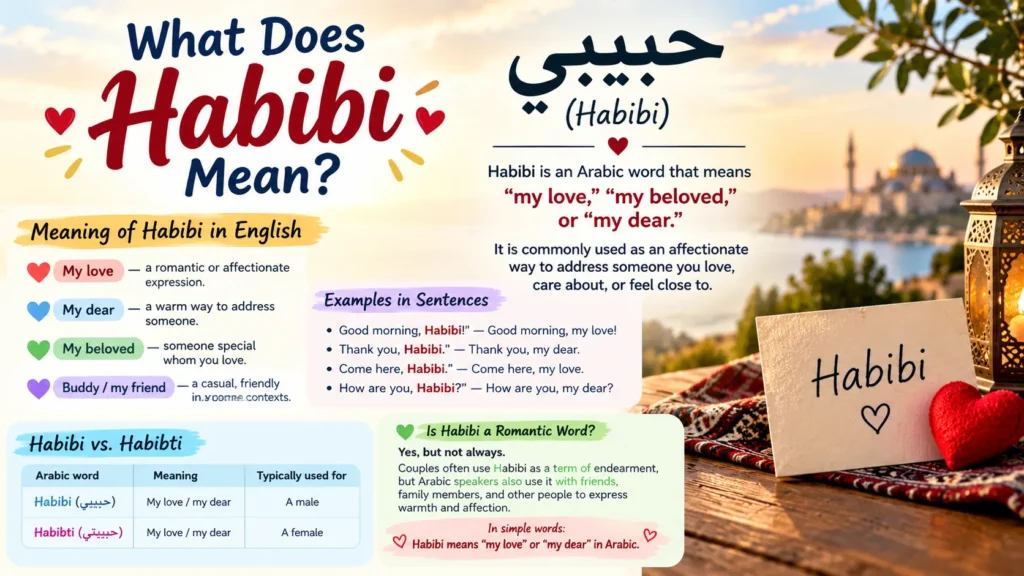
Habibi (حبيبي) is traditionally used when addressing a male, while habibti (حبيبتي) is traditionally used when addressing a female. Both can mean “my beloved,” “my dear,” or “my darling.”
Here are 15 important distinctions:
- Habibi is written حبيبي.
- Habibti is written حبيبتي.
- Habibi is traditionally used for a male addressee.
- Habibti is traditionally used for a female addressee.
- Both are terms of affection.
- Both can be used within families.
- Both can be used between friends.
- Both can be used by romantic partners.
- Neither word automatically signals romantic interest.
- Habibi is commonly approximated as ha-BEE-bee.
- Habibti is commonly pronounced ha-BIB-ti in everyday speech.
- More careful pronunciation of habibti may preserve an additional vowel.
- The feminine form contains the feminine ending associated with حبيبة.
- Dialect can affect how the words sound.
- Context helps determine the most natural English translation.
| Feature | Habibi | Habibti |
| Arabic spelling | حبيبي | حبيبتي |
| Traditional addressee | Male | Female |
| General meaning | My beloved or my dear | My beloved or my dear |
| Family use | Yes | Yes |
| Friendly use | Yes | Yes |
| Romantic use | Yes | Yes |
For example, a mother might call her son habibi and her daughter habibti. Both expressions can be affectionate without having anything to do with romance.
9. How Do You Write Habibi in Arabic?
Habibi is written حبيبي. Arabic uses a right-to-left writing system, so the word may look unfamiliar if you normally read English.
You can copy حبيبي when writing the word in Arabic script. Its feminine counterpart, حبيبتي, is also useful to recognize.
Here are 15 spelling and writing facts:
- The standard Arabic spelling is حبيبي.
- The feminine form is حبيبتي.
- The word is read from right to left.
- حبيب means beloved or dear.
- ـي expresses “my.”
- حب means love in Arabic.
- Habib is a related transliteration.
- Habibi is a common Latin-letter spelling.
- Ḥabībī is a more precise scholarly transliteration.
- The dot under ḥ indicates a distinct Arabic consonant.
- Habibti represents the feminine form in everyday transliteration.
- Ya habibi is written يا حبيبي.
- Transliteration conventions vary.
- Some digital writers use numbers to represent Arabic sounds.
- The spelling 7abibi is sometimes used online, with 7 representing ح.
If you are writing for an Arabic-speaking audience, using the correct Arabic script is a useful way to avoid spelling confusion.
10. What Does Ya Habibi Mean?
Ya habibi means “O my dear,” “hey, my dear,” or “my beloved.” The expression combines يا (ya), used when addressing someone, with حبيبي (habibi), meaning “my beloved” or “my dear.”
People use ya habibi to call someone’s attention, express affection, or make a conversation sound warmer.
Here are 15 examples of how it may be understood in English:
- “Ya habibi, come here.” — A familiar way to call someone.
- “Ya habibi, how are you?” — A warm greeting.
- “Thank you, ya habibi.” — Affectionate appreciation.
- “Ya habibi, don’t worry.” — Comfort and reassurance.
- “Good morning, ya habibi.” — An affectionate greeting.
- “Ya habibi, listen to me.” — An attempt to get someone’s attention.
- “Come on, ya habibi.” — Encouragement or a request.
- “Ya habibi, you’re late!” — A familiar remark.
- “Take care, ya habibi.” — A caring goodbye.
- “Ya habibi, you did it!” — Celebration and praise.
- “Ya habibi, that’s wonderful.” — Enthusiasm.
- “Ya habibi, sit down.” — A familiar instruction.
- “Ya habibi, everything will be fine.” — Reassurance.
- “Ya habibi, I missed you.” — Affection.
- “Good night, ya habibi.” — A warm farewell.
These English examples illustrate the expression’s possible conversational roles. They are not all literal translations word for word.
As with habibi, the phrase can be friendly, familial, or romantic.
11. How Do You Respond to Habibi?
There is no Single Response required when someone calls you habibi. You can reply naturally according to the message, your relationship, and how comfortable you feel using affectionate language.
Here are 15 possible responses:
- “Hey! How are you?”
- “Good morning! Hope you’re doing well.”
- “Thank you so much.”
- “You’re welcome!”
- “Take care, my friend.”
- “Good night. Sweet dreams!”
- “That’s so sweet of you.”
- “Thanks for checking on me.”
- “See you soon!”
- “I’m doing great. How about you?”
- “You’re the best!”
- “I appreciate you.”
- “Thanks, buddy!”
- “Hope you have an amazing day.”
- “Aww, thank you!”
You can also respond with an Arabic expression if you know how to use it appropriately. However, you do not need to speak Arabic to respond politely.
Example conversation
Person A: “Hey, habibi! How’s everything?”
Person B: “Everything’s good, thanks! How about you?”
This is a perfectly natural response in English. You can match the other person’s warmth without repeating a word you do not yet feel comfortable using.
12. How Is Habibi Used in Everyday Conversation?
Habibi appears in a variety of everyday settings, including family conversations, friendships, romantic relationships, and casual interactions.
Its precise use varies between individuals and Arabic-speaking communities. The following examples show situations in which the word may appear.
Here are 15 everyday contexts:
- A parent comforting a child.
- A friend greeting another friend.
- A partner sending a good-morning text.
- Someone thanking a close friend.
- A family member offering reassurance.
- Friends joking together.
- A person congratulating someone.
- A partner saying good night.
- Someone greeting a familiar person.
- A friend offering emotional support.
- A relative expressing concern.
- A person making a friendly request.
- Someone celebrating an achievement.
- A partner expressing affection.
- A familiar speaker saying goodbye.
The important point is that habibi is not restricted to one type of relationship.
However, affectionate language can feel too familiar in a professional setting or when addressing a stranger. If you are unsure whether the word is appropriate, begin with a neutral greeting and follow the other person’s lead.
Related To Another Article: https://genzwishes.com/happy-raksha-bandhan-wishes/
13. Common Mistakes to Avoid When Using Habibi
Habibi is a straightforward word to recognize, but misunderstanding its context can cause confusion. Learning a few basic distinctions will help you interpret it more accurately.
Here are 15 common mistakes and misconceptions:
- Assuming habibi always means “I love you.”
- Believing that every person who uses it is flirting.
- Confusing habibi with habibti.
- Translating every use as “my lover.”
- Ignoring the relationship between the speakers.
- Treating it as a formal title.
- Assuming every Arabic-speaking community uses it identically.
- Confusing literal meaning with conversational meaning.
- Assuming friends cannot use affectionate expressions.
- Believing that a romantic partner is the only person who can say it.
- Ignoring differences in Arabic dialects.
- Assuming English spelling perfectly represents Arabic pronunciation.
- Treating online transliteration as having only one correct spelling.
- Using intimate language with strangers without considering social norms.
- Concluding someone’s feelings from one word alone.
The best approach is to understand the word and consider the situation in which it appears.

14. Other Arabic Terms of Endearment
Arabic Contains many expressions of affection that can appear in family conversations, friendships, songs, and romantic messages.
Learning related words can help you understand their meanings, although the precise tone may vary by dialect and context.
Here are 15 related Arabic expressions and terms:
| Arabic | Transliteration | General meaning |
| حبيبي | Habibi | My beloved or my dear, addressed to a male |
| حبيبتي | Habibti | My beloved or my dear, addressed to a female |
| حبيب | Habib | Beloved or dear |
| حبيبة | Habiba | Female beloved or dear one |
| يا حبيبي | Ya habibi | O my dear |
| يا حبيبتي | Ya habibti | O my dear, addressed to a female |
| حب | Hubb | Love |
| قلبي | Qalbi | My heart |
| يا قلبي | Ya qalbi | O my heart |
| حياتي | Hayati | My life |
| روحي | Rouhi | My soul |
| عمري | Omri | My life or lifetime |
| يا روحي | Ya rouhi | O my soul |
| يا عمري | Ya omri | O my life or lifetime |
| حبايبي | Habaybi | My dear ones in some dialects |
These expressions do not all have the same emotional meaning. Some are common in casual speech, while others may sound more intimate or poetic depending on the speaker and situation.
If you are learning Arabic for personal messages, learn each expression’s meaning and usage together instead of relying only on a literal translation.
People Also Ask
A: Habibi means “my beloved,” “my dear,” or “my darling” in Arabic. In casual conversation, it can also mean “buddy” or “mate.”
A: No. Habibi means “my beloved” or “my dear,” rather than directly translating to “I love you.” It can express love, but it can also be friendly or familial.
A: Sometimes. Romantic partners use habibi affectionately, but friends and family members also use it. The word alone does not prove romantic interest.
A: A guy may use habibi to address a friend, relative, partner, or familiar person. His intention depends on the relationship and the surrounding conversation.
A: A girl may use habibi as an affectionate expression, a friendly form of address, or a romantic nickname. Its use does not automatically indicate romantic interest.
Conclusion
Habibi is a widely Recognized Arabic expression meaning “my beloved,” “my dear,” or “my darling.” It can express romantic love, family affection, friendship, or casual warmth.
The word is written حبيبي and is commonly pronounced ha-BEE-bee. Its traditional feminine counterpart is habibti (حبيبتي), used when addressing a female.
If someone calls you habibi, consider the relationship and the wider conversation before deciding what they mean. One affectionate word cannot tell you everything about another person’s feelings.