Introduction
DEI stands for Diversity, Equity, and Inclusion. It is a framework that organizations, schools, and businesses use to think about representation, fair opportunities, accessibility, and meaningful participation.
You may see DEI in workplace policies, school programs, Company Announcements, or political discussions. Although the abbreviation is short, each letter represents a different concept.
Understanding what DEI means can help you follow conversations about employment, education, fairness, and workplace culture. This guide explains its definition, real-life examples, related terms, and common misconceptions in simple English.
1. What Does DEI Stand For?
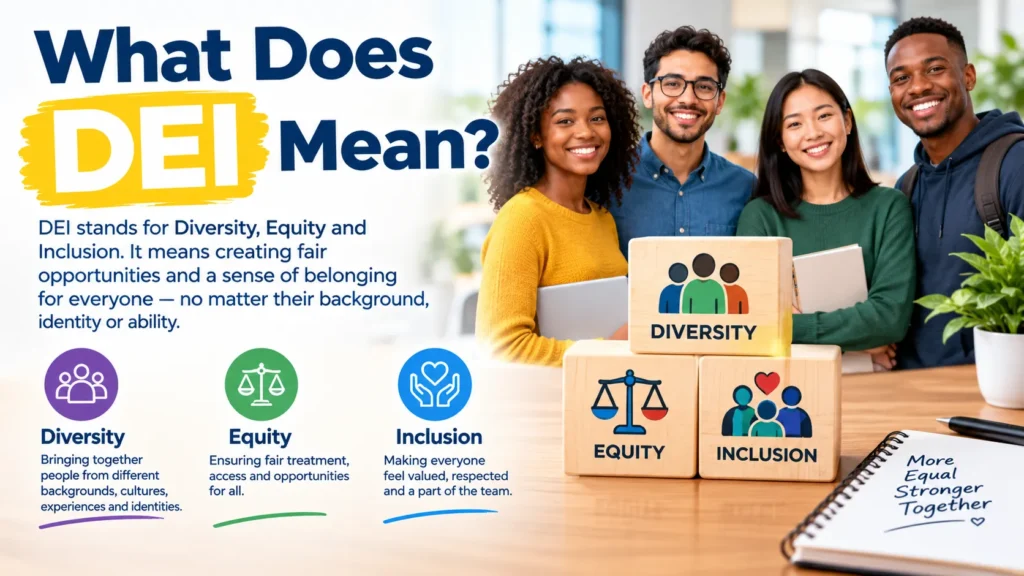
DEI stands for Diversity, Equity, and Inclusion. These three concepts are related, but each focuses on a different aspect of how people participate in an organization or community.
Here is a simple breakdown:
- D — Diversity: Recognizing the different backgrounds, experiences, characteristics, and perspectives people bring to a group.
- E — Equity: Identifying barriers and considering relevant needs to promote fair access to opportunities and resources.
- I — Inclusion: Creating an environment where people feel respected and can participate meaningfully.
For example, imagine a company that employs people with different professional backgrounds. It reviews its recruitment process to remove unnecessary barriers and encourages every employee to contribute during meetings.
The variety of employees reflects diversity. Reviewing barriers relates to equity. Encouraging participation reflects inclusion.
Together, these concepts help explain what DEI means in practical terms.
2. What Does Diversity Mean in DEI?
Diversity refers to the differences among people within a group, workplace, school, or community. These differences can include personal characteristics, experiences, skills, and perspectives.
Diversity may involve:
- Age and life experience.
- Race and ethnicity.
- Gender.
- Disability and accessibility needs.
- Religion and cultural background.
- Nationality and language.
- Socioeconomic background.
- Education and professional experience.
- Different ideas and problem-solving approaches.
For example, a classroom may include students who speak different languages, have different learning experiences, and bring different interests to their discussions.
Similarly, a company may employ people with different technical skills, educational backgrounds, and professional experiences.
Diversity is not limited to characteristics that people can immediately see. A person’s experiences, knowledge, and perspective may also contribute to the variety within a group.
In simple terms, diversity describes the differences represented among people. It does not automatically mean that everyone has equal opportunities or feels included. Those concerns relate to the other components of DEI.
3. What Does Equity Mean in DEI?
Equity means considering relevant circumstances and addressing barriers that may prevent people from accessing fair opportunities.
People do not always have the same resources, abilities, or starting circumstances. In some situations, providing appropriate support can help them participate more fairly.
Consider a student who uses a screen reader because of a visual impairment. Providing compatible digital learning materials can help that student access the same educational content as classmates.
Other examples of equity may include:
- Providing accessible workplace equipment.
- Offering academic support to students who need additional help.
- Making application processes accessible to qualified candidates.
- Reviewing unnecessary requirements in job advertisements.
- Ensuring employees understand how to apply for promotion.
- Providing appropriate accommodations where required.
Equity does not automatically mean giving everyone identical resources or guaranteeing identical results. Its meaning depends on the circumstances, the objective, and the policies involved.
It is also important to evaluate proposed equity measures carefully. A policy should address a genuine need, operate fairly, and comply with applicable law.
In short, equity focuses on fair access and the barriers that may prevent people from participating.
4. What Does Inclusion Mean in DEI?
Inclusion means creating an environment where people are respected, welcomed, and able to participate meaningfully.
A group can be diverse without being inclusive. For example, a company might employ people from many backgrounds but repeatedly ignore certain employees during discussions or exclude them from important projects.
An inclusive environment aims to prevent those barriers to participation.
Examples include:
- Giving employees opportunities to share ideas.
- Making meetings accessible to participants with disabilities.
- Encouraging respectful classroom discussions.
- Addressing bullying and harassment through appropriate procedures.
- Sharing relevant information with team members.
- Providing clear ways to raise concerns.
- Evaluating suggestions according to their merits.
- Treating colleagues professionally.
Inclusion is not simply about inviting someone into a room. It also concerns whether that person can contribute and participate without unnecessary barriers.
For example, inviting an employee to a meeting but never providing accessible materials may limit meaningful participation.
Diversity concerns representation, equity concerns fairness, and inclusion concerns participation.
These ideas work together, but they are not interchangeable.
5. What Is the Difference Between DEI, Equality, and Equity?
DEI, equality, and equity are closely related terms, but they have different meanings.
Equality generally focuses on equal rights, treatment, or opportunities. Equity considers relevant circumstances and barriers when determining what is needed for fair access.
Diversity and inclusion address other aspects of the same broader discussion.
| Term | Simple meaning | Practical example |
| Diversity | Recognizing differences among people | A team includes people with varied backgrounds and skills |
| Equity | Addressing barriers to fair opportunities | An employee receives appropriate accessible equipment |
| Inclusion | Supporting meaningful participation | Every team member has a genuine opportunity to contribute |
| Equality | Providing equal rights or treatment | All qualified applicants follow the same published application procedure |
Consider a school where every student receives the same textbook. The school provides the same resource to everyone.
However, a student who needs an accessible format may require a different version of the textbook to access the material.
Providing an appropriate format can address that barrier without changing the educational content.
This example illustrates why equal treatment and fair access are related but distinct ideas.
It does not mean equity always requires different treatment. Sometimes the fairest approach is to apply the same rules to everyone. The appropriate response depends on the circumstances.
6. What Does DEI Mean in the Workplace?
In the workplace, DEI refers to policies, practices, and behaviors intended to support diversity, fair opportunities, accessibility, and meaningful participation among employees.
Companies may discuss DEI when reviewing recruitment, professional development, workplace culture, accessibility, and employee experiences.
Common examples include:
- Writing clear job descriptions.
- Using consistent, job-related hiring criteria.
- Making recruitment systems accessible.
- Providing reasonable accommodations where required.
- Reviewing promotion procedures for unnecessary barriers.
- Establishing procedures for reporting discrimination.
- Making professional development opportunities accessible.
- Encouraging respectful communication.
- Evaluating workplace policies for their actual effects.
Imagine that a company’s online application form does not work properly with assistive technology. Qualified applicants who rely on that technology may encounter unnecessary difficulties.
The company could review the form, correct accessibility problems, and test the updated process.
This is an example of addressing a practical barrier.
However, the DEI label alone does not prove that a company has fair policies or that its programs are effective. Organizations need to evaluate how their policies operate and whether they achieve their stated goals.
Workplace rules also depend on the applicable legal framework. In the United States, for example, the Equal Employment Opportunity Commission explains that DEI-related practices can violate federal employment discrimination law when they involve unlawful discrimination. Employers should review their actual policies rather than assume that every program is automatically lawful or unlawful.
7. What Does DEI Mean in Education?
In Education, DEI refers to efforts to make learning environments accessible, fair, and welcoming to students with different backgrounds and needs.
Schools, colleges, and universities may consider DEI when developing classroom policies, designing learning materials, supporting students, and reviewing educational opportunities.
Examples include:
- Providing accessible digital learning materials.
- Making school facilities accessible.
- Offering additional academic support where appropriate.
- Establishing clear anti-bullying procedures.
- Encouraging respectful classroom discussions.
- Making eligible students aware of available resources.
- Using understandable instructions and assessment criteria.
- Giving students appropriate opportunities to ask questions.
For example, a teacher may provide written instructions alongside spoken directions so students can review the assignment at their own pace.
Another teacher may establish clear discussion rules to help students contribute without being interrupted or ridiculed.
These practices can support participation and help students understand expectations.
DEI does not automatically mean removing academic standards or guaranteeing the same grades for every student. An educational institution can maintain appropriate learning objectives while considering accessibility and fair opportunities.
The effectiveness of an educational DEI initiative depends on its design, implementation, and results.
8. What Are Some Real-Life Examples of DEI?
Practical examples make the meaning of DEI easier to understand. The following situations show how its principles may appear in everyday life.
Example 1: Accessible recruitment
A company makes its job application website compatible with assistive technology so qualified candidates can complete the application.
Example 2: Transparent promotion criteria
An employer publishes clear promotion requirements and explains how performance is evaluated.
Example 3: Classroom accessibility
A teacher provides learning materials in formats that eligible students can access.
Example 4: Fair meeting participation
A manager creates opportunities for every team member to share relevant ideas.
Example 5: Professional development
An organization clearly communicates available training and explains how employees can participate.
Example 6: Respectful communication
Colleagues listen to one another and assess proposals according to their merits rather than making assumptions about someone’s background.
Example 7: Consistent complaint procedures
A company establishes a process for reporting workplace discrimination and investigating concerns.
Example 8: Clear workplace expectations
A manager communicates performance standards so employees understand what their roles require.
Example 9: Accessible events
An organization considers venue access, communication needs, and other practical barriers when planning an event.
Example 10: Multiple recruitment channels
An employer advertises vacancies through appropriate channels so qualified candidates can learn about available positions.
These examples illustrate possible DEI-related practices. Whether a particular practice is appropriate depends on its purpose, implementation, results, and legal requirements.
9. What Are DEI Initiatives and Policies?
DEI initiatives are specific programs, activities, or organizational changes intended to address diversity, equity, or inclusion.
A DEI policy describes An Organization’s approach to a particular issue. An initiative may put that approach into practice.
Examples include:
- Accessibility reviews.
- Recruitment process assessments.
- Mentoring and professional development programs.
- Employee feedback surveys.
- Workplace conduct policies.
- Procedures for reporting discrimination.
- Reviews of promotion criteria.
- Training about respectful workplace behavior.
- Employee resource groups.
- Improvements to accessible communication.
For example, employees may report that an internal software system is difficult to use with assistive technology.
A company could investigate the problem, identify improvements, introduce changes, and ask affected employees whether the new system works better.
This process has a specific objective and a practical way to assess progress.
Effective initiatives should have clear goals, appropriate oversight, and measurable indicators where possible.
Organizations should also consider costs, unintended effects, employee feedback, and applicable legal requirements.
Simply announcing a DEI initiative does not demonstrate that it works. The important questions are whether it addresses a genuine issue and whether the results justify the approach.
10. What Does DEI Mean in Politics?
DEI appears frequently in political discussions, particularly in the United States, where people disagree about the goals, methods, fairness, and legal implications of particular programs.
Supporters often argue that well-designed DEI initiatives can help identify unnecessary barriers, improve accessibility, address discrimination, and expand access to opportunities.
Critics raise concerns about particular approaches, including whether they treat individuals fairly, place too much emphasis on group identity, create unnecessary bureaucracy, or conflict with merit-based decisions.
These disagreements concern specific policies and their effects. They do not change the standard meaning of the abbreviation.
It is useful to distinguish three questions:
- What does DEI stand for?
- What does a particular DEI policy actually do?
- Is that policy effective, fair, and lawful?
The first question has a straightforward answer: Diversity, Equity, and Inclusion.
The other questions require examining the policy itself, its implementation, the available evidence, and the applicable law.
For example, a program focused on improving website accessibility differs from a hiring policy that considers protected characteristics in employment decisions.
Treating every program as identical can create confusion.
A balanced understanding of DEI therefore requires examining actual practices rather than assuming that the abbreviation alone proves a policy’s value or shortcomings.
11. What Is the Difference Between DEI, EDI, DEIB, and DEIJ?
You may encounter several abbreviations related to diversity and inclusion. They describe overlapping ideas, but their wording highlights different priorities.
| Abbreviation | Full form | Main emphasis |
| DEI | Diversity, Equity, and Inclusion | Representation, fairness, and participation |
| DE&I | Diversity, Equity, and Inclusion | The same core concepts as DEI |
| EDI | Equity, Diversity, and Inclusion, in many US organizational contexts | Equity is listed first |
| EDI | Equality, Diversity, and Inclusion, in common UK usage | Equal treatment, diversity, and inclusion |
| D&I | Diversity and Inclusion | Representation and participation |
| DEIB | Diversity, Equity, Inclusion, and Belonging | Adds an explicit emphasis on belonging |
| DEIJ | Diversity, Equity, Inclusion, and Justice | Adds an explicit emphasis on justice |
The exact terminology may vary between organizations and countries.
For example, EDI can have more than one meaning. In the United Kingdom, it commonly stands for Equality, Diversity, and Inclusion. In some American organizations, it stands for Equity, Diversity, and Inclusion.
EDI also has a separate meaning in computing: electronic data interchange.
Context is therefore important when interpreting abbreviations.
If you see EDI in a discussion about workplace inclusion, it likely refers to equality, diversity, and inclusion or equity, diversity, and inclusion. In a technical document about exchanging business records between computer systems, it may refer to electronic data interchange.
12. What Are the Potential Benefits and Challenges of DEI?
DEI initiatives may help organizations identify barriers and improve the way people access opportunities. However, outcomes depend on the specific program and how it operates.
Potential benefits include:
- Improving accessibility.
- Identifying unnecessary barriers in existing procedures.
- Making workplace expectations clearer.
- Encouraging respectful communication.
- Improving access to professional development.
- Helping organizations understand different employee needs.
- Making complaint procedures easier to understand.
- Supporting meaningful participation.
DEI initiatives can also face challenges.
Poorly designed programs may have vague goals, use unsuitable measures, create confusion, or fail to solve the problems they were intended to address.
Organizations may disagree about which approaches are appropriate or how success should be measured.
A responsible evaluation should consider:
- The problem the initiative is intended to solve.
- Whether the proposed approach addresses that problem.
- The effects on employees, applicants, or students.
- The costs and practical limitations.
- Whether the program follows applicable law.
- Whether evidence shows meaningful progress.
For example, an organization may introduce mandatory training without identifying a specific workplace problem or measuring whether employee behavior changes.
The training itself does not establish that the organization has become more inclusive.
A more useful approach would identify a clear objective, assess the relevant problem, select an appropriate intervention, and review the results.
DEI is not a guarantee of better performance or proof that every organizational decision is fair. Specific programs should be assessed on their merits.
Related To Another Article: https://genzwishes.com/what-does-in-transit-mean/
13. Does DEI Mean Hiring People Based Only on Their Identity?
No. DEI is a broad framework, and the abbreviation alone does not establish how an employer makes hiring decisions.
Some DEI-related activities focus on improving accessibility, reviewing job advertisements, widening outreach, clarifying hiring criteria, or making professional development opportunities easier to access.
Other policies may raise questions about how protected characteristics influence employment decisions.
These practices should not be treated as interchangeable.
Consider a company that discovers its job advertisement requires a qualification that is not necessary for the role. The company reviews the requirement and removes it if doing so is appropriate.
That change may help more qualified applicants apply without lowering the actual requirements of the position.
By contrast, an employer that makes a hiring decision based on a protected characteristic may raise different legal questions.
In the United States, federal employment discrimination law can restrict employment decisions motivated by protected characteristics, including race and sex. The legal analysis depends on the particular action, facts, and applicable law.
Therefore, the most accurate answer is that DEI does not inherently mean hiring people solely because of their identities. To understand a particular employer’s approach, examine its actual hiring criteria and procedures.
14. Can DEI Have Another Meaning Outside Work and Education?
Yes. Although Diversity, Equity, and Inclusion is the common meaning in modern workplace, educational, and political discussions, DEI can have other meanings in different contexts.
One alternative is Dutch East Indies, a historical term associated with the former Dutch colonial territory in what is now Indonesia.
This meaning may appear in historical writing, colonial-era documents, and discussions of Southeast Asian history.
The surrounding context helps determine the intended definition.
| Context | Likely meaning |
| Human resources | Diversity, Equity, and Inclusion |
| Workplace policy | Diversity, Equity, and Inclusion |
| Education | Diversity, Equity, and Inclusion |
| Political discussion | Diversity, Equity, and Inclusion |
| Dutch colonial history | Dutch East Indies |
| Computing, when written as EDI | Electronic data interchange |
For example, if someone says a company is reviewing its DEI policy, they almost certainly mean Diversity, Equity, and Inclusion.
If a history book discusses the Dutch East Indies, the historical meaning is more appropriate.
Abbreviations can have multiple definitions, so it is best to interpret them using the subject, surrounding words, and source.
People Also Ask
A: DEI stands for Diversity, Equity, and Inclusion. It describes a framework focused on recognizing differences, addressing barriers to fair opportunities, and encouraging meaningful participation.
A: In simple terms, DEI means recognizing differences among people, considering fairness and accessibility, and creating environments where people can participate and receive respectful treatment.
A: In the workplace, DEI refers to practices that may address recruitment, accessibility, professional development, employee participation, and workplace culture.
A: In education, DEI refers to efforts to make learning environments accessible, fair, and welcoming to students with different backgrounds and needs.
A: Diversity concerns the differences represented within a group. Inclusion concerns whether people are respected and can participate meaningfully.
Conclusion
DEI stands for Diversity, Equity, and Inclusion. It is a framework for understanding representation, fair access to opportunities, and meaningful participation.
Diversity focuses on differences among people. Equity considers barriers and relevant circumstances when promoting fair opportunities. Inclusion focuses on whether people can participate meaningfully and receive respectful treatment.
You may encounter DEI in workplaces, schools, company policies, and political discussions. The general definition remains consistent, but the programs associated with it can vary considerably.
Understanding the difference between DEI, equality, affirmative action, and related abbreviations helps you interpret these discussions more accurately.
It is also important to distinguish a general framework from an individual policy. Whether a particular initiative is effective, fair, or lawful depends on what it does and how it operates.
If this guide helped you understand DEI, consider bookmarking it for future reference or sharing it with someone who has encountered the term. You can also explore related GenzWishes meaning guides to learn more about commonly used words and abbreviations.