
Introduction
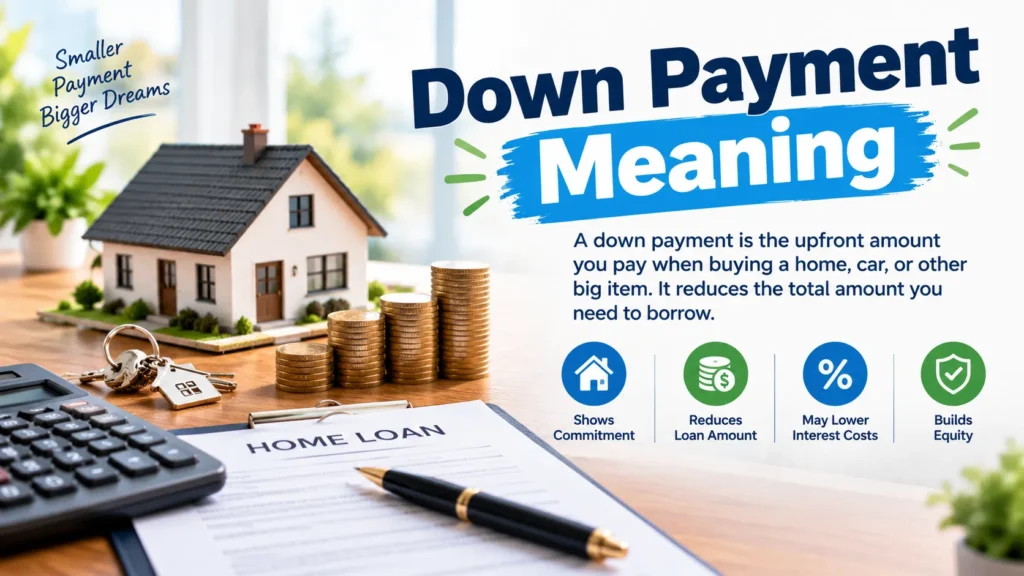
The Term Down Payment means the initial amount of money paid toward the total price of something when buying it.
For example, if you buy a car for $20,000 and pay $4,000 upfront, your down payment is $4,000. The remaining purchase price is $16,000 before accounting for any applicable interest, fees, or other charges.
Understanding down payment meaning helps you understand conversations about houses, cars, loans, and other expensive purchases. It is also a useful English expression to recognize when reading advertisements, financial documents, or everyday messages.
1. What Does Down Payment Mean?
A down payment is the initial portion of a purchase price that a buyer pays upfront. People commonly use it for expensive purchases, especially houses and cars, when buyers pay only part of the total price upfront.
For example, imagine purchasing a laptop for $1,000. The seller agrees to accept $200 initially, with the remaining amount due under an agreed payment arrangement. The initial $200 is the down payment.
You pay a down payment first, and it covers part of the total cost of something you want to buy.
The amount can be a fixed sum or a percentage of the purchase price. The required amount depends on the seller, lender, product, and terms of the agreement.
2. Down Payment Meaning in Simple Words
In simple English, a down payment means paying part of a product’s price at the beginning instead of paying the entire amount immediately.
Imagine buying something expensive and agreeing to pay a portion of its price today. You will pay the remaining balance later under the agreed terms.
People call that first payment a down payment.
Here is an easy example:
- Total price: $500
- Initial payment: $100
- Remaining purchase price: $400
In this example, the buyer pays $100 upfront, leaving $400 to be paid later.
A down payment does not automatically mean that the buyer will pay the balance in monthly installments. You can pay the remaining amount later on an agreed date or borrow the money through a loan.
The main idea is that the initial payment contributes toward the total purchase price.
3. How Does a Down Payment Work?
A down payment works by reducing the portion of a purchase price that remains unpaid.
The process usually follows these steps:
- The buyer chooses a product or property.
- The buyer and seller agree on the purchase price and payment terms.
- The buyer pays the required amount upfront.
For example, suppose a car costs $15,000, and the buyer pays $3,000 upfront.
The calculation is:
Purchase price − down payment = remaining purchase price
$15,000 − $3,000 = $12,000
The buyer must arrange payment for the remaining $12,000, potentially through financing.
When you take out a loan, interest and fees may increase the total cost. So, you may pay more than the remaining purchase price over time.
The exact process depends on the purchase agreement and financing arrangement.
4. Down Payment Examples With Simple Calculations
Examples make the meaning of down payment easier to understand. These scenarios show how an initial payment works for different purchases.
Example 1: Buying a car
A car costs $10,000, and the buyer pays $2,000 upfront.
- Purchase price: $10,000
- Down payment: $2,000
- Remaining purchase price: $8,000
The buyer must arrange payment for the remaining $8,000.
Example 2: Buying a house
A house costs $200,000, and the buyer makes a 10% down payment.
$200,000 × 10% = $20,000
The down payment is $20,000, leaving $180,000 of the purchase price to be covered through other funds or financing.
Additional transaction costs may apply.
Example 3: Buying furniture
A furniture set costs $1,200. The seller accepts $300 upfront, with the remaining amount due under an agreed payment plan.
The down payment is $300, and the remaining purchase price is $900.
How to calculate a down payment
Use this formula:
Down payment = Total purchase price × Down payment percentage
For example, a 15% down payment on a $40,000 purchase would be:
$40,000 × 0.15 = $6,000
The down payment would be $6,000.
These examples illustrate the calculation only. Actual down payment requirements and financing terms vary by transaction.
5. What Is a Down Payment on a House?
A down payment on a house is the amount a homebuyer pays toward the property’s purchase price using their own funds or other permitted sources. When the purchase involves a mortgage, the mortgage typically covers the remaining eligible amount.
For example, suppose a home costs $250,000, and the buyer pays 20% upfront.
$250,000 × 20% = $50,000
The down payment is $50,000, leaving $200,000 of the purchase price to be covered through other funds or a mortgage.
A larger down payment generally reduces the amount borrowed. Depending on the mortgage program and lender, it may also affect interest rates, eligibility, and mortgage insurance requirements.
However, buyers should not assume that every mortgage requires a 20% down payment. Requirements vary by country, lender, loan program, and borrower circumstances.
Homebuyers should also budget for other expenses, such as closing costs, moving expenses, and immediate repairs. These costs are separate from the down payment.
For additional guidance, the Consumer Financial Protection Bureau explains how to determine a home down payment.
6. What Does Down Payment Mean When Buying a Car?
When buying a car, a down payment is the initial amount paid toward the vehicle’s purchase price. If the buyer uses an auto loan, this payment reduces the amount that needs to be financed.
For example, imagine a car costs $25,00,0 and the buyer pays $5,000 upfront.
$25,000 − $5,000 = $20,000
The remaining purchase price is $20,000, which the buyer may finance through an auto loan, subject to lender approval.
A down payment on a car may be made with cash or, where accepted, the value of a trade-in vehicle.
A larger down payment can reduce the loan amount and may lower monthly payments or the total interest paid. However, the outcome depends on the interest rate, loan term, fees, and other financing conditions.
Before agreeing to a car purchase, buyers should compare the total cost of financing rather than considering only the upfront payment or monthly installment.
7. Why Is a Down Payment Required?
A down payment may be required because the seller or lender wants the buyer to contribute toward the purchase price at the beginning.
Its purpose depends on the type of transaction.
Common reasons include:
- Reducing the Amount Borrowed: Paying part of the price upfront generally means less financing is needed.
- Demonstrating financial commitment: The buyer contributes money toward the purchase.
- Meeting lender requirements: Some lenders require a minimum down payment before approving financing.
- Reducing lending risk: A smaller loan relative to the asset’s value may reduce the lender’s exposure.
- Building initial equity: In a financed property purchase, the down payment contributes to the buyer’s initial ownership stake.
A down payment does not guarantee loan approval. Lenders may also consider income, credit history, existing debts, the value of the asset, and other eligibility requirements.
Some purchases and financing programs allow low or no down payments. Therefore, the exact requirements should be checked before committing.
8. What Is a Good Down Payment Amount?
A good down payment amount is one that meets the applicable requirements and fits the buyer’s financial circumstances.
There is no single percentage that is best for every purchase. The appropriate amount depends on the price, financing terms, available savings, and other financial obligations.
Consider these illustrative percentages for a purchase costing $30,000.
| Down Payment Percentage | Upfront Amount | Remaining Purchase Price |
| 5% | $1,500 | $28,500 |
| 10% | $3,000 | $27,000 |
| 15% | $4,500 | $25,500 |
| 20% | $6,000 | $24,000 |
A larger down payment means less of the purchase price remains to be paid. If the buyer borrows the remaining amount, a smaller loan may reduce borrowing costs.
However, paying too much upfront can leave someone without enough money for emergencies or other essential expenses.
Before choosing an amount, consider:
- The minimum amount required by the seller or lender.
- The total amount available in savings.
- Additional purchase and transaction costs.
- Emergency savings and regular living expenses.
- The effect of the down payment on future payments and borrowing costs.
The best choice balances affordability with the benefits of borrowing less.
9. What Is the Difference Between a Down Payment and a Deposit?
The terms Down Payment and deposit can sometimes refer to similar payments, but they are not always interchangeable.
A down payment generally refers to the portion of the purchase price paid upfront. A deposit may be money paid to reserve an item, demonstrate commitment, or secure an agreement.
For example, someone buying a car may pay a deposit to reserve it before completing the purchase. That deposit might later be credited toward the down payment or purchase price, depending on the agreement.
| Feature | Down Payment | Deposit |
| Main purpose | Contributes toward the purchase price | May reserve an item or secure an agreement |
| Timing | Usually paid at the beginning of a purchase | Often paid when booking or agreeing to buy |
| Treatment | Normally reduces the unpaid purchase price | May be credited toward the price or handled separately |
| Refund rules | Depend on the agreement and applicable law | Depend on the agreement and applicable law |
A deposit is not necessarily refundable, and a down payment is not necessarily nonrefundable. The contract and applicable law determine how the money is treated.
In some transactions, the same payment can function as both a deposit and part of the down payment.
10. Down Payment vs. Installment: What’s the Difference?
A down payment and an installment are different parts of a payment arrangement.
A down payment is generally the initial amount paid toward a purchase. An installment is one of a series of payments made over time.
For example, a buyer purchases a phone for $1,000 and pays $200 upfront. The remaining $800 is scheduled to be paid in eight equal installments, assuming no additional charges.
Each installment would be $100.
The $200 is the down payment, while each $100 payment is an installment.
| Feature | Down Payment | Installment |
| Meaning | Initial portion of the purchase price | One payment in a series |
| Typical timing | At the beginning | At scheduled intervals |
| Main purpose | Reduces the amount initially unpaid | Pays the remaining balance over time |
| Example | Paying $200 upfront | Paying $100 each month |
Installment amounts may include interest, fees, or other charges when financing is involved.
The important distinction is that a down payment is an initial contribution, whereas an installment is a scheduled payment.
11. Down Payment Synonyms and Related Words
Several words and phrases are related to down payment, but their meanings can differ depending on the context.
Deposit: Money paid in advance to reserve something or secure an agreement. It may later count toward the purchase price.
Initial payment: A general term for the first payment made toward a purchase or obligation.
Upfront payment: Money paid at the beginning of a transaction rather than later.
Advance payment: Money paid before goods or services are fully delivered or before the full amount becomes due.
Part payment: A payment that covers only part of the total amount owed.
Prepayment: Money paid before its scheduled due date. Depending on the context, it can refer to paying a bill or loan early rather than making a down payment.
The word deposit is often listed as a synonym for down payment in dictionaries. However, the two terms can have different contractual meanings.
Down Payment Pronunciation
Down payment is pronounced approximately as down PAY-muhnt.
Its International Phonetic Alphabet pronunciation is commonly represented as /ˌdaʊn ˈpeɪ.mənt/.
The phrase is a noun and is generally written as two words, although the one-word spelling downpayment also appears.
Related To Another Article: https://genzwishes.com/inferiority-complex-meaning/
12. How to Use Down Payment in a Sentence
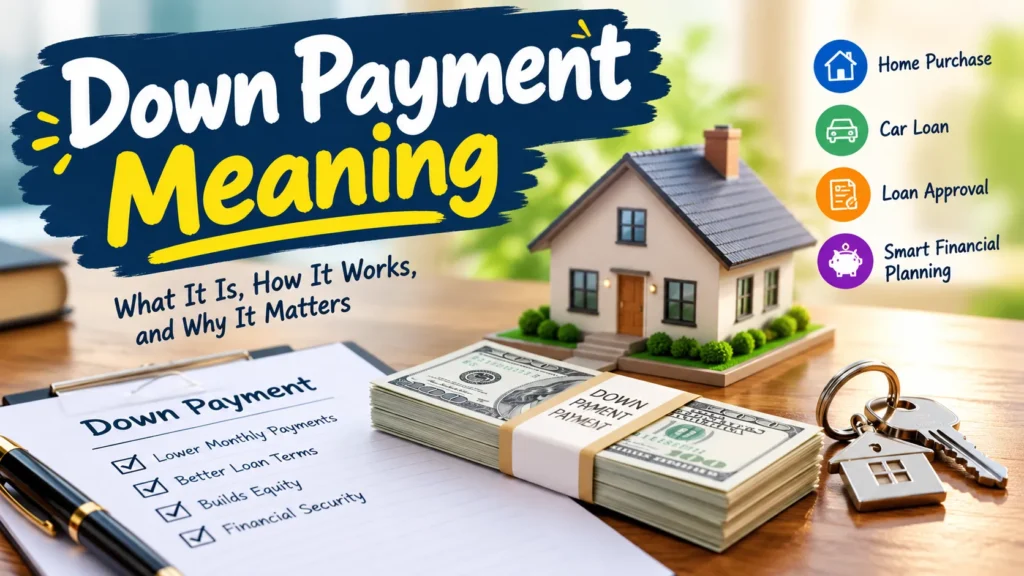
Learning example sentences can help you understand how to use down payment naturally in everyday English.
Here are 10 original examples:
- I am saving money for a down payment on a house.
- She made a down payment on her new car.
- The seller requested a down payment before completing the purchase.
- We need a larger down payment to reduce the amount we borrow.
- He paid $2,000 as a down payment for the vehicle.
- Their down payment covered 10% of the property’s purchase price.
- The bank explained the minimum down payment required for the loan.
- They could afford the monthly payments but needed more time to save for the down payment.
- A smaller down payment may mean borrowing more money.
- Before paying the down payment, read the agreement carefully.
Common Expressions With Down Payment
- Make a down payment: Pay an initial portion of the purchase price.
- Put a down payment on something: Pay money upfront toward an item or property.
- Save for a down payment: Set aside money for an upcoming purchase.
- Require a down payment: Make an initial payment a condition of the transaction.
- Minimum down payment: The smallest initial payment accepted under the applicable terms.
- Down payment assistance: Support that helps eligible buyers cover upfront purchase costs, often for a home.
For example, you could say, “We are saving for a down payment on our first home.”
These expressions appear frequently in conversations about purchases, loans, and personal finances.
13. Common Mistakes to Avoid When Understanding Down Payments
Although down payment is a common phrase, several misunderstandings can make it confusing.
Mistake 1: Thinking a down payment is the full purchase price
A down payment generally covers only part of the total price. The remaining balance must still be paid according to the agreement.
Mistake 2: Assuming every down payment is 20%
The required amount varies. Some transactions require a different percentage, a fixed amount, or no down payment at all.
Mistake 3: Confusing a down payment with an installment
A down payment is typically made at the beginning, while installments are scheduled payments made over time.
Mistake 4: Assuming the remaining balance has no interest
If the remaining amount is financed, interest and fees may apply. The total borrowing cost depends on the financing agreement.
Mistake 5: Assuming a deposit and down payment always mean the same thing
The terms can overlap, but their purposes and contractual treatment may differ.
Mistake 6: Forgetting additional purchase costs
The down payment may not include taxes, closing costs, insurance, registration charges, or other expenses.
Mistake 7: Assuming a larger down payment guarantees approval
Lenders may assess several factors, including income, credit history, debt, and the asset being financed.
Understanding these differences helps you use the term correctly and interpret financial agreements more accurately.
People Also Ask
A: It means paying an initial portion of the purchase price upfront, with the remaining balance paid according to the agreement.
A: It means paying one-fifth of the purchase price upfront. For a $100,000 purchase, a 20% down payment equals $20,000.
A: The timing depends on the transaction. Some payments are made when the agreement is signed, while others are paid at closing or another agreed stage.
A: A down payment generally contributes toward the purchase price rather than representing interest. However, the way money is allocated in a transaction depends on the agreement and applicable rules.
A: The buyer pays the remaining balance according to the purchase agreement. If financing is involved, the borrower follows the lender’s repayment schedule.
Conclusion
The meaning of Down Payment is straightforward: it is the initial portion of a purchase price that a buyer pays upfront.
Down payments are commonly associated with houses, cars, and other expensive purchases. They can reduce the amount remaining to be paid and, when financing is involved, lower the amount a buyer needs to borrow.
For example, if an item costs $5,000 and you pay $1,000 upfront, your down payment is $1,000, leaving $4,000 of the purchase price unpaid.
Remember that the required amount, payment schedule, additional charges, and refund rules depend on the transaction and its terms.
Understanding this phrase will help you read financial documents, follow conversations about purchases, and use the expression correctly in everyday English.
If this explanation helped you understand the term, bookmark it for future reference and explore more simple English meanings on GenzWishes.