Introduction
Have you ever felt your heart race when you saw your crush, waited for exciting news, or watched a suspenseful scene in an anime? The Japanese expression doki doki describes that familiar feeling of a pounding heart.
Doki Doki refers to a rapidly beating heart associated with excitement, nervousness, anticipation, romantic feelings, or fear. Written as ドキドキ or どきどき in Japanese, this expressive word appears in everyday conversations, anime, manga, and video games.
However, doki doki does not always mean love or happiness. Its meaning depends on the situation, making it an interesting expression for Japanese language learners and anime fans alike.
In this guide, you will discover its Japanese and English meanings, pronunciation, romantic significance, common phrases, and connection to Doki Doki Literature Club!.
1. What Does Doki Doki Mean?
Doki doki is a Japanese sound-symbolic expression that describes a pounding or rapidly beating heart. It can communicate the excitement, nervousness, or fear that makes someone feel their heartbeat more strongly.
Imagine meeting someone you secretly like. Your heart starts racing, you feel butterflies in your stomach, and you struggle to find the right words. That moment perfectly illustrates the emotional side of doki doki.
People can also experience this feeling before an important exam, during a job interview, or while waiting for unexpected news.
Here are the most common meanings:
- Excitement: Feeling thrilled about something about to happen.
- Love: Experiencing a racing heart around someone you like.
- Nervousness: Feeling tense before an important event.
- Fear: Feeling your heart pound during a frightening situation.
- Anticipation: Waiting eagerly or anxiously for an outcome.
The central idea remains the same: a pounding heartbeat associated with a physical sensation or an emotional experience.
For example, you might feel doki doki before your first date because you are excited and nervous. You might experience the same feeling while watching a horror movie because the suspense makes your heart race.
In simple words, doki doki means a pounding heart or the nervous, exciting feeling that makes your heart beat faster.
2. Doki Doki Meaning in Japanese
In Japanese, people commonly write doki doki as ドキドキ in katakana or どきどき in hiragana. Both forms represent the same expression, although writers may choose one form based on style and context.
Japanese uses onomatopoeia and related sound-symbolic expressions to describe sounds, movements, physical sensations, and emotional experiences. Doki doki imitates the rhythm or sensation of a rapidly beating heart.
You will often encounter it with the verb suru, which means “to do.” The expression ドキドキする (doki doki suru) describes having a pounding heart or feeling nervous and excited.
Consider this Japanese sentence:
Japanese: 好きな人と話すとドキドキする。
Romaji: Suki na hito to hanasu to doki doki suru.
English: My heart races when I talk to someone I like.
This example shows how Japanese speakers can use doki doki to communicate both a physical sensation and the emotions behind it.
The expression does not have one fixed English translation. Depending on the situation, you might translate it as “my heart is pounding,” “I’m nervous,” or “I have butterflies in my stomach.”
Understanding the context helps you choose the most natural translation.
3. How to Pronounce Doki Doki
Doki doki is pronounced approximately doh-kee doh-kee. Say the two parts with a similar rhythm, keeping the sounds clear and consistent.
The expression contains four syllables: do-ki-do-ki. Japanese vowel sounds differ slightly from English vowel sounds, so listening to a native speaker can help you develop more natural pronunciation.
Follow these simple steps to practice:
- Say “do” with a clear Japanese-style vowel.
- Add “ki” to complete the first part.
- Repeat the same sounds to say “doki doki.”
- Practice the expression in a complete Japanese sentence.
For example:
Japanese: 明日はドキドキする。
Romaji: Ashita wa doki doki suru.
English: I’m nervous or excited about tomorrow.
The exact translation depends on what the speaker expects to happen.
You may hear doki doki in anime dialogue, Japanese songs, romantic scenes, and online conversations. Once you recognize its rhythm and meaning, you can understand these situations more easily.
Remember that the expression communicates more than a sound. It can also describe the emotional experience that accompanies a racing heart.
4. What Does Doki Doki Mean in English?
In English, doki doki can be translated as “thump-thump,” “pitter-patter,” “a pounding heart,” or “a racing heart.” The best translation depends on the situation and the emotion the speaker wants to express.
English does not have one word that captures every nuance of this Japanese expression. Translators therefore choose wording that sounds natural in the surrounding sentence.
Consider these examples:
| Situation | Natural English Translation |
| Meeting your crush | My heart is racing. |
| Waiting for exam results | I’m nervous and excited. |
| Watching a scary movie | My heart is pounding. |
| Preparing for an interview | I’m feeling anxious. |
| Going on a first date | I have butterflies in my stomach. |
| Opening an unexpected gift | I can’t wait to see what’s inside. |
Each translation communicates a similar experience while reflecting the situation.
For instance, someone discussing a romantic moment might describe their feelings as doki doki. In natural English, they could say, “My heart skipped a beat” or “I got butterflies in my stomach.”
However, these expressions are not always interchangeable. A pounding heart during a frightening experience communicates something different from a pounding heart during a romantic confession.
The easiest way to understand doki doki in English is to focus on the heartbeat and the emotion causing it.
5. Doki Doki Meaning in Love and Romance
In love and romance, doki doki describes the fluttery, heart-pounding feeling that often accompanies attraction, nervous excitement, or an emotionally intense moment with someone special.
Imagine receiving a message from your crush. You immediately smile, reread the message, and wonder what to say next. Your heart beats faster because the conversation matters to you.
That familiar experience captures the romantic side of doki doki.
Romantic anime and manga often use this expression during a first meeting, a shy glance, an unexpected compliment, or a confession of love.
Here are some situations that can create a doki doki feeling:
- Seeing someone you secretly admire.
- Receiving an unexpected message from your crush.
- Holding hands for the first time.
- Preparing for your first date.
- Hearing someone confess their feelings.
- Waiting to discover whether someone likes you back.
- Sharing an unexpectedly intimate moment.
For example, consider this sentence:
Japanese: 好きな人に会うとドキドキする。
Romaji: Suki na hito ni au to doki doki suru.
English: My heart races when I see the person I like.
The sentence expresses the nervous excitement that someone experiences around a person they find attractive.
However, doki doki does not automatically mean that someone is in love. Nervousness, surprise, excitement, and fear can produce similar feelings.
Context makes the difference.
In romantic situations, doki doki captures the exciting and sometimes nervous feeling that makes your heart race around someone special.
6. Doki Doki Meaning in Anime and Manga
In anime and manga, doki doki often represents a character’s pounding heart during an emotionally intense moment. Creators use the expression to communicate feelings that a character might struggle to explain through dialogue.
You may see ドキドキ written beside a character who feels embarrassed, attracted to someone, nervous about an important event, or frightened by something unexpected.
Romantic anime frequently uses the expression during scenes involving crushes, confessions, unexpected compliments, and awkward encounters.
Imagine a character who appears completely calm while talking to their crush. Suddenly, the other person compliments their appearance. The character blushes, looks away, and struggles to respond.
Doki doki communicates that character’s emotional reaction.
The expression also appears in suspenseful scenes. A character approaching a mysterious door might experience doki doki because they do not know what awaits them.
This versatility makes the word useful in romance, comedy, drama, and horror.
When you encounter doki doki in anime, pay attention to the surrounding scene:
- Romantic scenes: It may suggest attraction or nervous affection.
- Comedy scenes: It may highlight embarrassment or an awkward crush.
- Suspenseful scenes: It may communicate anxiety or anticipation.
- Horror scenes: It may represent fear and a pounding heartbeat.
The expression itself does not tell you exactly which emotion a character feels. The dialogue, facial expressions, music, and situation help you interpret it.
7. Doki Doki Literature Club Meaning
Doki Doki Literature Club! is a psychological horror visual novel that uses the Japanese expression in its title. The title combines the idea of a pounding heart with a literature club, creating an initially playful impression.
The game begins with a school-based setting centered on a literature club and its characters. However, its story develops into psychological horror, creating a striking contrast with its cute visual presentation.
Understanding the ordinary Japanese meaning helps explain why the title works so effectively.
Doki doki can suggest romantic excitement, nervous anticipation, or the feeling of meeting someone new. These associations fit the game’s initial presentation.
As the story develops, the idea of a pounding heart takes on a more unsettling tone. The title’s cheerful appearance contrasts with the psychological tension that follows.
It is important to distinguish the Japanese expression from the game’s specific themes.
Doki doki does not inherently mean horror, danger, or manipulation. Those associations come from the game’s narrative and presentation, not from the expression’s ordinary Japanese meaning.
If you encountered the phrase through gaming communities, you may have seen it discussed alongside the characters or story of Doki Doki Literature Club!.
Understanding the original meaning makes the title easier to appreciate without confusing the game’s darker themes with the word’s everyday usage.
The game also contains disturbing material and is not suitable for every audience, so readers should consider its content warnings before playing.
8. Is Doki Doki a Positive or Negative Feeling?
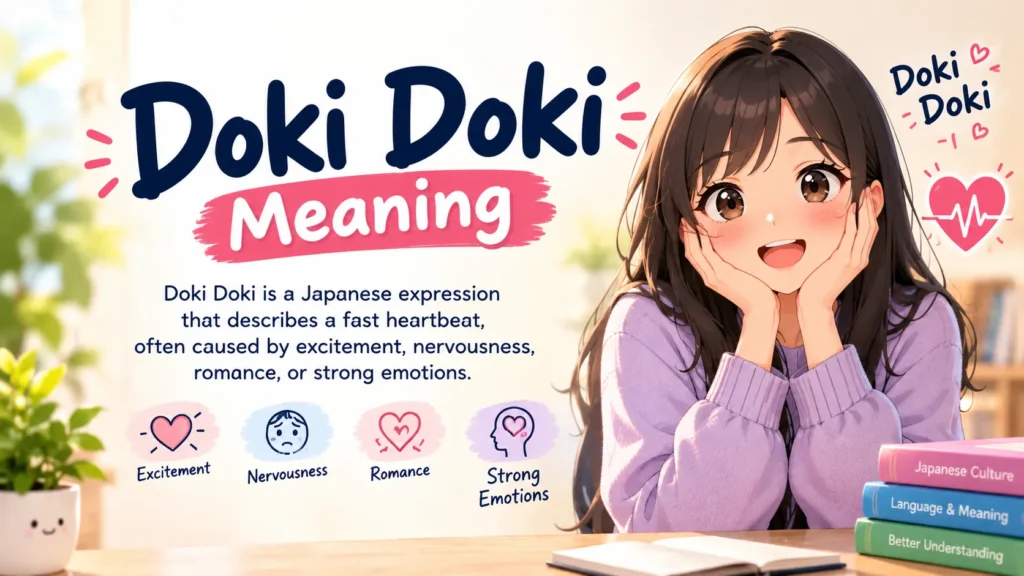
Doki doki can describe positive, negative, or mixed emotions. The expression focuses on a pounding heartbeat, while the surrounding circumstances determine whether that feeling comes from happiness, attraction, anxiety, or fear.
For example, you might feel doki doki before meeting your favorite person because you are excited. You might experience the same sensation before speaking in front of a large audience because you feel nervous.
Here is a quick comparison:
| Emotion | Example Situation | Possible Meaning |
| Happiness | Receiving exciting news | My heart is racing with excitement. |
| Romance | Seeing your crush | I have butterflies around them. |
| Nervousness | Waiting for interview results | My heart is pounding with anxiety. |
| Fear | Hearing a strange noise | My heart is racing because I’m scared. |
| Anticipation | Waiting for a surprise | I’m excited and can’t wait. |
| Uncertainty | Preparing for an important decision | I’m nervous about what will happen. |
This emotional range is one of the most important details to remember when learning the expression.
A character who feels doki doki during a romantic confession may be experiencing attraction. Another character who feels doki doki while entering a dark room may be frightened.
The physical sensation can be similar even though the emotions differ.
To understand the intended meaning, ask yourself two questions: What is happening in the scene, and what might the person be feeling?
Those clues will usually help you interpret the expression correctly.
9. How to Use Doki Doki in a Sentence
You can use doki doki when describing a pounding heart or an experience that makes you feel excited, nervous, or frightened. In Japanese, one common construction is ドキドキする (doki doki suru).
Learning complete sentences is more useful than memorizing the expression alone because the surrounding words help reveal its meaning.
Here are four examples.
Example 1: Romance
Japanese: 好きな人に会うとドキドキする。
Romaji: Suki na hito ni au to doki doki suru.
English: My heart races when I see the person I like.
Example 2: An important event
Japanese: 試験の前はドキドキする。
Romaji: Shiken no mae wa doki doki suru.
English: I feel nervous before an exam.
Example 3: Excitement
Japanese: プレゼントを開ける前にドキドキした。
Romaji: Purezento o akeru mae ni doki doki shita.
English: My heart was pounding before I opened the present.
Example 4: Fear
Japanese: 怖い映画を見てドキドキした。
Romaji: Kowai eiga o mite doki doki shita.
English: My heart was pounding while I watched the scary movie.
Notice how the English translation changes in each example. The first sentence suggests romantic excitement, the second expresses nervousness, the third communicates anticipation, and the fourth describes a reaction to fear.
If you are learning Japanese, practice identifying the situation before deciding which English translation fits best.
10. Common Japanese Phrases With Doki Doki
Japanese Speakers can combine doki doki with other words to describe a pounding heart or an ongoing emotional experience. Learning these expressions can help you recognize the word in conversations, manga, anime, and language-learning materials.
Here are four useful phrases.
1. ドキドキする — Doki doki suru
Meaning: To feel your heart pound or experience nervous excitement.
Example: 初めてのデートでドキドキする。
Translation: I feel nervous and excited about my first date.
2. ドキドキしている — Doki doki shite iru
Meaning: To be experiencing a pounding heart or continuing nervous excitement.
Example: 発表の前でドキドキしている。
Translation: I’m feeling nervous before the presentation.
3. 胸がドキドキする — Mune ga doki doki suru
Meaning: To feel your chest or heart pounding.
Example: 好きな人と話すと胸がドキドキする。
Translation: My heart races when I talk to someone I like.
4. ドキドキしながら — Doki doki shinagara
Meaning: While feeling nervous, excited, or experiencing a pounding heart.
Example: ドキドキしながら結果を待った。
Translation: I waited for the results with my heart pounding.
These phrases illustrate how the expression can appear in different sentence patterns.
You may also encounter variations in Japanese spelling, including hiragana and katakana forms. Both commonly represent the same basic expression.
When learning a new phrase, focus on the complete sentence rather than assuming that doki doki always refers to romance.
11. Doki Doki vs. Wakuwaku: What’s the Difference?
So, Doki doki and wakuwaku are both Japanese expressions associated with emotional anticipation, but they emphasize different aspects of an experience.
Doki doki (ドキドキ) emphasizes a pounding heart that may result from excitement, nervousness, romantic attraction, or fear.
Wakuwaku (ワクワク) generally emphasizes eager excitement and looking forward to something enjoyable.
Imagine planning a vacation. You might feel wakuwaku while choosing places to visit because you cannot wait to explore. You might feel doki doki before boarding the plane if the journey makes you nervous as well as excited.
Here is a simple comparison:
| Feature | Doki Doki | Wakuwaku |
| Japanese spelling | ドキドキ | ワクワク |
| Main idea | A pounding heart | Eager anticipation |
| Common emotions | Excitement, nervousness, attraction, fear | Enthusiasm and anticipation |
| Romantic example | Feeling your heart race around a crush | Looking forward to a romantic date |
| Travel example | Feeling nervous before departure | Excitedly planning a trip |
| English equivalent | My heart is racing | I can’t wait! |
These meanings are useful starting points, although actual usage can overlap.
For example, you might feel both doki doki and wakuwaku before an exciting event. You could look forward to the experience while also feeling nervous about what will happen.
Think of doki doki as the feeling of your heart pounding and wakuwaku as the excitement of anticipating something.
Learning this distinction can help you understand Japanese dialogue and express emotions more precisely.
12. Why Do Japanese Speakers Use Onomatopoeia?
Japanese uses onomatopoeia and related sound-symbolic expressions to communicate sounds, movements, physical sensations, and emotional states. These words can make ordinary descriptions more vivid and expressive.
English has familiar examples such as buzz, pop, and tick-tock. Japanese also has many expressions that communicate sensations or feelings rather than simply imitating external sounds.
Doki doki illustrates this feature by representing the sensation of a pounding heartbeat.
Instead of saying only that someone feels nervous, a speaker can use doki doki to evoke the physical experience accompanying that emotion.
Other Japanese expressions communicate different experiences through their own sound patterns. For instance, wakuwaku generally conveys eager anticipation, while doki doki emphasizes a pounding heart.
These expressions are especially useful in storytelling.
In manga, a creator may place ドキドキ beside a character to show an intense emotional reaction. Anime can reinforce that reaction through dialogue, music, facial expressions, and sound effects.
Readers can therefore recognize an emotional moment without needing a lengthy explanation.
Understanding Japanese sound-symbolic vocabulary can make anime, manga, and everyday language more accessible. It also reveals how languages can communicate feelings through expressions that do not have exact one-word equivalents in English.
Related To Another Article: https://genzwishes.com/sutra-meaning/
13. Is Doki Doki a Slang Word?
Doki doki is better understood as an established Japanese sound-symbolic expression than as ordinary internet slang. People also use it informally in conversations, entertainment, and online communities.
The expression is not limited to young people or social media. It appears in everyday Japanese, written stories, manga, and other contexts.
Online users may write doki doki when discussing a romantic moment, reacting to an attractive character, or expressing nervous excitement.
For example, someone watching a romantic anime scene might comment, “Doki doki!” to communicate that the moment makes their heart race.
In that situation, the expression works as a short, playful reaction rather than a complete sentence.
You may also encounter the abbreviation dkdk in Japanese text messaging. However, beginners will generally find the full expression easier to recognize.
If you see doki doki in a comment or message, consider the surrounding conversation. A romantic discussion may suggest attraction, while a conversation about an exam may indicate nervousness.
The key distinction is that doki doki is an established Japanese expression that can also appear in informal internet communication.
14. Common Misunderstandings About Doki Doki
Although doki doki is relatively easy to Understand, readers can misinterpret it when they encounter the expression without enough context. The most common mistake is assuming that it always describes romantic love.
Here are five important misunderstandings to avoid.
Misunderstanding 1: Doki doki always means love.
Romantic attraction is one common use, but the expression also describes excitement, anticipation, nervousness, and fear.
Misunderstanding 2: Doki doki is originally an English slang word.
The expression comes from Japanese. English speakers may use it when discussing Japanese culture, anime, or particular emotions, but its origin remains Japanese.
Misunderstanding 3: Doki doki means horror.
The expression appears in the title of Doki Doki Literature Club!, a psychological horror game. However, the ordinary Japanese expression does not inherently mean horror or danger.
Misunderstanding 4: Doki doki and wakuwaku mean the same thing.
Both expressions can relate to anticipation, but doki doki emphasizes a pounding heart, while wakuwaku generally communicates eager excitement.
Misunderstanding 5: Doki doki has only one English translation.
The best translation depends on the situation. It might mean “my heart is pounding,” “I’m nervous,” or “I have butterflies in my stomach.”
Understanding these distinctions will help you interpret the expression more accurately in Japanese conversations and popular culture.
It will also prevent you from confusing a word’s original meaning with the associations it develops through a particular anime, game, or online community.
People Also Ask
A: Doki doki is a Japanese expression describing a pounding or rapidly beating heart. It can communicate excitement, nervousness, romantic feelings, anticipation, or fear.
A: Not necessarily. Doki doki often appears in romantic situations because attraction can make someone’s heart race. However, people also use it to describe nervousness, excitement, and fear.
Doki doki can translate as “thump-thump,” “my heart is pounding,” or “my heart is racing.” The most natural translation depends on the emotion and situation.
A: In anime, doki doki often represents a character’s pounding heart during a romantic, exciting, nervous, or frightening moment. The surrounding scene helps determine its intended meaning.
A: Doki doki (ドキドキ or どきどき) is a Japanese sound-symbolic expression that describes a rapidly beating heart and the emotions associated with that sensation.
Conclusion
The Doki Doki Meaning centers on the feeling of a pounding or rapidly beating heart. This Japanese expression can describe romantic attraction, excitement, nervousness, anticipation, or fear, making it useful in everyday language and popular culture.
You will often encounter doki doki in anime, manga, romantic stories, and the title of Doki Doki Literature Club!. Although these contexts can give the expression different emotional associations, the underlying idea remains the same.
The most important lesson is that doki doki does not always mean love or happiness. The situation determines whether it expresses excitement, nervousness, fear, or romantic feelings.
If you found this guide helpful, bookmark it for future reference and share it with friends who enjoy the Japanese language, anime, or gaming culture. You can also explore more word meanings, internet expressions, and interesting language guides on GenzWishes.com.
Disclaimer: This article provides educational and cultural information about Japanese vocabulary. Interpretations can vary with context, and the examples illustrate common usage rather than every possible meaning.