Introduction
Have you ever wondered why certain mathematical proportions appear so fascinating or why philosophers encourage people to avoid extremes? Both questions connect to an interesting concept known as the Golden Mean.
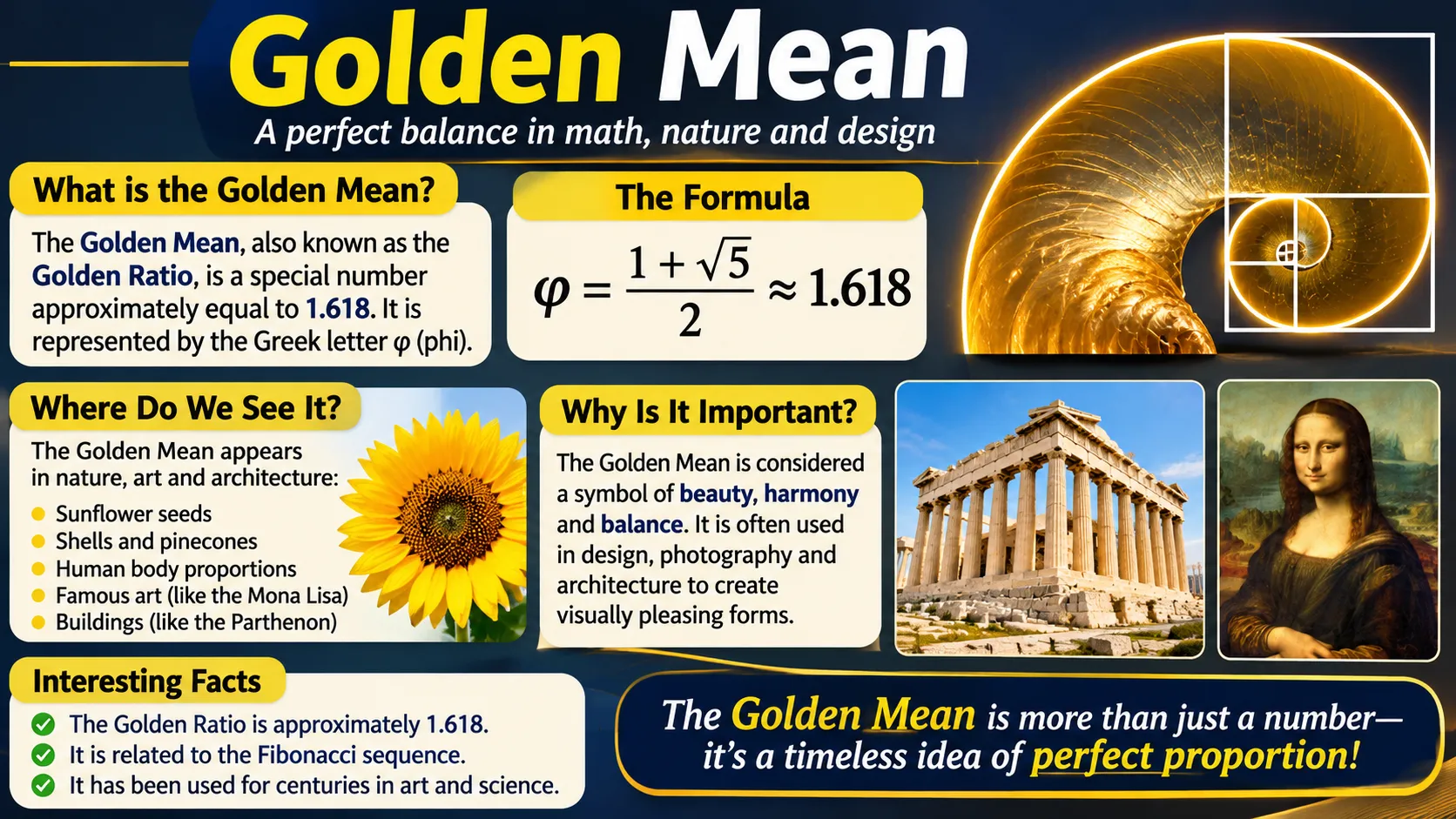
The Golden Mean has two major meanings. In mathematics, it refers to the golden ratio, an irrational number approximately equal to 1.6180339887. In philosophy, particularly in Aristotle’s teachings, it describes the principle of finding a desirable balance between excess and deficiency.
Although these interpretations belong to different fields, both offer interesting ways to understand proportion and balance.
In this guide, you will discover what the Golden Mean means, how its mathematical formula works, how Aristotle explained moderation, and where these concepts appear in mathematics, art, design, and everyday life.
1. What Is the Golden Mean?
The Golden Mean is a term used to describe two different but historically interesting concepts: a special mathematical proportion and a philosophical principle of moderation.
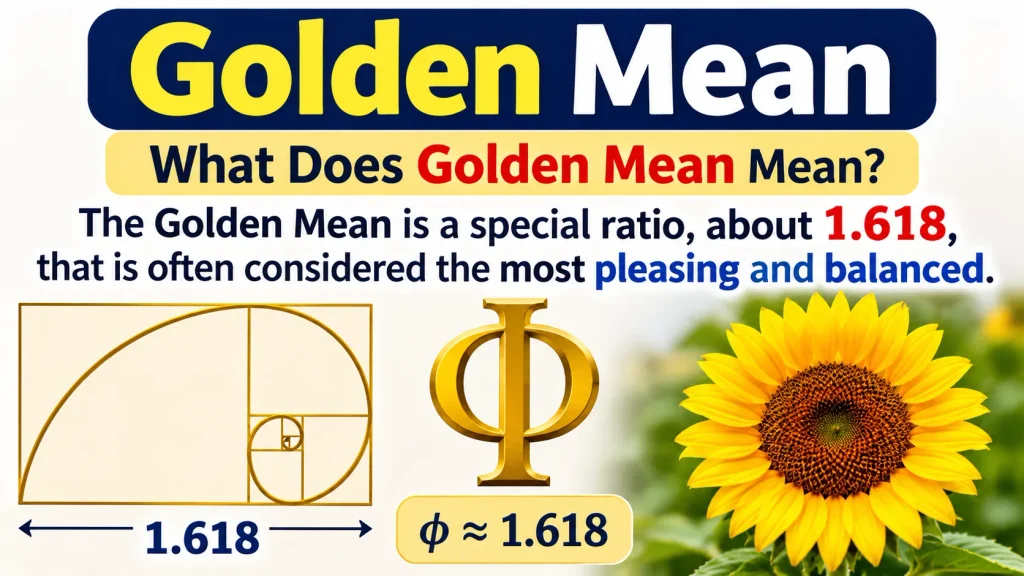
In mathematics, the Golden Mean is another name for the golden ratio, represented by the Greek letter phi (φ). Its approximate value is 1.6180339887.
In philosophy, the Golden Mean describes an appropriate balance between two extremes. Aristotle used this principle to explain how virtues can exist between excessive and deficient behavior.
For example, courage is traditionally understood as a desirable balance between cowardice and recklessness.
The two interpretations can be summarized as follows:
- Mathematical Golden Mean: A special proportional relationship represented by approximately 1.618.
- Philosophical Golden Mean: A principle of moderation that encourages appropriate behavior rather than extremes.
Understanding both meanings is important because the mathematical ratio and philosophical principle are not interchangeable.
2. Golden Mean Meaning in Simple Words
In simple words, the Golden Mean means finding a suitable proportion or balanced position instead of choosing an extreme.
Its exact meaning depends on the context.
In mathematics, it describes a special relationship between two parts of a whole. In philosophy, it encourages people to make thoughtful decisions and avoid excessive or insufficient behavior.
Imagine someone trying to maintain a healthy daily routine. Spending the entire day working without resting may lead to exhaustion. However, avoiding responsibilities completely can create different problems.
A thoughtful balance between work and relaxation is an everyday illustration of moderation.
Similarly, a designer might use mathematical proportions to arrange visual elements in an organized composition.
Simple definition: The Golden Mean refers either to the mathematical golden ratio or to the philosophical principle of finding an appropriate balance between two extremes.
3. The Two Main Meanings of the Golden Mean
Although the same expression appears in mathematics and philosophy, its meaning changes depending on the subject being discussed.
Here is a comparison of the two interpretations.
| Feature | Mathematical Golden Mean | Philosophical Golden Mean |
| Subject | Mathematics | Philosophy |
| Meaning | Special numerical proportion | Balance between extremes |
| Main symbol | Phi (φ) | No mathematical symbol |
| Associated figure | Euclid | Aristotle |
| Main concept | Approximately 1.618 | Moderation |
| Applications | Geometry and design | Ethics and decision-making |
| Main purpose | Understand proportions | Develop balanced behavior |
The mathematical interpretation follows a precise relationship that can be calculated.
The philosophical interpretation requires judgment because the appropriate action depends on the circumstances.
For example, 1.618 is a mathematical value, while choosing courage instead of cowardice or recklessness is an ethical decision.
Both meanings are important, but keeping them separate makes the concept much easier to understand.
4. Golden Mean in Mathematics
In mathematics, the Golden Mean is commonly known as the golden ratio or golden section.
It describes a special way of dividing a line into two unequal sections, a longer section and a shorter section.
The relationship is considered golden when the ratio of the entire line to its longer section equals the ratio of the longer section to the shorter section.
This produces the mathematical constant known as phi.
Its approximate value is:
φ = 1.6180339887…
The decimal continues forever without repeating a fixed pattern because phi is an irrational number.
Mathematicians study this proportion in geometry, algebra, and number theory.
It also appears in the properties of certain geometric figures, including regular pentagons and pentagrams.
The golden ratio is particularly interesting because a relatively simple relationship produces a mathematical constant with several distinctive properties.
5. What Is the Golden Mean Formula?
The mathematical golden ratio has a standard formula that can be used to calculate its value.
The formula is:
φ = (1 + √5) / 2
Where:
- φ represents the golden ratio.
- 1 is a mathematical constant.
- √5 represents the square root of five.
When calculated, the result is approximately:
φ = 1.6180339887…
Another important property of the golden ratio is:
φ² = φ + 1
This means that squaring the golden ratio produces the original value plus one.
It can also be expressed as:
φ = 1 + 1/φ
These relationships make phi an interesting mathematical constant.
The formula is useful when calculating golden proportions in line segments, rectangles, and other geometric constructions.
6. How to Calculate the Golden Mean
Calculating the Golden Mean becomes easier when you understand how the longer and shorter sections of a line are related.
Let’s use a simple example.
Step 1: Choose two lengths.
Suppose a line is divided into two sections:
- Longer section: 10 units
- Shorter section: 6.18 units
Step 2: Calculate the total length.
10 + 6.18 = 16.18 units.
Step 3: Divide the longer section by the shorter section.
10 ÷ 6.18 ≈ 1.618.
Step 4: Divide the complete length by the longer section.
16.18 ÷ 10 = 1.618.
Both calculations produce approximately the same result.
This demonstrates the golden ratio relationship:
Whole length ÷ Longer section = Longer section ÷ Shorter section
When both sides are equal, the line follows the golden ratio.
Remember that the example uses rounded decimal values, so very small differences can occur in practical calculations.
7. Easy Golden Mean Examples
Examples make mathematical concepts easier to understand, especially when they connect formulas with familiar measurements.
Here are four straightforward examples.
Example 1: A divided line
Imagine a line measuring 16.18 units. It is divided into a longer section of 10 units and a shorter section of 6.18 units.
The relationship between the two sections is approximately 1.618.
Example 2: A golden rectangle
A golden rectangle is a rectangle whose longer side divided by its shorter side equals approximately 1.618.
For example:
- Width: 10 cm
- Length: 16.18 cm
16.18 ÷ 10 = 1.618.
Example 3: Calculating a rectangle’s length
Suppose you want to create a golden rectangle with a width of 20 cm.
Multiply the width by the golden ratio:
20 × 1.618 = 32.36 cm.
The longer side should therefore measure approximately 32.36 cm.
Example 4: A philosophical example
Imagine someone deciding how to divide their time between studying and relaxation.
Studying constantly without taking breaks may cause exhaustion, while avoiding studying entirely can affect academic progress.
A balanced schedule is a practical illustration of moderation.
However, this final example represents the philosophical interpretation, not the mathematical ratio.
8. Golden Mean and the Fibonacci Sequence
The Golden Mean has a fascinating mathematical connection with the Fibonacci Sequence.
The Fibonacci sequence is a series of numbers in which each new number is calculated by adding the two preceding numbers.
It commonly begins:
0, 1, 1, 2, 3, 5, 8, 13, 21, 34, 55, 89, 144…
For example:
- 1 + 1 = 2
- 1 + 2 = 3
- 2 + 3 = 5
- 3 + 5 = 8
- 5 + 8 = 13
The interesting relationship appears when you divide consecutive Fibonacci numbers.
| Fibonacci Numbers | Calculation | Result |
| 5 and 8 | 8 ÷ 5 | 1.600 |
| 8 and 13 | 13 ÷ 8 | 1.625 |
| 13 and 21 | 21 ÷ 13 | 1.615 |
| 21 and 34 | 34 ÷ 21 | 1.619 |
| 34 and 55 | 55 ÷ 34 | 1.618 |
As the Fibonacci numbers become larger, the ratio of consecutive terms approaches the golden ratio.
This relationship connects a sequence of whole numbers with an irrational mathematical constant.
However, the Fibonacci sequence and the golden ratio are not the same thing. One is a number sequence, while the other is a mathematical constant.
9. Golden Mean in Philosophy
The philosophical Golden Mean is the principle of choosing moderation instead of falling into excessive or deficient behavior.
This concept is strongly associated with Aristotle, the ancient Greek philosopher.
According to his ethical philosophy, virtues often exist between two extremes.
For example, courage is understood as a desirable balance between cowardice and recklessness.
The principle does not mean that every situation has an exact numerical middle. Instead, it urges individuals to recognize what is appropriate in particular circumstances.
Consider generosity.
Giving nothing to someone who genuinely needs help may represent deficiency. Giving away everything without considering personal responsibilities may represent excess.
Generosity involves understanding what is appropriate.
The philosophical Golden Mean encourages good judgment, self-control, and thoughtful behavior.
It remains an important concept in discussions about ethics, character development, and personal responsibility.
10. Aristotle’s Golden Mean Explained
Aristotle developed the doctrine of the mean in his famous philosophical work, Nicomachean Ethics.
He explained that many moral virtues can be understood in relation to two extremes: one involving excess and the other involving deficiency.
The appropriate mean depends on the person, circumstances, and situation.
Consider these examples:
| Deficiency | Virtue or Mean | Excess |
| Cowardice | Courage | Recklessness |
| Stinginess | Generosity | Wastefulness |
| Lack of confidence | Proper self-confidence | Arrogance |
| Insensitivity | Appropriate gentleness | Excessive emotional reaction |
| Lack of self-control | Moderation | Self-indulgence |
These examples demonstrate how Aristotle’s principle can help explain ethical behavior.
An important detail is that Aristotle did not suggest choosing an exact mathematical midpoint.
For example, courage does not mean taking exactly half as many risks as a reckless person. It means responding appropriately to danger.
Similarly, generosity does not require giving away a fixed percentage of everything a person owns.
The right response depends on practical wisdom and the circumstances.
Aristotle also recognized that some actions are wrong in themselves. His doctrine does not mean that people should find a moderate amount of wrongdoing.
The central lesson is that good character involves developing the judgment to choose appropriate actions.
11. Examples of the Golden Mean in Everyday Life
The philosophical Golden Mean can be applied to Ordinary Situations involving responsibilities, relationships, habits, and personal decisions.
It encourages people to consider whether their behavior is excessive, insufficient, or appropriate.
Here are some practical examples.
1. Work and relaxation
Working constantly without rest can create exhaustion. Avoiding responsibilities completely can affect productivity.
A balanced routine makes room for both work and relaxation.
2. Spending and saving
Spending without planning can create financial difficulties. Refusing to spend on necessary things can also make life unnecessarily restrictive.
Responsible financial decisions involve considering both present needs and future goals.
3. Confidence and humility
Having too little confidence can prevent someone from pursuing opportunities. Excessive confidence may develop into arrogance.
Healthy confidence means recognizing your abilities while remaining open to improvement.
4. Exercise and recovery
Too little physical activity may affect fitness, while excessive training without recovery can increase the risk of injury.
A suitable exercise routine includes both activity and rest.
5. Honesty and kindness
Honesty is important, but communicating without considering another person’s feelings can create unnecessary conflict.
A thoughtful approach combines truthfulness with respect.
6. Independence and cooperation
Depending entirely on others can limit personal responsibility. Refusing all help can make teamwork difficult.
A balanced approach recognizes when to work independently and when to cooperate.
These examples show how moderation can help people think more carefully about their everyday choices.
Related To Another Article: https://genzwishes.com/sample-mean-calculator/
12. Golden Mean in Art, Architecture, and Nature
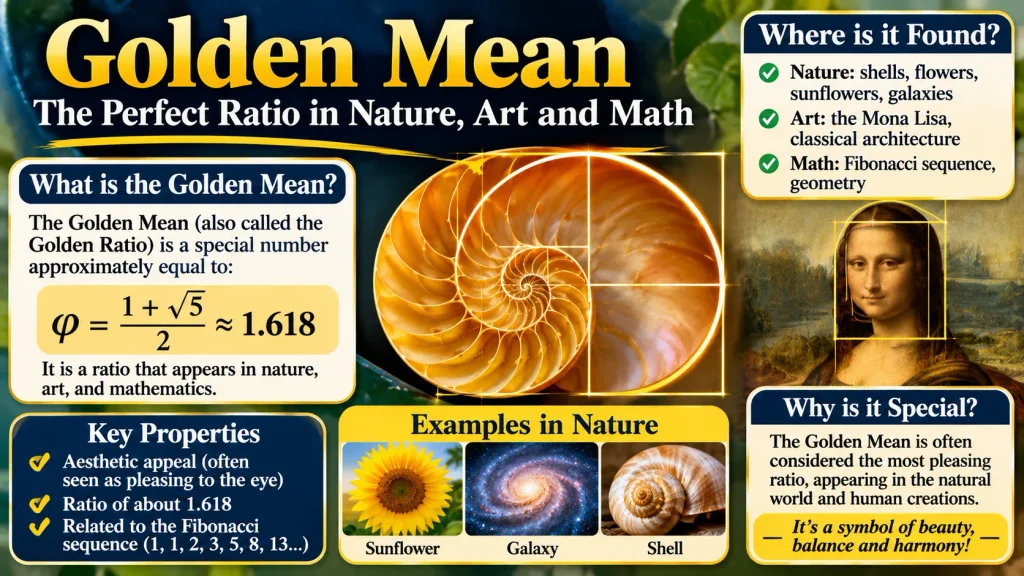
The mathematical golden ratio has attracted considerable attention in art, architecture, graphic design, photography, and the study of natural patterns.
It can be used as a proportional guide, although not every attractive design or natural structure follows this mathematical relationship.
Art and graphic design
Artists and designers sometimes use golden proportions to arrange visual elements, divide spaces, and create balanced compositions.
A golden rectangle, for example, can provide a useful starting point when planning a layout.
Architecture
The golden ratio is frequently discussed in relation to historical buildings and architectural proportions.
However, claims that particular ancient buildings were deliberately designed according to this ratio should be supported by historical evidence rather than visual resemblance alone.
Nature
The golden ratio is often discussed alongside mathematical patterns in plants and flowers.
Some plant arrangements are connected to Fibonacci numbers and the golden angle.
Nevertheless, not every natural spiral, shell, flower, or plant structure follows the golden ratio.
Photography
Photographers sometimes use golden-ratio grids to position important subjects within an image.
The rule of thirds is another popular composition technique, but it is not the same as the golden ratio.
Overall, the golden ratio provides one possible method for understanding proportion and visual organization. It is a design tool, not a universal requirement for beauty.
13. History and Origin of the Golden Mean
The mathematical history of the Golden Mean goes back to ancient Greek geometry.
Around 300 BCE, the Greek mathematician Euclid described a special way of dividing a line known as division in extreme and mean ratio.
His mathematical work, Elements, contains an important explanation of this proportional relationship.
During the Renaissance, interest in the golden proportion increased.
In 1509, Luca Pacioli published De Divina Proportione (On Divine Proportion), a work exploring mathematical and geometric relationships.
Leonardo da Vinci contributed illustrations to the publication, although he was not its co-author.
Over time, several names became associated with the mathematical proportion:
- Golden Ratio
- Golden Mean
- Golden Section
- Golden Proportion
- Divine Proportion
- Extreme and Mean Ratio
The philosophical meaning has a different historical background.
Aristotle discussed the doctrine of the mean in his ethical philosophy, particularly in Nicomachean Ethics.
Therefore, the mathematical and philosophical interpretations have separate historical developments, even though they share the expression Golden Mean.
14. Common Myths and Misconceptions About the Golden Mean
The Golden Mean is often surrounded by popular claims that can create confusion.
Understanding the difference between mathematical facts, historical evidence, and popular interpretations is essential.
Myth 1: The Golden Ratio always creates beauty.
The golden ratio is an interesting Mathematical Proportion, but it does not guarantee that a painting, design, building, or object will be beautiful.
Aesthetic preferences depend on many factors.
Myth 2: Every natural spiral follows the Golden Ratio.
Not all spirals follow the golden ratio. Natural structures can develop through different mathematical and biological processes.
Myth 3: The Golden Ratio is the same as the Fibonacci sequence.
The Fibonacci sequence consists of whole numbers, whereas the golden ratio is an irrational mathematical constant. Ratios of consecutive Fibonacci numbers approach phi as the sequence progresses.
Myth 4: Aristotle’s Golden Mean means choosing the exact middle.
Aristotle’s philosophical mean is not a mathematical midpoint. It refers to selecting an appropriate response between excess and deficiency.
Myth 5: The Golden Ratio is scientifically proven to determine facial beauty.
There is no convincing scientific evidence that the golden ratio is a universal formula for facial attractiveness. A 2024 review published in Maxillofacial Plastic and Reconstructive Surgery discusses why many popular claims about ideal facial proportions are unsupported.
Myth 6: Every famous ancient building was designed using the Golden Ratio.
Historical claims about golden proportions in ancient architecture require reliable evidence. A resemblance between measurements does not automatically establish intentional use.
Separating established facts from exaggerated interpretations makes the subject easier to understand.
15. Why Is the Golden Mean Important?
The Golden Mean remains important because it provides interesting ways to understand mathematical relationships and philosophical ideas.
Its mathematical interpretation helps explain geometric proportions, number sequences, and the properties of an irrational constant.
And its philosophical interpretation provides a framework for considering moderation, character, and ethical decisions.
Its importance can be understood through several areas:
- Mathematics: Demonstrates an interesting numerical relationship.
- Geometry: Helps explain golden rectangles and geometric constructions.
- Education: Connects algebra, geometry, and number sequences.
- Graphic design: Offers one possible approach to arranging visual proportions.
- Philosophy: Encourages moderation and thoughtful behavior.
- Personal development: Provides a way to reflect on balanced decisions and habits.
However, the Golden Mean is not a universal solution to every problem. Its value comes from understanding the particular mathematical or philosophical concept being discussed.
People Also Ask
A: The Golden Mean has two meanings. In mathematics, it refers to the golden ratio, approximately 1.618. In philosophy, it means finding an appropriate balance between two extremes.
A: The mathematical golden ratio formula is φ = (1 + √5) / 2. Its approximate value is 1.6180339887. It describes a special proportional relationship between two parts of a whole.
A: Aristotle’s Golden Mean is a philosophical principle that describes virtue as a desirable balance between excess and deficiency. For example, courage is traditionally considered a mean between cowardice and recklessness.
A: In mathematics, yes. Golden Mean is another name for the Golden Ratio or Golden Section. However, in philosophy, the expression refers to moderation between extremes.
A: The mathematical golden ratio can be used in geometry, graphic design, art, architecture, and photography. Its philosophical meaning can be applied to everyday decisions involving work, rest, confidence, generosity, and self-control.
Conclusion
The Golden Mean connects two areas of Human Knowledge: mathematics and philosophy.
Its mathematical interpretation describes a special proportion, approximately 1.618, while its philosophical interpretation encourages people to avoid extremes and make balanced decisions.
From golden rectangles and Fibonacci numbers to Aristotle’s teachings about courage and moderation, the concept offers valuable ways to understand proportion, harmony, and thoughtful judgment.
Whether you are studying mathematics, exploring ancient philosophy, or simply trying to understand the expression, knowing both meanings gives you a much clearer understanding of the Golden Mean.
If you found this explanation useful, consider sharing it with someone interested in mathematics, philosophy, or the fascinating ideas connecting the two.











1 thought on “Golden Mean: Meaning, Formula, Philosophy & Examples”