Introduction
Have you ever heard someone describe a relative as their First Cousin once removed and wondered what that actually means? Family relationships can get confusing when people are in different generations, especially when terms like first cousin, second cousin, and twice removed come up.
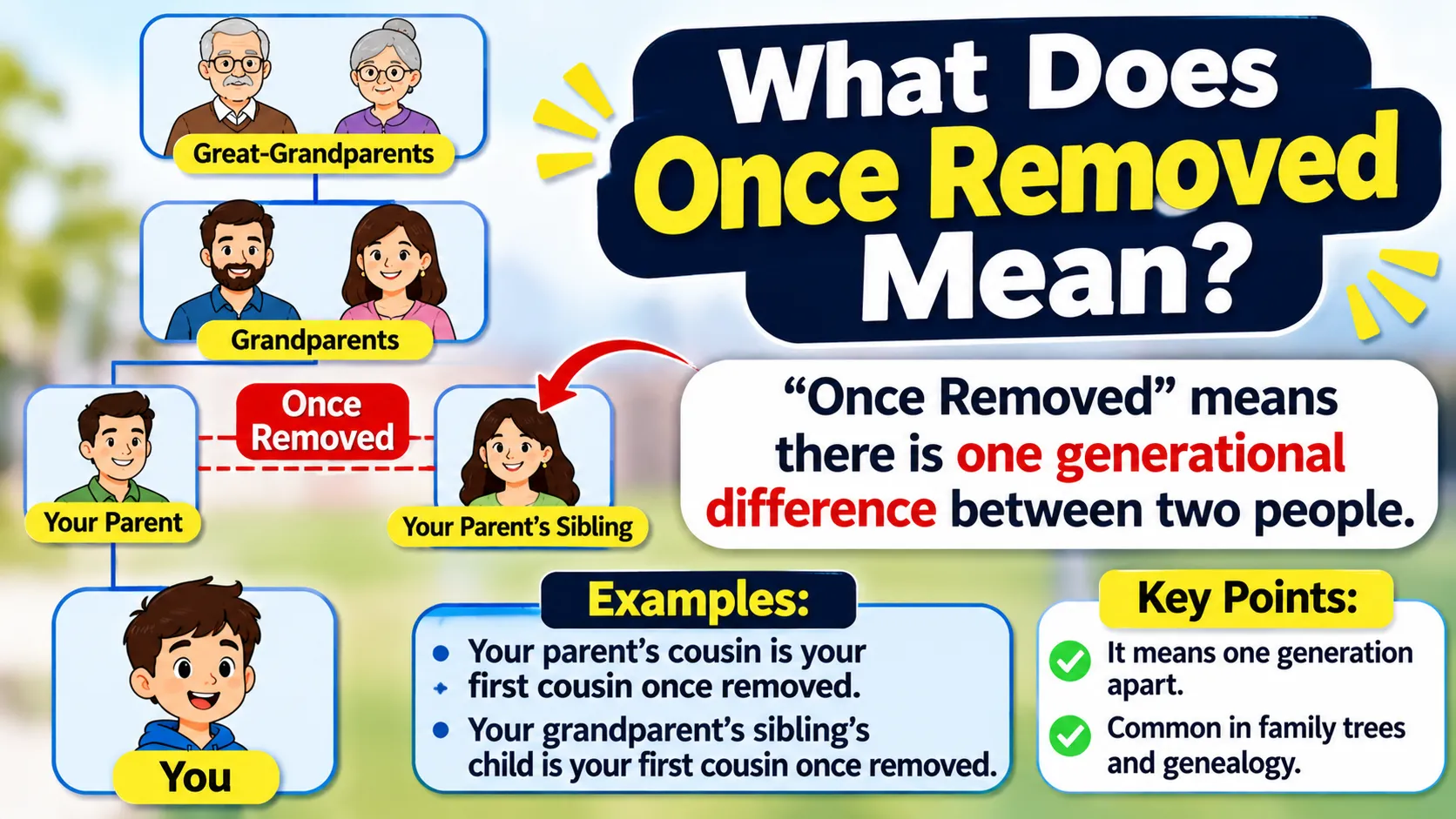
Simply put, once removed means two cousins are separated by one generation. This can describe someone one generation older or one generation younger than you.
For example, your first cousin’s child is your first cousin once removed. Similarly, your parent’s first cousin is also your first cousin once removed.
But why are both relationships called the same thing? And how can you figure out whether someone is your first cousin once removed, second cousin, or twice removed?
In this guide, you’ll discover the meaning of once removed, understand family relationships through simple examples, explore an easy cousin chart, and learn how to calculate your own family connections.
1. What Does Once Removed Mean?
Once removed means two cousins belong to different generations, with exactly one generation separating them. It is a genealogy term used to describe family connections rather than emotional distance or how closely two people communicate.
For example, your first cousin belongs to the same generation as you. However, your first cousin’s child belongs to the next generation. This makes that child your first cousin once removed.
The word “it” simply identifies the generation difference.
Here is the basic rule:
- Not: Both cousins belong to the same generation.
- Once: There is a one-generation difference.
- Twice removed: There is a two-generation difference.
- Three times removed: There is a three-generation difference.
Simple example: If your cousin has a daughter, she is your first cousin once removed. You do not become her aunt or uncle through that relationship, even though you may be much older than her.
The important thing to remember is that cousin numbers and removals describe two different parts of a family relationship.
2. What Does Once Removed Mean in a Family?
In a family tree, once removed describes two relatives who have a cousin relationship but belong to different generations.
This relationship can work in two directions. Someone can be one generation above you or one generation below you.
Consider these examples.
Example 1: Your first cousin’s child
Imagine your father’s brother has a daughter named Sarah. Sarah is your first cousin because you share grandparents.
Sarah later has a son named Daniel. Daniel is your first cousin once removed because he belongs to the generation below yours.
Example 2: Your parent’s first cousin
Suppose your mother has a first cousin named James. Your mother and James belong to the same generation.
Because you are one generation below your mother, James is your first cousin once removed.
Both examples describe the same generation difference, even though one relative is younger and the other is older.
| Family member | Your relationship |
| Your father’s brother’s daughter | First cousin |
| Your first cousin’s son | First cousin once removed |
| Your mother’s first cousin | First cousin once removed |
| Your first cousin’s grandchild | First cousin twice removed |
This is why understanding generations is more useful than simply comparing people’s ages.
3. What Is a First Cousin Once Removed?
A first cousin once removed is someone who has a first-cousin relationship with you but belongs to a generation one level above or below yours.
There are two common examples.
Your first cousin’s child
Your aunt or uncle has a child who becomes your first cousin. When that cousin has a child, the child becomes your first cousin once removed.
Your parent’s first cousin
Your parent and their first cousin share grandparents. Because you belong to the next generation, that relative becomes your first cousin once removed.
For example:
- Your name: Alex
- Your first cousin: Emma
- Emma’s daughter: Olivia
Your relationship with Emma is first cousins.
Your relationship with Olivia is first cousins once removed.
You may simply call Olivia your cousin in everyday conversation, but the formal genealogy term explains the exact connection.
Remember that you do not need to share the same age to belong to different family generations.
4. Is Once Removed Older or Younger?
Once removed can describe someone older or younger than you. It does not automatically mean an older family member.
The term only explains that there is a one-generation difference between two cousins.
Here are some examples:
| Relative | Your relationship | Generation |
| Your parent’s first cousin | First cousin once removed | One above |
| Your first cousin | First cousin | Same |
| Your first cousin’s child | First cousin once removed | One below |
| Your first cousin’s grandchild | First cousin twice removed | Two below |
| Your grandparent’s first cousin | First cousin twice removed | Two above |
Can someone be younger than you but still be your first cousin once removed?
Yes. A relative’s generation is determined by their position in the family tree, not their birth year.
For instance, your first cousin could have a child who is almost your age. That person is still your first cousin once removed.
This distinction is particularly important in families where siblings have children many years apart.
5. What Is the Difference Between Once Removed and Twice Removed?
The difference between once removed and twice removed is the number of generations separating two cousins.
Once removed means one generation apart, while twice removed means two generations apart.
For example, your first cousin’s child is your first cousin once removed. That child’s child is your first cousin twice removed.
Here is an easy comparison:
| Relationship term | Generation difference | Example |
| First cousin | 0 generations | Your aunt’s child |
| First cousin once removed | 1 generation | Your first cousin’s child |
| First cousin twice removed | 2 generations | Your first cousin’s grandchild |
| First cousin three times removed | 3 generations | Your first cousin’s great-grandchild |
The same pattern works in the opposite direction.
- Your parent’s first cousin is your first cousin once removed.
- Your grandparent’s first cousin is your first cousin twice removed.
- Your great-grandparent’s first cousin is your first cousin three times removed.
The easiest way to remember this is to count how many generations separate the two relatives.
6. First Cousin vs. First Cousin Once Removed
A first cousin and a first cousin once removed are different because they belong to different generations.
Your first cousin is usually the child of your aunt or uncle. You share grandparents and belong to the same generation.
Your first cousin once removed is either your first cousin’s child or your parent’s first cousin.
Compare the two:
| First cousin | First cousin once removed |
| Same generation | One generation apart |
| Shares your grandparents | Connected through a first-cousin relationship across generations |
| Your aunt’s or uncle’s child | Your cousin’s child |
| No removal | One removal |
Example:
Imagine your aunt has a daughter named Lily. Lily is your first cousin.
Lily has a son named Noah. Noah is your first cousin once removed.
Although Noah is part of your extended family, his formal relationship with you is different from Lily’s.
7. First Cousin Once Removed vs. Second Cousin
One of the Biggest Sources of confusion is the difference between a first cousin once removed and a second cousin.
They are not the same relationship.
A first cousin once removed belongs to a generation one step above or below you in a first-cousin relationship.
A second cousin belongs to your generation and shares great-grandparents with you.
Let’s use a simple example.
Your first cousin has a daughter named Mia. Mia is your first cousin once removed.
You also have a daughter named Sophia. Sophia and Mia are second cousins because they belong to the same generation and share great-grandparents.
Here is the difference:
| Relationship | Shared ancestor | Generation difference |
| First cousin | Grandparents | Same |
| First cousin once removed | Grandparents, with one generation difference | One |
| Second cousin | Great-grandparents | Same |
| Second cousin once removed | Great-grandparents, with one generation difference | One |
| First cousin twice removed | Grandparents, with two generation difference | Two |
Easy way to remember:
- First, second, and third describe the cousin relationship.
- Once, twice, and three times removed describe the generation difference.
These are two separate measurements.
Once you understand this distinction, identifying distant family members becomes much easier.
8. Once Removed Family Relationship Chart
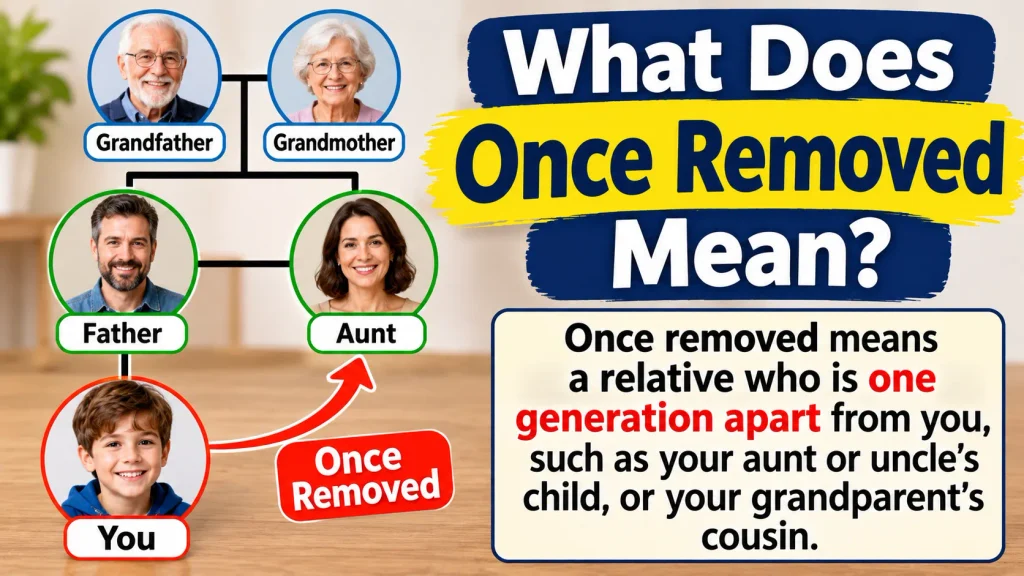
A family relationship chart makes the meaning of once removed easier to understand because you can see how relatives connect across generations.
Consider this simplified family tree:
Generation 1: Shared grandparents
- Grandfather and grandmother
And Generation 2: Their children
- Your parent
- Your aunt or uncle
Generation 3: Their grandchildren
- You
- Your first cousin
And Generation 4: Their great-grandchildren
- Your child
- Your first cousin’s child
Generation 5: Their great-great-grandchildren
- Your grandchild
- Your first cousin’s grandchild
Now look at your relationship with each relative:
| Family member | Relationship to you |
| Your first cousin | First cousin |
| Your first cousin’s child | First cousin once removed |
| Your first cousin’s grandchild | First cousin twice removed |
| Your first cousin’s great-grandchild | First cousin three times removed |
| Your parent’s first cousin | First cousin once removed |
| Your grandparent’s first cousin | First cousin twice removed |
The chart demonstrates an important point: the generation difference can go upward or downward.
You should always count the parent-to-child steps rather than assuming that someone is a particular cousin because of their age.
9. How to Calculate Once Removed Relationships
You do not need advanced genealogy Knowledge To Calculate a removed relationship. You only need to identify the closest shared ancestor and compare how many generations separate each person from that ancestor.
Follow these five steps.
Step 1: Find your common ancestor
Identify the closest ancestor that you and the other person share.
This could be your grandparents, great-grandparents, or an earlier generation.
Step 2: Count your generations
Count the parent-to-child steps between yourself and the common ancestor.
For example, your grandparents are two generations above you.
Step 3: Count the other person’s generations
Follow the same process for the other relative.
Your first cousin’s child is three generations below your shared grandparents.
Step 4: Calculate the difference
Subtract the smaller generation count from the larger one.
For example:
- Your distance from shared grandparents: 2 generations.
- Your cousin’s child’s distance from shared grandparents: 3 generations.
- Difference: 3 − 2 = 1.
Step 5: Combine the cousin number and removal
Your first cousin’s child is your first cousin once removed.
Here is the general formula:
Number of removals = Difference between the two generation counts.
The cousin number is determined by the shorter generation distance to the closest shared ancestor, minus one.
For example:
| Your generations | Other person’s generations | Relationship |
| 2 | 2 | First cousin |
| 2 | 3 | First cousin once removed |
| 2 | 4 | First cousin twice removed |
| 3 | 3 | Second cousin |
| 3 | 4 | Second cousin once removed |
| 3 | 5 | Second cousin twice removed |
This calculation method works for ordinary cousin relationships where you have identified the closest shared ancestor.
10. Real-Life Examples of Once Removed Relationships
Sometimes real family situations make genealogy terminology easier to understand than definitions alone.
Here are several examples that show how once removed works.
Example 1: Your cousin’s daughter
Your first cousin has a daughter named Mia. Mia is your first cousin once removed.
Example 2: Your father’s cousin
Your father has a first cousin named Robert. Robert is your first cousin once removed because he belongs to your parent’s generation.
Example 3: Your cousin’s son
Your cousin has a son named Noah. Even if Noah is almost your age, he is still your first cousin once removed.
Example 4: Your grandparent’s cousin
Your grandfather has a first cousin named William. William is your first cousin twice removed.
Example 5: Your cousin’s grandchild
Your first cousin becomes a grandparent. Their grandchild is your first cousin twice removed.
Example 6: Your parent’s second cousin
Your mother’s second cousin is your second cousin once removed.
Example 7: Your child’s second cousin
Your second cousin has a child. That child is your second cousin once removed, while your child and that person’s child would be third cousins if they share the relevant great-great-grandparents.
These examples demonstrate that the word removed applies to different cousin relationships, not only first cousins.
Related To Another Article: https://genzwishes.com/what-does-the-upside-down-smiley-face-mean/
11. What Does Second Cousin Once Removed Mean?
A second cousin once removed is someone who has a second-cousin connection with you but belongs to a generation one step above or below yours.
Second cousins share great-grandparents when they belong to the same generation.
If your second cousin has a child, that child becomes your second cousin once removed.
Similarly, your parent’s second cousin is also your second cousin once removed.
Here is a quick comparison:
| Relationship | Example |
| Second cousin | Your parent’s cousin’s child |
| Second cousin once removed | Your second cousin’s child |
| Second cousin twice removed | Your second cousin’s grandchild |
| Third cousin | Someone who shares your great-great-grandparents |
The cousin number identifies the shared ancestral relationship, while the removed number describes the generation difference.
This same principle applies to third cousins, fourth cousins, and more distant relatives.
12. Common Mistakes People Make About Removed Cousins
Family relationships can become confusing when people use everyday Family Names instead of formal genealogy terminology.
Here are some common mistakes that are worth avoiding.
Mistake 1: Thinking removed means emotionally distant
Removed does not mean you have a weak relationship with someone or that you are no longer part of the same family.
It simply describes the difference in generations.
Mistake 2: Calling your cousin’s child your second cousin
Your first cousin’s child is your first cousin once removed.
Your child and your first cousin’s child are second cousins.
Mistake 3: Thinking once removed always means older
A relative can be one generation above or below you.
Mistake 4: Confusing cousin numbers with removals
The first-cousin number and the once-removed label measure different things.
Mistake 5: Counting age instead of generations
Someone may be younger than you but still belong to a different generation.
Always follow the family tree rather than comparing birth years.
Mistake 6: Assuming every relative with the same surname is a cousin
A shared surname alone does not establish a cousin relationship. You need to identify the actual family connection and common ancestors.
Avoiding these mistakes will help you understand family trees and describe relatives more accurately.
13. Does Once Removed Mean Less Closely Related?
No. Once removed does not mean someone is emotionally less important or that the family connection has been removed.
It is a technical genealogy term describing how two relatives belong to different generations.
However, cousin relationships can also be described through shared DNA.
For example:
- First cousins share approximately 12.5% of their autosomal DNA on average.
- First cousins once removed share approximately 6.25% on average.
- Second cousins share approximately 3.125% on average.
These are statistical averages, not guaranteed percentages for every family.
Actual shared DNA can vary because inheritance is random.
It is also important to remember that a DNA match alone does not always establish one exact relationship. Several family connections can produce similar DNA-sharing amounts.
Therefore, family trees, historical records, and DNA information can be useful together when researching ancestry.
14. Why Understanding Once Removed Matters
Understanding once removed is useful in everyday family Conversations, genealogy research, and DNA testing.
Here are some situations where this knowledge can help.
Building a family tree
If you are creating a family tree, correct cousin terminology helps you organize relatives across several generations.
It also makes it easier to identify how different branches of your family connect.
Understanding genealogy records
Family history websites and historical documents often use terms such as first cousin once removed or second cousin twice removed.
Knowing these terms helps you understand what the records actually describe.
Understanding DNA results
Some DNA testing services use abbreviations to describe possible family relationships.
Common abbreviations include:
- 1C1R: First cousin once removed.
- 1C2R: First cousin twice removed.
- 2C1R: Second cousin once removed.
- 2C2R: Second cousin twice removed.
These labels can help you interpret possible connections, although DNA results should not be treated as proof of one exact relationship.
Explaining family connections
Sometimes you meet someone at a family gathering and cannot immediately explain how that person is related to you.
Knowing cousin terminology makes it easier to describe the connection.
Five internal linking opportunities for GenzWishes:
- Family Love Quotes – A relevant article for readers exploring family connections.
- Family Relationship Quotes – Useful for readers interested in different family bonds.
- Cousins Quotes – A natural supporting article about cousin relationships.
- Family Bonding Messages – Related content about strengthening family connections.
- Family Tree Quotes – A supporting topic for readers interested in ancestry.
Use these suggestions only when the corresponding articles are published and relevant.
Future supporting content opportunities:
- What Is a Second Cousin?
- What Does Twice Removed Mean?
- First Cousin vs. Second Cousin
- What Is a Third Cousin?
- How Are Cousins Related in a Family Tree?
These topics can help GenzWishes build a useful family relationship and terminology content cluster.
People Also Ask
A: Once removed means two cousins are one generation apart. Your first cousin’s child and your parent’s first cousin are both examples of first cousins once removed.
A: No. Your first cousin’s child is your first cousin once removed. Your child and your first cousin’s child are second cousins because they belong to the same generation and share great-grandparents.
A: Once removed means a one-generation difference, while twice removed means a two-generation difference. Your first cousin’s child is your first cousin once removed, whereas your first cousin’s grandchild is your first cousin twice removed.
A: Yes. Your parent’s first cousin is your first cousin once removed and belongs to a generation above yours. The term can also describe someone one generation younger than you.
A: Find the closest shared ancestor and count the generations between each person and that ancestor. If the relationship is a first-cousin connection and the generation difference is one, the person is your first cousin once removed.
Conclusion
Understanding what once removed means becomes much easier when you Separate Cousin numbers from generation differences.
Remember these simple rules:
- First cousins share grandparents.
- Second cousins share great-grandparents.
- Once removed means one generation apart.
- Twice removed means two generations apart.
- Your first cousin’s child is your first cousin once removed.
The next time someone mentions a first cousin once removed, you will know exactly what that relationship means.
If you are building a family tree or researching your ancestry, save this guide as a quick reference. You can also share it with relatives who find cousin terminology confusing.
After all, understanding your family connections should be easier than remembering everyone’s birthday!