Introduction
Have you ever received a message with an Upside-Down smiley face and wondered what the sender actually meant? It looks like a simple smiling expression, but its meaning can be surprisingly complicated.
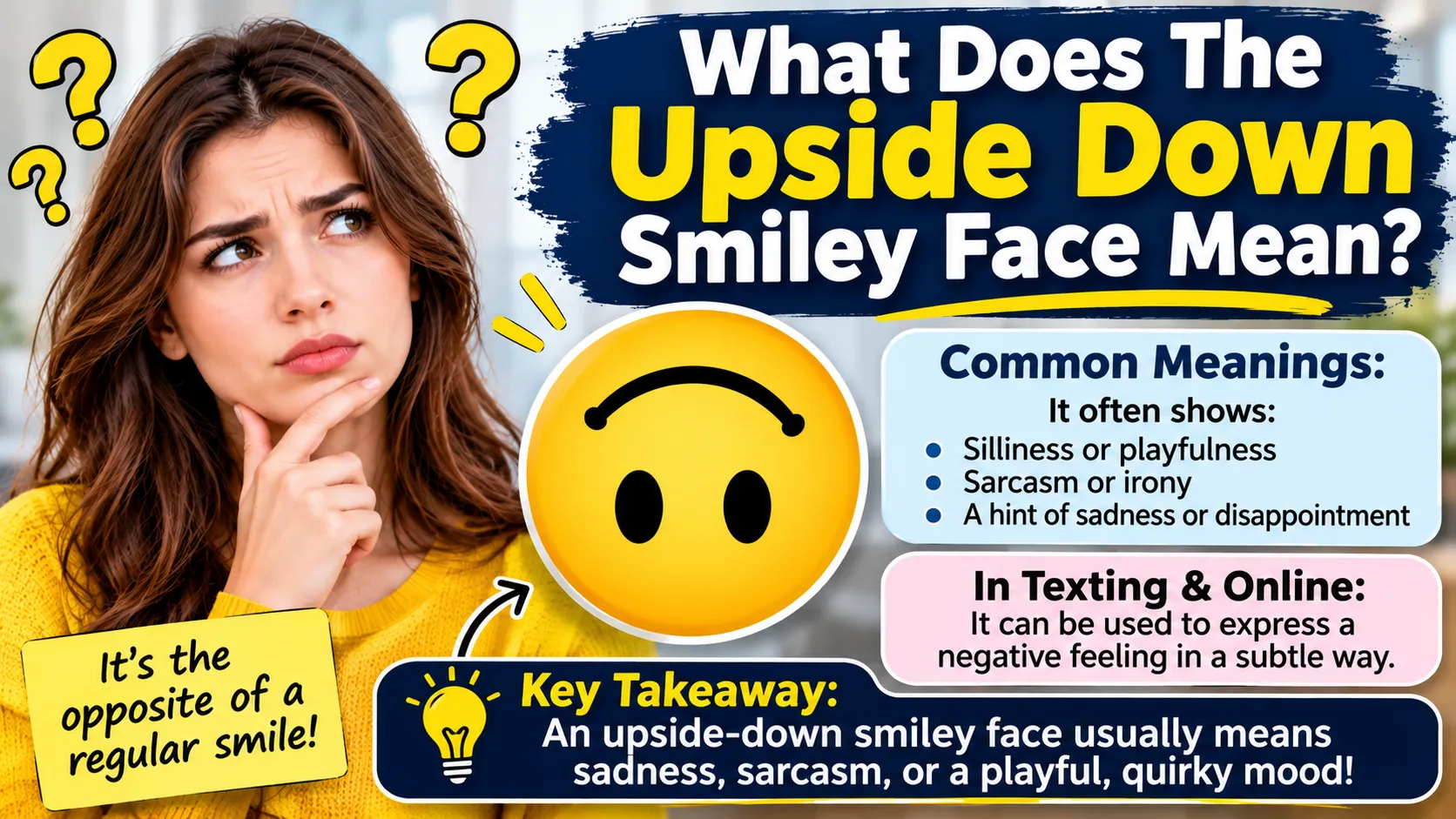
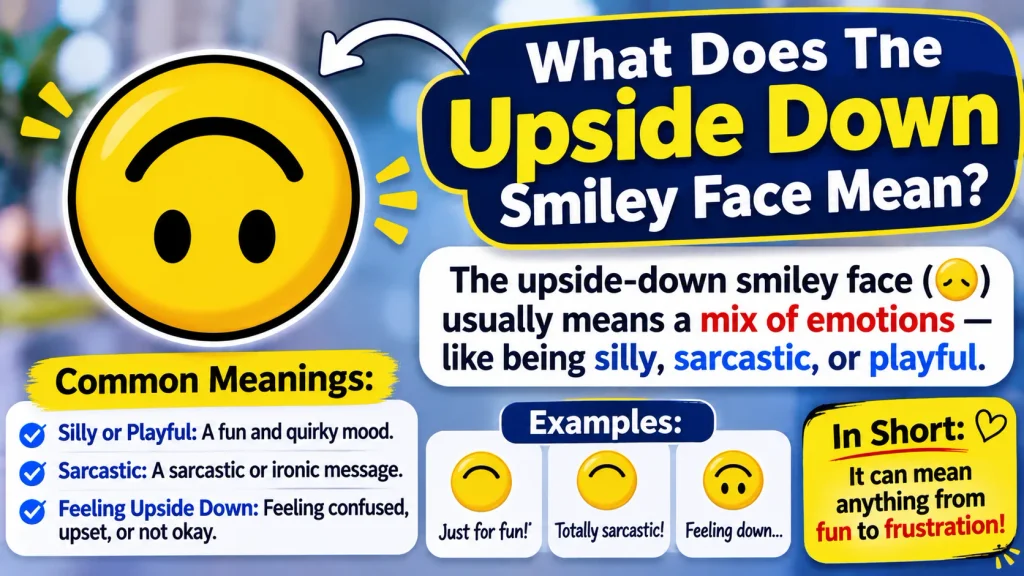
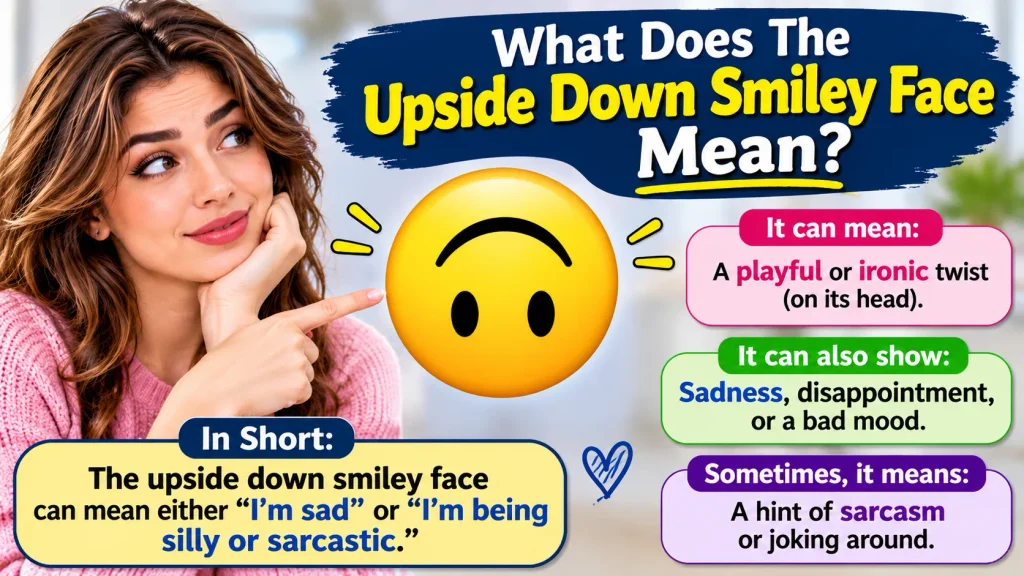
The upside-down smiley face commonly represents sarcasm, irony, awkwardness, silliness, or hidden frustration. People use it when their words do not completely express their actual feelings. Sometimes it communicates humor, while other times it suggests that something is not quite right.
Understanding its meaning can help you interpret conversations with friends, partners, family members, and people on social media.
In this guide, we will explore its different meanings, texting interpretations, flirting signals, practical examples, and the best ways to respond.
1. What Does the Upside Down Smiley Face Mean?
The upside-down smiley face usually represents sarcasm, irony, awkwardness, silliness, or mild frustration. It is commonly used when someone wants to communicate an emotion in a playful or indirect way.
For example:
“I’m having a wonderful Monday!”
If someone adds an upside-down smiley face to this statement, they might actually be having a terrible day. The expression suggests that their words should not necessarily be interpreted literally.
Here are its most common interpretations:
- Sarcasm: Expressing something differently from what you actually mean.
- Irony: Highlighting an unexpected or contradictory situation.
- Awkwardness: Showing embarrassment or discomfort.
- Frustration: Expressing mild annoyance without sounding overly serious.
- Playfulness: Adding a funny or unusual tone to a conversation.
- Hidden emotions: Pretending everything is fine when something is bothering you.
The important thing to remember is that its meaning depends on the surrounding conversation.
2. What Is the Upside Down Face Symbol?
The upside-down face is an inverted smiling expression used in digital communication. Its official Unicode name is Upside-Down Face.
It was approved as part of Unicode 8.0 in 2015 and included in Emoji 1.0 during the same year.
Unlike a traditional smile, its unusual orientation gives it a slightly confusing or ironic appearance. This makes it useful when someone wants to express feelings that are difficult to communicate through ordinary words.
For example:
- “I accidentally sent the message to the wrong person.”
- “Another Monday morning at work.”
- “Everything is going according to plan.”
Depending on the situation, these statements might communicate embarrassment, sarcasm, or playful frustration.
Its popularity comes from its versatility. A single expression can add humor, soften an uncomfortable statement, or suggest that the sender is not entirely serious.
3. The Most Common Meanings of the Upside Down Smiley Face
The upside-down smiley face has several interpretations in everyday conversations. Understanding its different uses can help you recognize the sender’s intended tone.
Sarcasm and irony
People often use it when making sarcastic comments.
Example: “I absolutely love waiting three hours for a bus.”
The sender probably does not enjoy waiting. Instead, they are highlighting an annoying experience through humor.
Awkwardness and embarrassment
It can also communicate discomfort after an embarrassing situation.
Example: “I waved at someone who wasn’t waving at me.”
The expression makes the situation feel less serious.
Hidden frustration
Sometimes people use it when they are annoyed but do not want to sound openly angry.
Example: “I have another assignment due tomorrow.”
The sender may be overwhelmed but chooses to express that feeling humorously.
Silliness and playful humor
Not every use has a negative meaning. Friends often use it to make ordinary conversations more entertaining.
Example: “I just ate pizza for breakfast.”
Here, it adds a playful and slightly ridiculous tone.
Pretending everything is fine
Another common interpretation involves smiling through an uncomfortable situation.
Example: “I forgot my homework, and the teacher is collecting it today.”
The sender is probably worried but using humor to make the situation easier to handle.
4. What Does the Upside Down Smiley Face Mean in Text Messages?
In texting, the upside-down smiley face adds emotional meaning to ordinary words. It can communicate sarcasm, embarrassment, frustration, or playfulness without requiring a long explanation.
Consider these common examples:
| Text message | Possible interpretation |
| “I’m fine.” | Something might be bothering me. |
| “That’s great.” | I might be responding sarcastically. |
| “Oops, my mistake.” | I feel a little embarrassed. |
| “Here we go again.” | I’m frustrated with this situation. |
| “You’re so funny.” | I’m teasing or being playful. |
| “Another exam tomorrow.” | I’m not particularly excited. |
One important detail is that the expression does not always change the literal meaning of a message. Instead, it adds a tone that helps the reader understand how the words should be interpreted.
For example, saying “Okay” can sound neutral, but adding an upside-down expression might suggest hesitation, sarcasm, or mild annoyance.
Always consider the entire conversation before deciding what someone means.
5. What Does the Upside Down Smiley Face Mean From a Girl?
When a girl sends an upside-down smiley face, she might be joking, Teasing, feeling embarrassed, flirting, or expressing mild frustration.
However, it does not automatically mean she likes you or has romantic feelings.
Here are some possible interpretations.
She is joking with you
Example: “You really forgot my birthday?”
She might be teasing you, although she could also be genuinely disappointed.
She feels awkward
Example: “I didn’t know what to say when you complimented me.”
This could suggest embarrassment or uncertainty.
She is flirting playfully
Example: “Maybe I’ll tell you my secret someday.”
Depending on your relationship, this could create a playful and slightly flirtatious atmosphere.
She is annoyed
Example: “You’re late again.”
She might be expressing disappointment without directly starting an argument.
The best way to understand her intention is to consider her words, previous messages, and usual communication style.
6. What Does the Upside Down Smiley Face Mean From a Guy?
When a guy uses the upside-down smiley face, he may be communicating humor, sarcasm, awkwardness, or playful teasing.
Its meaning is not necessarily different from when a girl uses it. The surrounding conversation matters more than the sender’s gender.
Here are some examples:
He is making a joke
“Guess who forgot his keys again.”
He is probably laughing at his own mistake.
He feels embarrassed
“I accidentally called my teacher Mom.”
He might be using humor to make an uncomfortable experience less serious.
He is flirting
“You’re becoming my favorite distraction.”
Depending on the relationship, this could be a playful expression of interest.
He is frustrated
“Another problem to deal with today.”
He might be communicating mild annoyance.
Remember that one expression cannot reliably reveal someone’s romantic intentions. Look at their overall behavior and communication.
7. What Does the Upside Down Smiley Face Mean When Flirting?
In flirting, the upside-down smiley face can add a playful, teasing, or slightly awkward tone to a message.
People sometimes use it when they want to show interest without making their feelings too obvious.
Consider these examples:
- “You looked really cute today.”
- “I was actually waiting for your message.”
- “Maybe I missed you a little.”
- “You’re making me smile too much.”
- “Don’t get too confident now.”
These statements can sound flirtatious when the sender and recipient already have a playful relationship.
However, the expression alone does not confirm romantic interest.
Pay attention to other signs, such as whether the person regularly starts conversations, shows genuine interest, remembers details about you, and makes an effort to communicate.
The overall interaction provides much more information than one symbol.
8. Does the Upside Down Smiley Face Mean Sarcasm?
Yes. Sarcasm is one of the most common interpretations of the upside down smiley face.
People use it when their words sound positive but their actual feelings may be completely different.
For example:
“Love waiting two hours for a bus.”
The sender probably does not enjoy waiting. Instead, they are making a sarcastic comment about an inconvenient experience.
Another example:
“Fantastic! My phone battery died again.”
The expression helps readers recognize that the statement is not meant to be taken literally.
However, sarcasm is not its only meaning. Some people use it simply to express silliness, awkwardness, or playful humor.
A useful way to identify sarcasm is to look for a contradiction between the message’s positive words and the negative situation being described.
9. Does the Upside Down Smiley Face Mean Someone Is Annoyed or Upset?
Sometimes, yes. The upside-down smiley face can suggest irritation, disappointment, or emotional frustration.
People may use it when they want to communicate uncomfortable feelings without directly expressing anger.
For example:
“Thanks for telling me at the last minute.”
This could suggest that the sender is disappointed or irritated.
Another example:
“I’ve explained this three times already.”
The person may be losing patience but is using humor to soften the message.
However, it is important not to assume that every use indicates negative emotions.
Some people regularly use this expression in completely harmless conversations. Their normal texting habits can help you understand its intended meaning.
10. Real-Life Examples of the Upside Down Smiley Face in Conversations
The easiest way to understand its different Interpretations is to examine realistic conversations.
Here are some examples showing how the same expression can communicate different emotions.
Example 1: When something goes wrong
Person A: “Did you finish your assignment?”
Person B: “I just realized I submitted the wrong file.”
Meaning: Person B feels embarrassed or frustrated about the mistake.
Example 2: When someone is sarcastic
Person A: “How was your Monday?”
Person B: “Amazing! Three meetings and no coffee.”
Meaning: Person B is making a sarcastic comment about having a difficult day.
Example 3: When flirting
Person A: “You always make me laugh.”
Person B: “Maybe that’s my secret talent.”
Meaning: Person B is responding in a playful and possibly flirtatious way.
Example 4: When feeling awkward
Person A: “Did you talk to your crush?”
Person B: “Yes, and I completely forgot what I wanted to say.”
Meaning: Person B feels embarrassed about the interaction.
Example 5: When something is frustrating
Person A: “Are you coming to the party?”
Person B: “My car won’t start again.”
Meaning: Person B is disappointed or annoyed by the situation.
Example 6: When pretending everything is fine
Person A: “How is your day going?”
Person B: “Everything is perfectly fine.”
Meaning: Person B might be dealing with problems but is expressing them humorously.
These examples demonstrate why context is so important when interpreting digital expressions.
11. What Does the Upside Down Smiley Face Mean on Snapchat, Instagram, TikTok, and WhatsApp?
The upside-down smiley face generally carries similar meanings across popular messaging and social media platforms. However, the way people use it can vary depending on the type of conversation.
On Snapchat
People may use it in private messages, snaps, and stories to communicate sarcasm, awkwardness, or playful emotions.
Example: “I just sent that snap to the wrong person.”
On Instagram
Instagram users may include it in captions, comments, direct messages, and stories.
Example: “Trying to look productive while doing absolutely nothing.”
On TikTok
It can appear in video captions and comments to communicate irony, relatable frustration, or humorous reactions.
Example: “Me saying I’ll sleep early and scrolling until 3 AM.”
On WhatsApp
People commonly use it in everyday conversations with friends, family, and other contacts.
Example: “I forgot to buy the groceries again.”
Although its general meaning remains similar, the sender’s intention depends on the words, relationship, and situation.
Related To Another Article: https://genzwishes.com/what-does-myf-mean/
12. Difference Between the Upside Down Smiley Face and Similar Expressions
Several facial expressions communicate emotions that overlap with the upside-down smiley face. However, each has a slightly different tone.
Apprehending these differences can help you interpret conversations more accurately.
| Expression | Common interpretation |
| Upside-down face | Sarcasm, irony, awkwardness, silliness |
| Slight smile | Politeness, friendliness, mild happiness |
| Smiling face with smiling eyes | Warmth, happiness, appreciation |
| Smirking face | Confidence, suggestiveness, teasing |
| Grinning face with sweat | Nervous laughter, relief, embarrassment |
| Grimacing face | Discomfort, awkwardness, tension |
| Melting face | Embarrassment, exhaustion, overwhelm |
Upside-down face vs. slight smile
A slight smile usually communicates friendliness or politeness. The upside-down version often adds irony, awkwardness, or a playful twist.
Upside-down face vs. smirking face
A smirking expression can suggest confidence, teasing, or suggestiveness. The upside-down expression is more commonly associated with sarcasm and unusual situations.
Upside-down face vs. nervous smile
A nervous smile often communicates embarrassment or relief. The upside-down expression has a wider range of possible interpretations.
Upside-down face vs. melting face
A melting expression can suggest emotional exhaustion, embarrassment, or feeling overwhelmed. The upside-down expression can communicate similar feelings but often adds a humorous or ironic tone.
The biggest difference is that the upside-down expression is particularly useful when someone wants to communicate mixed or contradictory feelings.
13. When Should You Use the Upside Down Smiley Face?
You can use the upside-down smiley face when you want to add humor, express mild frustration, or make an awkward situation feel less serious.
Here are some situations where it works naturally:
- After making a mistake: When you forget something or do something embarrassing.
- During sarcastic conversations: When your words are intentionally different from your actual feelings.
- While joking with friends: When you want to make an ordinary conversation more entertaining.
- When expressing disappointment: When something does not happen as expected.
- During playful teasing: When you want to create a lighthearted atmosphere.
- When describing an awkward situation: When you want to acknowledge embarrassment without making it serious.
However, avoid relying on it when communicating important information.
For example, if you need to apologize sincerely, explain a serious problem, or discuss an emotional issue, clear words are usually more appropriate.
14. How to Respond When Someone Sends You the Upside Down Smiley Face
Your response should depend on The Situation and what the sender is trying to communicate.
Here are some natural replies for different situations.
| Situation | Possible response |
| They are joking | “Haha, you’re funny!” |
| They are being sarcastic | “I can feel the sarcasm!” |
| They feel embarrassed | “Don’t worry, it happens!” |
| They seem frustrated | “Everything okay?” |
| They are flirting | “You’re making me smile too!” |
| They are teasing you | “Oh really? Explain that!” |
| They seem disappointed | “Sorry about that. What happened?” |
If you are unsure what they mean, asking a friendly question is usually better than making assumptions.
For example:
“Wait, should I take that seriously?”
This keeps the conversation natural and gives the other person an opportunity to explain their feelings.
The most important thing is to respond to the actual situation instead of interpreting one expression as proof of someone’s emotions.
People Also Ask
A: It does not have one fixed emotional meaning. It can express happiness, silliness, sarcasm, awkwardness, or hidden frustration. Its interpretation depends on the message and situation.
A: A girl might use it when joking, teasing, flirting, or expressing awkwardness. However, it does not automatically mean she has romantic feelings.
A: Sometimes. People may use it to express annoyance or disappointment indirectly. However, it can also be completely playful, so the surrounding conversation matters.
A: It might suggest sarcasm, awkwardness, hesitation, or mild frustration. The exact meaning depends on what happened earlier in the conversation.
A: It can be used in flirtatious conversations when someone wants to sound playful or teasing. However, it is not exclusively romantic and is also commonly used for sarcasm, humor, and awkwardness.
Conclusion
The upside-down smiley face may look like a Simple Expression, but it can communicate several different emotions. It commonly represents sarcasm, irony, silliness, awkwardness, and mild frustration.
When someone sends you this expression, pay attention to their words, your relationship, and the situation before deciding what they mean.
Sometimes it is simply a playful joke. Other times, it may be a subtle way of expressing disappointment or embarrassment.
Understanding these small details can make digital conversations easier and help you avoid unnecessary misunderstandings.
If you found this explanation helpful, share it with someone who often gets confused by texting expressions. You can also explore more texting meanings and internet slang guides on GenzWishes.











2 thoughts on “What Does the Upside-Down Smiley Face Mean?”