Introduction
Have you ever heard someone accused of Racketeering in a news report or criminal investigation? The word sounds complicated, especially if you are unfamiliar with legal terminology. However, its basic meaning is easier to understand than you might think.
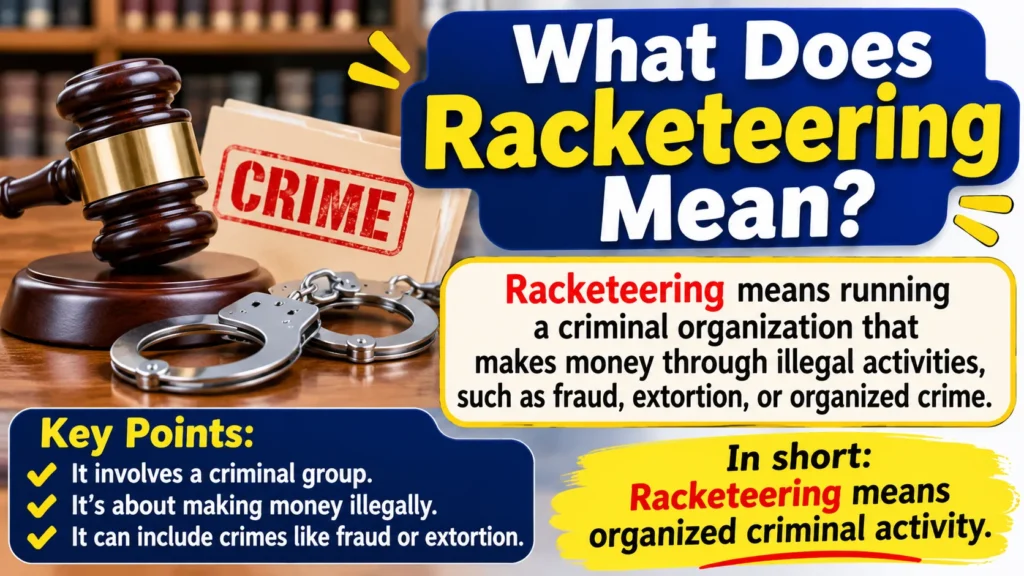
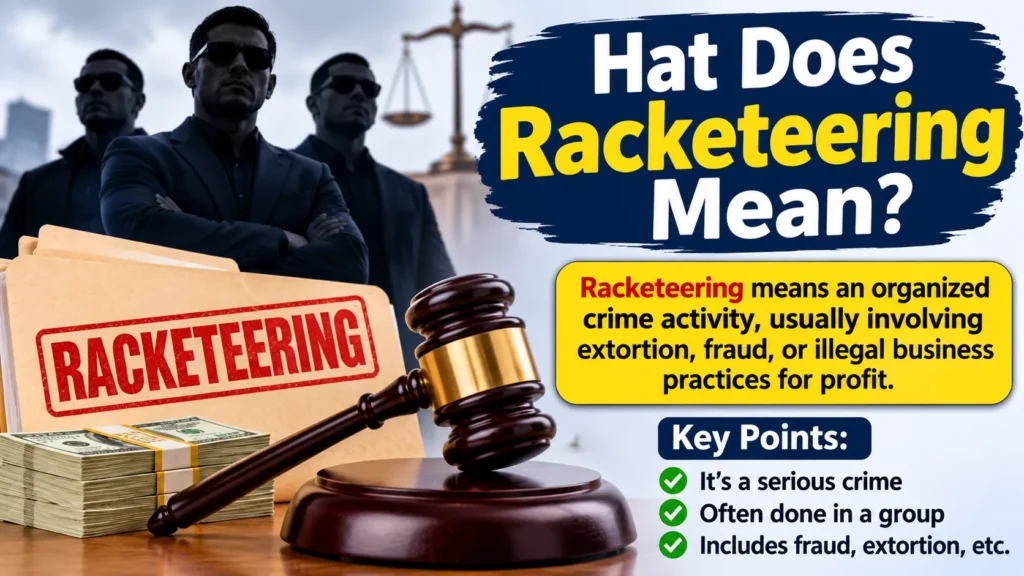
Racketeering means making money or gaining advantages through organized illegal activities, such as fraud, extortion, bribery, money laundering, or other criminal conduct. In the United States, the term is closely associated with the Racketeer Influenced and Corrupt Organizations Act, commonly called the RICO Act.
For example, imagine a criminal group that repeatedly threatens local businesses and demands money to prevent damage to their shops.
Racketeering is not limited to street gangs or traditional criminal organizations. It can also involve financial schemes, corrupt businesses, and other enterprises.
In this guide, you will learn what racketeering means, how it works, common examples, the RICO Act, possible penalties, and how to use the word correctly.
What Does Racketeering Mean?
Racketeering refers to conducting illegal activities through a scheme or enterprise, usually to obtain money, property, influence, or another unlawful benefit.
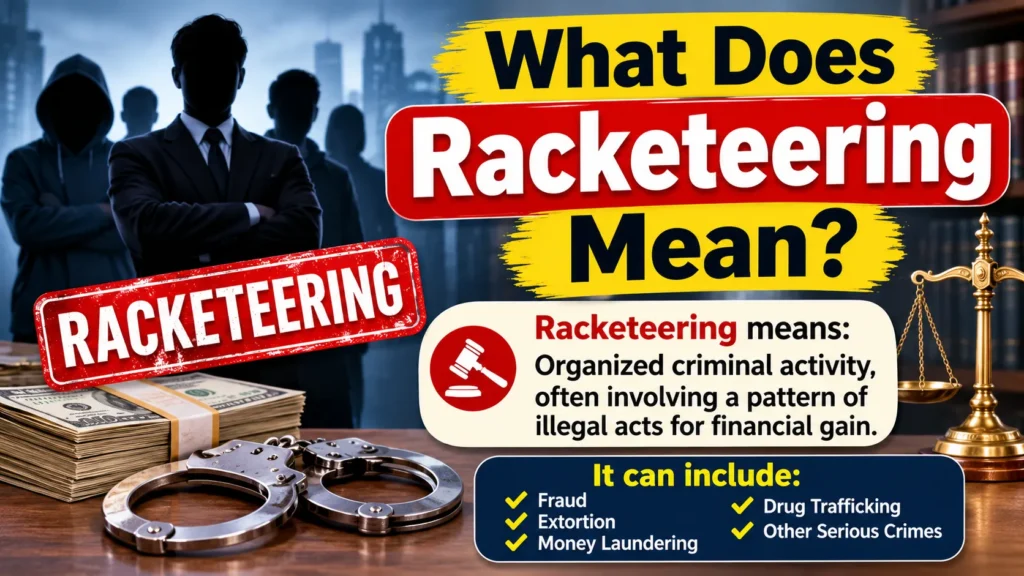
These activities can include:
- Extortion and blackmail.
- Fraud and financial deception.
- Bribery and corruption.
- Illegal gambling operations.
- Money laundering.
- Drug trafficking.
- Certain forms of human trafficking.
- Robbery and other qualifying offenses.
In everyday English, racketeering generally describes organized dishonest or illegal money-making activities.
However, its legal meaning is more specific. Under U.S. federal RICO law, racketeering activity refers to offenses listed in the statute. A RICO violation also requires the other elements of the relevant prohibited conduct.
Simple definition: Racketeering means earning money or gaining control through organized illegal activities.
The important point is that racketeering generally involves more than an ordinary disagreement, dishonest business practice, or isolated criminal incident.
What Is Racketeering in Simple Terms?
Think of racketeering as an illegal business operation.
A legitimate business earns money by providing lawful products or services. A racketeering operation, by contrast, uses criminal activities to generate income or maintain influence.
Imagine a fictional organization that demands monthly payments from several shop owners. It threatens those who refuse to pay and uses the collected money to finance additional illegal activities.
This example illustrates how a protection racket might operate.
Here is a simple breakdown:
| Activity | What it means |
| Demanding protection payments | Extortion |
| Paying officials for illegal favors | Bribery |
| Deceiving customers to obtain money | Fraud |
| Hiding criminal profits | Money laundering |
| Operating unlawful gambling businesses | Illegal gambling |
| Threatening people to maintain control | Intimidation or extortion |
These activities may qualify as racketeering offenses under applicable laws.
However, not every example automatically establishes a federal RICO violation. The prosecution must prove the relevant legal requirements.
How Does Racketeering Work?
Racketeering operations can take different forms. Some rely on threats and intimidation, while others involve financial deception, corruption, or illegal business arrangements.
A fictional racketeering operation might follow these stages:
1. Establishing an enterprise
An individual or group creates, joins, or uses an organization, business, or association.
2. Carrying out illegal activities
Participants become involved in offenses such as extortion, fraud, bribery, or illegal gambling.
3. Generating unlawful profits
The operation obtains money, property, or other benefits through criminal conduct.
4. Maintaining influence
Participants may use threats, corruption, or intimidation to protect their activities.
5. Concealing criminal proceeds
Some individuals may attempt to disguise the source of illegally obtained money through financial transactions.
6. Continuing the operation
The activities may continue over time, creating evidence of an ongoing criminal scheme.
Not every racketeering case follows this exact process. It is simply an illustration of how an illegal enterprise might operate.
What Are Common Examples of Racketeering?
Racketeering can involve several types of criminal activity. Some examples are traditionally associated with organized crime, while others involve businesses and financial transactions.
Here are eight common examples.
1. Extortion and Protection Rackets
Extortion involves obtaining money, property, or another benefit through unlawful threats or coercion.
For example, a criminal group might demand regular payments from shop owners and threaten to damage their businesses if they refuse.
When this conduct forms part of a qualifying criminal enterprise and pattern, it may support a racketeering prosecution.
2. Money Laundering
Money laundering involves disguising the illegal origin of money or making criminal proceeds appear legitimate.
For example, criminals might attempt to hide illegally obtained funds through financial transactions or business activities.
Money laundering is among the offenses included in the federal RICO statute.
3. Illegal Gambling Operations
Some criminal organizations operate unlawful gambling businesses and use bribery, threats, or intimidation to protect their activities.
Qualifying illegal gambling offenses can form part of a racketeering case.
4. Drug Trafficking
Drug trafficking involves the unlawful production, distribution, or sale of controlled substances.
A criminal organization involved in repeated qualifying drug-related offenses may face racketeering charges in addition to charges involving the underlying conduct.
5. Bribery and Corruption
Bribery involves offering, giving, receiving, or soliciting something valuable to improperly influence someone’s actions.
For example, an organization might pay an official to obtain an illegal advantage or protect its criminal activities.
Certain bribery offenses are included in the federal racketeering framework.
6. Business and Financial Fraud
Financial fraud involves deception used to obtain money, property, or another benefit.
A criminal enterprise might use repeated fraudulent schemes, false documents, or deceptive financial transactions to obtain money from victims.
Certain types of fraud are qualifying racketeering activities.
7. Human Trafficking
Human trafficking involves exploiting people through prohibited methods for forced labor, commercial sex, or other unlawful purposes.
Certain federal offenses involving human trafficking are included in the statutory definition of racketeering activity.
8. Witness Intimidation and Obstruction of Justice
Criminal organizations may attempt to interfere with investigations by threatening witnesses, tampering with evidence, or obstructing justice.
Certain offenses involving witness tampering and obstruction are included in the federal RICO framework.
What Is the RICO Act?
RICO stands for the Racketeer Influenced and Corrupt Organizations Act.
It is a U.S. federal law enacted in 1970 as part of the Organized Crime Control Act.
The law provides prosecutors with tools to address certain criminal activities carried out through enterprises. It also creates civil remedies for people and entities that satisfy the statutory requirements.
RICO was originally developed to help authorities address organized criminal operations, including organizations whose leaders could be difficult to connect directly to crimes committed by other members.
The federal statute appears in Title 18, Sections 1961–1968 of the United States Code.
It establishes four main categories of prohibited conduct:
- Using or investing income obtained through a pattern of racketeering activity in an enterprise.
- Acquiring or maintaining an interest in an enterprise through racketeering activity.
- Conducting or participating in an enterprise’s affairs through a pattern of racketeering activity.
- Conspiring to commit certain RICO violations.
RICO is not limited to traditional mafia organizations. It can apply to different kinds of enterprises when the applicable legal requirements are satisfied.
What Crimes Count as Racketeering?
Under 18 U.S.C. Section 1961(1), racketeering activity includes a specific list of qualifying state and federal offenses.
These offenses are commonly called predicate acts or predicate offenses.
Examples include:
| Category | Qualifying examples |
| Violent crimes | Murder, kidnapping, robbery, and arson |
| Financial crimes | Mail fraud, wire fraud, and bank fraud |
| Corruption | Certain bribery and embezzlement offenses |
| Illegal businesses | Certain gambling offenses and unlawful debt collection |
| Drug-related crimes | Qualifying controlled-substance offenses |
| Money-related crimes | Money laundering and specified financial offenses |
| Human exploitation | Certain slavery and human trafficking offenses |
| Criminal interference | Witness tampering and obstruction of justice |
| Property crimes | Certain stolen-property and counterfeiting offenses |
This is not a complete list. The statute identifies numerous qualifying offenses, and the exact legal classification depends on the particular provision and circumstances.
An important distinction is that not every illegal activity automatically qualifies as a federal RICO predicate offense.
What Is a Pattern of Racketeering Activity?
A pattern of racketeering activity is one of the most important concepts in federal RICO law.
Under 18 U.S.C. Section 1961(5), a pattern generally requires at least two qualifying racketeering acts within ten years of each other, subject to the statute’s wording.
However, there is a common misunderstanding worth correcting:
Committing two crimes does not automatically establish a RICO pattern.
The acts must also be related and amount to, or pose a threat of, continued criminal activity. Courts examine the relationship between the acts and whether they demonstrate continuity.
For example, imagine a fictional organization that repeatedly uses similar fraudulent schemes to deceive different customers over an extended period.
The repeated conduct could be relevant to establishing a racketeering pattern, depending on the evidence and legal requirements.
By contrast, two unrelated criminal incidents do not automatically establish the necessary pattern.
The distinction matters because RICO addresses certain continuing criminal operations rather than treating every pair of offenses as racketeering.
What Are the Main Elements of a RICO Case?
A federal criminal RICO Prosecution Requires the government to establish the elements of the particular statutory provision beyond a reasonable doubt.
For a common charge under Section 1962(c), the government generally must establish the following:
1. An enterprise existed
An enterprise may include an individual, partnership, corporation, association, or group of people associated together for a common purpose.
2. The enterprise affected interstate or foreign commerce
The enterprise must satisfy the federal commerce requirement.
3. The defendant was associated with or employed by the enterprise
The prosecution must establish the required connection between the defendant and the enterprise.
4. A pattern of racketeering activity existed
The prosecution must establish qualifying racketeering activity, relatedness, and continuity.
5. The defendant participated in conducting the enterprise’s affairs
The defendant must have participated in the enterprise’s operation or management through the required pattern of racketeering activity.
These elements describe Section 1962(c), not every possible RICO offense. Other subsections have different requirements.
A RICO accusation does not establish guilt. The government must prove the required elements through admissible evidence.
Is Racketeering the Same as Organized Crime?
Racketeering and organized crime are closely connected, but they do not mean exactly the same thing.
Organized crime is a broader term describing coordinated criminal activities carried out by individuals or groups.
Racketeering describes certain illegal schemes and activities. Under federal RICO law, it has a specific statutory meaning connected to enterprises and qualifying patterns of criminal activity.
| Racketeering | Organized crime |
| Focuses on qualifying illegal activities and patterns. | Describes coordinated criminal organizations or operations. |
| Can involve financial fraud and corruption. | Can involve several forms of continuing criminal conduct. |
| Has a specific legal meaning under RICO. | Is a broader criminal justice concept. |
| Can involve a legitimate business used for illegal purposes. | Can involve formal or informal criminal groups. |
For example, a criminal organization might engage in extortion, illegal gambling, and money laundering.
Its qualifying activities could form the basis of a racketeering case if the relevant legal elements are established.
However, the two terms should not be used interchangeably in every situation.
What Is the Difference Between Racketeering and Fraud?
Fraud and Racketeering are related concepts, but they describe different things.
Fraud generally involves intentional deception used to obtain money, property, services, or another unlawful benefit.
Racketeering is broader in the RICO context because it involves an enterprise and a qualifying pattern of designated criminal activity or unlawful debt.
Consider this fictional example:
A person creates a fake investment opportunity and tricks one customer into sending money. This may constitute fraud.
Now imagine an enterprise repeatedly operates similar fraudulent schemes and satisfies the other requirements of federal RICO law.
That broader situation could potentially involve racketeering.
| Fraud | Racketeering |
| Involves deception or misrepresentation. | Involves qualifying enterprise-related criminal conduct. |
| Can occur as an individual offense. | RICO requires additional statutory elements. |
| Can involve one fraudulent incident. | Generally requires a qualifying pattern or unlawful debt under the relevant provision. |
| Can be prosecuted under different laws. | Can be prosecuted under federal or applicable state racketeering laws. |
Fraud can be a predicate offense for RICO, but not every fraud case qualifies as racketeering.
What Are the Penalties for Racketeering?
Racketeering penalties depend on the applicable law, the offenses involved, and the circumstances of the case.
Under federal RICO law, a person convicted of violating Section 1962 can face:
- Up to 20 years in federal prison.
- Life imprisonment if the violation is based on a racketeering activity carrying a possible life sentence.
- Criminal fines.
- Forfeiture of certain property and interests connected to the violation.
The actual sentence depends on the applicable legal provisions and sentencing rules.
What Are Civil RICO Penalties?
RICO also provides civil remedies.
Under 18 U.S.C. Section 1964(c), a person whose business or property is injured by a qualifying RICO violation may bring a civil lawsuit.
A successful plaintiff may recover:
- Three times the actual damages.
- The costs of the lawsuit.
- Reasonable attorney fees.
This is commonly called treble damages.
However, a civil RICO claim has its own legal requirements. Someone cannot automatically win a civil RICO lawsuit simply because another person acted dishonestly.
Can a Legitimate Business Be Involved in Racketeering?
Yes. A business does not have to look criminal on the surface to become involved in a racketeering operation.
Some enterprises may operate legitimate businesses while certain participants use the organization to carry out or conceal illegal activities.
For example, imagine a fictional company that provides ordinary commercial services while some individuals use its transactions to disguise money obtained through criminal schemes.
In another situation, a legitimate business might become a victim of extortion or bribery.
These circumstances are different. A business being targeted by criminals does not automatically mean the business itself is participating in racketeering.
Under RICO, a legitimate enterprise can be involved in a violation if the relevant statutory requirements are satisfied.
Related To Another Article: https://genzwishes.com/mean-platelet-volume-low/
How Do Authorities Investigate Racketeering?
Racketeering investigations can be complex because they may involve multiple people, transactions, businesses, and underlying criminal offenses.
Investigators may examine several types of evidence.
Financial records: Bank statements, business accounts, payment records, and suspicious financial transactions.
Communication records: Relevant emails, messages, phone records, and other information obtained through lawful investigative procedures.
Witness statements: Information from victims, employees, associates, and other people connected to the investigation.
Business documents: Contracts, ownership records, accounting information, and transaction histories.
Evidence of predicate offenses: Records and other evidence that help establish the underlying qualifying criminal activities.
Authorities may also cooperate across jurisdictions when an investigation involves several locations or organizations.
The objective is to determine whether the evidence establishes an enterprise, qualifying criminal conduct, and the other elements required by the applicable law.
How to Use Racketeering in a Sentence
Understanding how to use the word in everyday English can make its Meaning Easier to remember.
Here are some examples:
- The business owner was accused of racketeering after investigators uncovered an alleged illegal operation.
- Federal authorities launched an investigation into suspected racketeering activities.
- The criminal organization faced racketeering charges under the RICO Act.
- Money laundering and bribery were among the alleged activities in the case.
- The court examined whether the defendants participated in a pattern of racketeering activity.
- The investigation revealed an alleged scheme involving extortion and organized fraud.
- The newspaper reported that several individuals had been charged with racketeering.
- Prosecutors presented financial records as evidence in the racketeering case.
These sentences show how the term appears in legal discussions, news reports, and everyday explanations.
How Do You Pronounce Racketeering?
The word racketeering is pronounced:
RAK-uh-TEER-ing
Its American English phonetic pronunciation is:
/ˌræk.əˈtɪr.ɪŋ/
It is a noun describing the practice of engaging in dishonest or illegal money-making activities.
The related word racketeer refers to a person who participates in racketeering.
For example:
- Racketeering: The illegal activity or practice.
- Racketeer: A person involved in that activity.
- Racketeering charge: A formal accusation under an applicable racketeering law.
What Are Synonyms for Racketeering?
The closest alternative expressions depend on the context in which the word is used.
Some related terms include:
- Organized criminal activity.
- Criminal enterprise.
- Illegal business operation.
- Extortion.
- Financial fraud.
- Criminal scheme.
- Corruption.
- Swindling.
- Financial deception.
- Organized illegal activity.
However, these expressions are not exact legal substitutes.
For example, fraud and extortion describe particular types of conduct, while racketeering has a broader meaning.
People Also Ask
A: Racketeering means making money or gaining advantages through organized illegal activities, such as fraud, extortion, bribery, and money laundering. Under U.S. federal RICO law, it involves additional requirements relating to an enterprise and qualifying criminal activity.
A: Examples include protection rackets, certain illegal gambling operations, bribery schemes, money laundering, qualifying financial fraud, and certain drug trafficking offenses. Whether an activity supports a RICO charge depends on the applicable legal requirements.
A: Being charged with racketeering means prosecutors have formally accused someone of violating an applicable racketeering law. Under federal RICO, the accusation generally involves an enterprise and a qualifying pattern of criminal activity or another prohibited form of conduct. A charge is not the same as a conviction.
A: Under federal RICO, a pattern generally requires at least two qualifying racketeering acts within ten years. However, the acts must also be related and amount to, or threaten, continued criminal activity. Two unrelated offenses are not automatically enough.
A: A federal RICO conviction can carry up to 20 years in prison. Life imprisonment may be possible when the violation is based on a racketeering activity that carries a possible life sentence. The actual punishment depends on the applicable law and circumstances.
Conclusion
Racketeering describes illegal Activities Connected to schemes or enterprises that seek financial benefits, influence, or control through criminal conduct.
It can involve extortion, bribery, money laundering, fraud, illegal gambling, and other qualifying offenses.
In the United States, the RICO Act provides a legal framework for addressing certain patterns of criminal activity involving enterprises.
The most important point to remember is that racketeering is not simply another word for fraud or organized crime. It has a specific legal meaning under RICO, with requirements that must be established before someone can be convicted.
Understanding these distinctions makes it easier to interpret racketeering charges, follow criminal cases in the news, and recognize how organized illegal operations differ from isolated offenses.
If this guide helped you understand the term, consider bookmarking it or sharing it with