Introduction
Have you ever heard someone say, “I have a mountain of homework” or “My Brother has a heart of gold”? These expressions sound unusual when you interpret their words literally. However, their actual meanings are much easier to understand when you look beyond the words themselves.
This creative way of communicating is called figurative language.
But what does figurative language mean, and why do people use it in everyday conversations, books, poems, and stories?
Figurative language allows speakers and writers to communicate ideas beyond ordinary literal meanings. It makes descriptions more interesting, expresses emotions, creates mental pictures, and helps readers understand complicated ideas.
In this guide, you will discover its meaning, explore 15 important language techniques, read 30 practical examples, and learn how to identify figurative expressions in everyday English.
1. What Does Figurative Language Mean?
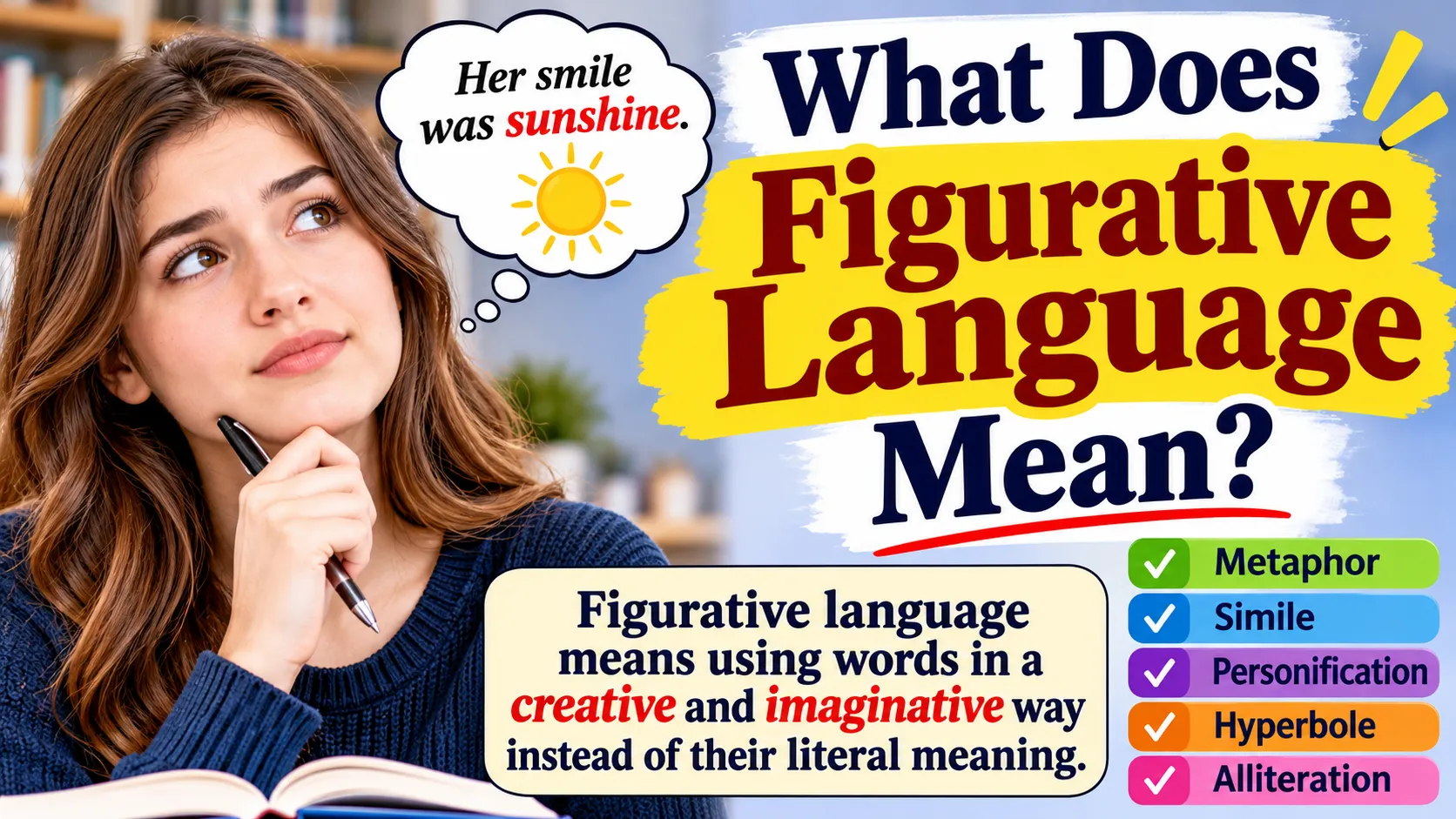
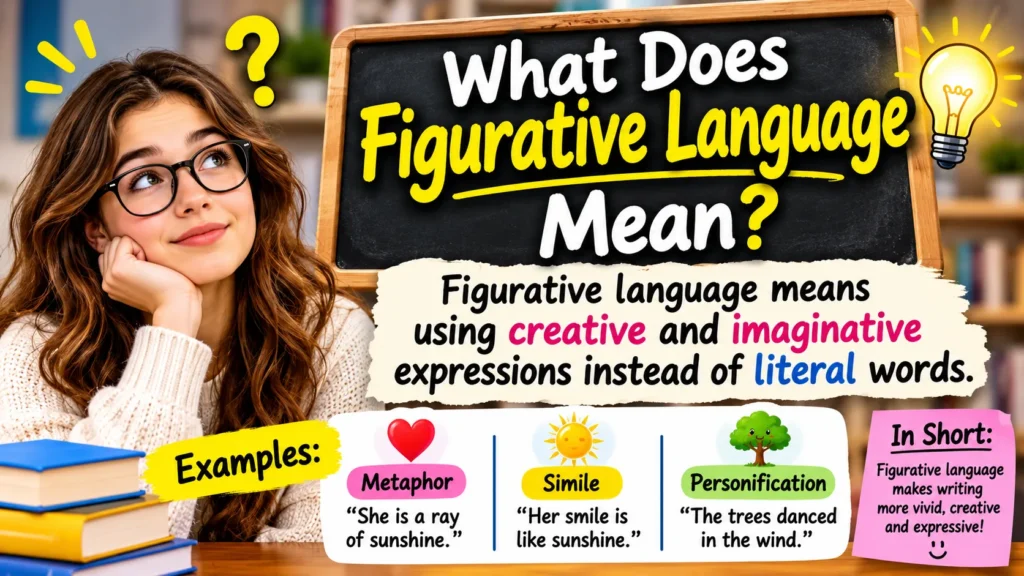
Figurative language means using words or expressions to communicate something beyond their ordinary, literal meanings. It helps people express ideas creatively through comparisons, exaggerations, associations, and other language techniques.
In simple words, figurative language is a way of saying something without necessarily meaning the exact words you use.
For example:
“My brother is a walking encyclopedia.”
This sentence does not mean that your brother is an actual encyclopedia. It means he knows a lot of information about different subjects.
Consider another example:
“The stars danced across the night sky.”
Stars cannot physically dance like humans. This expression gives stars a human action to create an imaginative picture.
These examples demonstrate how figurative expressions communicate additional meaning.
Instead of describing everything directly, speakers and writers use creative language to make their messages more memorable and expressive.
Simple Definition of Figurative Language
Here is an easy definition to remember:
Figurative language is the use of words in a creative or nonliteral way to express ideas, feelings, and descriptions beyond their direct meanings.
It appears in:
- Everyday conversations.
- Poetry and literature.
- Novels and short stories.
- Songs and lyrics.
- Advertisements.
- Speeches and presentations.
- Social media captions.
- Creative writing.
You probably use figurative expressions more often than you realize. Phrases such as “piece of cake,” “time flies,” and “on cloud nine” are common examples.
2. What Is the Difference Between Literal and Figurative Language?
Literal and figurative language communicate information differently. Literal language uses words according to their direct meanings, while figurative language communicates an implied, creative, or nonliteral meaning.
Understanding this distinction makes it easier to recognize figures of speech.
Here is a simple comparison:
| Literal language | Figurative language |
| The room is very cold. | The room is an icebox. |
| She runs very fast. | She runs like the wind. |
| He is very happy. | He is walking on sunshine. |
| I am very hungry. | I could eat a horse. |
| The sun is setting. | The sun is saying goodbye. |
| He is unkind. | He has a heart of stone. |
Examples of Literal Language
“The child cried because he lost his favorite toy.”
This sentence describes an actual situation. The words communicate their ordinary meanings without an imaginative comparison.
“The water in the glass is cold.”
This is another literal statement because it directly describes the temperature of the water.
Examples of Figurative Language
“The child cried a river of tears.”
The child did not actually produce a river. The expression exaggerates the amount of crying to emphasize sadness.
“Her smile lit up the entire room.”
Her smile did not physically produce light. The expression means that her happiness made the atmosphere more cheerful.
Easy Way to Remember the Difference
- Literal language: What the words directly say.
- Figurative language: What the words suggest beyond their direct meanings.
Always consider the context because some expressions can have both literal and figurative interpretations.
3. What Are the 15 Main Types of Figurative Language?
There are several types of figurative language, and each creates a Different Effect. Some compare two things, others exaggerate experiences, and some communicate deeper meanings through familiar expressions.
Below are 15 important figures of speech and related literary techniques, explained with simple definitions and original examples.
1. Simile
A simile compares two different things using words such as “like” or “as.” Writers use similes to make descriptions easier to imagine.
Examples:
- She is as brave as a lion.
- His voice sounds like thunder.
- The baby slept like an angel.
Meaning: These expressions compare people or things with familiar objects, animals, or experiences to highlight particular qualities.
2. Metaphor
A metaphor directly describes one thing as another to create a comparison without using “like” or “as.”
Examples:
- Time is money.
- Her smile is sunshine.
- The classroom was a zoo.
Meaning: These sentences connect different ideas to communicate a deeper message. For example, calling a classroom a zoo suggests that it is noisy or chaotic.
3. Personification
Personification gives human qualities, feelings, or actions to animals, objects, nature, or abstract ideas.
Examples:
- The wind whispered through the trees.
- The flowers danced in the garden.
- My alarm clock screamed at me.
Meaning: These expressions make descriptions more imaginative by presenting nonhuman things as if they behave like people.
4. Hyperbole
Hyperbole is an intentional exaggeration used to emphasize an idea, feeling, or situation. It is not intended to be understood as an exact factual statement.
Examples:
- I have told you a million times.
- This suitcase weighs a ton.
- I am so hungry I could eat a horse.
Meaning: These expressions exaggerate ordinary situations to make a message stronger, funnier, or more memorable.
5. Idiom
An idiom is a commonly used expression whose overall meaning cannot always be understood from its individual words.
Examples:
- Break the ice.
- Piece of cake.
- Hit the books.
- Under the weather.
Meaning: “Break the ice” means making people feel comfortable in a social situation. It does not mean physically breaking a block of ice.
6. Onomatopoeia
Onomatopoeia refers to words that imitate or suggest the sounds they describe.
Examples:
- The balloon went pop.
- The bees buzzed around the flowers.
- The clock went tick-tock.
- The door closed with a bang.
Meaning: These words help readers imagine sounds and experience a scene more vividly.
7. Oxymoron
An oxymoron combines two words with seemingly contradictory meanings to create an interesting expression.
Examples:
- Deafening silence.
- Bittersweet memories.
- Living dead.
- Act naturally.
Meaning: These expressions combine contrasting ideas to communicate complex feelings or situations.
8. Alliteration
Alliteration is the repetition of the same initial consonant sound in nearby words. Writers use it to create rhythm, emphasis, and memorable phrases.
Examples:
- Peter picked purple peppers.
- Busy bees buzzed by.
- Sally sells shiny shoes.
Meaning: Repeated beginning sounds make phrases more rhythmic and enjoyable to read or hear.
9. Assonance
Assonance is the repetition of similar vowel sounds in nearby words, usually within stressed syllables.
Examples:
- Go slow over the road.
- The light of the fire shined bright.
- The rain stayed late.
Meaning: Repeated vowel sounds create musical patterns and improve the rhythm of writing.
10. Consonance
Consonance is the repetition of consonant sounds within or at the ends of nearby words. Unlike alliteration, these repeated sounds do not need to appear at the beginning.
Examples:
- The stroke of luck.
- The lumpy, bumpy road.
- The black rock cracked.
Meaning: Repeated consonant sounds connect words and create rhythm in poetry and creative writing.
11. Irony
Irony occurs when the actual meaning, result, or situation contrasts with what someone expects or says.
Examples:
- A fire station catches fire.
- A traffic police officer receives a speeding ticket.
- Someone says “What lovely weather!” during a heavy storm.
Meaning: These situations create irony because what happens or what someone says conflicts with expectations.
12. Symbolism
Symbolism occurs when an object, color, person, or action represents an idea beyond its ordinary meaning.
Examples:
- A white dove can symbolize peace.
- A broken chain can represent freedom.
- A red rose can represent love.
Meaning: Symbols communicate larger ideas through recognizable objects or images. Their interpretations can depend on cultural and literary context.
13. Allusion
An allusion is an indirect reference to a famous person, historical event, literary work, or cultural story.
Examples:
- He is a real Romeo.
- This challenge feels like climbing Mount Everest.
- She opened Pandora’s box.
Meaning: These expressions refer to familiar people, places, or stories to communicate an idea without explaining every detail.
14. Euphemism
A euphemism is a mild or indirect expression used instead of a word or phrase that may sound unpleasant, harsh, or uncomfortable.
Examples:
- He passed away.
- She is between jobs.
- The company is letting some employees go.
Meaning: These expressions communicate difficult information in a gentler or more considerate way.
15. Metonymy
Metonymy is a figure of speech in which a related word or concept replaces the actual name of something.
Examples:
- The crown announced a new decision.
- The White House released a statement.
- The pen is mightier than the sword.
Meaning: “The crown” can represent a monarch, while “the White House” can represent the US presidential administration.
Important classification note: Not every technique in this list is strictly a form of nonliteral language. Simile, metaphor, personification, hyperbole, idiom, and metonymy are commonly treated as figurative language. Alliteration, assonance, consonance, and onomatopoeia are sound devices. Symbolism and allusion are broader literary techniques. They are included because readers frequently encounter them when studying figurative language and figures of speech.
These examples demonstrate how creative expressions make ordinary communication more colorful and memorable.
5. Why Do Writers Use Figurative Language?
Writers use figurative language because ordinary descriptions do not always communicate the full feeling or meaning behind an experience.
Creative expressions help readers imagine situations, understand emotions, and connect with ideas.
Here are seven important reasons writers use these techniques.
1. To Create Vivid Imagery
Figurative language helps readers picture scenes in their minds.
For example, “The golden sun smiled over the quiet village” creates a more imaginative picture than simply saying the sun was shining.
2. To Express Emotions
Some feelings are difficult to describe directly. Figurative expressions communicate happiness, sadness, fear, excitement, and love in memorable ways.
3. To Make Writing Memorable
Creative comparisons and unusual expressions make sentences easier to remember.
For example, “Her heart was made of gold” creates a stronger impression than simply saying she was kind.
4. To Simplify Complicated Ideas
A metaphor can explain an unfamiliar concept through something readers already understand.
For example, describing life as a journey helps communicate the idea of personal growth and experiences.
5. To Add Humor
Writers use exaggeration, irony, and wordplay to make readers laugh.
For example, “My homework is multiplying faster than rabbits” creates a humorous impression of having too much work.
6. To Create Rhythm and Beauty
Sound devices such as alliteration and assonance make poetry and other writing more enjoyable.
7. To Communicate Deeper Meanings
Metaphors, symbolism, and allusions allow writers to communicate complex ideas without explaining everything directly.
6. Where Is Figurative Language Used?
Figurative language appears in many forms of communication. People use it both intentionally and naturally, often without realizing that they are using a literary technique.
Everyday Conversations
People say expressions such as “I am over the moon” or “That costs an arm and a leg” to communicate feelings and situations.
Poetry
Poets use metaphors, similes, personification, and sound devices to create emotional and imaginative experiences.
Stories and Novels
Authors use creative expressions to develop characters, describe settings, and make important moments more meaningful.
Songs and Music
Songwriters use comparisons, symbolism, and exaggeration to communicate emotions and tell stories.
Speeches and Presentations
Speakers use metaphors and other rhetorical techniques to make messages more persuasive and memorable.
Advertisements
Businesses sometimes use creative expressions to make products and messages more attractive to audiences.
Social Media
People use idioms, metaphors, and exaggeration in captions, comments, and online conversations.
For example, someone might write, “My weekend disappeared in the blink of an eye” to express how quickly their free time passed.
7. How Do You Identify Figurative Language?
Identifying figurative language becomes easier when you understand how words work beyond their Literal Meanings.
You do not need to memorize every literary device to recognize creative expressions. Instead, follow these seven steps.
Step 1: Read the Complete Sentence
Understand the context before deciding what the words mean. A single expression can have different meanings in different situations.
Step 2: Check Whether the Sentence Makes Literal Sense
Ask yourself whether the statement could actually happen.
For example, “The flowers danced in the wind” does not mean flowers have human dancing abilities.
Step 3: Look for Comparisons
Words such as “like” and “as” can indicate a simile. Direct comparisons may indicate a metaphor.
Step 4: Look for Exaggeration
Expressions such as “I waited forever” usually communicate strong feelings rather than an exact amount of time.
Step 5: Identify Unusual Human Actions
If a nonhuman object whispers, smiles, cries, or dances, the sentence may use personification.
Step 6: Think About the Intended Meaning
Ask what the speaker or writer wants you to understand beyond the literal words.
Step 7: Identify the Technique
Once you understand the intended meaning, determine whether the expression uses a metaphor, simile, idiom, hyperbole, or another device.
Example:
“The classroom was a zoo.”
- Literal meaning: A classroom is a place where students learn.
- Figurative meaning: The classroom was noisy, crowded, or chaotic.
- Technique: Metaphor.
This simple process helps readers understand creative expressions in books, conversations, and other forms of writing.
8. What Is the Difference Between Figurative Language, Imagery, and Symbolism?
Figurative language, imagery, and symbolism are closely connected, but they do not mean the same thing.
Understanding their differences helps readers analyze writing more accurately.
| Concept | Meaning | Example |
| Figurative language | Words communicate beyond their literal meanings. | The wind whispered. |
| Imagery | Descriptive language appeals to the senses. | The warm bread smelled sweet and buttery. |
| Symbolism | Something represents a larger idea. | A dove represents peace. |
Figurative Language
Figurative language focuses on creative expressions and implied meanings.
Example: “The classroom was a zoo.”
The classroom is compared to a zoo to suggest noise and disorder.
Imagery
Imagery helps readers experience descriptions through sight, sound, smell, taste, or touch.
Example: “The warm bread smelled sweet and buttery.”
This sentence appeals to the sense of smell.
Importantly, imagery can be literal or figurative.
Symbolism
Symbolism uses something recognizable to represent a deeper concept.
Example: A white dove can represent peace.
These techniques can work together. A writer might describe a dark forest using visual imagery, call its trees silent guardians through personification, and use the forest to symbolize fear.
9. Is Figurative Language the Same as a Figure of Speech?
Figurative language and figures of speech are closely related terms, but they are not always used in the same way.
Figurative language is the broader concept of using words and expressions beyond their ordinary meanings or expected use.
Figures of speech are specific techniques that speakers and writers use to create these effects.
For example:
- A metaphor compares two different things.
- A simile uses “like” or “as” to make a comparison.
- Hyperbole exaggerates an idea.
- Personification gives human qualities to nonhuman things.
- Metonymy replaces something with a closely related term.
These are commonly taught as figures of speech and examples of figurative language.
However, terminology can vary between dictionaries, schools, and literary textbooks. Some definitions include a wider range of sound and structural techniques.
Related To Another Article: https://genzwishes.com/what-does-mashallah-mean/
10. How Can You Use Figurative Language in Your Writing?
You can use figurative language to make your writing more engaging, expressive, and memorable.
You do not need to be a professional writer or poet. A few thoughtful expressions can make ordinary sentences more interesting.
Here are seven practical writing tips.
1. Start With a Clear Idea
Think about what you want readers to understand. Choose an expression that supports your message rather than distracting from it.
2. Use Familiar Comparisons
Compare unfamiliar experiences with things your readers already know.
Example:
“Her voice was as soft as a breeze.”
This creates a simple and understandable comparison.
3. Choose Expressions That Match the Emotion
Use gentle descriptions for peaceful moments and stronger expressions for exciting or dramatic situations.
4. Avoid Unnecessary Exaggeration
Hyperbole can make writing entertaining, but using too much can make your message feel unrealistic.
5. Combine Different Techniques Carefully
A metaphor, imagery, and personification can work together to create a powerful description.
6. Consider Your Audience
Simple expressions are often more effective when writing for beginners or young readers.
7. Keep Your Meaning Clear
Creative language should help readers understand your message, not make them struggle to interpret it.
Ordinary sentence:
“The girl was very nervous before the examination.”
Figurative sentence:
“Butterflies danced in her stomach before the examination.”
The second sentence uses an imaginative expression to communicate nervousness in a more memorable way.
11. What Are Common Mistakes to Avoid When Understanding Figurative Language?
Learning figurative language becomes easier when you understand which mistakes to avoid.
Here are six common misunderstandings.
1. Taking Every Expression Literally
A sentence such as “He has a heart of stone” does not mean someone’s heart is actually made of stone.
2. Confusing Similes With Metaphors
Similes usually use “like” or “as” to compare things. Metaphors make a direct comparison without those words.
3. Thinking All Descriptive Language Is Figurative
A sentence can create a strong mental picture without using a figure of speech.
For example, “The red flowers grew beside the wooden fence” is descriptive but can be entirely literal.
4. Assuming Every Exaggeration Is Hyperbole
Intentional exaggeration is hyperbole. However, an incorrect statement is not automatically hyperbole. The speaker must use exaggeration for an expressive effect.
5. Ignoring Context
Some expressions have both literal and figurative meanings. You need to understand the surrounding sentence to interpret them correctly.
6. Using Too Many Figures of Speech
Overloading a paragraph with comparisons and exaggerated expressions can make writing confusing.
The best approach is to use creative language naturally and make sure every expression serves a purpose.
12. Figurative Language Practice Questions With Answers
The best way to improve your understanding is to practice identifying Different Language techniques.
Read each sentence and decide which technique it uses before checking the answer.
Question 1
“The moon smiled down at the village.”
Answer: Personification.
The moon is given the human ability to smile.
Question 2
“He is as strong as an ox.”
Answer: Simile.
The sentence compares his strength to an ox using “as.”
Question 3
“I have a mountain of homework.”
Answer: Hyperbole.
The sentence exaggerates the amount of homework.
Question 4
“Her voice is music to my ears.”
Answer: Metaphor.
Her voice is directly compared to music to express how pleasant it sounds.
Question 5
“The bees buzzed around the garden.”
Answer: Onomatopoeia.
The word “buzzed” imitates the sound made by bees.
People Also Ask
A: Figurative language means using words creatively to express something beyond their exact, literal meanings. For example, “I am drowning in work” means someone has too much work, not that they are physically underwater.
A: “The stars danced in the sky” is an example of personification. It gives stars a human action to create an imaginative description.
A: Five commonly taught types are simile, metaphor, personification, hyperbole, and idiom. Each uses language differently to communicate ideas beyond ordinary literal meanings.
A: Writers and speakers use figurative language to create vivid descriptions, express emotions, emphasize ideas, add humor, and make communication more memorable.
A: Literal language communicates the direct meaning of words, while figurative language communicates an implied or creative meaning. For example, “He is very fast” is literal, while “He runs like the wind” is figurative.
Conclusion
So, what does Figurative Language Mean? It means using words creatively to express ideas beyond their ordinary, literal definitions. Instead of simply describing something, it helps speakers and writers communicate feelings, create mental pictures, and make their messages more meaningful.
From simple expressions such as “piece of cake” to imaginative comparisons such as “the classroom was a zoo,” figurative language is an important part of everyday communication.
Understanding its different types makes it easier to interpret literature, recognize creative expressions, and improve your own writing.
The next time someone says, “Time flies” or “I have a mountain of work,” remember that their words may communicate much more than their literal meanings.
If you found this guide helpful, bookmark it for future learning and share it with someone who wants to improve their English skills.