Introduction
Have you ever looked at a car advertisement or an Online Product listing and wondered what MSRP means? You might have noticed this abbreviation next to a price and wondered whether it represents the amount you must actually pay.
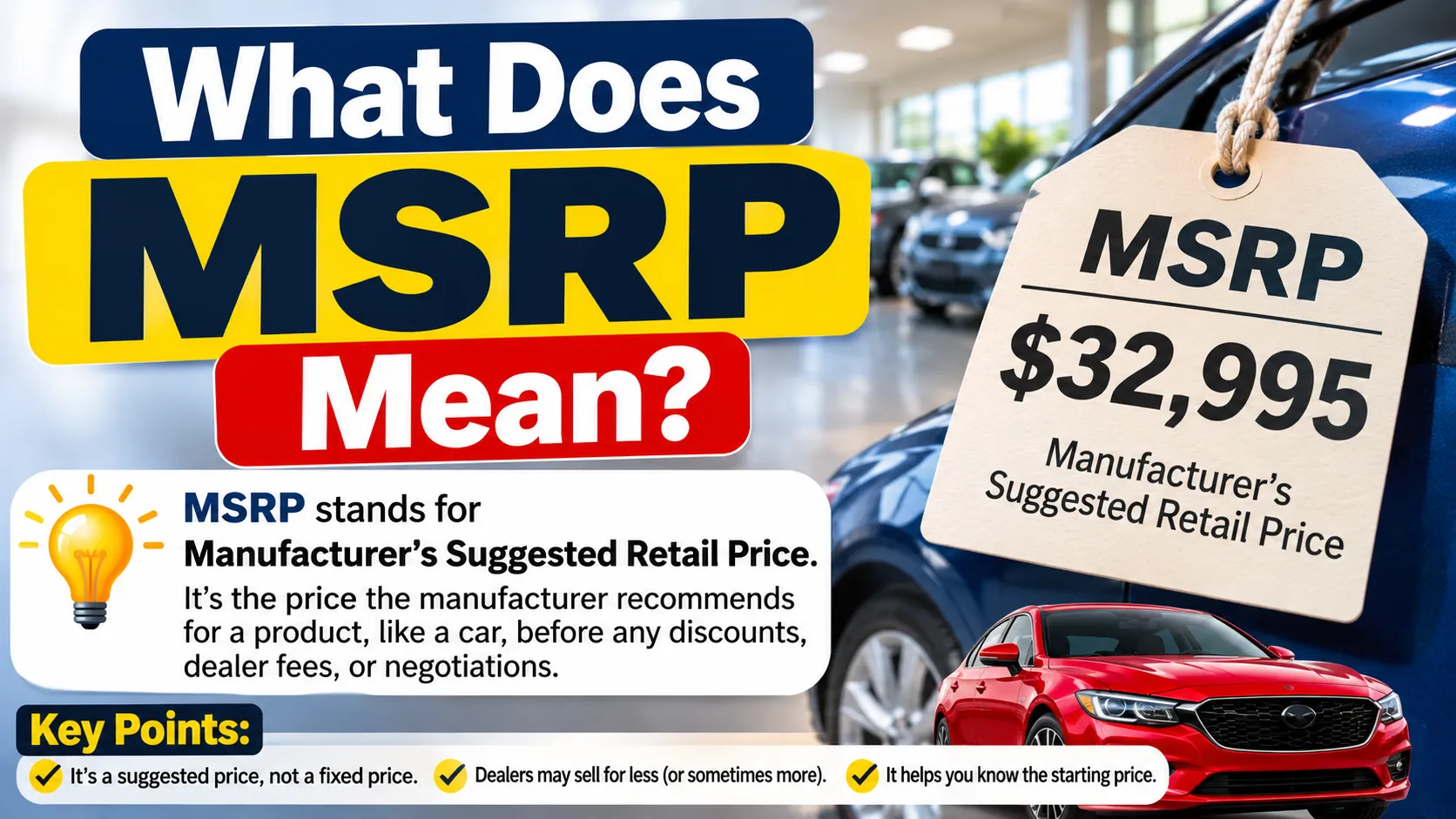
MSRP stands for Manufacturer’s Suggested Retail Price. It is the price a manufacturer recommends retailers charge customers for a particular product. However, it is not necessarily the final selling price. Retailers may offer discounts or charge more depending on demand, inventory, competition, and other market conditions.
Understanding MSRP can help you compare prices, recognize genuine discounts, and make smarter purchasing decisions. Whether you are buying a car, smartphone, television, or household appliance, knowing how this pricing term works can save you from confusion.
What Does MSRP Mean?
MSRP means Manufacturer’s Suggested Retail Price. It is the price a manufacturer recommends that retailers charge customers when selling a particular product.
Manufacturers commonly use MSRP for automobiles, electronics, appliances, and other branded products. It provides a pricing reference that retailers can use when establishing their selling prices.
For example, imagine a manufacturer recommends selling a television for $800. This amount represents its MSRP.
However, different retailers may offer different prices:
- Store A sells the television for $800.
- Store B offers it for $750.
- Store C discounts it to $700.
All three stores sell the same product at different prices. The original $800 MSRP provides a reference for comparing their offers.
The most important word in this abbreviation is suggested. It means the manufacturer recommends a price rather than automatically requiring every retailer to charge that exact amount.
What Does MSRP Stand For?
MSRP is an abbreviation made from four words. Each word explains a different part of the pricing concept.
- M – Manufacturer’s: The company responsible for producing the product.
- S – Suggested: A recommended amount rather than necessarily a mandatory selling price.
- R – Retail: The sale of products directly to customers.
- P – Price: The amount associated with purchasing the product.
Together, these words form Manufacturer’s Suggested Retail Price.
You may encounter this abbreviation in vehicle advertisements, online shopping listings, electronics catalogs, and product packaging.
Although people frequently associate it with automobiles, manufacturers also use suggested retail pricing for many other consumer products.
What Is MSRP in Simple Terms?
In simple terms, MSRP is the price a manufacturer recommends a store charge for its product.
Think of it as a starting reference rather than a fixed amount you must always pay.
For example, suppose a laptop has an MSRP of $1,200.
One retailer sells it for $1,200, another offers it for $1,100, and a third advertises a promotional price of $1,050.
The original $1,200 price helps shoppers understand how much each retailer’s offer differs from the manufacturer’s recommendation.
This makes price comparisons easier and helps customers evaluate available discounts.
However, a lower price does not automatically mean a better deal. You should also compare product specifications, condition, warranty coverage, and additional charges.
How Does MSRP Work?
MSRP begins with the manufacturer, which establishes a recommended retail price for a particular product. Retailers can then use that amount as a reference when determining their own selling prices.
The process generally involves four steps.
1. The manufacturer determines a suggested price.
The company considers production expenses, materials, distribution costs, product features, market demand, and its overall pricing strategy.
2. The manufacturer communicates the price.
The suggested amount may appear in product catalogs, manufacturer websites, pricing documents, or vehicle window stickers.
3. Retailers establish their selling prices.
Stores consider competition, inventory, operating expenses, customer demand, and profit goals before deciding how much to charge.
4. Customers compare available offers.
Shoppers compare the actual selling price with MSRP to understand whether a retailer offers a discount or charges more than the suggested amount.
The exact process varies between industries. Automotive dealerships, electronics retailers, and other businesses may handle suggested pricing differently.
What Does MSRP Include?
What MSRP includes depends on the product and how the manufacturer presents its pricing information.
For a vehicle, the manufacturer’s suggested price generally reflects the selected model or trim level, along with applicable factory-installed equipment and options.
For other products, MSRP usually represents the manufacturer’s recommended retail price for a particular model or item.
Several factors can influence this price:
- Manufacturing costs: Materials, labor, and production expenses.
- Product features: Standard equipment, upgraded specifications, and optional features.
- Distribution expenses: Costs associated with moving products through the supply chain.
- Market demand: Customer interest and the availability of similar products.
- Pricing strategy: How the manufacturer positions its product against competitors.
However, MSRP should not automatically be confused with the complete amount a customer pays.
For example, a vehicle’s purchase cost may include applicable taxes, registration charges, dealer fees, and optional accessories. Its window sticker may also show factory options and a destination charge separately or as part of the displayed total.
Always review the actual pricing breakdown before purchasing.
What Is the Difference Between MSRP and Sticker Price?
MSRP and sticker price are closely related terms, particularly in the Automotive Industry. However, they do not always describe exactly the same amount.
MSRP refers to the manufacturer’s suggested retail price.
Sticker price generally refers to the price displayed on a product label or vehicle window sticker. In car shopping, people sometimes use sticker price and MSRP interchangeably.
However, a vehicle’s window sticker may include additional information, such as factory-installed options and a destination charge.
Consider this example:
| Pricing Detail | Amount |
| Vehicle base MSRP | $30,000 |
| Factory-installed options | $1,500 |
| Destination charge | $1,000 |
| Total displayed sticker price | $32,500 |
In this example, the base MSRP is $30,000, while the displayed vehicle price is $32,500.
The distinction matters because customers should understand exactly which charges are included in the quoted amount.
In the United States, the official vehicle window sticker is commonly called the Monroney label. It provides important pricing and vehicle information for prospective buyers.
MSRP vs Invoice Price: What’s the Difference?
So, MSRP and invoice price represent two different parts of automotive pricing.
MSRP is the manufacturer’s recommended retail price for customers.
Invoice price is the amount shown on the manufacturer’s invoice to the dealership when a vehicle is delivered or billed.
Here is a simple comparison:
| Feature | MSRP | Invoice Price |
| Meaning | Suggested retail price | Manufacturer’s invoiced amount to dealer |
| Purpose | Retail pricing reference | Dealer billing reference |
| Main audience | Consumers and retailers | Dealerships |
| Usually lower? | Often higher | Often lower |
| Negotiation relevance | Starting reference | Another pricing reference |
For example, suppose a vehicle has an MSRP of $35,000 and an invoice price of $32,500.
The difference is:
$35,000 − $32,500 = $2,500
However, this does not automatically mean the dealership earns $2,500 in profit.
Manufacturer incentives, dealer holdbacks, advertising allowances, operating expenses, and other financial arrangements can affect the dealership’s actual costs.
Therefore, invoice price is useful information, but it does not reveal the dealership’s complete financial position.
MSRP vs Sale Price: Which One Do You Pay?
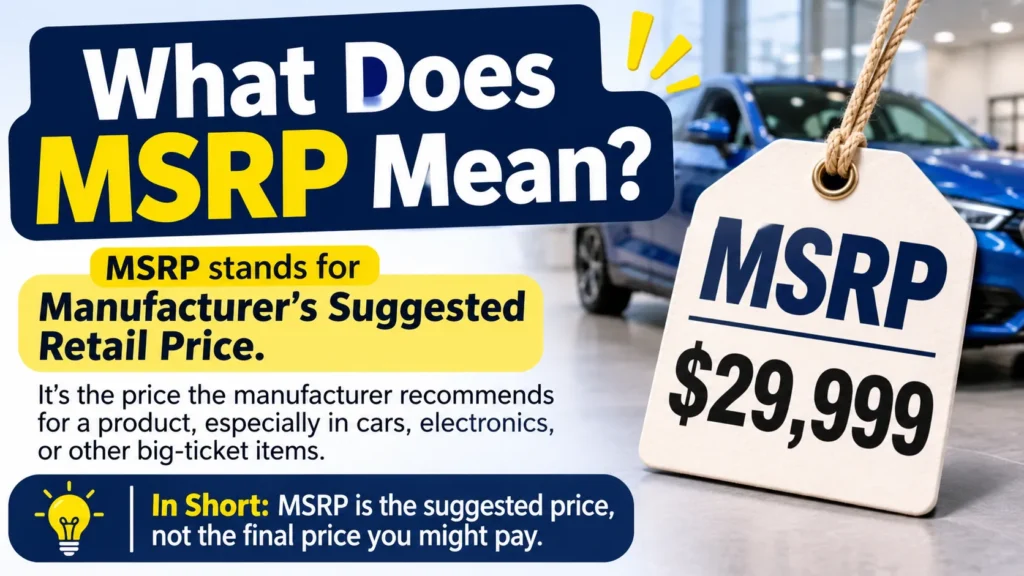
MSRP and sale price are different because MSRP is a manufacturer’s recommendation, while the sale price is the amount a retailer actually agrees to charge before applicable additional costs.
Imagine a smartphone has an MSRP of $900.
A retailer advertises it for $820 during a seasonal promotion.
The discount is:
$900 − $820 = $80
The customer receives an $80 discount compared with MSRP.
Here is another example:
| Price Detail | Amount |
| Original MSRP | $900 |
| Retail discount | −$80 |
| Sale price | $820 |
| Additional charges | $40 |
| Total payable | $860 |
The customer pays $860 in total.
This example demonstrates why shoppers should compare the actual amount payable rather than relying only on the advertised discount.
The sale price may be lower than MSRP, but applicable taxes, delivery expenses, and other charges can increase the final cost.
MSRP vs MRP vs MAP vs RRP
These abbreviations can look similar, but they describe different pricing concepts.
Understanding their differences is particularly useful when shopping across different countries and industries.
| Term | Full Form | Meaning |
| MSRP | Manufacturer’s Suggested Retail Price | A manufacturer’s recommended retail price |
| MRP | Maximum Retail Price | A maximum retail price in markets where this system applies |
| MAP | Minimum Advertised Price | A manufacturer’s policy concerning the lowest advertised price |
| RRP | Recommended Retail Price | A recommended selling price used in some markets |
MSRP vs MRP
MSRP generally represents a recommended retail price. MRP can represent a legally regulated maximum retail price in certain countries, including India. Their legal meaning and application depend on local regulations.
MSRP vs MAP
MSRP suggests a retail price, while MAP concerns the lowest price a participating retailer may advertise under a manufacturer’s pricing policy.
MAP does not necessarily prevent a retailer from completing a sale at a lower price.
MSRP vs RRP
Both MSRP and RRP refer to recommended retail pricing. RRP is commonly used in markets such as the United Kingdom and Australia, while MSRP is especially common in the United States.
These terms should not be treated as legally interchangeable because pricing regulations vary between countries.
Why Do Dealers Sell Above or Below MSRP?
Car dealerships and other retailers do not always sell products at the manufacturer’s suggested price.
Their actual prices can change depending on market conditions, inventory, competition, and business decisions.
Here are some common reasons.
1. High customer demand
When many customers want a particular vehicle or product, retailers may have less reason to offer discounts. In some situations, dealerships charge above MSRP.
2. Limited inventory
A shortage of available products can create competition among customers. This may encourage retailers to maintain higher prices.
3. Seasonal discounts
Retailers sometimes reduce prices during holidays, promotional events, or end-of-season sales to attract customers.
4. Older inventory
Stores may discount older models to make room for newer products.
5. Competition between retailers
A store may offer a lower price than competing businesses to attract customers and increase sales.
6. Dealer-installed extras
Car dealerships may add accessories, protection packages, or other products that increase the final amount customers are asked to pay.
Always check whether additional items are optional or required before agreeing to a purchase.
Can You Negotiate Below MSRP?
Yes. In many situations, Customers Can Negotiate a selling price below MSRP, particularly when purchasing a new vehicle.
However, the success of a negotiation depends on several factors, including customer demand, available inventory, competition, vehicle availability, and current manufacturer incentives.
Here are some practical ways to approach a negotiation:
- Research the prices of similar products or vehicles.
- Compare written offers from multiple retailers.
- Ask about available manufacturer discounts and rebates.
- Check whether the quoted price includes dealer-installed accessories.
- Request a written breakdown of all charges.
- Compare the final out-the-door price instead of focusing only on monthly payments.
For example, imagine a vehicle has an MSRP of $40,000.
You could ask the dealership whether it would accept $38,500.
The dealership may accept your offer, reject it, or suggest a different price.
There is no universal discount that every customer can expect. A popular vehicle with limited inventory may leave little room for negotiation, while a less popular model may receive larger discounts.
How to Calculate the Actual Price After MSRP
Understanding the difference between MSRP and the final purchase price can help you estimate your spending.
For a basic calculation, start with the negotiated selling price and add applicable expenses.
Final Purchase Price = Selling Price + Applicable Taxes + Fees + Optional Extras
Consider this example:
A customer wants to purchase a vehicle with the following pricing details:
| Item | Amount |
| MSRP | $32,000 |
| Dealer discount | −$2,000 |
| Selling price | $30,000 |
| Taxes | $1,800 |
| Registration and other fees | $300 |
| Optional accessories | $200 |
| Final purchase price | $32,300 |
The customer pays $32,300 in total.
Although the vehicle’s MSRP was $32,000, the final amount is different because the transaction includes a discount and additional expenses.
Actual tax rates and fees vary by location, so this example is for illustration only.
When comparing vehicle offers, ask for the out-the-door price. This figure helps you understand the complete purchase cost, including applicable taxes and fees.
Related To Another Article: https://genzwishes.com/what-does-low-hemoglobin-mean/
Common Misunderstandings About MSRP
Many shoppers misunderstand MSRP because they assume it represents a fixed or guaranteed selling price.
Let’s clear up some common misconceptions.
Misunderstanding 1: Every retailer must charge MSRP.
Not necessarily. MSRP is a manufacturer’s suggested price. Retailers generally determine their own selling prices, subject to applicable laws and agreements.
Misunderstanding 2: MSRP is always the final purchase cost.
Incorrect. Taxes, delivery, registration, and other applicable charges may increase the final amount.
Misunderstanding 3: Every product has an MSRP.
Not every product uses this pricing system. Manufacturers commonly publish MSRP for branded products, but it is not universal.
Misunderstanding 4: A product below MSRP is automatically a great deal.
Not always. Compare its actual market prices, specifications, condition, and competing offers before making a decision.
Misunderstanding 5: MSRP and invoice price are identical.
They are different. MSRP is a recommended retail price, while invoice price represents the manufacturer’s billing amount to the dealership.
Misunderstanding 6: MSRP only applies to cars.
MSRP is also used for electronics, appliances, and other retail products.
Misunderstanding 7: Invoice price reveals the dealer’s exact cost.
Not necessarily. Manufacturer incentives, holdbacks, and other arrangements can affect the dealership’s actual net cost.
Why Is Understanding MSRP Important?
Knowing what MSRP means can make shopping decisions easier and Help Customers avoid confusion about advertised prices.
Here are some important benefits:
- Better price comparisons: You can compare retailer offers against a common reference price.
- Smarter negotiations: MSRP gives you a starting point when discussing prices with a dealership.
- Discount awareness: You can identify how far a retailer’s offer differs from the suggested price.
- Improved budgeting: Understanding additional charges helps you estimate the amount you may actually spend.
- Fewer pricing surprises: You become more aware of the difference between a recommended price and the final amount payable.
MSRP is not a guarantee of value or a promise that a product is worth its suggested price. It is simply one useful reference when evaluating a purchase.
People Also Ask
A: MSRP stands for Manufacturer’s Suggested Retail Price. It is the price a manufacturer recommends retailers charge customers for a particular product. Retailers may sell the product for less or more, depending on market conditions and applicable rules.
A: No. MSRP is the manufacturer’s recommended retail price, while the selling price is the amount a retailer actually charges. A retailer may offer a discount below MSRP or charge more in certain situations.
A: No. MSRP is the manufacturer’s recommended price for customers, while invoice price is the amount billed to a dealership by the manufacturer. These figures are different and do not necessarily reveal the dealership’s complete costs or profit.
A: Yes. Many dealerships offer discounts below MSRP, depending on vehicle demand, available inventory, competition, and manufacturer incentives. However, some popular or limited-inventory vehicles may sell at or above MSRP.
A: Not necessarily. MSRP generally refers to the manufacturer’s recommended product price. Applicable taxes, registration charges, shipping, dealer fees, and other expenses may be additional. Always review the full pricing breakdown to understand the actual purchase cost.
Conclusion
MSRP stands for Manufacturer’s Suggested Retail Price. It represents the price a manufacturer recommends retailers charge for a product, but it does not automatically determine the final selling price.
Whether you are shopping for a car, smartphone, television, or household appliance, understanding MSRP can help you compare offers and recognize pricing differences.
Remember to distinguish it from invoice price, sticker price, sale price, and the final amount you actually pay.
The smartest approach is to use MSRP as a reference, compare available offers, and review all additional charges before completing your purchase. Save this guide for your next shopping trip, and explore more easy-to-understand explanations on GenzWishes.