Introduction
Have you received a blood test report showing an MPV result outside the normal range? You may wonder whether it indicates a health problem or requires treatment.
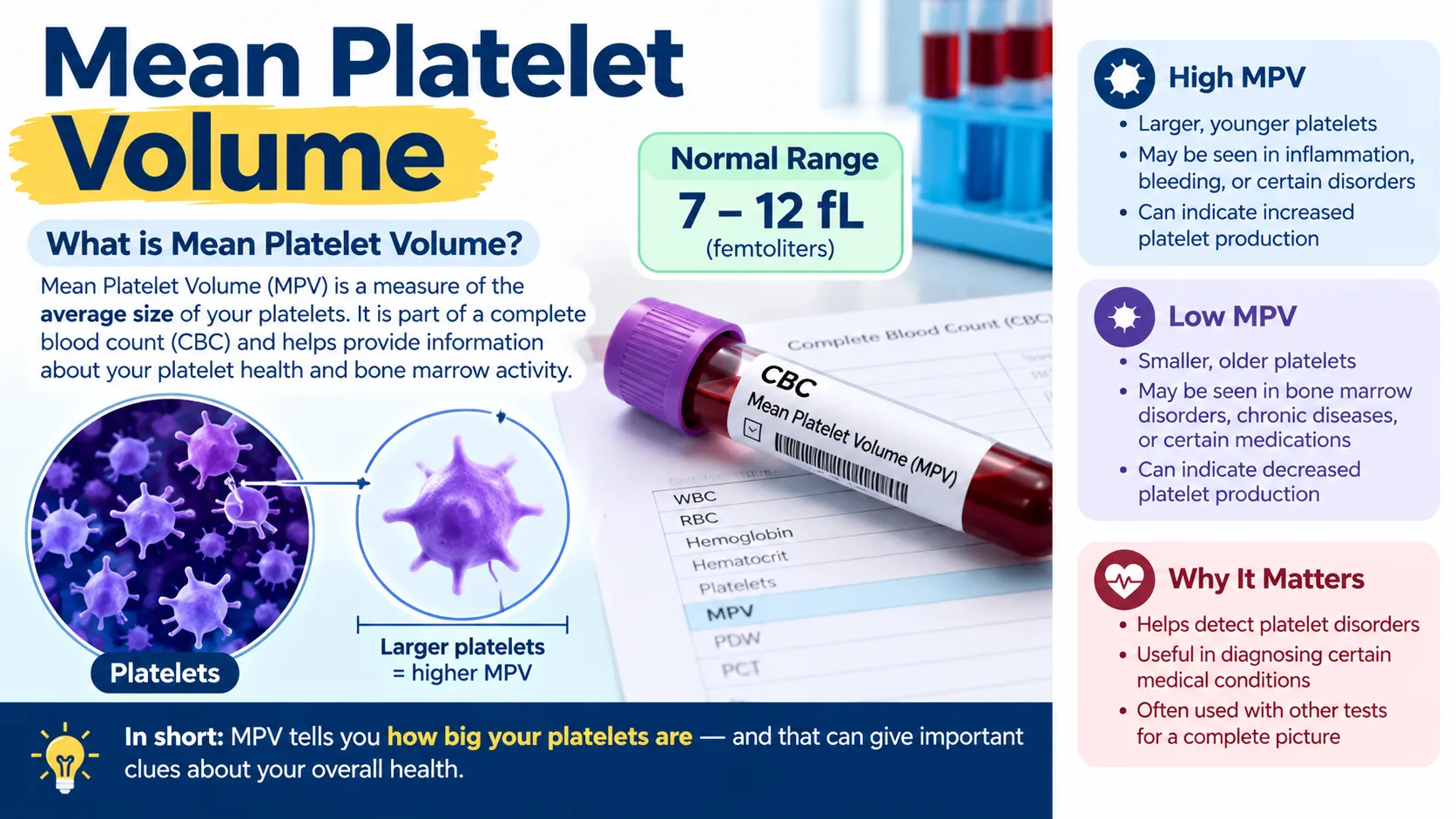
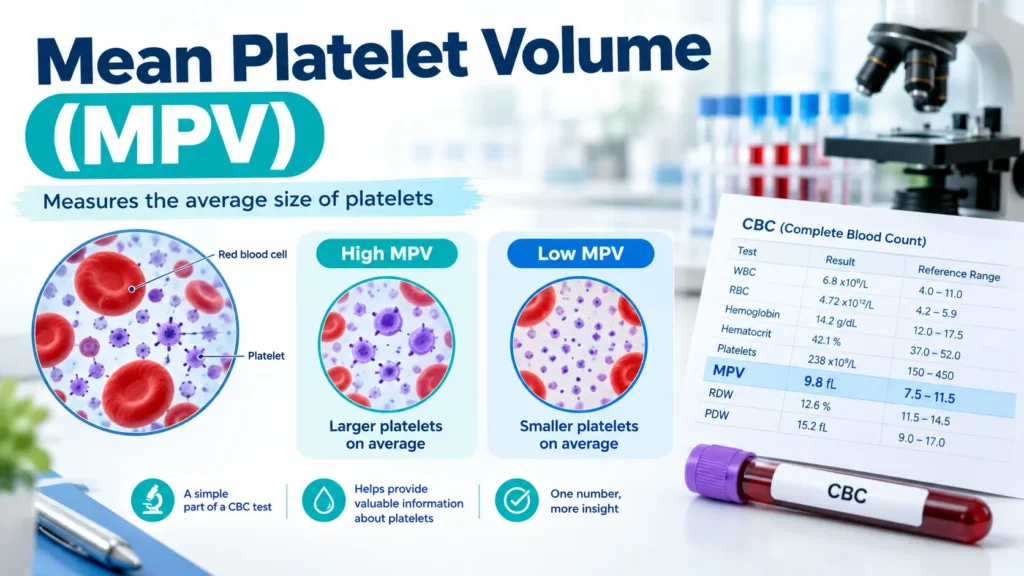
Mean platelet volume (MPV) Measures The Average size of platelets in your blood. Doctors usually review it alongside your platelet count and other complete blood count (CBC) results. A high or low value does not automatically mean you have a disease.
This guide explains how the test works, what different results may mean, which factors can affect your reading, and when you should discuss your results with a healthcare professional.
1. What Is Mean Platelet Volume (MPV)?
Mean platelet volume is a measurement of the average size of platelets in a blood sample. Platelets are small blood components that help your body form clots and control bleeding after an injury.
Your bone marrow produces platelets and releases them into your bloodstream. Newly produced platelets are often larger than older ones, so their average size can provide clues about platelet production and turnover.
However, platelet size is only one part of your blood health.
For example, an elevated result may occur when your body releases more newly formed platelets. A lower result may occur in certain conditions affecting platelet production.
In simple English: MPV tells you how large your platelets are on average, not how many platelets you have.
2. What Does an MPV Blood Test Measure?
An MPV blood test measures the average volume of platelets in a blood sample. Laboratories generally report the result in femtoliters (fL), a unit used to measure extremely small volumes.
The measurement is commonly included in a complete blood count, which evaluates several components of your blood.
Your report may include these measurements:
- Platelet count (PLT): The number of platelets in a specific volume of blood.
- MPV: The average size of your platelets.
- White blood cell count: The number of white blood cells, which help fight infections.
- Red blood cell count: The number of red blood cells that carry oxygen.
- Hemoglobin: The protein in red blood cells that carries oxygen.
Doctors examine these values together to understand your results more accurately.
For instance, an elevated MPV combined with a low platelet count may require a different assessment from an elevated result with a normal platelet count.
Your doctor may also consider your symptoms, medications, medical history, and previous blood tests before recommending further investigations.
3. What Is the Normal Mean Platelet Volume Range?
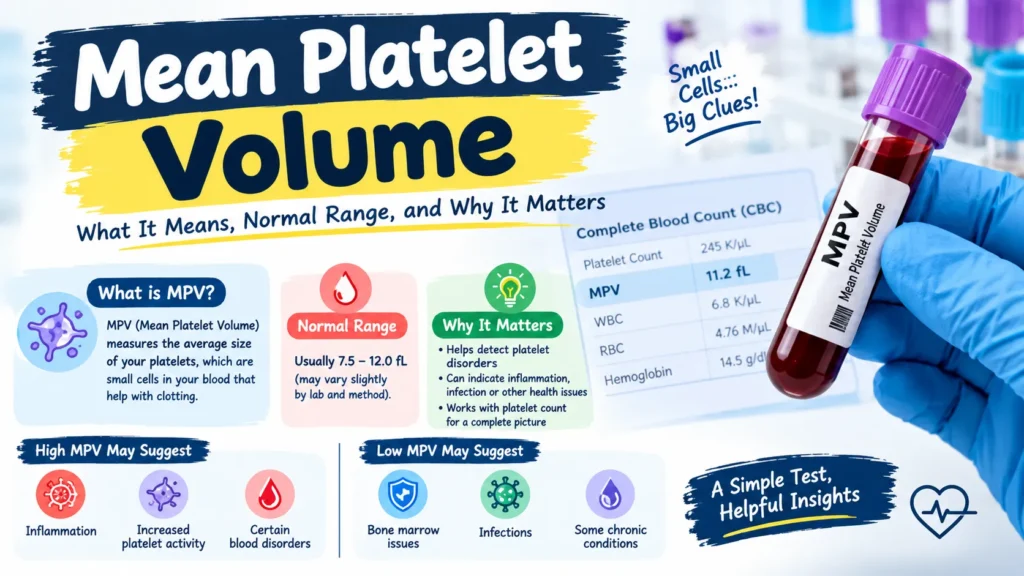
The normal range depends on the laboratory, testing equipment, and measurement method. Therefore, there is no single reference interval that applies to every person and every laboratory.
Some laboratories report a range around 7–12 fL, while others use different limits. Cleveland Clinic, for example, describes a general range of approximately 7–9 fL for non-pregnant adults. These differences demonstrate why you should check your own report rather than rely on a universal number.
Use this table to understand the basic interpretation:
| Result | General meaning | What to do |
| Within the reference range | Average platelet size falls within the laboratory’s expected limits. | Review it with the rest of your blood results. |
| Below the reference range | Platelets are smaller than the laboratory’s expected range. | Ask your doctor whether the finding needs follow-up. |
| Above the reference range | Platelets are larger than the laboratory’s expected range. | Consider the platelet count and other findings. |
A slightly abnormal result does not automatically indicate a serious condition. Likewise, a normal reading cannot rule out every blood-related problem.
Tip: Look for the reference interval printed beside your result. If your report marks the value as high or low, ask your healthcare professional what that means in your specific situation.
4. What Does High Platelet Volume Mean?
A high result means your platelets are larger than the laboratory’s expected range.
Because newly produced platelets are often larger than older platelets, an elevated reading can sometimes indicate increased platelet production or turnover. However, many factors can influence this measurement.
A high value does not automatically mean you have cancer, heart disease, or another serious condition.
Your platelet count helps provide additional context. For example, an elevated reading alongside a low platelet count may lead your doctor to investigate increased platelet destruction or other causes of a reduced platelet count.
In contrast, an elevated reading with a normal platelet count may have a different explanation.
Your doctor may also compare the result with previous tests and consider whether you have symptoms such as unexplained bruising or unusual bleeding.
The most important point is that one measurement cannot establish a diagnosis. Your healthcare professional must interpret it alongside your complete blood count and medical history.
5. What Causes High MPV?
Several conditions and circumstances may be Associated with an elevated reading. The possible explanation depends on your other blood results and individual health circumstances.
Increased platelet production or turnover
When platelets are destroyed or used more quickly than usual, your bone marrow may release additional newly formed platelets. Their larger size can increase the average.
Immune thrombocytopenia
Immune thrombocytopenia (ITP) occurs when the immune system mistakenly attacks platelets. Some people with this condition have an elevated reading, but the measurement alone cannot diagnose it.
Certain bone marrow disorders
Conditions affecting blood cell production can influence platelet size and number. Doctors may investigate other blood count abnormalities before deciding whether additional tests are necessary.
Inflammatory and metabolic conditions
Research has identified associations between platelet measurements and some inflammatory, cardiovascular, and metabolic conditions. However, an association does not prove that an elevated result means you have a particular disease.
Pregnancy-related conditions
Platelet measurements may change during pregnancy. Doctors interpret unusual results alongside blood pressure, platelet count, symptoms, and other relevant findings.
Laboratory-related factors
Blood sample handling, testing methods, and the time between collection and analysis can influence the reported value.
Remember: These are possible explanations, not a list of conditions you should assume you have. Your healthcare professional can determine which possibilities are relevant to your circumstances.
6. What Does Low Mean Platelet Volume Mean?
A low result means your platelets are smaller than the laboratory’s expected range.
Smaller platelets may sometimes be associated with changes in platelet production. However, a low value does not necessarily mean your bone marrow is failing or that you have a serious illness.
The platelet count and other blood test results help determine whether the finding requires further investigation.
For example, a low reading alongside a low platelet count may prompt your doctor to investigate conditions affecting platelet production. The same reading with a normal platelet count may have a different significance.
Your healthcare professional may review previous results, medications, symptoms, and laboratory methods to understand the finding.
If your report shows a low value, avoid diagnosing yourself from that number alone. Ask whether the result is clinically significant and whether you need any additional testing.
7. What Causes Low MPV?
A low result can occur in several circumstances, but it cannot identify a specific cause on its own.
Reduced platelet production
Some conditions affecting bone marrow function can influence platelet production and size. Other abnormalities in your blood count may provide additional clues.
Certain medications
Some medicines can affect blood cell production. Tell your doctor about your prescribed medications, over-the-counter products, and supplements.
Do not stop a prescribed medicine without professional advice.
Infections and inflammatory conditions
Certain infections and inflammatory or autoimmune conditions can affect platelet measurements. The changes may differ from one person to another.
Inherited platelet conditions
Some inherited disorders affect platelet size, production, or function. Doctors may consider your family history, symptoms, and other laboratory findings when investigating these possibilities.
Laboratory variation
Different analyzers may produce different results. Sample handling and testing procedures can also influence the measurement.
Your healthcare professional can help determine whether a low value needs follow-up or represents a minor finding without clinical significance.
8. How Does MPV Relate to Platelet Count?
These two measurements provide different information about your platelets.
The Average-Volume measurement describes platelet size, while the platelet count measures how many platelets are present in a specific volume of blood.
Doctors often review both results together.
| Average platelet size | Platelet count | Possible interpretation |
| High | Low | Increased platelet turnover or destruction may be considered. |
| Low | Low | A condition affecting platelet production or another cause may require investigation. |
| High | Normal | Platelet size is elevated, but its significance depends on other findings. |
| Low | Normal | The result may have limited significance without other abnormalities. |
| High | High | Both findings require interpretation in the context of the full blood count. |
These patterns are examples, not diagnostic rules. Different conditions can produce similar results, and neither measurement independently establishes the cause.
Your doctor may review a blood smear, previous blood counts, symptoms, or additional laboratory tests if necessary.
9. Can MPV Be High or Low With a Normal Platelet Count?
Yes. Your average platelet size can fall outside the laboratory’s reference range even when your platelet count is normal.
This happens because the measurements assess different characteristics of your blood.
A normal platelet count means the number of platelets falls within the laboratory’s expected limits. It does not necessarily mean their average size is also within range.
When an isolated abnormality appears, your doctor may consider:
- How far the result falls outside the reference interval.
- Whether other blood count measurements are abnormal.
- Whether you have unusual bleeding or bruising.
- Whether previous tests showed similar results.
- Whether sample handling or laboratory methods influenced the measurement.
If the difference is small and other findings are reassuring, your doctor may decide that immediate investigation is unnecessary. In other situations, additional testing may be appropriate.
The correct approach depends on your complete clinical picture rather than one number.
10. What Factors Can Affect MPV Results?
Several factors can influence the measurement or its interpretation.
Laboratory equipment: Different analyzers use different methods and may report different reference intervals.
Blood sample handling: The time between collection and analysis, the anticoagulant used, and other processing conditions can affect platelet measurements.
Individual characteristics: Biological differences, including age and other individual factors, may influence blood measurements.
Pregnancy: Pregnancy can affect blood test results, so healthcare professionals consider the wider clinical picture.
Medications and medical conditions: Some medicines and illnesses can affect platelet production, turnover, size, or number.
Previous test results: Comparing measurements from different laboratories may be misleading if their methods or reference intervals differ.
If your result seems inconsistent with your other blood measurements, ask your doctor whether laboratory factors could have influenced it.
Related To Another Article: https://genzwishes.com/what-does-dei-mean/
11. How Is an MPV Blood Test Performed?
The test is generally performed as part of a complete blood count and requires a blood sample.
The process usually follows these steps:
- A healthcare professional cleans the skin, usually on your arm.
- They insert a small needle into a vein.
- They collect a blood sample in a suitable tube.
- The laboratory analyzes the sample using a blood analyzer.
- Your results appear on your blood test report.
You may feel a brief sting when the needle enters your skin. Mild soreness or bruising can occur afterward.
The test itself generally requires no special preparation. However, if your doctor orders other tests that require fasting, follow the instructions provided by your healthcare professional.
The procedure is common, and serious complications are uncommon.
12. What Happens if Your MPV Is Abnormal?
An abnormal result does not always require treatment. The next step Depends on the size of the abnormality, your platelet count, other blood results, symptoms, and medical history.
Your healthcare professional may recommend one or more of the following steps.
Review the complete blood count.
Your doctor may compare the result with your platelet count, hemoglobin, white blood cell count, and other measurements.
Discuss your medical history.y
Previous blood tests, recent illnesses, medications, and unusual bleeding or bruising may help explain the finding.
Repeat the blood test
If the result is unexpected or sample-related factors may have influenced it, your doctor may recommend repeat testing.
Order additional investigations
Depending on the findings, your healthcare professional may request a blood smear or other tests to investigate the cause.
Treat an underlying condition if necessary.
Treatment depends on the underlying problem, not simply on whether the measurement is high or low.
There is no single food, vitamin, supplement, or home remedy that reliably corrects every abnormal result. Avoid taking supplements specifically to change your platelet measurements unless your healthcare professional identifies a reason to use them.
13. When Should You Seek Medical Attention?
An abnormal reading alone does not necessarily indicate an emergency. However, symptoms and other blood test abnormalities may make medical assessment more urgent.
Contact a healthcare professional if you experience:
- Unexplained or frequent bruising.
- Repeated nosebleeds.
- Bleeding gums.
- Unusually heavy menstrual bleeding.
- Bleeding that takes longer than expected to stop.
- Unusual red or purple spots on your skin.
Seek urgent medical care for severe or uncontrolled bleeding, blood in vomit, black or bloody stools, or a sudden severe headache accompanied by neurological symptoms. Sudden weakness on one side, difficulty speaking, or difficulty breathing also requires emergency assessment.
If your platelet count is very low or your doctor has identified another concerning abnormality, follow their instructions about how urgently you need care.
Do not wait for symptoms to become severe if a healthcare professional has already advised urgent follow-up.
People Also Ask
A: MPV stands for mean platelet volume. It measures the average size of platelets in a blood sample and is commonly included in a complete blood count.
A: The reference range varies by laboratory and testing method. Check the range printed on your report instead of assuming that one number applies to everyone.
A: Not necessarily. An elevated result can have several explanations, and its significance depends on your platelet count, other blood measurements, symptoms, and medical history.
A: A low result means your platelets are smaller than the laboratory’s expected range. It does not identify a specific disease or prove that your bone marrow is not functioning properly.
A: Yes. Platelet size and platelet number are separate measurements, so one may be outside its reference range while the other remains normal.
Conclusion
Mean platelet volume is a Measurement of the average size of platelets in your blood. Doctors use it alongside platelet count and other blood test results to understand platelet-related findings.
A high result means your platelets are larger than the laboratory’s expected range, while a low result means they are smaller. Neither finding independently establishes a disease or determines whether treatment is necessary.
Your laboratory’s reference interval, complete blood count, symptoms, and medical history all help determine the significance of an abnormal result.
If your report shows an unusual value, discuss it with your healthcare professional rather than trying to diagnose yourself from one measurement.
Medical disclaimer: This article provides general educational information and does not replace professional medical advice, diagnosis, or treatment. Consult a qualified healthcare professional about your individual blood test results.