Introduction
Have you ever encountered the Word Sutra in a spiritual book, yoga class, or discussion about ancient philosophy? Although the word may seem unfamiliar, its meaning becomes much easier to understand when you explore its Sanskrit origin and historical use.
Sutra literally means “thread” or “string” in Sanskrit. In Indian literary traditions, it also refers to a concise rule, principle, teaching, or religious text. Its precise meaning depends on the context in which people use it.
For example, the Yoga Sutras of Patanjali present teachings about yoga and the mind, while Buddhist sutras preserve important religious teachings. Jain traditions also have their own body of sutra literature.
In this guide, you will learn what sutra means, how to pronounce it, what it represents in different religious traditions, and how to distinguish it from related terms such as mantra and aphorism.
1. What Does Sutra Mean?
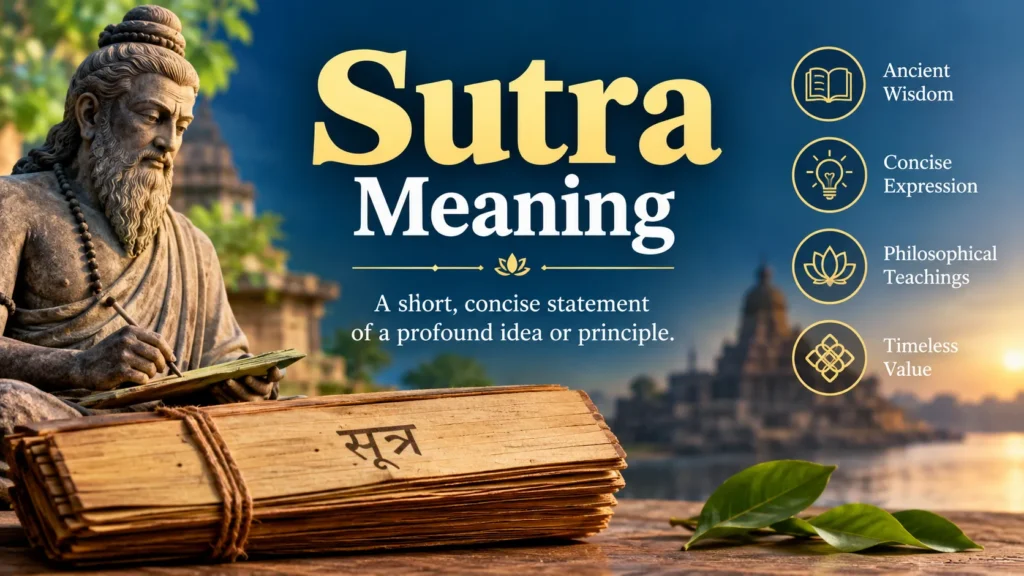
Sutra is a Sanskrit word that literally means “thread” or “string.” In literature and philosophy, it refers to a concise statement, rule, or teaching. It can also describe a complete text that contains religious or philosophical teachings.
Think of a physical thread that connects separate objects. Similarly, a sutra can connect important ideas through a carefully expressed statement or an organized collection of teachings.
Traditional Indian scholars used sutras to present complex subjects in concise forms. Students could memorize these statements and study their meaning with help from teachers and commentaries.
For example, a philosophical sutra might express a principle in only a few words. A teacher could then explain its meaning, context, and implications.
In simple words, a sutra is a concise teaching or a text that communicates teachings, particularly in Indian religious and philosophical traditions.
However, not every sutra is a single short sentence. The term can refer to an individual statement, a collection of rules, or an entire religious scripture.
2. Sutra Pronunciation and Definition
The word sutra is commonly pronounced SOO-truh in English. Its pronunciation may vary slightly between speakers and languages.
Here is a simple breakdown:
- Soo: Rhymes with the beginning of “soon.”
- Truh: Sounds like “truh,” with a short, unstressed final syllable.
The Oxford Learner’s Dictionaries gives the pronunciation as /ˈsuːtrə/. It defines the word as a rule or statement in Sanskrit literature, a set of rules, or a Buddhist or Jain holy text.
Here are the essential details:
| Feature | Explanation |
| Word | Sutra |
| Part of speech | Noun |
| Sanskrit form | सूत्र |
| Common pronunciation | SOO-truh |
| Plural | Sutras |
| Literal meaning | Thread or string |
| Literary meaning | A concise rule, statement, or teaching |
| Religious meaning | A text associated with particular religious teachings |
Example: The student studied a sutra to understand an important philosophical principle.
When you encounter this word in a religious or philosophical book, consider the surrounding context. That context will help you identify whether the author means a short statement, a collection of rules, or a sacred text.
3. Origin and Etymology of Sutra
The word sutra comes from Sanskrit, an ancient language associated with India’s literary, religious, and philosophical traditions.
The Sanskrit form is सूत्र (sūtra), which means “thread” or “string.” The word also developed a literary meaning associated with concise statements and collections of rules or teachings.
The thread metaphor offers a useful way to understand the term. A physical thread holds things together, while a sutra can connect ideas through a compact statement or an organized body of knowledge.
Ancient Indian scholars used sutra compositions in subjects such as philosophy, grammar, religious rituals, and law. Their concise style supported memorization and oral instruction.
However, brevity also created a challenge. Readers could memorize a statement without fully understanding its philosophical meaning. Teachers and commentators therefore explained the principles behind many traditional sutras.
This practice helped preserve complex systems of knowledge across generations.
The word’s history also explains why its meaning varies between traditions. In some Hindu philosophical works, a sutra is characteristically a short, technical statement. In Buddhist literature, the same term often identifies a religious discourse or scripture.
Understanding this development makes the word easier to remember: a sutra can serve as a thread that connects a concise statement with a larger body of knowledge.
4. What Does Sutra Mean in Hinduism?
In Hinduism, a sutra commonly refers to a concise statement or collection of statements that explains philosophical principles, religious practices, or systematic rules.
Different Hindu schools developed sutra texts to organize and communicate their teachings. These texts address subjects such as yoga, philosophy, grammar, rituals, and ethical conduct.
One well-known example is the Yoga Sutras of Patanjali. This work presents teachings about yoga, the mind, disciplined practice, meditation, and spiritual development.
Hindu sutras often use concise language, so readers may need additional explanation to understand technical terms and philosophical arguments.
For example, someone studying the Yoga Sutras might read a statement about the mind and then consult a teacher or commentary to understand its meaning.
The word sutra in this setting does not simply mean a general spiritual message. It identifies a literary form used to present principles and organize knowledge.
Example: A student of classical yoga studies the Yoga Sutras to understand the philosophical foundations of the practice.
The exact interpretation of a sutra can differ between schools and commentators. Readers should therefore consider the particular text rather than assuming that every Hindu sutra expresses the same teaching.
5. What Does Sutra Mean in Buddhism?
In Buddhism, a sutra generally refers to a religious text associated with Buddhist teachings. Many sutras preserve discourses attributed to the historical Buddha, although their content and literary forms vary across Buddhist traditions.
Buddhist sutras explore subjects such as wisdom, compassion, ethical conduct, meditation, and the path toward awakening. Some take the form of dialogues or sermons, while others use narratives and extended philosophical explanations.
Two well-known examples are the Lotus Sutra and the Heart Sutra, both important texts in Mahayana Buddhism.
The Lotus Sutra explores significant Buddhist teachings through an extended religious and literary presentation. The Heart Sutra is particularly associated with the perfection of wisdom and the teaching of emptiness.
These examples show why readers should not assume that every sutra consists of one short sentence. In Buddhist usage, the word can identify a substantial religious work.
Buddhist communities have preserved and transmitted sutras through different languages and literary traditions. These texts continue to influence religious study, practice, and cultural history.
Example: A Buddhist practitioner might read a sutra to study a teaching and reflect on how it relates to everyday life.
Although the Sanskrit word has a historical connection with “thread,” the religious meaning of a Buddhist sutra depends on the text and the tradition that studies it.
6. What Does Sutra Mean in Jainism?
In Jainism, the word sutra refers to religious teachings and scriptures within Jain literary and spiritual traditions.
Jain religious literature preserves teachings about ethical responsibilities, spiritual discipline, religious practices, and the lives or teachings of important spiritual figures.
Some Jain sutras form part of the Jain Agamas, a body of religious literature associated with Jain teachings. Their precise status and interpretation depend on the Jain tradition and the text under discussion.
One notable example is the Kalpa Sutra, an important text in the Svetambara Jain tradition. It is associated particularly with accounts of Jain spiritual teachers and religious observances.
The term shares a connection with the wider Indian practice of organizing and transmitting knowledge through structured teachings. However, Jain sutras should be understood within Jain religious history rather than automatically interpreted through Hindu or Buddhist beliefs.
Example: A reader studying Jain philosophy might explore a religious sutra to understand a teaching about ethical conduct or spiritual discipline.
Although Hinduism, Buddhism, and Jainism all have traditions of sutra literature, their scriptures, beliefs, and interpretations are not interchangeable.
7. What Is the Spiritual Meaning of Sutra?
The spiritual meaning of sutra depends on the teachings contained in a particular text and the tradition that studies it.
In a general explanatory sense, people may associate sutras with wisdom, learning, reflection, discipline, and the preservation of spiritual knowledge. These associations arise from the role sutra literature plays in religious and philosophical education.
However, sutra does not have one universal spiritual definition that applies identically to every tradition.
For example, a reader exploring the Yoga Sutras may focus on the mind, meditation, and disciplined practice. Someone studying Buddhist sutras may explore teachings about compassion, wisdom, or the nature of experience.
The word itself identifies a type of teaching or text; the specific spiritual message comes from the work being studied.
This distinction matters because people sometimes treat every ancient religious term as if it had one universal symbolic meaning. In reality, different traditions use their own concepts and interpret their texts in different ways.
A useful approach is to read the passage, identify its religious or philosophical context, and then explore the explanation offered by the relevant tradition.
In simple terms: The spiritual significance of a sutra comes from the teachings it communicates within a particular religious or philosophical tradition.
8. Famous Sutras and Their Meanings
Several Well-Known texts demonstrate how sutra literature appears across Indian religious and philosophical traditions.
Yoga Sutras of Patanjali
The Yoga Sutras of Patanjali is an important text in classical yoga philosophy. It presents concise statements about yoga, mental discipline, meditation, and spiritual development.
Readers often consult commentaries to understand its technical language and philosophical ideas.
Lotus Sutra
The Lotus Sutra is an influential scripture in Mahayana Buddhism. It presents important Buddhist teachings through an extended religious and literary work.
Its interpretation and role vary across Buddhist traditions.
Heart Sutra
The Heart Sutra is a well-known Mahayana Buddhist text associated with the perfection of wisdom. It discusses emptiness, a central concept in Buddhist philosophy that requires careful interpretation.
Kalpa Sutra
The Kalpa Sutra is an important Jain religious text associated with the Svetambara tradition. It includes accounts relating to Jain spiritual teachers and religious observances.
These examples show that sutra literature covers more than one religion or subject. Some texts organize philosophical principles, while others preserve religious discourses, narratives, and teachings central to a particular community.
When exploring any of these works, readers should consider its historical setting and religious context rather than assuming that all sutras communicate identical ideas.
9. Sutra Examples in Sentences
The following examples show how people use the word sutra in everyday English.
1. Religious study: The student read a Buddhist sutra to learn more about Buddhist teachings.
2. Yoga philosophy: She studied the Yoga Sutras to deepen her understanding of meditation and mental discipline.
3. Historical research: The researcher examined an ancient sutra to understand its philosophical context.
4. Buddhist scripture: The Lotus Sutra holds an important place in several Mahayana Buddhist traditions.
5. Sanskrit literature: The scholar explained how a sutra can communicate a complex principle through a concise statement.
6. Comparative religion: The class explored how Hindu, Buddhist, and Jain traditions use sutra literature.
7. Philosophical learning: The teacher explained a sutra before discussing its wider implications.
8. Religious history: The museum displayed an ancient manuscript containing a Buddhist sutra.
9. Traditional learning: Students memorized concise statements and discussed their meanings with a teacher.
10. Academic discussion: The researcher compared two interpretations of a philosophical sutra.
These sentences illustrate the word’s common uses. They also show why context matters: sutra can identify a literary form, an individual teaching, or a religious text.
10. Sutra vs. Scripture, Aphorism, and Mantra
People sometimes confuse sutra with related religious and literary terms. Although these words can overlap in certain contexts, they do not mean the same thing.
| Term | Meaning | Main difference |
| Sutra | A concise rule or teaching, or a religious text containing teachings | Associated with particular Indian literary and religious traditions |
| Scripture | A sacred or authoritative religious text | A broader term used across many religions |
| Aphorism | A brief statement expressing a principle or observation | Does not necessarily have a religious meaning |
| Mantra | A sacred utterance, word, syllable, or phrase used in religious or spiritual practice | Often associated with recitation or repetition |
| Philosophy | The systematic exploration of fundamental questions and principles | A field of inquiry rather than a particular literary form |
Sutra vs. Mantra
A sutra generally communicates a teaching or identifies a religious text. A mantra is a sacred utterance, word, syllable, or phrase associated with religious or spiritual practice.
The two terms can appear in the same religious setting, but they serve different functions.
Sutra vs. Aphorism
An aphorism expresses a principle or observation in a concise form. Some sutras resemble aphorisms, particularly in Hindu philosophical literature, but not every aphorism is a sutra.
Sutra vs. Scripture
Scripture is a broad term for a sacred or authoritative religious text. A sutra can be a scripture, but the word also refers to concise rules and teachings in particular literary traditions.
Understanding these distinctions helps readers use each term accurately and interpret religious writing more carefully.
11. Why Are Sutras Written in Short Statements?
Many traditional sutras use concise language to communicate important principles efficiently.
In ancient Indian educational traditions, students often learned through listening, memorization, repetition, and instruction from teachers. Short statements could make complex material easier to remember and transmit.
However, concise writing also creates challenges. A brief statement may contain technical language, unstated assumptions, or references to ideas that readers cannot fully understand without additional context.
Commentaries therefore play an important role in interpreting many sutra texts. Teachers and scholars explain the language, explore the philosophical setting, and discuss how individual statements relate to a broader system of thought.
The original statement provides a foundation, while interpretation helps readers explore its meaning.
This process also explains why scholars and religious teachers may interpret the same passage differently. They may disagree about its historical setting, intended meaning, or implications for practice.
A short statement can communicate a complex idea, but brevity does not guarantee simplicity.
The key idea: Sutras often present essential teachings concisely, while teachers and commentators help readers understand their deeper context and significance.

12. Common Misunderstandings About Sutra
Understanding a few common misconceptions makes the word easier to interpret.
Misunderstanding 1: Every sutra is a short sentence.
Many sutra compositions use concise statements, but the word can also refer to an entire religious text or an extended collection of teachings.
Misunderstanding 2: Sutra belongs to only one religion.
Hinduism, Buddhism, and Jainism all have traditions of sutra literature. Their texts, beliefs, and interpretations differ.
Misunderstanding 3: Sutra always means spiritual wisdom.
The word can refer to teachings about philosophy, grammar, rituals, or other subjects. Its meaning depends on the particular text and context.
Misunderstanding 4: Sutra and mantra mean the same thing.
These terms serve different functions. A sutra generally communicates a teaching or identifies a text, whereas a mantra is a sacred utterance, word, syllable, or phrase associated with religious or spiritual practice.
Misunderstanding 5: The literal meaning explains every use of the word.
Although sutra literally means “thread” or “string” in Sanskrit, its established literary and religious meanings extend beyond a physical thread.
Misunderstanding 6: Every sutra expresses the same philosophy.
Different traditions and schools preserve their own teachings. Readers should examine each text within its historical, religious, and philosophical setting.
Keeping these distinctions in mind helps you understand the word without oversimplifying its cultural and religious significance.
Related To Another Article: https://genzwishes.com/utilitarianism-meaning/
13. How to Understand a Sutra in Its Context
If you encounter the word sutra in a book, article, yoga class, or religious discussion, a few practical steps can help you identify its meaning.
First, identify the tradition. Determine whether the author is discussing Hindu philosophy, Buddhism, Jainism, or another subject.
Second, identify the text. A reference to the Yoga Sutras will have a different context from a reference to the Lotus Sutra.
Third, examine the surrounding passage. Look at the sentences before and after the word. They may reveal whether the author means a concise statement, a collection of rules, or a religious scripture.
Fourth, check unfamiliar terms. Religious and philosophical texts often use words with specialized meanings. A reliable dictionary or scholarly explanation can help.
Fifth, compare interpretations carefully. If you read different explanations of the same sutra, consider the author’s tradition and approach before deciding what the passage means.
Practical example
Imagine that you encounter the sentence, “She studies the Yoga Sutras every morning.”
The phrase refers to a particular philosophical text associated with classical yoga. It does not simply mean that she reads short inspirational quotes.
Now consider the sentence, “The museum displayed an ancient Buddhist sutra.”
Here, the word refers to a Buddhist religious text.
These examples demonstrate an important principle: the surrounding context determines the most appropriate interpretation.
People Also Ask
A: Sutra means “thread” or “string” in Sanskrit. It also refers to a concise rule, teaching, or religious text. The exact meaning depends on the context.
A: The Sanskrit word sūtra (सूत्र) literally means “thread” or “string.” It also developed literary meanings associated with concise statements and collections of teachings.
A: In English, sutra is commonly pronounced SOO-truh, with the stress on the first syllable.
A: The spiritual significance depends on the particular text and tradition. Sutras may communicate teachings about wisdom, discipline, meditation, ethics, or spiritual development.
A: In Hinduism, a sutra commonly refers to a concise statement or collection of statements that presents philosophical principles, religious rules, or other teachings.
Conclusion
The Word Sutra has a rich history that connects language, literature, philosophy, and religion. Originating from the Sanskrit word for “thread” or “string,” it also came to describe concise teachings, rules, and religious texts.
In Hindu philosophical traditions, sutras often present systematic principles in concise statements. In Buddhism, the term commonly refers to religious texts associated with Buddhist teachings. Jainism also has a distinct tradition of sutra literature.
Understanding these differences helps you appreciate the word without reducing it to a single definition.
The most important point is simple: sutra refers to more than a short statement. Its meaning depends on the literary form, religious tradition, and teachings associated with the text.
If you enjoy exploring the meanings of words, spiritual terminology, and ancient concepts, explore more educational articles on GenzWishes and bookmark this guide for future reference.