
Introduction
Have you ever felt that everyone around you is smarter, more attractive, or more successful than you? Do you sometimes overlook your achievements because you believe other people are simply better? These feelings may be related to what is commonly called an inferiority complex.
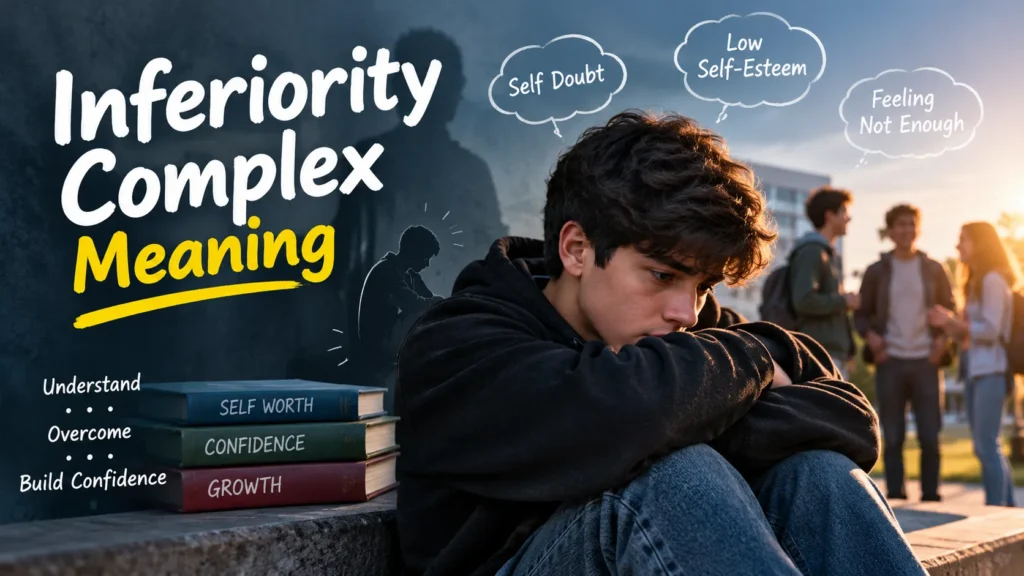
The Inferiority Complex refers to a persistent pattern of feeling inadequate, less capable, or less worthy than other people. These feelings can influence confidence, relationships, decision-making, and the way someone responds to challenges.
Everyone experiences insecurity occasionally. However, persistent feelings of inferiority can become difficult when they interfere with everyday life or prevent someone from recognizing their strengths.
In this guide, you will learn the meaning of an inferiority complex in simple English, its common signs and possible causes, real-life examples, differences from related concepts, and practical ways to develop a healthier self-image.
1. What Does Inferiority Complex Mean?
An inferiority complex describes persistent feelings of being less capable, important, attractive, intelligent, or worthy than other people.
Someone experiencing these feelings may believe that everyone else is better than them, even when there is little evidence to support that belief.
For example, a student might receive a good grade but still feel unsuccessful because a classmate scores higher. Instead of appreciating the achievement, the student focuses entirely on the comparison.
The concept is associated with psychologist Alfred Adler, who explored feelings of inferiority and their relationship to personal development.
An inferiority complex does not mean that someone is actually inferior. It describes a pattern of feelings and beliefs about oneself.
In simple terms, it means feeling that you are not good enough compared with others, even when your abilities and personal worth cannot fairly be measured through comparison.
2. Inferiority Complex Meaning in Simple Words
In simple English, an inferiority complex means feeling that you are not as good as other people.
A person may believe that others are more intelligent, attractive, talented, successful, or deserving of appreciation.
Imagine two friends applying for the same job. One receives an offer, while the other does not.
The disappointed friend might recognize the setback and prepare for another opportunity. However, someone struggling with persistent feelings of inferiority might conclude that they are useless and will never succeed.
The difference lies in how the experience is interpreted.
A rejection does not determine your entire future. Likewise, another person’s success does not reduce your personal worth.
Here are some simple examples:
- Feeling unintelligent whenever someone answers a question before you.
- Believing that your appearance is unacceptable because someone else looks different.
- Assuming that your friends are more important or interesting than you.
- Avoiding opportunities because you expect everyone else to perform better.
- Dismissing your achievements because another person has achieved more.
These examples illustrate possible patterns, not a diagnostic test. Experiencing occasional insecurity does not automatically mean you have an inferiority complex.
3. Inferiority Complex Meaning in Psychology
In psychology, an inferiority complex describes persistent feelings of inadequacy that may influence a person’s self-image and behavior.
Alfred Adler discussed feelings of inferiority within his theory of individual psychology. He proposed that recognizing limitations can motivate people to develop their abilities and work toward meaningful goals.
For example, a beginner learning football may recognize that an experienced player has better ball control. This awareness can encourage practice and improvement.
The situation becomes more concerning when the beginner interprets the skill difference as proof that they are fundamentally worthless or incapable of learning.
People respond to feelings of inferiority differently. Some withdraw from challenges, while others become excessively competitive or feel compelled to prove their worth.
It is important to distinguish a psychological concept from a formal diagnosis. An inferiority complex is not a standalone diagnosis in the DSM-5-TR. Persistent feelings of inadequacy may occur alongside other concerns that deserve professional assessment.
4. Examples of an Inferiority Complex in Everyday Life
An inferiority complex can affect different areas of life. These examples illustrate how persistent self-comparison may influence everyday thoughts and decisions.
At school: A student receives good marks but feels unintelligent because another student performs better.
In friendships: Someone remains quiet because they assume their opinions are less interesting than everyone else’s.
On social media: A person compares their everyday life with carefully selected photographs of other people’s holidays, possessions, and achievements.
At work: An employee avoids sharing an idea during a meeting because they believe their colleagues are more knowledgeable.
In appearance: Someone avoids photographs because they constantly compare their physical features with other people’s.
In relationships: A person repeatedly worries that their partner will find someone more attractive or successful.
These situations can involve insecurity, anxiety, or other experiences. A single behavior does not establish that someone has an inferiority complex.
The important question is whether negative self-comparisons repeatedly affect the person’s confidence, choices, and well-being.
5. Common Signs of an Inferiority Complex
There is no single checklist that definitively identifies an inferiority complex. However, several patterns may indicate that feelings of inadequacy are affecting everyday life.
Constant comparison: You frequently compare your appearance, intelligence, income, or achievements with those of other people.
Negative self-talk: You repeatedly describe yourself as incapable, unattractive, unsuccessful, or unworthy.
Difficulty accepting compliments: You dismiss praise because you assume that people are only being polite.
Fear of failure: You avoid opportunities because you are afraid of making mistakes or appearing foolish.
Social withdrawal: You stay away from conversations or gatherings because you expect other people to judge you.
Excessive need for approval: You depend heavily on other people’s opinions to determine how you feel about yourself.
Difficulty recognizing achievements: You minimize your successes or immediately compare them with someone else’s accomplishments.
Overcompensation: Some people respond to insecurity by boasting, becoming excessively competitive, or trying hard to prove their superiority. These behaviors have many possible explanations and do not automatically indicate underlying inferiority.
The key consideration is whether these patterns persist and interfere with relationships, education, work, or daily functioning.
6. What Causes an Inferiority Complex?
There is no single cause of an inferiority complex. Persistent feelings of inadequacy may develop through a combination of experiences, social pressures, learned beliefs, and individual circumstances.
Childhood Criticism: Repeated messages that a child is incapable or disappointing may influence their developing self-image.
Bullying and rejection: Being mocked, excluded, or repeatedly humiliated can affect confidence and create fears of negative judgment.
Unhealthy comparisons: Constantly measuring yourself against friends, colleagues, or online personalities can create unrealistic expectations.
Academic or professional setbacks: Poor grades, rejection, or disappointing results may undermine confidence, particularly when a temporary setback becomes a judgment about personal worth.
Family expectations: When approval appears to depend entirely on achievement, someone may struggle to feel valuable without performing exceptionally well.
Appearance-related insecurity: Negative comments and unrealistic beauty standards may influence how someone evaluates their physical features.
Difficult life experiences: Discrimination, trauma, financial hardship, and relationship problems can contribute to negative beliefs about oneself.
Perfectionism: People who expect flawless performance may interpret ordinary mistakes as evidence that they are not good enough.
These factors do not affect everyone in the same way. Understanding the experiences that influence your self-image can help you identify unhelpful beliefs and decide what support might be useful.
7. Types of Inferiority Feelings
People can experience feelings of inferiority in different areas of life. The following categories are useful descriptions rather than formal diagnostic subtypes.
Physical inferiority: Believing that your height, appearance, body shape, or physical abilities make you less valuable than others.
Intellectual inferiority: Assuming that you are less intelligent or less capable of learning than your classmates or colleagues.
Social inferiority: Believing that you are less likable, interesting, or socially capable than other people.
Financial inferiority: Feeling unsuccessful because you cannot afford the same possessions, holidays, or lifestyle as your peers.
Academic inferiority: Assuming that your grades or educational achievements make you less capable than other students.
Professional inferiority: Believing that your career progress, skills, or accomplishments are inadequate compared with those of colleagues.
Identifying the area in which insecurity occurs can help you challenge a specific belief instead of judging your entire identity.
8. Inferiority Complex vs. Superiority Complex
An inferiority complex centers on persistent feelings of inadequacy. A superiority complex involves an exaggerated sense of importance, ability, or status.
In some psychological interpretations, exaggerated displays of superiority may serve as overcompensation for underlying insecurity. However, arrogance does not automatically mean that someone feels inferior.
| Feature | Inferiority Complex | Superiority Complex |
| Main belief | I am not good enough. | I am better than everyone else. |
| Self-image | Feels persistently inadequate | Exaggerates personal importance or ability |
| Comparison | Often feels worse than others | Often emphasizes being above others |
| Possible behavior | Self-criticism or withdrawal | Boasting or excessive competitiveness |
| Response to criticism | May feel deeply inadequate | May become defensive or dismissive |
These descriptions are general patterns, not rules that apply to every person.
For example, one person may respond to insecurity by avoiding competition, while another may work excessively hard to prove their worth.
9. Inferiority Complex vs. Low Self-Esteem
An inferiority complex and low self-esteem are related concepts, but they are not identical.
Low Self-Esteem Generally means having a negative evaluation of your own worth or abilities. An inferiority complex emphasizes persistent feelings of being less capable or valuable than others.
The terms overlap, and their distinction is not always clear-cut.
| Feature | Inferiority Complex | Low Self-Esteem |
| Basic meaning | Persistent feelings of being inferior to others | Negative evaluation of oneself |
| Comparison | Often plays an important role | May or may not be central |
| Common thought | Everyone is better than me. | I am not good enough. |
| Possible effects | Confidence and relationships may suffer | Confidence and well-being may suffer |
For example, someone with low self-esteem may struggle to recognize their strengths in general. Someone experiencing strong inferiority feelings may focus particularly on how they compare with friends, classmates, or colleagues.
A person can experience both patterns simultaneously.
10. How an Inferiority Complex Can Affect Relationships
Persistent feelings of inadequacy can influence how people communicate and interpret other people’s behavior.
Fear of rejection: Someone may assume that friends or romantic partners will eventually reject them.
Excessive reassurance-seeking: A person may repeatedly ask whether others still like them or whether they have done something wrong.
Jealousy and comparison: Someone may compare themselves with a partner’s friends, colleagues, or previous relationships.
Difficulty expressing needs: A person may avoid setting boundaries because they fear disappointing others.
Sensitivity to criticism: Constructive feedback may feel like a personal attack when someone already believes they are inadequate.
Healthy relationships do not require perfection. They benefit from honest communication, mutual respect, and the understanding that everyone has strengths and limitations.
11. How an Inferiority Complex Can Affect School and Work
Persistent self-doubt can influence educational and professional decisions when it repeatedly undermines confidence.
At school, a student may avoid asking questions because they fear appearing unintelligent. They might refuse to participate in activities even when they have useful ideas.
At work, an employee may hesitate to apply for a promotion because they assume that everyone else is more qualified. They might avoid sharing suggestions or struggle to accept positive feedback.
These patterns can limit opportunities to learn and develop new skills.
A more helpful approach is to focus on progress instead of personal ranking.
Ask yourself:
- What skill am I developing?
- What progress have I made?
- What can I learn from this experience?
- What is one realistic step I can take next?
Recognizing areas for improvement is useful. Treating every weakness as proof of personal failure is not.
Related To Another Article: https://genzwishes.com/angina-meaning/
12. How to Overcome an Inferiority Complex
Overcoming persistent feelings of inferiority does not mean convincing yourself that you are better than everyone else. It means developing a more balanced understanding of your strengths, limitations, and personal worth.
1. Identify negative self-talk. Notice thoughts such as “I always fail” and ask whether the evidence truly supports such a broad conclusion.
2. Reduce unhelpful comparisons. If certain social media accounts repeatedly leave you feeling inadequate, consider limiting your exposure to them.
3. Recognize your strengths. Write down your skills, positive qualities, accomplishments, and challenges you have overcome.
4. Set realistic goals. Break large goals into manageable steps and recognize progress along the way.
5. Learn from mistakes. Treat an unsuccessful attempt as information about what you can improve rather than proof that you lack worth.
6. Practice self-compassion. Speak to yourself with the same patience you would offer a friend facing a difficult situation.
7. Build supportive relationships. Spend time with people who respect your boundaries and encourage your development.
8. Develop skills through practice. Experience can help you recognize your abilities and become more comfortable with challenges.
9. Focus on personal progress. Compare your current abilities with your previous efforts rather than treating another person’s success as your only standard.
10. Consider professional support. If persistent feelings of inadequacy affect your everyday life, a qualified mental health professional can help you explore the underlying issues. Cognitive behavioral therapy may help some people identify unhelpful thought patterns and develop more balanced responses.
Progress takes time. You do not need to eliminate every insecurity before you can live confidently and meaningfully.
13. When Should You Seek Professional Help?
Occasional insecurity is common. However, professional support may be helpful when negative beliefs about yourself become overwhelming or difficult to manage.
Consider speaking with a qualified mental health professional if you regularly feel worthless, avoid important activities because of insecurity, experience persistent fear of judgment, or find that self-criticism is damaging your relationships.
Support may also be appropriate when feelings of inadequacy occur alongside prolonged sadness, hopelessness, significant anxiety, or changes in everyday functioning.
A professional can help you understand your experiences and assess whether they are connected to another concern that needs attention.
You do not have to wait until your feelings become severe before asking for help. Seeking support is a practical step toward understanding yourself and improving your well-being.
14. Synonyms, Related Words, and Example Sentences
Understanding related expressions can make the meaning of an inferiority complex easier to recognize.
Insecurity: Uncertainty about yourself, your abilities, or how others perceive you.
Self-doubt: A lack of confidence in your decisions, abilities, or judgment.
Low self-esteem: A negative evaluation of your own worth or abilities.
Feelings of inadequacy: The sense that you do not meet a particular standard or expectation.
Self-consciousness: Being excessively aware of how you appear or may be judged by others.
These expressions are related, but they are not exact synonyms.
Inferiority Complex in a Sentence
- He developed an inferiority complex after constantly comparing his achievements with those of his classmates.
- Her inferiority complex made it difficult for her to accept compliments.
- Repeated criticism can contribute to feelings of inadequacy.
- He worked on his confidence instead of allowing self-doubt to control his decisions.
- Comparing your everyday life with other people’s achievements can make you feel unnecessarily inferior.
- She realized that making mistakes did not make her less capable than her colleagues.
- His fear of being judged sometimes prevented him from sharing useful ideas.
- Learning to recognize her strengths helped her develop a healthier self-image.
Is an Inferiority Complex Always Negative?
Persistent feelings of inadequacy can be distressing, but recognizing a limitation does not have to be harmful.
For example, noticing that an experienced athlete has better skills than you may encourage you to practice.
The problem arises when the comparison becomes a belief that you are inherently less valuable or incapable of improving.
Healthy development focuses on learning, realistic goals, and personal progress rather than proving that you are better than other people.
People Also Ask
A: An inferiority complex refers to persistent feelings of inadequacy, insecurity, or being less capable or worthy than other people.
A: In simple words, it means feeling that you are not good enough compared with others. Someone experiencing these feelings may constantly compare themselves with other people and overlook their strengths.
A: A student who receives good grades but still believes they are unintelligent because another student performs better illustrates a possible pattern of inferiority feelings. One example alone does not establish a diagnosis.
A: Possible contributing factors include repeated criticism, bullying, rejection, perfectionism, difficult experiences, and unhealthy social comparisons. There is no single cause that applies to everyone.
A: An inferiority complex is a psychological concept rather than a standalone diagnosis in the DSM-5-TR. Persistent feelings of inadequacy may nevertheless occur alongside concerns that benefit from professional assessment.
Conclusion
The Inferiority Complex Centers on persistent feelings of inadequacy, insecurity, and being less capable or worthy than other people.
These feelings may affect confidence, relationships, education, work, and everyday decisions. However, feeling insecure does not mean that you are actually inferior.
Recognizing negative thought patterns, reducing unhealthy comparisons, setting realistic goals, and practicing self-compassion can help you develop a healthier relationship with yourself. Professional support may also be useful when these feelings become overwhelming.
Remember, your worth is not determined by winning every comparison. You can recognize your weaknesses, improve your skills, celebrate your achievements, and treat yourself with respect at the same time.
If this guide helped you understand the term, consider bookmarking it for future reference and exploring related meaning articles on GenzWishes.