1. Introduction
A dashboard is a panel or screen that displays important information and may provide access to useful controls. Its exact meaning depends on the context.
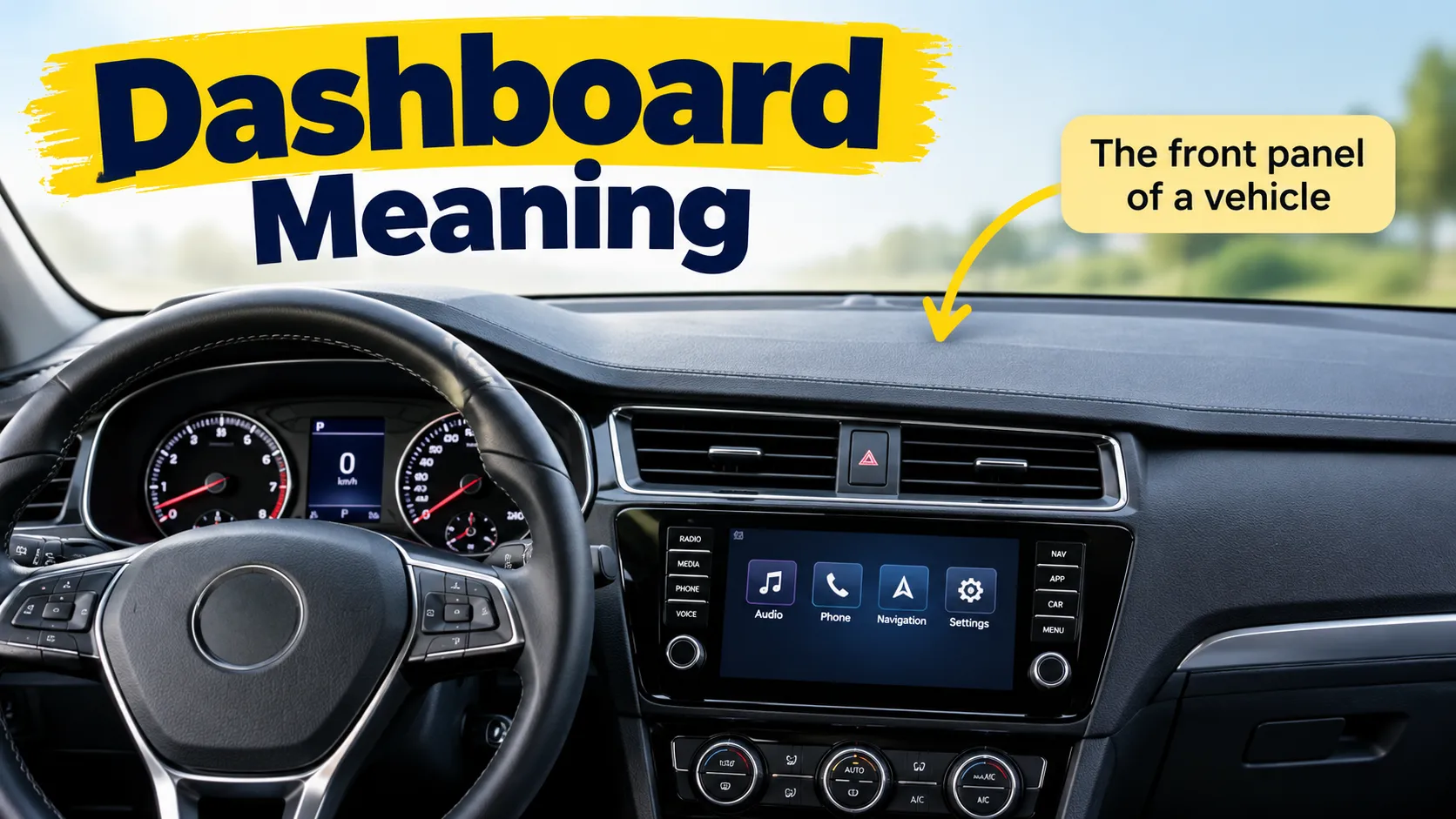
In a car, the Dashboard Contains instruments and indicators that help the driver monitor the vehicle. On a website or app, a dashboard usually displays account information, statistics, activities, or useful tools in one place.
For example, a driver might check the fuel level on a car dashboard, while a website owner might open a dashboard to review visitor statistics.
In simple terms, a dashboard brings relevant information together so people can find and understand it more easily.
2. Dashboard Meaning in Simple English
In simple English, a dashboard means a panel or screen that brings important information and controls together in one place.
Imagine opening an app and immediately seeing your recent activities, notifications, and account details. That screen may be called a dashboard because it gives you a convenient overview.
The word has two particularly common uses:
- Physical dashboard: The instrument panel located in front of a vehicle’s driver.
- Digital dashboard: A screen in a website, application, or computer system that displays information and provides access to features.
Although these dashboards look different, they share a similar purpose: making useful information easier to access.
Think of a dashboard as a central information hub. Instead of looking in several places, you can check the details that matter from one main screen.
3. Dashboard Pronunciation, Word Type, and Plural
Dashboard is a noun. It names a physical instrument panel or a digital screen used to present information.
Pronunciation: DASH-bord
Phonetic spelling: /ˈdæʃ.bɔːrd/
Plural form: Dashboards
Example sentence: The manager checked the dashboard before the meeting.
In this sentence, dashboard refers to a screen or panel containing information the manager needs.
The word is written as one word, not two separate words. You should write dashboard rather than dash board when using the standard modern spelling.
Dashboard is common in American and British English. Pronunciation can vary slightly between accents, but the meaning is generally understood from context.
4. What Is a Dashboard in a Car?
A car dashboard is the panel located in front of the driver. It contains instruments, displays, warning indicators, and controls that help the driver monitor the vehicle and operate certain features.
Depending on the vehicle, the dashboard may include:
- Speedometer: Displays how fast the vehicle is moving.
- Fuel gauge: Shows the approximate amount of fuel remaining.
- Odometer: Records the distance travelled by the vehicle.
- Warning lights: Alert the driver to certain vehicle conditions.
- Engine temperature display: Provides information about engine temperature when fitted.
- Climate controls: Allow the driver or passenger to adjust heating and air conditioning.
- Infotainment screen: May display navigation, music, and other vehicle features.
Modern vehicles may use digital displays instead of traditional gauges, but the dashboard’s general purpose remains similar.
Example: A warning light appeared on the car’s dashboard.
This means that an indicator on the vehicle’s instrument panel became visible.
A dashboard warning light does not always indicate the same level of urgency. Drivers should consult the vehicle’s manual and respond according to the specific warning.
5. What Does Dashboard Mean on a Website or App?
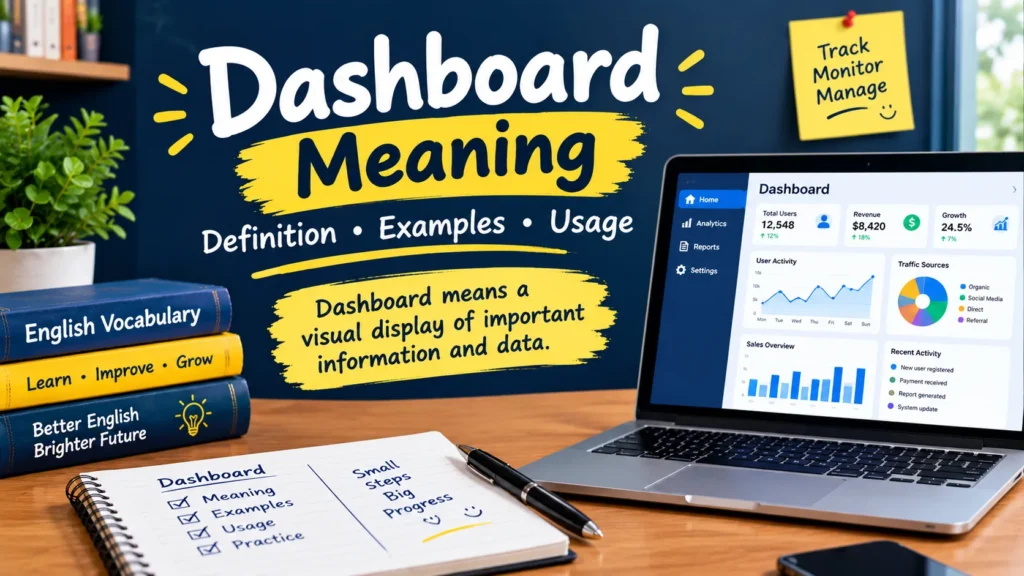
On a website or mobile app, a dashboard is a digital page that organizes important information, account details, activity summaries, and tools in one place.
After signing in to an online service, you may see a dashboard that helps you manage your account or review your recent activity.
For example, a website dashboard might display published articles, visitor statistics, notifications, or account settings. An online store dashboard might show orders, sales figures, and delivery information.
Common dashboard features include:
- Summary cards showing important numbers.
- Charts and graphs presenting trends.
- Navigation menus linking to different tools.
- Notifications about recent activity.
- Filters for viewing particular information.
- Account settings and management options.
The available features depend on the website or application.
Example: Log in to your account and open the dashboard to check your latest activity.
Here, dashboard means the main screen where you can access relevant information and available tools.
If a website tells you to go to your dashboard, it generally means opening the central area of your account rather than the public homepage.
6. What Is a Dashboard in Business and Data Analytics?
In business, a dashboard is a visual display of selected information and performance measurements that helps people monitor activities and make informed decisions.
Businesses may track sales, revenue, expenses, customer activity, website visits, and progress toward goals. A dashboard organizes selected measurements so users can understand what is happening without reviewing every individual record.
For example, an online store might use a dashboard to review daily orders, total sales, and website traffic.
Business dashboards often display key performance indicators, commonly called KPIs. These are measurable values used to evaluate progress toward specific objectives.
A dashboard can help teams:
- Monitor business performance.
- Compare results across different periods.
- Identify changes in important measurements.
- Track progress toward targets.
- Find areas that may need attention.
However, a dashboard does not automatically explain why a result changed or guarantee that a decision will be correct. The quality of the information and the user’s interpretation both matter.
Example: The marketing team used a dashboard to compare campaign results.
This means the team reviewed relevant marketing measurements in one visual display.
7. What Are the Common Types of Dashboards?
Dashboards are designed for different purposes. Their layouts and features depend on the needs of the people using them.
A personal dashboard organizes information such as tasks, appointments, reminders, and individual goals.
Example: My personal dashboard helps me organize my daily schedule.
Website dashboard
A website dashboard provides access to website management tools, content, settings, or visitor information.
Example: The website owner used the dashboard to publish a new article.
Business dashboard
A business dashboard summarizes selected measurements such as revenue, expenses, orders, and sales performance.
Example: The business dashboard showed the company’s monthly sales figures.
Analytics dashboard
An analytics dashboard presents data through charts, graphs, tables, and other visual elements.
Example: The analytics dashboard revealed which pages received the most visits.
Project dashboard
A project dashboard helps a team track assignments, deadlines, milestones, and progress.
Example: Our project dashboard lists the tasks that still need to be completed.
Educational dashboard
A school or learning platform may use a dashboard to display assignments, grades, attendance, course progress, or learning resources.
Example: The student checked the school dashboard for updated assignment details.
Vehicle dashboard
A vehicle dashboard presents driving information and provides access to certain controls.
Example: The driver checked the dashboard before beginning the journey.
Although these dashboards serve different audiences, they share one central idea: presenting relevant information in an accessible place.
8. What Information Does a Dashboard Show?
The information shown on a dashboard depends on the system and its purpose. A car dashboard focuses on driving, while a business dashboard focuses on performance, and a personal dashboard may focus on daily activities.
| Dashboard type | Information commonly displayed |
| Car dashboard | Speed, fuel level, warning indicators |
| Website dashboard | Site activity, content, settings |
| Business dashboard | Sales, revenue, expenses |
| Analytics dashboard | Traffic, trends, comparisons |
| Project dashboard | Tasks, deadlines, progress |
| Educational dashboard | Grades, assignments, attendance |
| Personal dashboard | Goals, reminders, activities |
Some dashboards update automatically, while others refresh periodically or rely on manually entered information. The update frequency depends on the underlying system.
A useful dashboard does not necessarily show everything available. Instead, it highlights the information that helps users understand their current situation.
For example, a store owner may need to see sales and pending orders immediately, while a student may care more about upcoming assignments and grades.
The best dashboard is one that makes the most relevant information easy to find without overwhelming the user.
9. Dashboard Examples in Everyday Sentences
Reading dashboard in different sentences can help you Understand how the word works in everyday English.
- The car’s dashboard showed that the fuel level was low.
- I opened my website dashboard to publish a new article.
- The teacher checked the school dashboard for student progress.
- Our manager reviewed the sales dashboard before the meeting.
- The app dashboard displays my recent activities.
- She used the project dashboard to track upcoming deadlines.
- A warning light appeared on the vehicle’s dashboard.
- The analytics dashboard helped us compare website traffic.
- You can change your account settings from the dashboard.
- The dashboard provides a quick overview of important information.
- The driver noticed an unfamiliar symbol on the dashboard.
- The company created a dashboard to monitor customer support requests.
- I could not find the report in my account dashboard.
- The student dashboard displayed the latest assignment results.
- Our team checks the dashboard every morning to review progress.
These examples show that a dashboard can refer to a physical panel or a digital information screen. The surrounding words usually make the intended meaning clear.
10. What Does Dashboard Mean in Different Contexts?
Dashboard can have slightly different meanings depending on where the word appears.
In a car: It means the instrument panel in front of the driver, including displays, indicators, and certain controls.
On a website: It usually means a central page for viewing website information and accessing management tools.
In a mobile app: It refers to a screen that summarizes account activity or provides shortcuts to important features.
And in business: It means a visual summary of selected business measurements and performance information.
In education: It may refer to a digital portal showing grades, attendance, assignments, and course progress.
And in data analytics: It describes a visual interface that organizes data through charts, tables, indicators, and other elements.
In project management: It often means a screen showing tasks, milestones, deadlines, and progress.
And in everyday conversation: It generally refers to a main panel or screen used to check information or manage something.
For example, if someone says, “Check the dashboard,” you need the surrounding context to know whether they mean a vehicle’s instrument panel or a digital screen.
If the conversation is about a website, the digital meaning is more likely. If someone is discussing driving, the automotive meaning is more likely.
11. Dashboard vs. Control Panel: What Is the Difference?
Dashboard and control panel are related terms, but they do not always mean exactly the same thing.
A dashboard generally emphasizes displaying important information in one place. A control panel generally emphasizes managing settings, controls, or system functions.
| Feature | Dashboard | Control panel |
| Main purpose | Present and summarize information | Manage settings and controls |
| Typical content | Statistics, charts, status updates | Buttons, switches, configuration options |
| Online example | Account overview and activity | Account preferences and system settings |
| Vehicle example | Speed, fuel, warning indicators | Controls for selected vehicle functions |
The distinction is not absolute. Some dashboards include controls, and some control panels display information.
For example, an online dashboard might show website statistics and also provide buttons for publishing content. A control panel might let an administrator change settings while displaying the current configuration.
The intended meaning depends on how the particular system is designed.
Related To Another Article: https://genzwishes.com/tren-de-aragua-meaning/
12. What Are the Synonyms and Related Words for Dashboard?
The best alternative for dashboard depends on whether you are discussing a vehicle, a website, or a business report.
Instrument panel: A common term for the panel containing vehicle instruments and indicators.
Display: A screen or surface that presents visual information.
Interface: The part of a digital system through which a person interacts with it.
Control panel: A collection of controls used to operate or configure a system.
Overview: A summary of the most important details.
Data panel: A panel that presents selected information or measurements.
Status screen: A screen that shows the current state of a system.
Reporting screen: A screen designed to present reports or performance information.
These terms are related, but they are not interchangeable in every situation.
For example, instrument panel is appropriate when discussing a car, while overview may describe the information presented by a digital dashboard.
If you want to explain dashboard in simple English, you can say “a main information screen” when discussing websites and apps or “an instrument panel” when discussing vehicles.
13. What Is the Origin and History of the Word Dashboard?
The word dashboard originally referred to a board fitted to a horse-drawn carriage to protect the driver and passengers from mud or water thrown up by the horses.
The word combines dash and board. In this historical context, dash referred to the splashing or throwing up of water and mud.
As motor vehicles developed, dashboard became the name for the panel located in front of the driver. This panel eventually held instruments, indicators, and controls that helped drivers monitor the vehicle.
Later, computing and business adopted the term for digital displays that bring important information together.
Today, dashboard is widely used in automotive technology, websites, mobile applications, business reporting, and data analytics.
The physical and digital meanings are different in appearance, but both reflect the idea of a central place where useful information can be viewed conveniently.
People Also Ask
A: Dashboard means a panel or screen that displays important information and may provide access to controls or tools. Its exact meaning depends on the context.
A: In a car, a dashboard means the instrument panel in front of the driver. It contains displays, gauges, warning indicators, and sometimes controls for vehicle functions.
A: A website dashboard is a central page where users can access information, account tools, statistics, settings, or content management features.
A: A dashboard is used to bring relevant information together in one place. It can help people monitor a vehicle, manage an account, track a project, or review business performance.
A: Dashboard is written as one word in standard modern English.
Conclusion
The word dashboard has several Related Meanings, but its central idea is simple: it brings useful information and, in many cases, controls together in one accessible place.
In a car, the dashboard helps drivers monitor the vehicle. On a website or app, it helps users access account information and features. In business, it presents selected data that can support performance monitoring and decision-making.
The surrounding context tells you which meaning is intended. If someone mentions a vehicle, dashboard usually means the instrument panel. If they discuss an online account, it usually means the main information screen.