Introduction
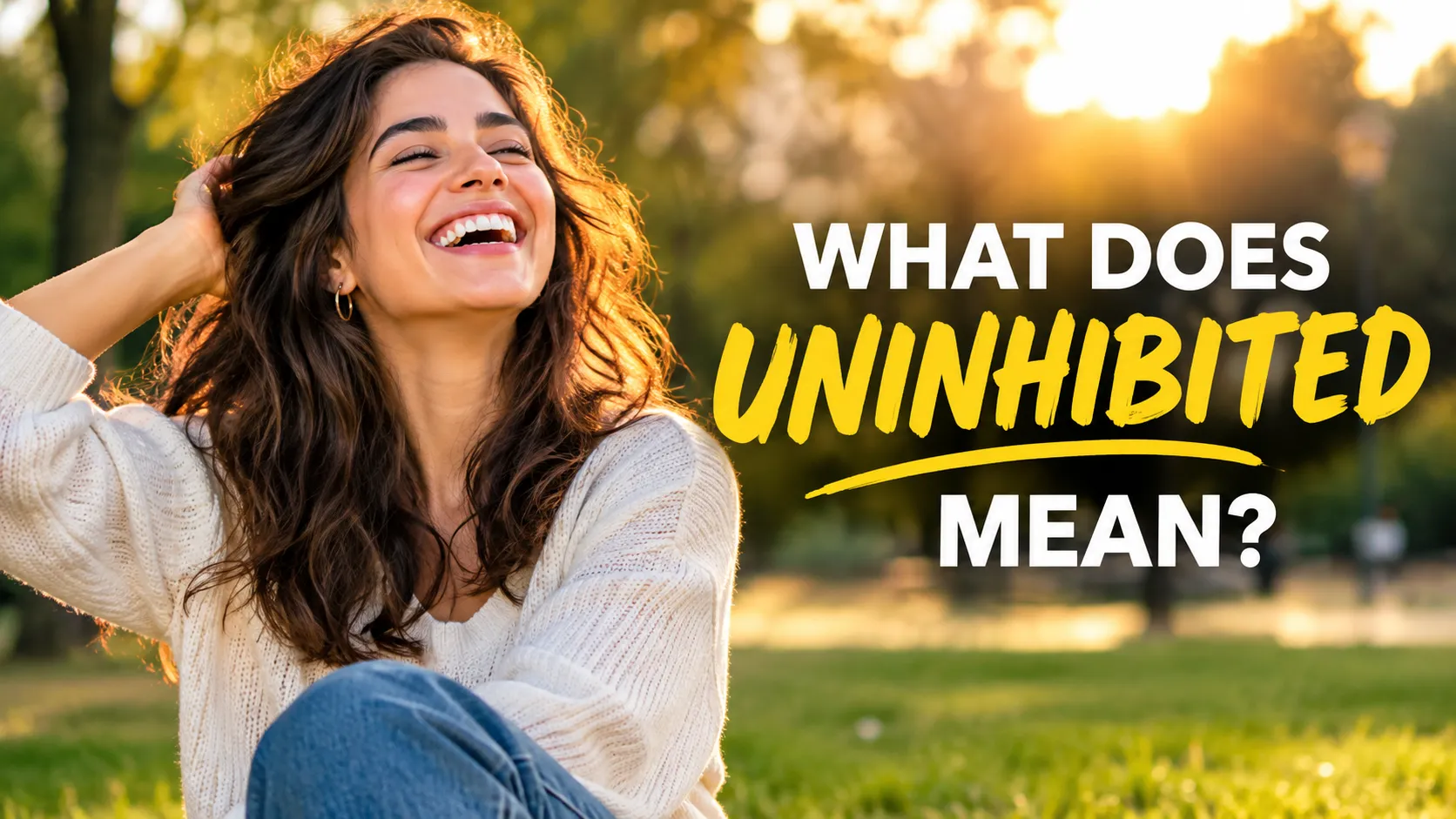
Have you ever laughed loudly, danced freely, or shared your thoughts without worrying about what other people think? The word uninhibited describes this kind of natural, unrestrained behavior.
Uninhibited Meaning: Free to express yourself or behave naturally without excessive embarrassment, self-consciousness, or restraint.
People use this word to describe personalities, conversations, emotions, performances, creativity, and social interactions. It often has a positive meaning, but its tone can change depending on the situation.
In this guide, you’ll discover the definition of uninhibited, its pronunciation, meaning in text messages, synonyms, antonyms, practical examples, and the difference between being uninhibited and being reckless.
1. What Does Uninhibited Mean?
Uninhibited is an adjective that describes someone or something that is not held back by embarrassment, self-consciousness, or ordinary social restraints.
An uninhibited person generally feels comfortable expressing thoughts, feelings, or actions without constantly worrying about how others will react.
For example:
- She gave an uninhibited laugh that made everyone smile.
- He felt uninhibited while performing on stage.
- Their uninhibited creativity produced several unusual ideas.
The word does not automatically mean that someone behaves badly or ignores rules. It usually describes freedom from unnecessary hesitation or restraint.
2. Uninhibited Meaning in Simple English
In simple English, uninhibited means feeling free to express yourself without being overly shy or embarrassed.
Imagine a student who usually feels nervous speaking in class. One day, the student confidently shares ideas, asks questions, and joins the discussion. You could describe the student’s behavior as more uninhibited.
Here are a few simple explanations:
- Uninhibited person: Someone who expresses themselves freely.
- Uninhibited laughter: Natural laughter that is not held back.
- Uninhibited dancing: Dancing without excessive worry about looking awkward.
- Uninhibited conversation: An open discussion in which people feel comfortable sharing their thoughts.
- Uninhibited creativity: Exploring ideas without unnecessary self-restriction.
The easiest way to remember the word is to think of someone who feels comfortable being themselves.
3. How to Pronounce Uninhibited
The word uninhibited is pronounced approximately as un-in-HIB-it-id.
- Part of speech: Adjective
- Syllables: Five
- Main stress: The third syllable, HIB
- IPA pronunciation: /ˌʌnɪnˈhɪbɪtɪd/
- Opposite: Inhibited
For example, you might say, “My normally quiet friend became uninhibited during the party.”
Both British and American English use the same basic word and pronunciation pattern, although some vowel sounds differ slightly between accents.
4. Is Uninhibited a Positive or Negative Word?
Uninhibited is often positive when it describes confidence, creativity, openness, or natural enjoyment. However, it can sound negative when someone’s behavior appears excessive or inappropriate.
| Context | Meaning | Example |
| Positive | Confident and expressive | She gave an uninhibited performance. |
| Neutral | Open and unrestricted | They had an uninhibited discussion. |
| Potentially negative | Lacking appropriate restraint | His uninhibited remarks embarrassed his colleagues. |
The surrounding sentence determines the tone.
Calling someone uninhibited may be a compliment because they seem relaxed and authentic. In another situation, the same word might suggest that the person speaks or acts without considering the consequences.
Remember that expressing yourself freely does not mean ignoring other people’s boundaries.
5. Uninhibited Meaning in Text and Everyday Conversation
In text messages and casual conversation, uninhibited usually means being open, relaxed, expressive, or comfortable behaving naturally.
It is not a standard texting abbreviation or a word with a separate, fixed internet-slang definition. Its ordinary English meaning generally carries over into digital conversations.
Example 1
Message: “You were so uninhibited at the concert last night!”
Meaning: You seemed relaxed, expressive, and comfortable enjoying yourself.
Example 2
Message: “I wish I could be more uninhibited around new people.”
Meaning: The person wants to feel less shy and express themselves more naturally.
Example 3
Message: “Our conversation became completely uninhibited.”
Meaning: Everyone felt comfortable speaking openly without excessive hesitation.
Example 4
Message: “She has such an uninhibited personality.”
Meaning: She tends to express herself naturally without worrying too much about other people’s opinions.
When interpreting the word in a message, consider the relationship between the people and the surrounding conversation. The context may reveal whether the speaker intends a compliment, a neutral observation, or a criticism.
6. Examples of Uninhibited in a Sentence
These original examples demonstrate how to use uninhibited in everyday English.
- Her uninhibited laughter filled the room with happiness.
- He felt uninhibited among his closest friends.
- The children danced in an uninhibited way.
- Her uninhibited imagination helped her create a wonderful story.
- The singer delivered an uninhibited performance.
- They enjoyed an uninhibited conversation about their dreams.
- His uninhibited enthusiasm encouraged the entire team.
- She became more uninhibited after getting to know everyone.
- The artist took an uninhibited approach to painting.
- Their uninhibited celebration continued into the evening.
- He expressed his opinions in an uninhibited manner.
- The relaxed atmosphere encouraged uninhibited discussion.
- Her uninhibited personality made social gatherings enjoyable.
- The actor portrayed an uninhibited character.
- The team played with uninhibited confidence after scoring.
Notice how the word can describe feelings, actions, personalities, performances, and communication. In every example, the central idea is freedom from unnecessary restraint.

7. What Is an Uninhibited Person Like?
An uninhibited person generally feels comfortable expressing themselves rather than constantly worrying about other people’s opinions.
Depending on the situation, they may demonstrate these characteristics:
- Expressive: Shares feelings and ideas openly.
- Spontaneous: Responds naturally instead of overthinking every action.
- Confident: Feels comfortable participating in social situations.
- Creative: Experiments with ideas without excessive fear of criticism.
- Sociable: May find it easier to interact with others.
- Authentic: Often behaves naturally instead of trying to appear perfect.
These are possible characteristics, not a personality test. An uninhibited person does not necessarily display every trait, and a quiet person can still be confident.
For example, someone may feel uninhibited when playing music but reserved when meeting strangers. People often behave differently depending on their surroundings, experiences, and level of comfort.
Being uninhibited is therefore better understood as a description of behavior than as a permanent label for someone’s entire personality.
8. Synonyms of Uninhibited
Synonyms are words with similar meanings. The best replacement depends on whether you want to emphasize confidence, openness, spontaneity, or freedom from restraint.
| Synonym | Meaning | Example |
| Unrestrained | Not held back | She laughed with unrestrained joy. |
| Unreserved | Open or wholehearted | He offered unreserved support. |
| Spontaneous | Natural and unplanned | Their spontaneous dancing delighted everyone. |
| Outgoing | Sociable and friendly | Her outgoing nature helped her make friends. |
| Open | Willing to express thoughts | He was open about his feelings. |
| Free-spirited | Independent and unconstrained | She has a free-spirited personality. |
| Unselfconscious | Not overly concerned about how others see you | The child danced in an unselfconscious way. |
| Candid | Honest and direct | She gave a candid answer. |
| Expressive | Showing thoughts or feelings clearly | His expressive performance moved the audience. |
| Unconstrained | Not limited or restricted | The artist enjoyed unconstrained creativity. |
These words are related, but they are not always interchangeable. For example, outgoing emphasizes sociability, while candid emphasizes honesty and directness.
Choose a synonym that communicates the specific meaning you intend.
9. Antonyms of Uninhibited
An antonym is a word with an opposite or contrasting meaning.
The closest direct antonym of uninhibited is inhibited. Other alternatives describe related qualities, such as shyness, hesitation, or emotional restraint.
| Antonym | Meaning | Example |
| Inhibited | Held back by restraint | He felt inhibited during the interview. |
| Shy | Nervous around other people | She was shy when meeting strangers. |
| Reserved | Not openly expressive | He remained reserved at the gathering. |
| Self-conscious | Worried about how others perceive you | She felt self-conscious while dancing. |
| Restrained | Controlled or held back | His response was restrained. |
| Bashful | Shy or easily embarrassed | The bashful child hid behind a parent. |
| Timid | Lacking confidence in a situation | The timid speaker hesitated to ask questions. |
| Guarded | Careful about revealing thoughts or feelings | She was guarded about her personal life. |
The right antonym depends on the sentence. For instance, shy describes a person’s social behavior, while restrained can describe emotions, actions, or responses.
10. Uninhibited vs. Inhibited
So, Uninhibited and inhibited describe contrasting ways of expressing yourself.
| Feature | Uninhibited | Inhibited |
| General meaning | Free from unnecessary restraint | Held back or restrained |
| Social behavior | Expresses themselves comfortably | May hesitate to participate |
| Emotional expression | Often open and natural | May keep feelings private |
| Dancing | Moves without excessive embarrassment | Worries about looking awkward |
| Conversation | Speaks freely | Hesitates to share opinions |
Uninhibited example: Maya sang enthusiastically at the party without worrying about making mistakes.
Inhibited example: Maya wanted to sing but felt too embarrassed to join in.
Neither word automatically describes someone’s entire personality. A person may feel uninhibited among close friends but inhibited in an unfamiliar environment.
The difference is not necessarily about confidence in every area of life. It is about how much a person feels held back in a particular situation.
11. Uninhibited vs. Unrestrained vs. Reckless
These words overlap, but their meanings are different.
Uninhibited: Describes freedom from excessive self-consciousness or ordinary social restraint.
Example: He gave an uninhibited performance and enjoyed every moment.
Unrestrained emphasizes the absence of limits or control. It can describe positive feelings or behavior that goes too far.
Example: The crowd responded with unrestrained excitement.
Reckless describes behavior that ignores danger, risk, or possible consequences.
Example: The driver made a reckless decision by ignoring the warning signs.
| Word | Main emphasis | Does it imply danger? |
| Uninhibited | Freedom of expression | Not necessarily |
| Unrestrained | Lack of limits or control | Not necessarily |
| Reckless | Disregard for risk or consequences | Usually suggests risk |
The key distinction is that being uninhibited does not necessarily mean acting carelessly. Someone can dance freely, speak confidently, and enjoy life while still making responsible decisions.

12. Uninhibited Behavior in Different Situations
The meaning of uninhibited becomes clearer when you see how people use it in different contexts.
Social situations: An uninhibited person may join conversations, introduce themselves, or make jokes without excessive worry about embarrassment.
Example: “The friendly atmosphere made everyone more uninhibited.”
Music and dancing: Uninhibited dancing or singing involves enjoying an activity without constantly worrying about how it looks or sounds.
Example: “She danced with uninhibited joy.”
Creativity: Uninhibited creativity means exploring ideas without immediately rejecting them because of fear or self-doubt.
Example: “The workshop encouraged uninhibited creative thinking.”
Communication: Uninhibited communication involves speaking openly and honestly about opinions or experiences.
Example: “The discussion became more uninhibited as the participants grew comfortable.”
Family gatherings: People may laugh loudly, tell stories, and express affection more naturally around relatives they trust.
Example: “He greeted his family with uninhibited happiness.”
School and education: Students may become more willing to ask questions, participate in discussions, or present their ideas when they feel comfortable.
Example: “The supportive classroom encouraged uninhibited participation.”
Workplace creativity: In a respectful brainstorming session, employees may share unusual ideas without worrying that every suggestion must be perfect.
Example: “The manager encouraged uninhibited creative thinking while keeping the discussion respectful.”
Across these situations, the central idea remains freedom of expression. The exact meaning depends on what the word describes.
Related To Another Article: https://genzwishes.com/groove-meaning/
13. Uninhibited Word Forms and Grammar
Understanding related word forms helps you use the word correctly.
| Word form | Part of speech | Meaning | Example |
| Uninhibited | Adjective | Free from restraint or excessive self-consciousness | She is an uninhibited performer. |
| Uninhibitedly | Adverb | In an uninhibited manner | He laughed uninhibitedly. |
| Uninhibitedness | Noun | The quality of being uninhibited | Her uninhibitedness surprised the audience. |
| Inhibited | Adjective | Held back or restrained | He seemed inhibited at first. |
| Inhibit | Verb | To restrain or hold back | Fear can inhibit participation. |
| Inhibition | Noun | A feeling or factor that restrains behavior | She overcame her inhibition about speaking. |
The most common form is uninhibited, which generally appears before a noun or after a linking verb.
Correct examples:
- She has an uninhibited personality.
- His behavior seemed uninhibited.
- They enjoyed uninhibited laughter.
The adverb uninhibitedly is also correct, although phrases such as “without hesitation” may sound more natural in some situations.
People Also Ask
A: Uninhibited means feeling free to express yourself or behave naturally without excessive shyness, embarrassment, or restraint.
A: Yes, it can be. Calling someone uninhibited may praise their confidence, openness, or natural self-expression. However, the word can sound critical when the behavior seems excessive or inappropriate.
A: An uninhibited person tends to express thoughts, feelings, or actions freely without worrying too much about embarrassment or other people’s opinions.
A: The closest opposite is inhibited. Other contrasting words include shy, reserved, restrained, self-conscious, and guarded.
A: No. Uninhibited describes freedom from excessive self-consciousness or restraint, while reckless describes behavior that disregards risks or consequences.
Conclusion
The meaning of Uninhibited is straightforward: it describes being free to express yourself or behave naturally without excessive embarrassment, hesitation, or restraint.
You can use it to describe laughter, dancing, creativity, conversation, performances, and an expressive personality. The word is often positive, but context matters because freedom of expression is not the same as ignoring boundaries or acting recklessly.
Remember this simple distinction: uninhibited means not holding yourself back unnecessarily, while reckless means disregarding risks or consequences.
Save this guide for future vocabulary practice, share it with someone learning English, and explore more word meanings on GenzWishes to continue building your vocabulary.