
Introduction
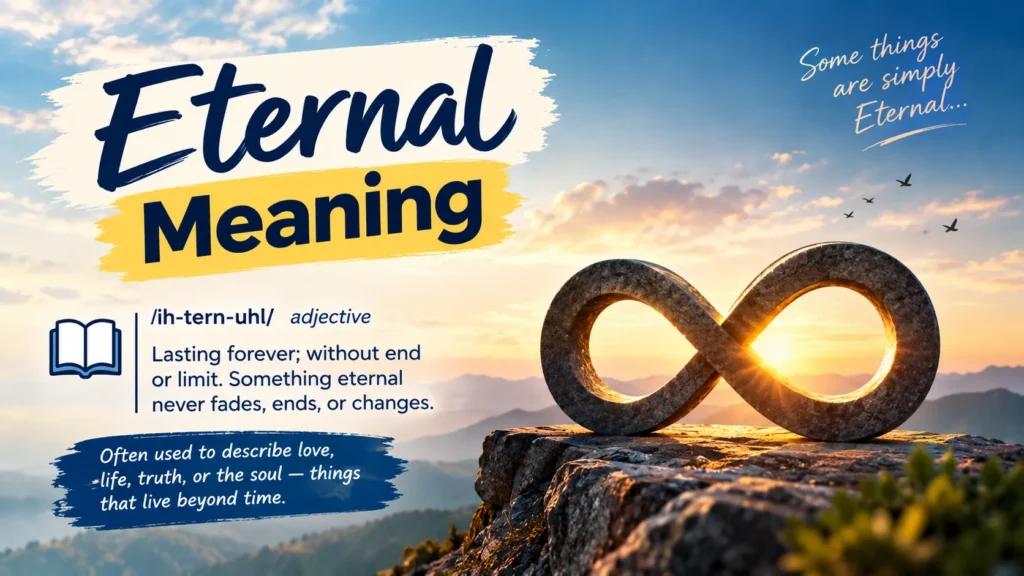
The word Eternal Means lasting forever, having no end, or seeming to continue endlessly. It is commonly used to describe love, friendship, life, memories, and ideas that remain meaningful over time.
For example, eternal love describes love believed or hoped to last forever. In everyday conversation, however, someone might call a long meeting an eternal meeting to express how exhausting it feels.
Understanding the eternal meaning helps you recognize whether the word expresses everlasting devotion, a spiritual belief, a timeless idea, or simply something that seems never-ending.
1. What Does Eternal Mean?
Eternal means lasting forever, without an end, or seemingly continuing forever. Its exact meaning depends on the situation in which someone uses it.
The word often expresses permanence, timelessness, or the idea that something will never stop. It can describe both abstract ideas and everyday experiences.
For example:
- Eternal love means love believed to last forever.
- Eternal life refers to everlasting life, particularly in religious contexts.
- Eternal friendship describes a friendship intended or believed to endure.
- Eternal questions are questions that remain relevant across generations.
- Eternal complaints are complaints that seem to happen repeatedly.
The word can have a positive, neutral, or negative meaning. Eternal love sounds romantic, eternal truth suggests an enduring principle, and eternal arguments describe an annoying situation that appears to have no end.
In simple terms, eternal means forever or seemingly endless.
2. Eternal Meaning in Simple Words
In simple English, eternal means something that never ends or feels as though it will never end.
Imagine promising someone that your friendship will last forever. You could describe your friendship as eternal because you believe the connection will remain meaningful throughout your lives.
Here are some easy examples:
| Expression | Simple meaning |
| Eternal love | Love believed to last forever |
| Eternal friendship | A friendship intended to last forever |
| Eternal life | Life understood as everlasting |
| Eternal gratitude | Deep, lasting thankfulness |
| Eternal beauty | Beauty considered timeless |
| Eternal happiness | Happiness imagined to continue forever |
| Eternal struggle | A struggle that seems never-ending |
| Eternal waiting | Waiting that feels extremely long |
These expressions share the idea of lasting, continuing, or having no obvious end.
However, eternal does not always describe something that literally lasts forever. People also use it to exaggerate their feelings about an experience.
For example, a student might say, “This school day feels eternal!” The student simply means the day feels unusually long.
3. Eternal Definition, Pronunciation, and Origin
Eternal is an adjective used to describe something believed to last forever, remain timeless, or seem never-ending.
Word: Eternal
Part of speech: Adjective
Pronunciation: /ɪˈtɜːrnəl/ in a common American-style transcription; pronunciation varies by accent.
Simple definition: Lasting forever, without an end, or seemingly endless.
Word origin: Eternal entered English through Old French and Late Latin, ultimately deriving from Latin aeternus, associated with lasting forever.
An adjective describes a person, place, thing, quality, or experience. Eternal therefore helps explain the nature of something rather than naming an action.
Consider these sentences:
- They believe in eternal life.
- She expressed eternal gratitude.
- Their relationship represents an eternal bond.
- The eternal noise made it difficult to concentrate.
- The poem explores eternal questions about existence.
In the first three examples, eternal describes something lasting or intended to last. In the final example, it emphasizes the impression that something continues without stopping.
The word’s meaning becomes clearer when you examine the surrounding sentence rather than interpreting it in isolation.
4. Different Meanings of Eternal
Although eternal is commonly associated with forever, it has several related meanings. Recognizing these differences helps you understand the word in literature, everyday conversations, and philosophical discussions.
1. Lasting forever
This is the central meaning of eternal. It describes something understood or believed to have no end.
Example: They dreamed of eternal happiness.
2. Existing beyond ordinary time
In some religious and philosophical discussions, eternal describes existence understood as beyond the usual limits of time.
Example: The philosopher explored the concept of eternal existence.
3. Timeless or enduring
Eternal can describe principles, questions, or qualities that remain meaningful across generations.
Example: The novel explores eternal questions about human nature.
4. Seemingly endless
In everyday English, eternal can describe something that feels much longer than expected.
Example: The journey felt eternal because of the heavy traffic.
5. Repeated or constant
The word can also describe behavior that happens so often that it becomes irritating.
Example: His eternal complaints interrupted the discussion.
These meanings are connected by the idea of continuity, permanence, or the absence of an obvious end. Context tells you which interpretation makes sense.
5. Eternal Meaning in Love and Relationships
In love and relationships, eternal usually expresses the idea of love that lasts forever. It can communicate deep affection, loyalty, commitment, and the hope that a relationship will remain meaningful throughout life.
When someone says, “My love for you is eternal,” they are expressing the belief that their feelings will not fade with time.
The phrase can appear in romantic messages, wedding vows, love letters, poetry, and personal conversations.
What Does Eternal Love Mean?
Eternal love means love believed, promised, or hoped to continue forever. It can describe romantic devotion, spiritual love, or an emotional connection that someone considers timeless.
For example:
- “My love for you feels eternal.”
- “You will always have a special place in my heart.”
- “Our connection is something I will always cherish.”
- “Distance cannot erase the memories we have created.”
- “I hope our love continues to grow throughout our lives.”
These statements express lasting affection without requiring the exact word eternal.
What Does Eternal Mean in a Relationship?
In a relationship, eternal suggests that two people want their connection to remain strong despite changing circumstances.
It may represent trust, loyalty, shared memories, and a commitment to face life’s challenges together.
However, calling a relationship eternal does not guarantee that it will last forever. The word expresses an intention, hope, belief, or emotional feeling rather than a measurable promise about the future.
Its power comes from what it communicates: a desire for love that reaches beyond temporary circumstances.
6. Eternal Meaning in Spirituality and Religion
In spiritual and religious contexts, eternal often refers to Everlasting Existence, divine qualities, or life understood as extending beyond ordinary human limitations.
The precise meaning depends on the belief system being discussed. Different religious and philosophical traditions interpret eternity, the afterlife, and the soul in different ways.
Here are several common expressions.
Eternal life: Life understood as everlasting, particularly in religious belief. In some traditions, it refers to life beyond physical death or a particular relationship with the divine.
Eternal soul: A soul believed in some traditions to continue beyond physical death. Not every belief system understands the soul in the same way.
1. Eternal peace: A lasting state of peace, spiritual rest, or freedom from suffering, depending on context.
2. Eternal rest: A religious expression associated particularly with prayers for the dead.
3. Eternal truth: A truth or principle believed to remain valid across time.
4. Eternal punishment: A religious concept involving punishment understood as everlasting in some interpretations.
These expressions should be understood within their cultural, religious, or philosophical contexts rather than treated as having one universal interpretation.
In general, eternal adds the idea of permanence or timelessness to a spiritual concept. It describes how something is understood in relation to time, existence, or belief.
7. Eternal Meaning in Everyday Life
Eternal is not limited to romance, religion, or philosophy. People also use it in everyday conversations to describe experiences that feel unusually long or situations that seem to repeat endlessly.
For example, someone might say, “That traffic jam felt eternal.” The traffic did not literally last forever; the speaker is emphasizing frustration and the feeling that time passed slowly.
Here are practical examples from different situations.
At school: “The final lesson felt eternal because everyone was waiting for the bell.”
At work: “We spent the afternoon in what seemed like an eternal meeting.”
With friends: “Our friendship has remained strong through many changes.”
At home: “The eternal debate about what to watch started again.”
In literature: “The novel examines eternal questions about life and death.”
On social media: “Waiting for the weekend feels eternal.”
These examples show that eternal can make ordinary experiences sound more dramatic.
The word can also add emotional depth to writing. Describing a memory as eternal suggests that it will remain meaningful, while describing an argument as eternal communicates irritation.
When Should You Use Eternal?
Use eternal when you want to emphasize permanence, timelessness, or an experience that seems endless.
It works particularly well in reflective writing, romantic messages, literature, and informal exaggeration.
For formal writing, make sure the intended meaning is clear. If you mean that something continues for a limited but lengthy period, words such as lasting, prolonged, or long-lasting may be more precise.
8. Eternal Examples in Sentences
The easiest way to learn a word is to see how it works in complete sentences. The following examples demonstrate the different meanings of eternal in natural English.
- Their friendship felt eternal. Their connection seemed capable of lasting forever.
- She expressed eternal gratitude to her parents. She felt deeply thankful for their support.
- The poem celebrates eternal love. It explores love believed to have no end.
- We waited an eternal hour for the results. The wait felt unusually long.
- The artist hoped to create something of eternal beauty. The artist wanted to produce work that would remain beautiful across generations.
- They promised eternal loyalty to each other. They intended to remain loyal indefinitely.
- The novel explores eternal questions about human existence. It examines questions that remain relevant across time.
- He seemed trapped in an eternal cycle of worry. His worries appeared to repeat without stopping.
- The mountains looked eternal against the changing sky. They appeared enduring and timeless.
- She will be eternally grateful for their kindness. She expects to remain deeply thankful.
- The characters searched for eternal happiness. They wanted happiness that would never end.
- His eternal complaining frustrated everyone. His complaints seemed constant and irritating.
- The memorial honors the memory of those who died. It expresses the intention to preserve their memory over time.
- The story describes an eternal darkness. The darkness is portrayed as having no end.
- Their promise was meant to last for all eternity. They intended the promise to continue forever.
Notice that eternal does not mean exactly the same thing in every sentence. Sometimes it expresses literal or believed permanence; at other times, it exaggerates how long something seems to last.
Understanding this distinction will help you use the word naturally.
9. Eternal Synonyms
Synonyms are words with similar meanings. The best synonym for eternal depends on whether you want to emphasize endless duration, permanence, or something that seems never to stop.
| Synonym | Meaning | Example |
| Everlasting | Continuing forever | They hoped for everlasting peace. |
| Endless | Having no apparent end | The road seemed endless. |
| Timeless | Remaining relevant or beautiful across different periods | The design has timeless appeal. |
| Perpetual | Continuing or recurring repeatedly | The machine produced a perpetual hum. |
| Infinite | Having no limits or boundaries | The story explores infinite possibilities. |
| Unending | Continuing without stopping | They faced an unending series of challenges. |
| Undying | Continuing despite the passage of time | She expressed undying affection. |
| Enduring | Lasting over time | Their enduring friendship inspired others. |
| Immortal | Living forever or not subject to death | The legend describes an immortal hero. |
| Permanent | Intended or expected to remain unchanged | They wanted a permanent solution. |
These words are related, but they are not always interchangeable.
For example, immortal usually relates to living forever or escaping death. Timeless often describes something that remains relevant, meaningful, or beautiful across different periods.
Similarly, perpetual can describe something that repeatedly happens, while eternal often emphasizes the idea of lasting without end.
Choose a synonym based on the precise meaning you want to communicate.
10. Eternal Antonyms
An Antonym is a word with an opposite or contrasting meaning. Because eternal suggests endless duration or timelessness, its opposites often describe something temporary, limited, or likely to end.
| Antonym | Meaning | Example |
| Temporary | Lasting for a limited time | The problem was temporary. |
| Transient | Lasting only briefly | Fame can be transient. |
| Fleeting | Passing quickly | They enjoyed a fleeting moment of happiness. |
| Finite | Having a limit or an end | Human resources are finite. |
| Brief | Lasting a short time | Their meeting was brief. |
| Impermanent | Not lasting forever | The decoration was impermanent. |
| Short-lived | Lasting only a short period | The excitement was short-lived. |
| Mortal | Subject to death | Human beings are mortal. |
| Ephemeral | Lasting for a very short time | The blossom’s beauty was ephemeral. |
| Changeable | Likely to change | Fashion trends are changeable. |
The most appropriate antonym depends on the context.
For example, temporary is a natural opposite of eternal when describing duration. Mortal is more suitable when discussing living beings, while fleeting works well for brief experiences or emotions.
Understanding these differences will help you choose the right word rather than relying on a single opposite in every situation.
11. Eternal vs. Everlasting vs. Forever
Eternal, everlasting, and forever are closely related because they all express the idea of continuing without an end or for an extremely long time.
However, they have different grammatical roles and typical uses.
| Word | Part of speech | Basic meaning | Example |
| Eternal | Adjective | Lasting forever or seemingly endless | They believe in eternal life. |
| Everlasting | Adjective | Continuing forever or indefinitely | She hoped for everlasting happiness. |
| Forever | Adverb, also used as a noun | For all time or an extremely long time | I will remember you forever. |
Is Eternal the Same as Everlasting?
In many situations, eternal has nearly the same meaning. Both can describe something that continues without end.
However, eternal is frequently used in philosophical, spiritual, and timeless contexts. Everlasting more directly emphasizes the idea of something continuing forever or indefinitely.
The distinction is not absolute, and the two words often overlap.
Is Eternal the Same as Forever?
Not exactly in grammar, although both can communicate the same general idea.
Eternal is an adjective, as in “eternal love.” Forever commonly functions as an adverb, as in “I will love you forever.”
Both expressions communicate lasting affection, but they fit into sentences differently.
Quick tip: Use eternal to describe something, everlasting to emphasize continued duration, and forever when expressing how long an action or feeling continues.
Related To Another Article: https://genzwishes.com/hero-meaning/
12. What Does Eternally Mean?
Eternally is the adverb form of eternal. It means forever, in an everlasting way, or continually, depending on the context.
An adverb can describe how an action happens or how a condition continues.
For example:
- “I will be eternally grateful for your help.”
- “She is eternally optimistic about the future.”
- “The characters seem eternally trapped in the same situation.”
- “He searched eternally for the perfect solution.”
In the first sentence, eternally emphasizes deep and lasting gratitude. And in the second, it describes a consistently optimistic attitude. In the third, it suggests an endless condition.
The related noun is eternity, which refers to endless time or existence. In everyday conversation, an eternity can also mean a period that feels extremely long.
For example, “I waited an eternity for the bus” means the wait felt much longer than expected.
The three forms are easy to distinguish:
- Eternal: An adjective describing something lasting forever.
- Eternally: An adverb describing how something continues.
- Eternity: A noun referring to endless time or existence.
Learning these forms will help you recognize and use the word in different sentences.
13. Common Expressions With Eternal
Eternal appears in several common expressions that communicate lasting feelings, timeless ideas, or seemingly endless experiences.
Understanding these phrases can help you recognize the word in books, conversations, formal writing, and romantic messages.
Eternal flame: A flame intended to burn continuously, often symbolizing remembrance or honor. Figuratively, it can represent lasting passion or connection.
Example: The eternal flame served as a memorial to those who had died.
Eternal gratitude: Deep and lasting thankfulness.
Example: “I will be eternally grateful for your kindness.”
Eternal rest: A religious expression associated particularly with prayers for the dead.
Example: The family prayed for the eternal rest of their loved one.
Eternal optimist: A person who consistently expects positive outcomes, even when circumstances are difficult.
Example: She is an eternal optimist who always looks for a solution.
Eternal question: A question that people continue to consider across generations because it remains important or difficult to resolve.
Example: What makes a life meaningful is an eternal question explored by philosophers and writers.
Eternal youth: A condition of remaining young forever, often appearing in myths, stories, or discussions about aging.
Example: The legend describes a magical fountain believed to grant eternal youth.
Eternal bond: A connection believed or intended to remain meaningful forever.
Example: Their memories represented an eternal bond between the two friends.
These expressions demonstrate that eternal can communicate different ideas depending on the noun it describes. Some refer to spiritual beliefs, others express emotional commitments, and some are simply figurative.
People Also Ask
A: Eternal means lasting forever, having no end, or seeming to continue endlessly. It is often used to describe love, life, memories, and timeless ideas.
A: In love, eternal means love that is believed or hoped to last forever. It expresses deep affection, commitment, and the desire for a lasting emotional connection.
A: Yes, eternal often means forever or without end. However, it can also describe something that seems endless, such as an eternal argument or an extremely long wait.
A: Both words can mean lasting forever. Eternal is often associated with spiritual, philosophical, or timeless concepts, while everlasting emphasizes continued duration. Their meanings frequently overlap.
A: Common opposites include temporary, transient, fleeting, and finite. The most appropriate word depends on whether you are describing time, a feeling, a living being, or a situation.
In informal English, the phrase “an eternity” can describe a period that feels extremely long.
Conclusion
Eternal Means lasting forever, having no end, or seeming to continue endlessly. It is a powerful word used to describe love, friendship, spiritual beliefs, timeless principles, and experiences that feel never-ending.
Its meaning depends on context. Eternal love expresses lasting affection, eternal life has particular religious and philosophical meanings, and an eternal argument describes something that seems never to stop.
Words such as everlasting, timeless, perpetual, and forever can help communicate similar ideas, but each has its own uses.
The easiest way to remember the meaning is this: eternal describes something believed to last forever or something that feels as though it will never end.
If this explanation helped you understand the word, save it for future reference and explore other GenzWishes meaning guides to continue building your English vocabulary.