Introduction
Have you ever wondered why some atoms become negatively charged while others become positively charged? The answer is easier to understand than you might think. It all comes down to electrons, and that is where the term anion comes in.
Anion refers to an atom or group of atoms with an overall Negative Electrical Charge. Anions commonly form when atoms gain electrons, and they play an important role in chemistry, ionic compounds, and many everyday substances.
In this guide, you will discover what an anion means, how it forms, how it differs from a cation, and which examples are easiest to remember. Whether you are studying for an exam or simply curious about chemistry, these straightforward explanations will help you understand the concept without getting lost in complicated scientific language.
1. What Does Anion Mean?
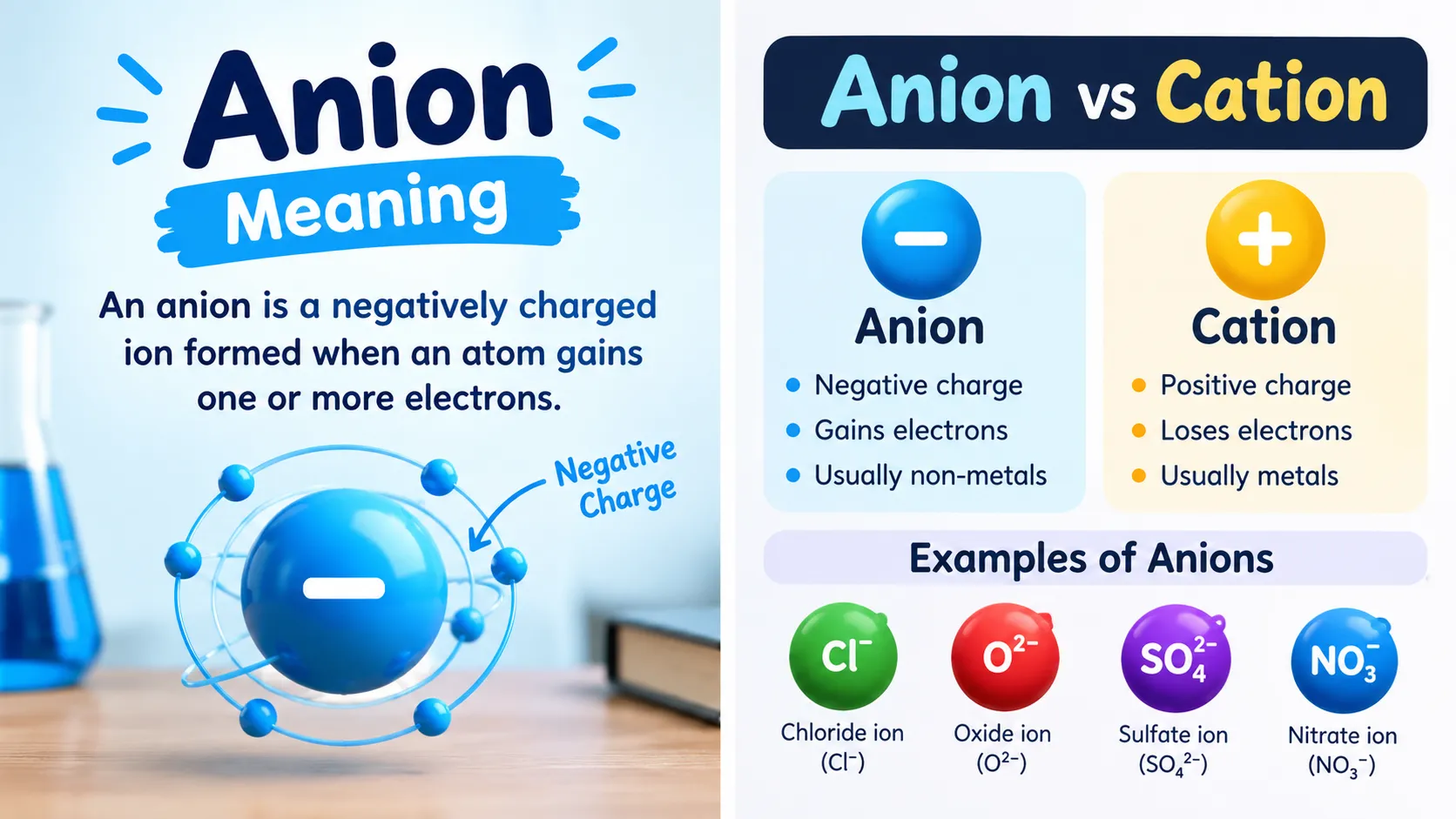
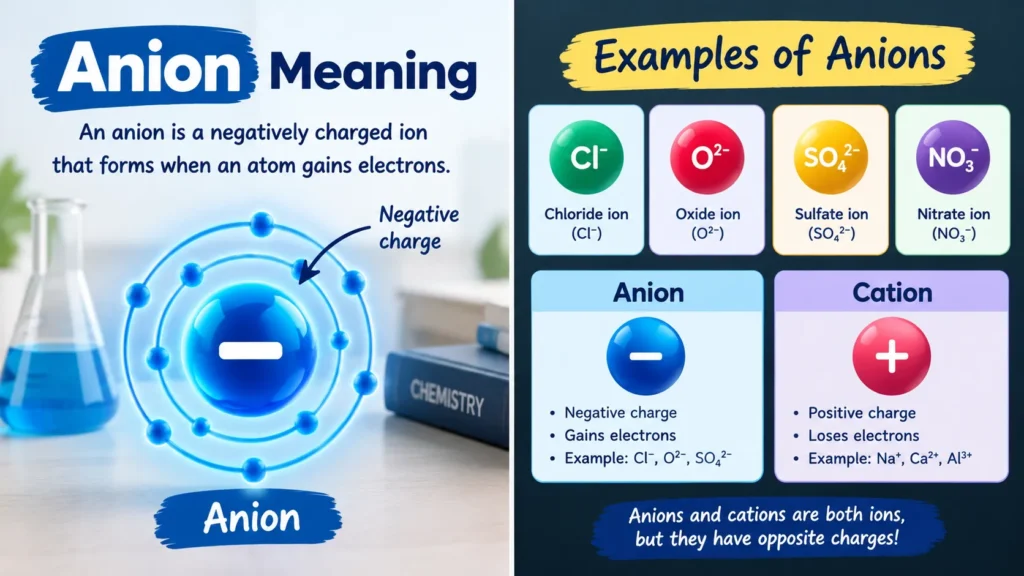
An anion is a negatively charged ion. It has more electrons than protons overall, giving it a net negative electrical charge.
The easiest way to remember the definition is that anions are negative ions. For example, chloride (Cl⁻) is an anion because it has one more electron than protons.
2. How Do You Pronounce Anion?
Anion is commonly pronounced AN-eye-on. Breaking the word into syllables can make it easier to recognize and remember.
You might hear the term in science classes, chemistry textbooks, and educational videos. For example, “Chloride is an anion because it carries a negative charge.”
3. What Is an Anion in Chemistry?
In chemistry, an anion is a chemical species with a net negative charge. It may contain a single atom or several bonded atoms.
Chloride (Cl⁻) is a single-atom example, while sulfate (SO₄²⁻) is a multi-atom example. Both qualify as anions because their overall electrical charges are negative.
4. How Does an Anion Form?
An anion Commonly Forms when an atom gains one or more electrons. Because electrons are negatively charged, gaining them can give the atom a negative charge.
For example, a neutral chlorine atom gains one electron to become a chloride ion:
Cl + e⁻ → Cl⁻
The number of protons remains unchanged during this ordinary process of ion formation.
5. Anion vs. Cation: What Is the Difference?
Anions and cations are both ions, but they have opposite electrical charges. Anions are negative, while cations are positive.
| Feature | Anion | Cation |
| Charge | Negative | Positive |
| Common formation | Gains electrons | Loses electrons |
| Example | Cl⁻ | Na⁺ |
| Another example | O²⁻ | Mg²⁺ |
A useful memory trick is to remember the sign: anion means negative, and cation means positive.
6. What Are Common Examples of Anions?
Anions occur in many chemical substances. Some contain one atom, while others consist of groups of bonded atoms.
| Anion name | Formula | Charge |
| Fluoride | F⁻ | −1 |
| Chloride | Cl⁻ | −1 |
| Oxide | O²⁻ | −2 |
| Sulfide | S²⁻ | −2 |
| Hydroxide | OH⁻ | −1 |
| Nitrate | NO₃⁻ | −1 |
| Carbonate | CO₃²⁻ | −2 |
| Sulfate | SO₄²⁻ | −2 |
| Phosphate | PO₄³⁻ | −3 |
These examples are especially useful for students learning chemical formulas and ionic compounds.
7. What Are the Different Types of Anions?
Anions can be classified by the number of atoms they contain.
Monatomic Anions consist of one atom, such as fluoride (F⁻), chloride (Cl⁻), and oxide (O²⁻).
Polyatomic anions contain multiple bonded atoms, such as hydroxide (OH⁻), nitrate (NO₃⁻), and sulfate (SO₄²⁻).
The important distinction is that both types carry an overall negative charge, even though their structures differ.
8. How Are Anions Named?
Many simple anions are named by changing the ending of an element’s name to “-ide.”
For example, chlorine becomes chloride, fluorine becomes fluoride, and oxygen becomes oxide.
Polyatomic anions follow different naming conventions. Common examples include nitrate, sulfate, carbonate, and phosphate. Learning these names helps students identify ions in chemical equations.
9. What Is the Role of Anions in Ionic Compounds?
Anions combine with positively charged cations to form many ionic compounds. Their charges balance to produce an electrically neutral compound.
For example, sodium chloride (NaCl) contains sodium ions (Na⁺) and chloride ions (Cl⁻) in a one-to-one ratio.
Magnesium chloride (MgCl₂) contains magnesium ions (Mg²⁺) and chloride ions (Cl⁻). Two chloride ions balance the positive charge of one magnesium ion.
10. Why Are Anions Important?
Anions participate in chemical reactions and influence the properties of many substances.
They occur in everyday materials, biological systems, environmental processes, and industrial applications. Chloride and bicarbonate ions, for example, have important roles in biological systems, while nitrate and phosphate are relevant to soil and water chemistry.
Different anions have different properties, so their effects depend on the particular ion and the environment.
11. Anion Meaning in a Sentence
Using anion in a sentence can make the definition easier to understand.
- Chloride is an anion with a negative electrical charge.
- The student identified sulfate as a polyatomic anion.
- An anion commonly forms when an atom gains electrons.
- The teacher explained the difference between anions and cations.
- Nitrate is an anion studied in environmental chemistry.
In each example, the word refers to a negatively charged chemical species.
Related To Another Article: https://genzwishes.com/dashboard-meaning/
12. What Is the Origin of the Word Anion?
The word anion was introduced by scientist William Whewell in the nineteenth century and is associated with the movement of ions during electrolysis.
The term relates to anions moving toward the anode during electrolysis. This historical connection helps explain why anion, cation, anode, and cathode are closely related terms in chemistry.
Although the word has a historical connection to electrode movement, its defining feature today is its net negative electrical charge.
13. What Are Common Misconceptions About Anions?
Several common misunderstandings can confuse beginners about anions.
- Anions are positive: Incorrect. Anions have a net negative charge.
- All anions contain one atom: Incorrect. Sulfate and nitrate are polyatomic anions.
- All anions have a −1 charge: Incorrect. Oxide has a −2 charge, and phosphate has a −3 charge.
- Anions form by gaining protons: Incorrect in ordinary ion formation. Anions commonly form through electron gain.
- Anions and cations mean the same thing: Incorrect. Their electrical charges are opposite.
Remembering these differences will make basic chemistry easier to understand.
People Also Ask
A: An anion is an atom or group of atoms with an overall negative electrical charge.
A: An anion is negative. A positively charged ion is called a cation.
A: An anion commonly forms when an atom gains one or more electrons.
Chloride (Cl⁻) is a common example. Other examples include oxide (O²⁻), nitrate (NO₃⁻), and sulfate (SO₄²⁻).
A: Yes. Sulfate (SO₄²⁻) is a polyatomic anion with an overall charge of −2.
Conclusion
Anion becomes simple once you understand Electrical Charges. An anion is a negatively charged ion that commonly forms when an atom gains electrons or when a group of atoms carries an overall negative charge.
Examples such as chloride (Cl⁻), oxide (O²⁻), nitrate (NO₃⁻), and sulfate (SO₄²⁻) demonstrate that anions can have different structures and charge values.
The most important point to remember is that anions are negative, while cations are positive. Save this guide for revision, share it with a classmate, and explore more beginner-friendly meaning articles on GenzWishes.