Introduction
Have you ever seen the word “Nonse” in a British text message, social media comment, online argument, or television show and wondered what it meant? If English is not your first language, this unusual spelling can be particularly confusing.
The nonse meaning in British slang usually refers to “nonce,” a highly offensive British slang term associated with sexual offenders, especially people who commit sexual offences against children. Major dictionaries use the spelling “nonce” for this slang meaning, while “nonse” is generally an alternative spelling or misspelling encountered online.
Unlike everyday slang that describes someone as funny, annoying, or foolish, this term carries a serious implication. Understanding it can help you interpret British conversations, recognise the tone of an online argument, and avoid using an offensive expression without realising its significance.
In this guide, you will learn the definition, pronunciation, spelling, historical background, examples, online usage, and differences between nonse, nonce, and nonsense. You will also discover why context matters whenever you encounter this word.
1. What Does Nonse Mean in British Slang?
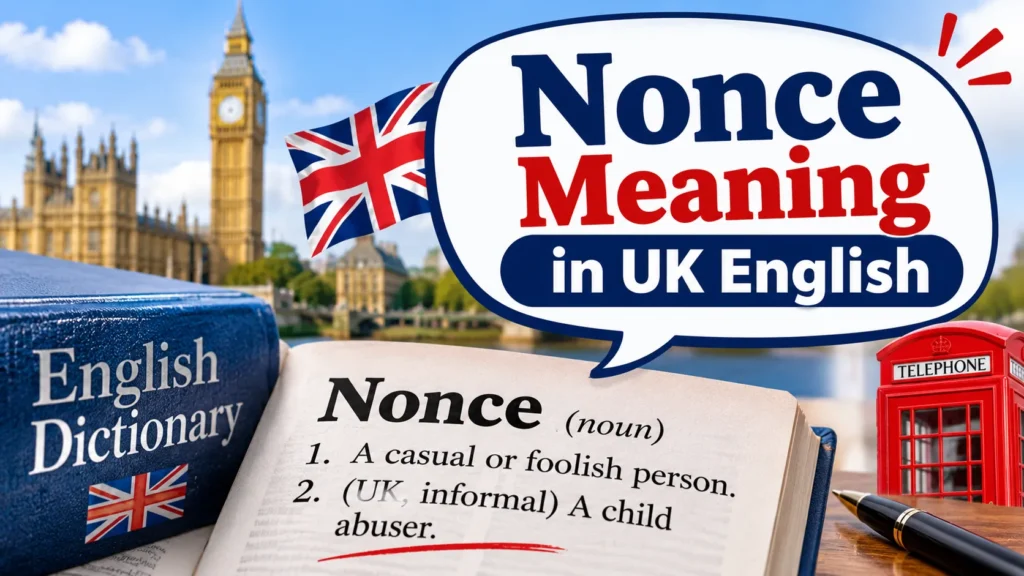
In British slang, “nonse” usually refers to “nonce.” The established slang term is a derogatory label associated with a sexual offender, particularly someone who commits sexual offences against children.
Cambridge Dictionary lists the slang meaning of nonce as a person who commits a crime involving sex, especially sex with a child. Collins also identifies it as derogatory prison slang. These definitions explain why the word can provoke such a strong reaction in British conversations.
For example, imagine reading this sentence in an online discussion:
“He called the man a nonce during the argument.”
The sentence tells you that the speaker used a serious insult. However, it does not establish whether the accusation was true, whether the person had been convicted of a crime, or whether the speaker was repeating something they had heard.
That distinction is essential. A slang word can communicate an accusation without providing evidence to support it.
The spelling “nonse” often appears when people write the word as they believe it sounds. Readers searching for the term are generally looking for the established British slang meaning of “nonce.”
Quick definition: Nonse usually means nonce in British slang, an offensive term associated with sexual offenders. The standard spelling is nonce, and the word should not be treated as a harmless everyday insult.
2. Is Nonse the Correct Spelling of Nonce?
No. The standard dictionary spelling of the British slang term is nonce, not nonse.
The difference is easy to understand. People sometimes encounter unfamiliar words in conversation before seeing them in writing. When they later type the word into a search engine, they may use the spelling that seems closest to the pronunciation.
This is particularly common with slang because informal expressions are often learned through friends, television, online videos, and social media rather than through textbooks.
Here is a quick comparison:
| Word or spelling | Meaning | Usage |
| Nonce | A derogatory British slang term associated with sexual offenders | Standard spelling of the slang term |
| Nonse | Usually a misspelling or informal spelling variation of nonce | Often appears in searches and informal online writing |
| Nonsense | Something foolish, absurd, unreasonable, or without meaningful sense | Ordinary English vocabulary |
| Nonce word | A word coined for a particular occasion or purpose | Linguistics |
If you are learning British English, remember the spelling “nonce” when referring to the offensive slang term.
However, if you saw “nonse” in a message, do not assume the writer intended something entirely different. The surrounding conversation will usually help you identify the intended word.
It is also worth remembering that spelling alone cannot tell you the speaker’s intention. Someone might be discussing the word academically, quoting dialogue from a television programme, or using it as an insult.
3. How Do You Pronounce Nonce?
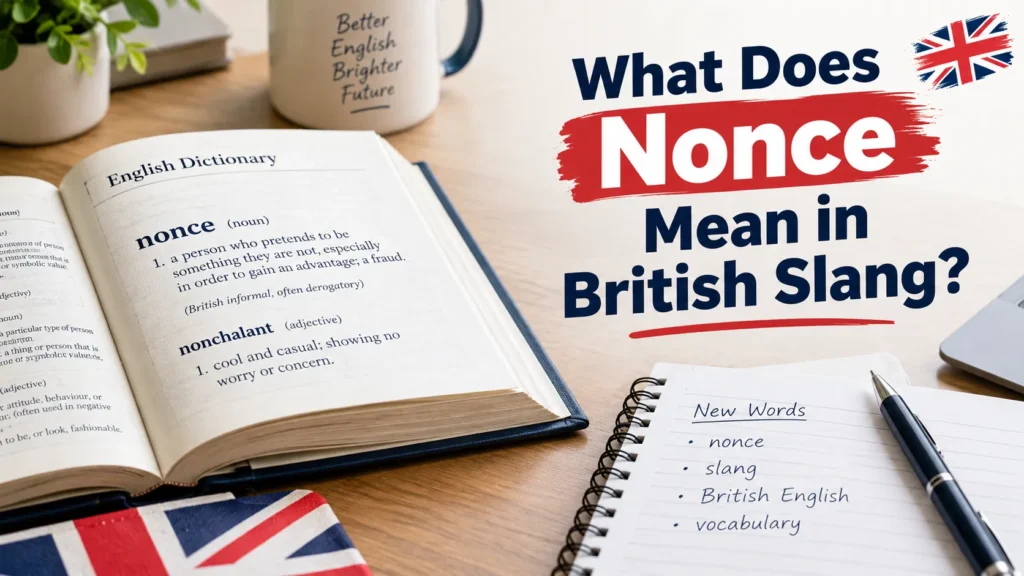
The standard British English pronunciation of “nonce” is /nɒns/. It is pronounced as a single syllable.
The final written letter “e” is silent. The word therefore sounds closer to “nons” than to a two-syllable word.
Here is a simple pronunciation guide:
- Written form: nonce
- British IPA: /nɒns/
- Number of syllables: One
- Final letter: Silent e
- Common spelling confusion: Nonse
Pronunciation can vary slightly with accent, but Cambridge Dictionary provides /nɒns/ for British English.
Why does this matter? Suppose you are watching a British drama and hear a character use the term. You may recognise the sound but struggle to identify the written word. Understanding the pronunciation can help you connect the dialogue to the correct dictionary entry.
The same principle applies to many other English expressions. People often learn spoken vocabulary before learning its spelling, especially when they are exposed to informal conversation rather than formal lessons.
If you are writing an article, school assignment, or vocabulary note, use the established spelling “nonce” when discussing this slang meaning.
4. What Does Nonce Mean in Simple English?
In simple English, “nonce” is an extremely offensive British slang term associated with a person who commits sexual offences, particularly offences against children.
It is not simply another word for a foolish person, an irritating friend, or someone who makes a mistake. Although people sometimes use it carelessly during arguments, its established meaning is much more serious.
For readers unfamiliar with British slang, it helps to separate three things:
The dictionary meaning: The word refers to a sexual offender in its modern derogatory slang sense.
The speaker’s intention: A person might use the word as an insult, repeat it from a conversation, or discuss it while explaining British vocabulary.
The facts about the person being discussed: The word itself does not establish that anyone has committed an offence.
These distinctions matter because words can be used inaccurately, unfairly, or without sufficient knowledge of the facts.
For example, a student might ask, “Why did that character call him a nonce?” This is a question about language and dialogue. It does not mean the student is making an allegation against a real person.
Similarly, an English learner might find the word in an online comment and want to know whether it is positive or negative. The answer is that the slang term is strongly derogatory and should be understood carefully.
When explaining sensitive vocabulary, a clear definition is more helpful than repeating the offensive word unnecessarily.
5. What Does Nonse Mean in Text Messages and Online Chats?
When someone types “nonse” in a text message or online chat, they usually intend the British slang term “nonce.”
The precise meaning depends on the surrounding conversation. The word might appear in an argument, a discussion about a criminal case, a television recap, a spelling question, or a conversation about British culture.
Here are some illustrative examples.
Example 1: An online argument
Person A: “Why did you call him that?”
Person B: “I was angry, and I used an offensive insult.”
Meaning: The speaker acknowledges using a derogatory term. The example does not establish whether any accusation was justified.
Example 2: A vocabulary question
Person A: “I saw the word nonse in a comment. What does it mean?”
Person B: “They probably meant nonce, which is an offensive British slang term.”
Meaning: The speakers are discussing vocabulary rather than directing the insult at anyone.
Example 3: A television discussion
Person A: “I heard that word in a British drama.”
Person B: “It is associated with sexual offenders in British slang.”
Meaning: The speakers are explaining dialogue from a programme.
Example 4: A spelling correction
Person A: “Is nonse the correct spelling?”
Person B: “Nonce is the standard spelling for the slang term.”
Meaning: The conversation is about spelling.
These examples show why context is important. A word appearing in a message does not automatically reveal the speaker’s complete intention or establish the truth of an accusation.
When you encounter unfamiliar slang online, look at the surrounding sentences before deciding how the word is being used.
6. How Is Nonce Used in British Conversation?
The word “nonce” can appear in informal British conversation, online discussions, television dialogue, news commentary, and references to prison culture.
Its use generally falls into several contexts.
As a serious accusation
Someone might use the term while discussing a person accused or convicted of a sexual offence. This context is particularly sensitive because the word carries a serious implication.
As an insult during an argument
People sometimes use highly offensive words when they are angry. In this situation, the term may function as an insult, but that does not make it harmless or establish the truth of an allegation.
As a subject of discussion
A journalist, teacher, linguist, or English learner might mention the word to explain its meaning. In these cases, the word itself is being discussed rather than necessarily directed at a person.
In television and online media
British dramas, social media discussions, and online videos can introduce viewers from other countries to slang they have never encountered before.
The same word can appear in all these situations, but the context changes how readers should interpret it.
For example, compare these two sentences:
- “The character used the word nonce in the scene.”
- “The speaker accused a real person of being a nonce.”
The first describes language used in a fictional scene. The second describes a potentially serious accusation about an individual.
Understanding this difference is useful for English learners, journalists, content creators, and anyone who watches British television.
7. Examples of Nonce in Sentences
The following original sentences illustrate how the standard spelling “nonce” can appear in different contexts. They are educational examples, not endorsements of the insult.
- “He searched for the Meaning Of Nonce after hearing it in a British drama.”
- “The dictionary explained why nonce is considered an offensive slang term.”
- “She asked whether nonse was the correct spelling.”
- “The article discussed the word without directing it at anyone.”
- “The student wanted to understand the British slang before watching the programme.”
- “The character used the word during a heated argument.”
- “They discussed the meaning of nonce in their English lesson.”
- “The online comment contained an offensive accusation.”
- “He learned that nonce and nonsense have different meanings.”
- “The writer explained the term neutrally and educationally.”
- “The viewer paused the episode to look up the unfamiliar slang.”
- “The teacher explained why some words carry serious implications.”
- “The discussion focused on the word’s meaning rather than its use as an insult.”
- “The reader checked a dictionary to confirm the standard spelling.”
- “The article advised readers to consider context before interpreting offensive language.”
These sentences demonstrate several useful patterns: talking about a word, reporting its use, explaining its meaning, and discussing the social impact of offensive language.
Notice that not every sentence requires the word to be directed at a person. This distinction helps writers explain sensitive vocabulary without unnecessarily targeting anyone.
For an English learner, the most useful approach is to learn both the definition and the situations in which the word appears.
8. Why Is the Word Nonce Offensive?
The word is offensive because its established modern British slang meaning is associated with sexual offending, particularly offences against children.
Unlike ordinary negative words such as “foolish” or “annoying,” it can imply deeply harmful conduct. When someone directs the term at another person, the listener may understand it as a serious accusation rather than a casual expression of dislike.
There are several reasons to treat the word carefully.
It carries a serious implication. The term is associated with sexual offences, so using it against a person can communicate a damaging allegation.
It can cause distress. Discussions of sexual abuse may be painful for survivors and their families. Turning the subject into a casual joke can be hurtful.
It can escalate disagreements. Using an extreme insult during an argument can make an already tense situation worse.
It may be interpreted as a factual claim. Even when a speaker intends to insult someone, others may understand the word as an allegation of criminal behaviour.
It can damage someone’s reputation. Serious allegations should not be made casually or without appropriate evidence.
This does not mean people can never discuss the word. It is entirely reasonable to explain its meaning in a dictionary, educational article, news report, or language lesson.
The important distinction is between discussing an offensive term and using it to target someone.
If you have a genuine concern about inappropriate behaviour, describe the specific behaviour and seek appropriate help rather than relying on a slang label.
9. Where Did the Slang Word Nonce Come From?
The history of “nonce” is more complicated than many online explanations suggest because the word has an older English meaning as well as its modern offensive slang meaning.
The older English meaning
The expression “for the nonce” means for the present occasion or for a particular purpose. This older usage has a history in Middle English.
Collins traces this historical form to a mistaken division of an earlier expression meaning “for the once.” This history is separate from the modern offensive slang meaning.
The modern slang meaning
Collins identifies the modern derogatory prison-slang meaning as a twentieth-century usage and describes its origin as unknown.
This is an important point for anyone writing about British slang. The existence of a popular explanation does not automatically mean that explanation is historically verified.
One widely repeated claim suggests that NONCE is an acronym for “Not On Normal Communal Exercise,” supposedly connected with prison practices. However, Collins does not confirm this as the origin of the modern slang term.
It is therefore more accurate to say that the precise origin of the offensive slang meaning is uncertain.
Why origin stories become popular
People enjoy discovering memorable explanations for unusual words. Acronyms, dramatic historical anecdotes, and simple stories can be easier to remember than a statement that a word’s origin is unknown.
However, an explanation can become popular through repetition without being supported by strong historical evidence.
For an accurate vocabulary guide, distinguish documented history from theories. This approach helps readers understand the word without being misled by an appealing but unverified story.
10. What Does Nonce Mean in Adolescence?
The British television drama Adolescence brought renewed attention to the word among viewers trying to understand its dialogue and visual details.
Some viewers searched for “nonse meaning” after encountering the misspelled form in graffiti associated with the programme.
The important distinction is between the spelling seen in a scene and the conventional spelling found in dictionaries.
- Nonse: The spelling that may appear in informal writing or graffiti.
- Nonce: The established spelling of the offensive British slang term.
- Meaning: The same underlying slang meaning is generally intended when the alternative spelling refers to this term.
A spelling difference can be significant in storytelling. A character’s written words may reveal something about how they learned the language, their familiarity with a term, or the social environment in which the word appears.
However, it is best not to infer a character’s complete background or motivation from one spelling mistake alone. The broader story and dialogue provide the relevant context.
Viewers outside Britain may also be unfamiliar with the word because slang varies considerably across English-speaking countries.
For that reason, explaining the term in simple language helps international audiences follow the dialogue without needing to know every regional expression.
The word does not have a special definition simply because it appears in a drama about young people. Its meaning remains tied to British slang and the context in which it is used.
11. What Is the Difference Between Nonse, Nonce, and Nonsense?
These words look or sound similar, but their meanings are not interchangeable.
| Word | Meaning | Typical context |
| Nonse | Usually a misspelling or informal variant of nonce | Informal writing and online searches |
| Nonce, slang | A derogatory British term associated with sexual offenders | British slang and prison-related discussions |
| Nonsense | Something foolish, absurd, unreasonable, or without sense | Everyday English |
| For the nonce | For the present occasion or purpose | Older or formal English |
| Nonce word | A word coined for a particular occasion | Linguistics |
Consider these examples.
“That is nonsense.”
This means that something is foolish, unreasonable, or does not make sense. It is an ordinary English expression and does not carry the same meaning as the offensive slang term.
“The writer used a nonce word.”
In linguistics, a nonce word is a word coined for a particular occasion. This technical usage is unrelated to the offensive slang definition.
“We will use this arrangement for the nonce.”
In this older expression, the meaning is approximately “for the present occasion.”
“He used the word nonce as an insult.”
Here, the modern derogatory slang meaning is intended.
These distinctions are especially useful for students and non-native English speakers because the same spelling can have different meanings in different contexts.
The best way to interpret an unfamiliar word is to check the sentence, identify the subject being discussed, and consult a reliable dictionary when necessary.
12. Is Nonce Used Outside the UK?
The offensive slang meaning of “nonce” is strongly associated with British English, but people outside the United Kingdom may also encounter it.
British television, international streaming services, online gaming, social media, and video-sharing platforms expose audiences around the world to regional vocabulary.
For example, someone in Pakistan, India, the United States, or another English-speaking community might encounter the word while watching a British drama. They may understand the dialogue from context without having heard the expression before.
However, familiarity varies between countries and communities. It is not safe to assume that every English speaker recognises the term or interprets it in exactly the same way.
The word also has meanings outside the offensive slang context.
In the phrase “for the nonce,” it refers to the present occasion or purpose. And in linguistics, a “nonce word” is coined for a particular occasion. In computing, a nonce can refer to a value used once, such as in certain authentication or security protocols.
These are separate uses of the same written word.
For English learners, this provides a useful lesson: a dictionary entry can contain several meanings, and context helps determine which one applies.
When you encounter the word outside a British conversation, check whether the subject is slang, linguistics, historical English, or technology before interpreting it.
Related To Another Article: https://genzwishes.com/blur-meaning/
13. When Should You Avoid Using This Word?
In most everyday situations, it is best to avoid using “nonce” as an insult.
Its modern British slang meaning is highly derogatory, and people may interpret it as a serious accusation. Using the word casually at school, at work, in a public post, or during a disagreement can create unnecessary conflict.
There is a difference between learning about a word and using it against someone.
You can explain the meaning in an English lesson, discuss a line of dialogue, or quote a source when necessary. However, using the term to provoke someone or make an unsupported accusation is a different matter.
Better ways to describe uncomfortable behaviour
If someone behaves in a way that makes you uncomfortable, you can describe the behaviour directly.
Instead of using an extreme insult, consider these alternatives:
- “That behaviour is inappropriate.”
- “I am uncomfortable with those messages.”
- “That interaction raises concerns.”
- “Please stop making those comments.”
- “I think someone responsible should look into this.”
These expressions communicate concern without making an unsupported claim about a person’s criminal conduct.
In school and family settings
Young people may encounter offensive slang through friends, games, videos, or social media. Explaining the meaning calmly is often more useful than encouraging them to repeat it.
Parents and teachers can discuss why some words are harmful, how context affects meaning, and what to do if a conversation makes someone feel unsafe.
In workplaces and public communication
Professional writing should prioritise accurate descriptions of behaviour and evidence. Avoiding inflammatory labels makes communication clearer and reduces the risk of misunderstandings.
If you have a genuine safeguarding concern, focus on the facts and seek help through appropriate reporting channels.
14. Common Misunderstandings About Nonse Meaning
Several misunderstandings can arise when people encounter this word for the first time.
Misunderstanding 1: Nonse is the standard spelling
The established spelling of the British slang term is “nonce.” The spelling “nonse” is generally an informal variation or misspelling.
Misunderstanding 2: It simply means a foolish person
That is not the principal modern British slang meaning documented by major dictionaries. The term has a much more serious association with sexual offending.
Misunderstanding 3: Every person called a nonce has committed a crime
An insult is not proof of criminal conduct. A person may use the word as an accusation, repeat something they have heard, or refer to a documented case. The facts must be considered independently.
Misunderstanding 4: Nonce and nonsense mean the same thing
They do not. “Nonsense” means something foolish, absurd, or unreasonable. The modern slang meaning of “nonce” is different.
Misunderstanding 5: The origin is definitely a prison acronym
The precise origin of the modern slang meaning remains uncertain according to Collins. A popular acronym explanation should not be presented as confirmed history.
Misunderstanding 6: The word is harmless because people use it online
Popularity does not remove a word’s offensive meaning. Casual online use can still cause distress or escalate an argument.
Misunderstanding 7: The word always has the same meaning
The spelling “nonce” also appears in the older expression “for the nonce,” in linguistics, and in computing. The subject and surrounding sentence determine which meaning applies.
Misunderstanding 8: Every use of the word is an accusation
Not necessarily. A person might be explaining the word, quoting a television programme, or asking a vocabulary question.
Misunderstanding 9: The spelling tells you everything about the speaker
A misspelling can result from unfamiliarity with the word, typing habits, or informal writing. It is not enough to establish the writer’s age, education, or intentions.
Misunderstanding 10: You should repeat a word to learn its meaning
You can understand offensive vocabulary without using it against another person. Reading a definition and learning the context is often sufficient.
The key lesson is simple: distinguish spelling from meaning, meaning from intention, and an accusation from facts.
People Also Ask
A: “Nonse” usually refers to “nonce,” a highly offensive British slang term associated with sexual offenders, especially people who commit sexual offences against children.
A: No. “Nonce” is the standard spelling of the British slang term. “Nonse” is generally an informal spelling variation or misspelling.
A: In text messages, it usually carries the same derogatory meaning as in British conversation. Depending on the context, it may be used as an insult, an accusation, or a word being discussed.
A: Yes. Its modern slang meaning is highly derogatory and associated with serious sexual offences. It should not be used casually.
A: In British English, “nonce” is pronounced /nɒns/, as one syllable. The final written e is silent.
Conclusion
The Nonse Meaning In British Slang usually refers to “nonce,” the standard spelling of a highly offensive British term associated with sexual offenders, particularly people who commit sexual offences against children.
The most important points are straightforward: nonce is the established spelling, nonse is generally a spelling variation or misspelling, and the modern slang meaning carries serious implications. The word should not be confused with “nonsense,” the older expression “for the nonce,” or technical uses in linguistics and computing.
Context matters whenever you encounter unfamiliar slang. A person may be using the term as an insult, discussing a television scene, explaining British vocabulary, or referring to an allegation. The word itself does not prove that an allegation is true.
If this guide helped you understand the term, consider bookmarking it for future reference and exploring more British slang and English-meaning guides on GenzWishes.