Introduction
Have you ever seen the word pupil in a school textbook and then encountered it in an article about the human eye? Although the word looks the same in both situations, its meaning depends on the context.
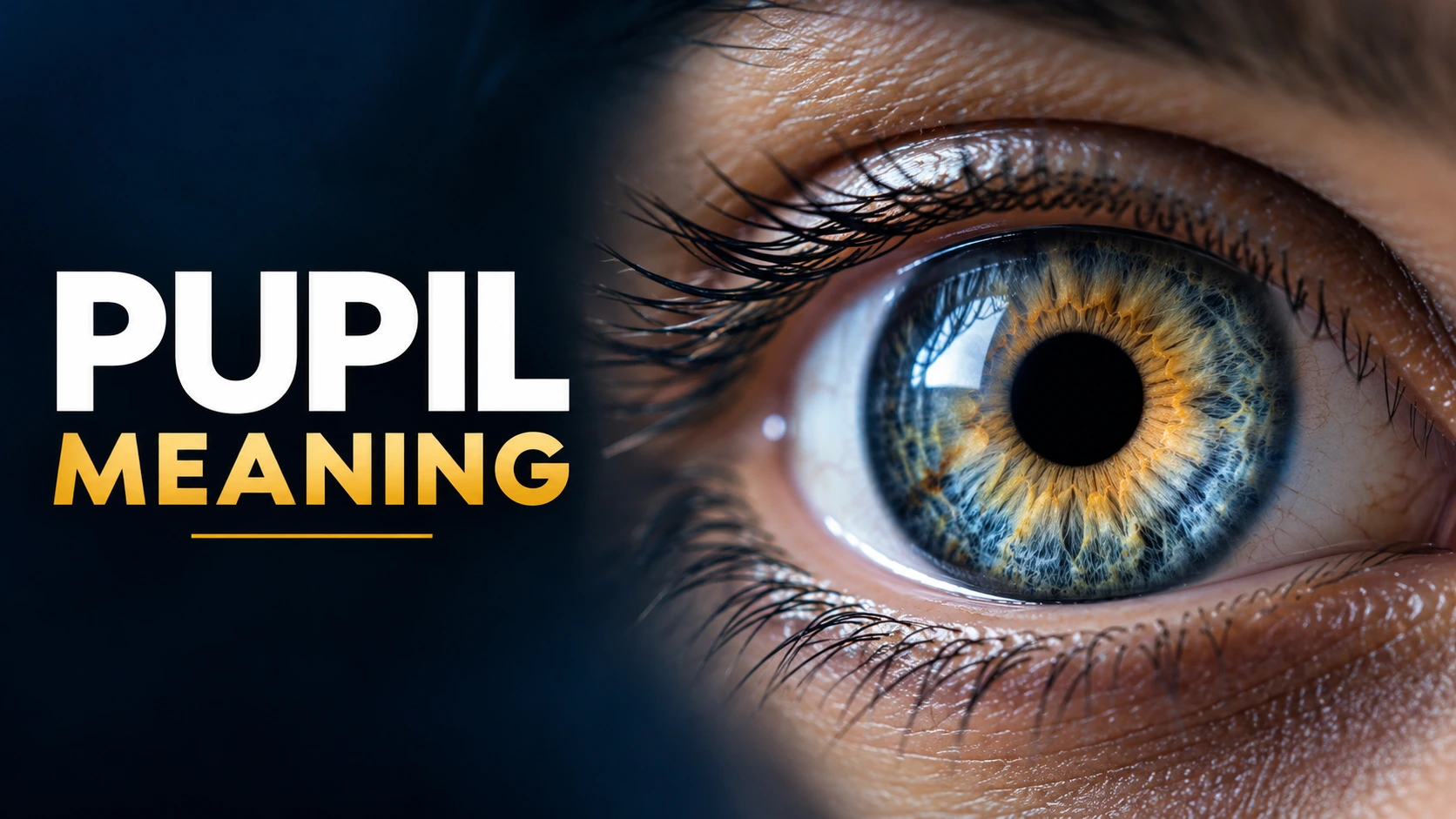
Pupil Meaning: A pupil is a person who is taught by a teacher, especially a schoolchild. It also means the opening in the center of the iris through which light enters the eye.
For example, “The pupil answered the teacher’s question” refers to a learner, while “The doctor examined the pupil” may refer to the opening in the eye if the surrounding text discusses eye anatomy.
Understanding these two meanings will help you use the word correctly in everyday English, schoolwork, conversations, and reading.
1. What Does Pupil Mean?
The word pupil is a noun with two common meanings. It can describe someone receiving instruction or the opening in the center of the eye’s iris.
The intended meaning usually becomes clear from the surrounding words.
Examples:
- The pupil completed her homework before dinner.
- Every pupil received a new textbook.
- The teacher praised the hardworking pupil.
- The doctor checked the patient’s pupils.
- The pupil becomes smaller in bright light.
In the first three examples, pupil refers to a learner. In the final two, it refers to the eye’s opening.
2. Pupil Meaning in Simple English
In simple English, pupil means either a learner or the opening in the middle of the eye.
Think of the word in two ways:
- A learner: Someone who receives teaching or instruction.
- An eye opening: The part of the eye through which light enters.
For example, a child learning mathematics at school is a pupil. The dark-looking circle in the center of that child’s eye is also called a pupil.
The spelling and pronunciation remain the same, but the meaning changes according to the situation.
3. Pupil Meaning in School
In education, a pupil is someone who receives instruction, especially a child attending school. The word is particularly common in British English, where expressions such as “primary school pupils” and “secondary school pupils” are widely used.
It can also describe someone learning a particular skill from an expert, such as a musician learning from an experienced performer.
Examples of pupil in school:
- The pupil raised his hand to answer the question.
- Every pupil must bring a notebook to class.
- The teacher helped a pupil understand fractions.
- Our school welcomed several new pupils.
- She was an excellent pupil who enjoyed science.
The word can describe learners beyond ordinary classroom situations, but student is often more natural when discussing college and university education.
4. Pupil Meaning in the Eye
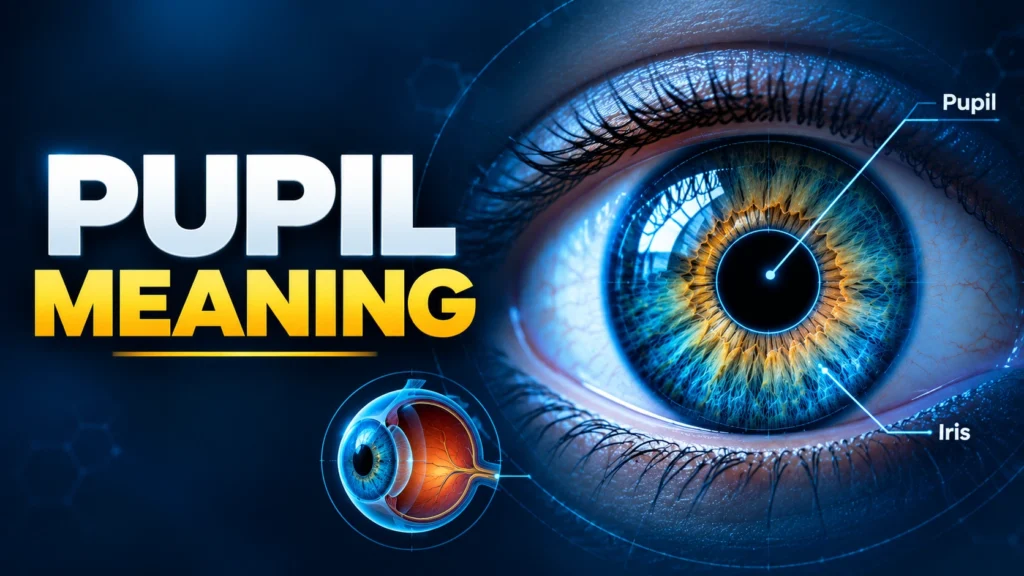
In anatomy, the pupil is the opening at the center of the iris, the colored part of the eye. It allows light to pass into the eye toward the retina, which contains light-sensitive cells.
The iris contains muscles that change the pupil’s size according to lighting conditions and other influences.
Examples:
- The pupil becomes smaller in bright sunlight.
- Both pupils usually become larger in dim light.
- The eye specialist examined the patient’s pupils.
- The iris surrounds the pupil.
- Light enters the eye through the pupil.
Although the pupil often looks black, it is an opening rather than a separate piece of black tissue.
5. Pupil Pronunciation and Word Type
The word pupil is a countable noun. Its standard pronunciation is approximately PYOO-puhl, with the stress on the first syllable.
Its phonetic representation is /ˈpjuː.pəl/ in both British and American English, although accents can vary.
Word forms:
| Form | Example |
| Singular | The pupil is attentive. |
| Plural | The pupils are attentive. |
| Pronunciation | PYOO-puhl |
| Part of speech | Noun |
More examples:
- My brother is a pupil at a local school.
- The optometrist checked both pupils.
- The pupils listened carefully to their teacher.
The plural form pupils works for both meanings. The sentence determines whether it refers to learners or eye openings.
6. Pupil vs. Student
So, Pupil And Student both describe people who learn, but they differ in typical usage. Pupil is especially associated with schoolchildren in British English, while student is a more flexible term for people studying at schools, colleges, and universities.
| Pupil | Student |
| Commonly associated with schoolchildren | Used for learners of different ages |
| Especially common in British school contexts | Widely used in British and American English |
| Can describe someone learning from an expert | Can describe someone studying a subject or course |
| Example: The pupil read aloud. | Example: The student attended a university lecture. |
These distinctions are not absolute. A school learner can also be called a student, and a person learning a skill from an expert may be described as a pupil.
Which word should you use?
Use pupil when discussing school learners in contexts where the word sounds natural. Use student when referring to university learners or when you want a broadly understood term.
7. Pupil vs. Iris
The pupil and iris are different parts of the eye, even though people sometimes confuse them.
The pupil is the opening, while the iris is the colored tissue surrounding it. The iris contains muscles that adjust the opening’s size.
| Feature | Pupil | Iris |
| What is it? | An opening | Colored tissue |
| Location | Center of the iris | Surrounds the pupil |
| Main role | Allows light to enter | Helps regulate light entry by changing pupil size |
| Appearance | Usually looks black | May appear brown, blue, green, or another eye color |
For example, when someone says, “Her pupils became smaller in sunlight,” the statement describes the openings in her eyes, not a change in eye color.
Remembering this difference makes it easier to understand biology lessons and articles about vision.
8. Pupil Synonyms and Related Words
The most suitable synonym for pupil depends on whether you are talking about a learner or an eye.
When the word describes a learner, several alternatives may work. However, these words have slightly different meanings and are not interchangeable in every sentence.
Synonyms and related words for a learner:
- Student: A person studying at a school, college, or university.
- Learner: Someone acquiring knowledge or a skill.
- Trainee: Someone learning to perform a particular task or job.
- Apprentice: Someone learning a trade through practical training.
- Disciple: A follower who learns from a teacher or leader.
For the eye-related meaning, eye pupil is a useful clarifying expression. Aperture means an opening in general, but it is not usually a natural replacement for pupil in everyday descriptions of the eye.
Choose synonyms according to context rather than simply replacing one word with another.
9. Pupil in a Sentence: Examples
Reading sentences is one of the easiest ways to understand the two meanings of pupil. Look for clues that identify whether the sentence concerns education or eye anatomy.
Pupil meaning a learner:
- The pupil completed her English assignment.
- The teacher encouraged every pupil to participate.
- A pupil asked an interesting question.
- The school welcomed its new pupils.
- He was a talented pupil who enjoyed drawing.
- Each pupil received a certificate.
- The pupil practised spelling every evening.
- Our teacher explained the lesson patiently.
- The youngest pupil won the reading competition.
- The music teacher taught several pupils.
Pupil meaning the eye’s opening:
- The pupil contracts in bright light.
- The doctor examined the patient’s pupils.
- Her pupils appeared larger in the dim room.
- The iris surrounds the pupil.
- Light passes through the pupil toward the retina.
- The nurse checked both pupils’ responses to light.
- The pupil became smaller after the lights were switched on.
- The eye’s pupil changes size under different lighting conditions.
- The optometrist examined the pupils during the appointment.
- The pupils of both eyes responded to the light.
Words such as teacher, assignment, and school suggest the educational meaning. Words such as iris, retina, and light point toward the anatomical meaning.
10. Common Phrases Using Pupil
The word appears in several common Expressions Related to education and eye anatomy. Learning these phrases can improve your reading comprehension and vocabulary.
Educational phrases:
- School pupil: A person attending school.
- Primary school pupil: A learner in primary education.
- Former pupil: Someone who previously attended a particular school.
- Bright pupil: A learner who demonstrates strong ability or understanding.
- Private pupil: Someone receiving individual lessons from an instructor.
- Pupil-teacher relationship: The relationship between a learner and a teacher.
Eye-related phrases:
- Dilated pupils: Pupils that have become larger.
- Constricted pupils: Pupils that have become smaller.
- Pupil response: The way the pupil reacts to light or other stimuli.
- Pupil size: The diameter of the eye’s opening.
- Pupil examination: An assessment of the pupils during a medical or eye examination.
Examples in context:
- The school organized a reunion for former pupils.
- The teacher designed a lesson for every pupil in the class.
- The doctor checked the patient’s pupil response.
- Bright light caused the pupils to constrict.
The surrounding words help you identify the meaning without needing to look up the term every time.
11. How the Eye’s Pupil Works
The pupil regulates how much light enters the eye by changing its size. The iris controls this adjustment through its muscles.
When you move from a dark room into bright sunlight, your pupils generally become smaller. This is called constriction. In dim lighting, the pupils generally become larger through dilation.
Several factors can influence pupil size, including:
- Changes in brightness and darkness.
- Normal physiological responses.
- Certain medicines and eye drops.
- Emotional arousal and nervous-system activity.
- Some eye or neurological conditions.
Pupil size alone cannot reliably reveal someone’s emotions or diagnose a medical condition.
If you notice a sudden change in pupil size, particularly alongside severe headache, eye pain, vision changes, confusion, or a head injury, seek urgent medical assessment.
12. Why Does Pupil Have Two Meanings?
The two meanings of pupil have different historical origins.
The educational meaning developed through words associated with a child or young person under another person’s care. Over time, it came to describe someone receiving instruction from a teacher.
The eye-related meaning comes from a different historical pathway. It is associated with the Latin word pupilla, meaning “little doll.” One explanation connects this meaning to the tiny reflected image visible in the eye.
Today, both meanings share the same spelling and pronunciation. This makes pupil an example of a word whose meaning depends heavily on context.
Understanding word origins can make English vocabulary more memorable, but the most useful everyday skill is recognizing the clues surrounding the word.
- Related To Another Article: https://genzwishes.com/cholesterol-meaning/
13. Common Mistakes When Using Pupil
English learners may confuse pupil with similar words or assume that it has only one meaning. These examples show how to avoid common errors.
Mistake 1: Assuming pupil always means a learner.
Correction: The word also describes the opening in the center of the eye’s iris.
Mistake 2: Confusing the pupil with the iris.
Incorrect: The pupil is the colored part of the eye.
Correct: The iris is the colored part, and the pupil is the opening in its center.
Mistake 3: Assuming pupil and student are completely different.
Correction: Both words can describe learners, although their typical usage differs.
Mistake 4: Using pupil when student is more natural.
Correction: Student is generally the more flexible choice for college and university learners.
Mistake 5: Ignoring the sentence context.
Compare these examples:
- “The pupil studied hard for the examination.” Here, pupil means a learner.
- “The pupil widened in the darkness.” Here, pupil means the eye’s opening.
Mistake 6: Thinking the pupil is a separate black object.
Correction: The pupil is an opening that usually appears black because of how light enters and is absorbed within the eye.
Checking the surrounding words is usually the simplest way to choose the correct interpretation.
People Also Ask
A: A pupil is a person receiving instruction, especially a schoolchild, or the opening in the center of the eye’s iris through which light enters.
A: In school, a pupil is a learner who receives instruction from a teacher. The word is particularly common in British English.
A: The pupil is the opening at the center of the iris. It changes size to help regulate how much light enters the eye.
A: The meanings overlap, but usage differs. Pupil is commonly associated with schoolchildren, while student can refer to learners at schools, colleges, and universities.
A: The pupil is the opening in the center of the eye. The iris is the colored tissue surrounding it and contains the muscles that control the pupil’s size.
Conclusion
The Word Pupil has two common meanings: a person who receives instruction, especially at school, and the opening in the center of the iris that allows light to enter the eye.
Context determines which meaning applies. Words associated with teachers and classrooms usually indicate the educational sense, while words related to vision, light, and the iris indicate the anatomical sense.
Remember the difference between a pupil and an iris, and use student when it better fits the educational context. With a few examples and a little practice, you can recognize and use the word confidently.
If this guide helped you understand the word, save it for future English practice and explore more vocabulary explanations on GenzWishes.